

Microsoft's quiet move to rework the foundations of Windows 11 — rolling the Dev channel forward to the 26300 series and warning of “behind‑the‑scenes platform changes” — is more than a routine engineering note. It’s a deliberate attempt to re‑engineer the operating system’s platform baseline after a year in which visible features and aggressive AI positioning outpaced the work required to stabilize the OS. That change arrives against a backdrop of declining adoption: public market tracking shows Windows 11’s desktop share sliding from roughly 55% in October 2025 to approximately 50.7% by December 2025, a loss that has analysts and IT managers asking whether Microsoft can fix Windows 11 under the hood — and whether doing so will be enough to restore user confidence.
On January 27, 2026, Microsoft shipped Windows Insider Preview Build 26300 to the Dev channel and explicitly said the new series will include behind‑the‑scenes platform changes, adding that such builds “may have different known issues” as a consequence. This is not a marketing line about new features; it is a clear engineering statement: Microsoft is reworking low‑level code paths, and those changes will surface as known and unknown regressions during preview flights.
At the same time, independent telemetry trackers recorded a meaningful drop in Windows 11’s share of desktop pageviews over the autumn and winter of 2025. Statcounter’s desktop Windows version dataset put Windows 11’s share at roughly 55.17% in October 2025, falling to the low‑50s by December. That swing — a decline of several percentage points in a couple of months — is a blunt signal that adoption momentum has stalled and that some users or environments are choosing to stay on or move back to Windows 10 or even older releases.
Why this matters: the platform code is where scheduling, drivers, power management, security primitives and CPU/SoC enablement live. When the foundation is unstable, visible features — even the most compelling AI hooks — inherit fragility. Microsoft’s statement and the channel shuffle are a response to that reality: the company is prioritizing the basement before redecorating the living room.
Microsoft knows this now and has signaled a more compartmentalized rollout plan. Splitting Bromine to hardware partners and isolating Germanium refinements to Dev/Beta channels is designed to reduce the blast radius. The bet is that fixing the engine without chopping the frame out from under the car will deliver smoother long‑term stability.
Why users didn’t jump immediately to Windows 11 at the end of Windows 10 support:
But execution will decide the story. If Microsoft manages the flighting, detection, rollback, and communication well, Windows 11 can emerge more stable and more performant, and adoption momentum can recover. If the program releases platform fixes that swap one set of breakages for another, the company risks a longer erosion of trust that will slow migration and give enterprises more reason to postpone upgrades.
The takeaway for Windows users is simple: expect important, low‑level fixes to roll through Insider builds in 2026. Be cautious about early installs on production machines. For Microsoft, the imperative is equally clear: deliver measurable improvements under the hood, then earn back the confidence that features and glossy AI demos alone cannot buy.
Source: TechRadar https://www.techradar.com/computing...tats-suggest-it-could-be-too-little-too-late/
 Background / Overview
On January 27, 2026, Microsoft shipped Windows Insider Preview Build 26300 to the Dev channel and explicitly said the new series will include behind‑the‑scenes platform changes, adding that such builds “may have different known issues” as a consequence. This is not a marketing line about new features; it is a clear engineering statement: Microsoft is reworking low‑level code paths, and those changes will surface as known and unknown regressions during preview flights.At the same time, independent telemetry trackers recorded a meaningful drop in Windows 11’s share of desktop pageviews over the autumn and winter of 2025. Statcounter’s desktop Windows version dataset put Windows 11’s share at roughly 55.17% in October 2025, falling to the low‑50s by December. That swing — a decline of several percentage points in a couple of months — is a blunt signal that adoption momentum has stalled and that some users or environments are choosing to stay on or move back to Windows 10 or even older releases.
Why this matters: the platform code is where scheduling, drivers, power management, security primitives and CPU/SoC enablement live. When the foundation is unstable, visible features — even the most compelling AI hooks — inherit fragility. Microsoft’s statement and the channel shuffle are a response to that reality: the company is prioritizing the basement before redecorating the living room.
What Microsoft actually announced — the essentials
- The Windows Insider Dev channel has moved forward to the 26300 series; once Build 26300.x is installed, switching channels back to Beta becomes more complicated.
- Microsoft noted these Dev builds will receive behind‑the‑scenes platform changes, and that those internal adjustments may cause different known issues compared to Beta channel releases.
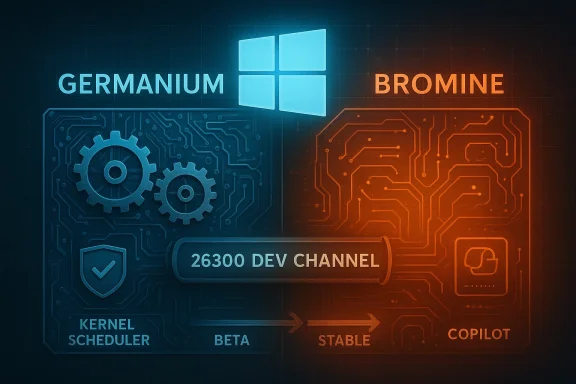
- Microsoft continues to develop two parallel platform tracks: the existing Germanium baseline that underpins the majority of present‑day Windows 11 installations (24H2/25H2), and a newer Bromine platform tied to the early 26H1 release targeted at next‑generation Arm silicon and a narrow set of Copilot+ hardware.
- The product cadence has been split so platform enablement for new silicon (Bromine/26H1) can proceed without forcing every Windows 11 PC to switch to a new kernel or baseline at the same time.
What “platform changes” mean — a plain‑English technical primer
When engineers talk about platform code, they mean the low‑level plumbing that everything else runs on. Platform changes typically touch:- The kernel scheduler and process model (how threads and processes are prioritized and dispatched).
- Hardware compatibility layers and drivers (storage, audio, GPU, firmware interfaces).
- Power management and thermal policies (which directly affect battery life and performance on laptops).
- Security primitives (secure boot, Pluton/NPU interfaces, updated crypto and sandboxing).
- ABI (application binary interface) compatibility and system calls that drivers and legacy applications rely on.
Germanium vs Bromine: what’s new and what’s being protected
Microsoft’s recent update strategy has effectively split Windows 11 into two platform families:- Germanium: the current baseline that underpins Windows 11 versions 24H2 and 25H2. Microsoft has made incremental improvements to Germanium through 2025 while keeping the same servicing branch for compatibility reasons.
- Bromine: a newer internal platform engineered to enable next‑generation Arm processors (Snapdragon X2 family and similar SoCs) and to support new CPU features that the Germanium baseline does not expose.
- Bromine is a hardware‑enablement branch that will initially appear only on new devices shipping with the silicon it supports; it is not being pushed broadly to existing Windows 11 PCs as a feature update.
- Microsoft is keeping Bromine development mostly isolated (Canary/early channels) to avoid repeating the broad rollout problems that followed the Germanium‑based 24H2 release.
- For non‑Arm PCs, Microsoft intends to continue refining Germanium — the goal is to harden the current baseline rather than rush everyone onto a new underlay.
Lessons from history: why platform work has previously gone wrong
The last big platform reset (the Germanium changes rolled into the 24H2 family) produced a high volume of widely reported problems. Users, developers and media noted issues such as:- Audio problems and driver regressions that reverted volume levels or caused device corruption on some USB/USB‑DAC setups.
- File Explorer UI glitches (misplaced flyouts and toolbar issues).
- Task Manager misreports and occasional process enumeration errors.
- Game crashes and incompatibilities tied to anti‑cheat or driver assumptions.
Microsoft knows this now and has signaled a more compartmentalized rollout plan. Splitting Bromine to hardware partners and isolating Germanium refinements to Dev/Beta channels is designed to reduce the blast radius. The bet is that fixing the engine without chopping the frame out from under the car will deliver smoother long‑term stability.
The market reality: Windows 11 adoption is softening — why that matters
Public tracking shows a tangible adoption reversal for Windows 11 in late 2025. Statcounter‑derived metrics put Windows 11 at roughly 55.17% in October 2025, slipping to around 50.7% by December 2025. The nominal losers were Windows 11 itself (down several points) and the primary beneficiary was Windows 10 — which, thanks to Microsoft’s consumer ESU program, remained a viable short‑term option for many users and organizations.Why users didn’t jump immediately to Windows 11 at the end of Windows 10 support:
- Microsoft offered a consumer Extended Security Updates (ESU) bridge through October 13, 2026, with enrollment paths that include a free option tied to Microsoft account features, point redemptions, or a modest one‑time fee. That bridge let risk‑averse users delay migration.
- Windows 11’s public reputation took hits from well‑publicized bugs, visible UI regressions and aggressive marketing of AI features that many users felt were experimental or unwelcome.
- Hardware compatibility barriers (TPM, CPU generation requirements) and corporate inertia slowed enterprise migration cycles.
The risk calculus: can under‑the‑hood fixes restore faith?
There are two critical, competing outcomes from Microsoft’s platform work:- Best case: Microsoft successfully hardens Germanium, reduces driver regressions, and pushes out incremental fixes that improve day‑to‑day stability and performance across the install base. That outcome would likely halt Windows 11 defections and restore momentum in both consumer and corporate environments.
- Worst case: platform changes fix some issues but introduce new regressions in other subsystems. Those new breakages could amplify the perception that Windows 11 is flaky and drive further reluctance to upgrade, particularly among enterprise admins and power users.
- Quality of Insider flighting — Are the Dev/Beta rings catching representative driver stacks and OEM firmware permutations?
- Telemetry and rollback — Does Microsoft have rapid rollback and mitigation paths for platform regressions discovered post‑flight?
- OEM partner coordination — Are OEMs and silicon vendors fully integrated into Bromine validation so new Arm and mixed hardware emerge with robust driver stacks?
What users and IT teams should do now
Practical, conservative guidance for different groups:- For everyday consumers:
- If you prefer stability over early access, do not install Dev channel builds. Use Beta/Release Preview and wait for cumulative updates before moving to a new major baseline.
- Keep regular backups and create a system restore point before installing any major update. That reduces migration grief if a rollback is required.
- If you remain on Windows 10 and have not enrolled in ESU, consider whether your device is eligible and whether a migration to Windows 11 (or a hardware refresh) is the safer long‑term route.
- For enthusiasts and developers:
- Use the Dev channel if you want to help surface platform regressions, but confine flights to non‑critical machines.
- Log and report bugs early and provide OEM/driver stack details — the more data Microsoft gets, the faster it can correlate regressions to platform changes.
- For IT administrators and enterprise teams:
- Establish a test ring that mirrors your device fleet (drivers, docking stations, VPN/endpoint agents).
- Hold major platform migrations (26H2/26H1) in controlled pilot groups — do not push to production until OEM‑certified drivers and security tooling are validated.
- Use tools like WSUS, Intune, or SCCM to control update rings and to automate rollback if necessary.
- Reassess vendor support contracts and plan for driver testing windows in your hardware refresh cycle.
What Microsoft must get right to restore trust
Stability is a prerequisite, but perception and communication matter just as much. Microsoft should prioritize:- Transparent A/B testing and telemetry explanations. Explain what the platform changes do and why some builds will show differing known issues.
- Clear release disciplines. Separate platform enablement from user‑facing feature launches; shipping both together compounds risk and confuses users.
- OEM and driver certification: Make it easier for OEMs and ISV partners to test and certify drivers against both Germanium and Bromine code paths well before shipping.
- Measured AI messaging: For many users, relentless AI marketing has overshadowed core stability improvements. Calm, trust‑building messaging that foregrounds reliability and security would resonate better.
- Faster mitigation and hotfix delivery: When platform regressions do occur, rapid cumulative updates and clear guidance help contain fallout.
The trade‑offs Microsoft faces
The company is balancing three competing pressures:- Ship platform support for new silicon quickly (Bromine / 26H1).
- Maintain compatibility and stability for the vast installed base on Germanium.
- Continue to introduce visible features that keep Windows competitive.
A realistic timeline and expectations
- Short term (first half of 2026): expect ongoing Dev‑channel platform flights (26300 series), isolated hardware launches with Bromine/26H1 on specific Arm devices, and iterative Germanium fixes in Beta/Release Preview.
- Mid term (remainder of 2026): Microsoft will aim to consolidate platform stability into a broader public feature release (26H2) once Germanium refinements have proven successful in cumulative updates.
- Long term: if Microsoft can demonstrate measurable reductions in high‑impact regressions (audio, storage, GPU/driver crashes), market confidence should begin to recover. However, recovery in user sentiment is slower than code fixes — perception lags reality.
Final analysis: will this make or break Windows 11?
This is a make‑or‑break inflection point in perception more than in pure engineering. The technical plan — isolate platform changes, gate Bromine to silicon partners, and flight Germanium fixes in Dev/Beta — is sensible and aligned with best practices. It addresses the root cause: fundamentals, not frivolities, must be fixed.But execution will decide the story. If Microsoft manages the flighting, detection, rollback, and communication well, Windows 11 can emerge more stable and more performant, and adoption momentum can recover. If the program releases platform fixes that swap one set of breakages for another, the company risks a longer erosion of trust that will slow migration and give enterprises more reason to postpone upgrades.
The takeaway for Windows users is simple: expect important, low‑level fixes to roll through Insider builds in 2026. Be cautious about early installs on production machines. For Microsoft, the imperative is equally clear: deliver measurable improvements under the hood, then earn back the confidence that features and glossy AI demos alone cannot buy.
Source: TechRadar https://www.techradar.com/computing...tats-suggest-it-could-be-too-little-too-late/
