Windows 11 Recovery Gets Cloud Powered: PITR Cloud Rebuild and QMR

  • Thread Author
Microsoft’s Ignite stage introduced a pivotal change to Windows 11 recovery: Microsoft announced two new, cloud‑aware recovery actions — Point‑in‑Time Restore (PITR) and Cloud Rebuild — that extend pre‑boot recovery, remote remediation and fleet orchestration through Intune, Autopatch and WinRE, while Quick Machine Recovery (QMR) receives deeper tooling and management integration to make large‑scale repairs faster and less hands‑on.

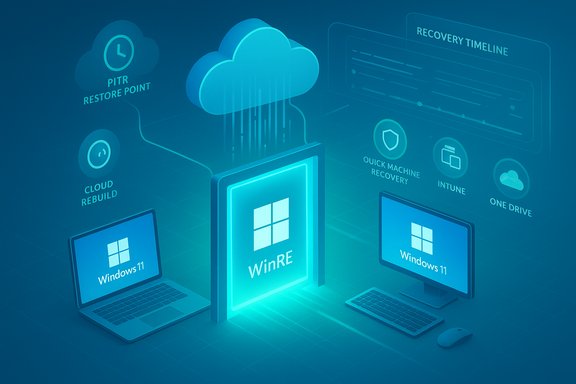
Windows 11 PCs boot into a cloud-based WinRE recovery environment.Background / Overview​

Microsoft framed these additions as part of the Windows Resiliency Initiative (WRI), an engineering program aimed at reducing the frequency and impact of large‑scale outages caused by bad updates, drivers or misconfigurations. The overall intent is clear: move recovery from manual imaging and technician trips to managed, auditable, cloud‑assisted flows that resume user productivity in minutes rather than hours or days. These new actions are tightly coupled with existing and expanded pre‑boot capabilities (WinRE networking and telemetry), Quick Machine Recovery (QMR) for automated remediation pre‑boot, and the Microsoft management plane (Intune, Autopatch, Autopilot, OneDrive and Windows Backup for Organizations). Microsoft says Intune will be able to trigger PITR and Cloud Rebuild for managed devices; preview waves were announced and broader rollouts are planned, with many outlets and Microsoft guidance indicating staged previews into 2026.

What changed and why it matters​

The headline capabilities​

  • Point‑in‑Time Restore (PITR) — A modern rollback tool that can return a Windows 11 device to a previous working state, restoring not just the OS image but apps, settings and local files where supported. Microsoft positions PITR as a fast alternative to reimaging for recent regressions like a faulty update or driver.
  • Cloud Rebuild — A zero‑touch, remote reinstall/reprovision flow initiated from Intune that downloads Windows 11 installation media, performs a clean install, reenrolls the device via Autopilot and reprovisions apps and policies, then rehydrates user data and settings from OneDrive or Windows Backup for Organizations. It’s explicitly designed as the fallback when PITR or QMR can’t restore service.
  • Quick Machine Recovery (QMR) — While not new at Ignite, QMR is being expanded and documented as the first‑line automated remediation in WinRE: when a device repeatedly fails to boot, WinRE can connect to the network, upload diagnostics, query a cloud remediation catalog (Windows Update) and apply targeted fixes pre‑boot. QMR’s configuration surfaces for IT (Intune, Group Policy, reagentc) and a test mode are now well documented.

Why this is different from legacy tools​

Legacy System Restore primarily rolled back a limited set of system files and registry settings and rarely captured user files or installed apps. PITR aims to be broader — more akin to a short‑term snapshot/restore system that can return the entire device state (OS, apps, settings, and local data) to a prior point. That difference is crucial: it changes the expected recovery objective (RTO/RPO) for many common incidents. Microsoft’s messaging emphasizes speed, scale and manageability — particularly for IT administrators supporting large fleets.

How Point‑in‑Time Restore (PITR) is described to work​

Scope and intent​

PITR is intended to let administrators or end users roll a single device or groups of devices back to a known‑good state with minimal troubleshooting. Microsoft describes the feature as capable of restoring the OS image, installed applications, device and user settings, and local files in the restore window — making it a far broader rollback than classic System Restore. PITR will be surfaced from WinRE as a Troubleshoot option and — critically for enterprises — triggerable from Intune for managed devices.

Storage model, retention and cadence — what we know (and what is provisional)​

Initial reporting and early previews (community captures and preview screenshots) show PITR operating with frequent, short‑term restore points (examples reported include snapshots at configurable intervals like every 4–24 hours and short retention windows such as 72 hours). However, Microsoft’s public Ignite and Windows Experience posts did not publish a definitive retention policy or storage architecture at launch; those operational details remain preview‑era items and are subject to change. Until Microsoft publishes formal product documentation with precise RPO/RTO numbers, retention windows and storage locations should be treated as preview defaults, not fixed guarantees. Treat the exact snapshot cadence and retention as provisional until official docs appear.

Typical PITR workflow (high level)​

  • Device or admin identifies a problem that likely resulted from a recent change.
  • From WinRE (or Intune for managed devices), select the desired restore point timestamp.
  • PITR applies the snapshot, rolling back the OS, apps, settings and supported local files to that chosen point.
  • Device reboots into the restored state and resumes normal operation (user files created after the restore point may be lost — PITR warns about that risk).

How Cloud Rebuild works and when to use it​

Cloud Rebuild: the remote reimage​

Cloud Rebuild is the “nuclear” option when a device is too corrupted to be repaired by QMR or PITR. Initiated from Intune, it will:
  • Select the target Windows 11 release and language via the Intune portal.
  • Trigger the device to download installation media and perform a clean install from WinRE or cloud media.
  • Reenroll the device using Autopilot and Intune so policies and apps are enforced automatically.
  • Rehydrate user files and settings from OneDrive and Windows Backup for Organizations where these backups exist and are healthy.
This flow is explicitly designed to reduce downtime and avoid shipping devices to a service desk. Because it downloads a full OS image and reprovisions drivers and apps, Cloud Rebuild will be network‑heavy and depends on reliable cloud backup hygiene (OneDrive/Windows Backup), driver availability from Windows Update/OEM channels, and robust Intune/Autopilot configuration.

Rehydration caveats​

Cloud Rebuild assumes:
  • User data is protected by OneDrive or Windows Backup for Organizations. Local‑only files that were never synced or mirrored may be lost after a rebuild.
  • Drivers needed for some OEM‑specific functionality are present in the driver catalog Windows Update or the OEM repositories; otherwise manual intervention might still be required.
  • The device can reach the network and the Intune/Autopilot endpoints during provisioning.
Because of these dependencies, Cloud Rebuild is powerful but not universal — it’s the right choice for managed devices with cloud backups and Autopilot profiles. For air‑gapped, highly regulated or offline fleets, traditional imaging and local recovery remain necessary.

Quick Machine Recovery (QMR): pre‑boot automation and its role​

QMR is the automation layer that turns WinRE into a proactive repair channel. When Windows detects repeated boot failures, QMR:
  • Boots the device into WinRE.
  • Establishes network connectivity (supported today for wired Ethernet and WPA/WPA2 password Wi‑Fi; enterprise 802.1X support is being expanded).
  • Uploads diagnostics and queries Windows Update or Microsoft’s remediation catalog.
  • Downloads and applies targeted remediation packages from pre‑boot, then reboots to verify success.
QMR is best‑effort — it can resolve many widespread boot regressions automatically, but it’s not a guarantee for every failure scenario. It also introduces operational dependencies (WinRE networking, telemetry flows, and remediation package availability) that administrators must plan for. Microsoft publishes configuration and test mode tooling so enterprises can simulate QMR behavior before enabling auto remediation broadly.

Management plane and WinRE networking: the plumbing behind the magic​

Intune, Autopatch and WinRE plug‑ins​

Microsoft is exposing these recovery actions through Intune and Autopatch, adding visibility into devices that enter WinRE and letting admins trigger recovery flows remotely. The WinRE plug‑in model also allows third‑party EMMs to integrate with pre‑boot recovery actions, and Azure Portal integration for server VMs is on the roadmap. These management connections are what let admins orchestrate PITR or Cloud Rebuild at scale.

WinRE networking practicalities​

WinRE now reuses network credentials and configuration from the installed OS when possible, which reduces the manual configuration burden in recovery. Today the supported connectivity list is conservative (wired Ethernet and WPA/WPA2 password Wi‑Fi), with enterprise certificate‑based Wi‑Fi and WPA3/802.1X expanding over time. Some Wi‑Fi adapters may require additional drivers to be available in WinRE to connect reliably; this remains an operational detail admins must validate in pilots.

Practical implications — what IT teams and users must do​

For IT administrators (recommended checklist)​

  • Inventory and pilot: Choose a representative pilot cohort of devices (different OEMs, Wi‑Fi/Ethernet mixes) to validate WinRE networking, driver coverage and BitLocker key escrow.
  • Verify key escrow: Ensure BitLocker recovery keys are backed up to Azure/Entra or enterprise escrow — pre‑boot recovery is useless without accessible keys.
  • Backup hygiene: Require OneDrive for Business or Windows Backup for Organizations for user data rehydration in Cloud Rebuild scenarios. Local‑only files must have separate protection.
  • Governance: Configure role‑based access, approval gates and auditing in Intune for destructive flows like PITR and Cloud Rebuild. Maintain strict change control for who can trigger rebuilds.
  • Test QMR: Use reagentc test mode to simulate QMR and verify remediation flows in a controlled environment before enabling auto remediation.

For consumers and small businesses​

  • Keep local backups or use OneDrive; do not assume cloud rehydration will restore data you never synced.
  • Check where your BitLocker recovery key is stored (Microsoft account, Azure AD or a printed copy).
  • Expect PITR to be a helpful rescue for recent regressions but treat it as complementary to regular backups.

Strengths: what Microsoft gets right​

  • Faster mean time to repair (MTTR): For many common failures (bad updates, driver conflicts, small corruptions), PITR and QMR can reduce downtime from hours to minutes. Cloud Rebuild avoids shipping devices back to a depot for reimaging in many cases.
  • Centralized management and auditability: Intune and Autopatch integration provide governance, allowing enterprises to approve and log recovery actions rather than relying on ad‑hoc technician workflows.
  • Extensibility: The WinRE plug‑in architecture and documented management surfaces enable third‑party EMMs and partners to adopt the approach for heterogeneous fleets.
  • Real operational lessons baked in: The tooling set explicitly addresses the real pain exposed by prior large‑scale update incidents — remote, pre‑boot remediation via the cloud and fast rollback options reduce blast radius and manual work.

Risks and open questions (critical analysis)​

1) Network dependence and coverage gaps​

All cloud‑assisted flows assume pre‑boot network access. Many retail, branch, industrial, or air‑gapped deployments will not meet this requirement, limiting the applicability of PITR/QMR/Cloud Rebuild. Organizations must keep offline recovery paths for such environments.

2) BitLocker and key escrow​

Encrypted disks complicate pre‑boot recovery. If recovery keys aren’t escrowed to Azure/Entra, WinRE‑initiated restores will stall. Key management becomes non‑negotiable for safe adoption.

3) Driver and OEM coverage​

Devices that rely on OEM‑specific drivers unavailable in WinRE or Windows Update may fail to connect or function after a cloud reinstall. This is especially true for legacy or niche hardware. Admins must inventory driver dependencies and plan fallbacks.

4) Telemetry, privacy and regulatory compliance​

QMR and other flows transmit diagnostic telemetry during remediation. Organizations with strict data sovereignty or privacy rules must carefully evaluate telemetry flows, retention policies and consent requirements before enabling cloud‑assisted recovery.

5) False sense of security and backup discipline​

PITR and Cloud Rebuild are powerful, but not a replacement for robust backups. PITR’s likely short retention and Cloud Rebuild’s reliance on cloud backups mean local‑only data can still be lost if not proactively protected. Administrators should not rely on these features as a substitute for comprehensive backup strategy.

6) Unclear GA timelines and preview caveats​

Microsoft announced previews and Intune integration plans, and reporting points to preview availability and staged rollouts into 2026. Exact retention windows, storage models for PITR snapshots, licensing and edition restrictions remain to be confirmed in full product documentation. Treat timeline and feature limits as tentative until Microsoft publishes final docs.

Recommended adoption strategy​

  • Pilot the features on a small, diverse device cohort to validate network, driver and BitLocker behavior.
  • Validate OneDrive / Windows Backup health and rehydration times under load before trusting Cloud Rebuild as the primary recovery path.
  • Escrow BitLocker keys for all managed devices and document restore playbooks.
  • Implement RBAC and approval gates in Intune for destructive recovery actions and audit every restore event.
  • Maintain offline imaging and recovery media for devices that can’t meet WinRE networking or driver prerequisites.

Final assessment — pragmatic innovation with caveats​

Microsoft’s announcements at Ignite represent a pragmatic, platform‑level evolution in Windows recovery: combining pre‑boot automation (QMR), surgical rollback (PITR) and zero‑touch reprovisioning (Cloud Rebuild) into a single, manageable ecosystem changes the calculus for endpoint resiliency. For many organizations — especially those already invested in Intune, Autopilot and OneDrive backup — these tools can materially shrink downtime and operational cost. However, the promise depends on operational readiness: reliable WinRE networking, driver coverage, BitLocker key management, and cloud backup hygiene are not optional. In regulated, air‑gapped, or legacy hardware environments the new flows will be partial at best. Microsoft’s messaging and preview releases are encouraging, but several critical technical specifics (exact snapshot retention, encryption/validation guarantees, licensing limits and GA dates) remain to be nailed down in official product documentation — organizations should pilot cautiously and continue to rely on proven backup and imaging practices until GA and full documentation are available.
Microsoft’s recovery redesign is the most significant rethink of Windows recovery in years: it treats recoverability as a platform capability rather than a last‑resort manual process. When the preview waves mature and documentation fills in the remaining blanks, many organizations will find the combination of PITR, Cloud Rebuild and QMR a transformative improvement — provided they prepare the supporting operational plumbing and governance now.
Source: PCWorld Windows 11 is getting easier to fix, thanks to two new recovery tools
 

Giatec’s use of Microsoft AI and cloud services has turned a century‑old, intuition‑driven trade into a data‑first operation—promising real reductions in concrete’s carbon footprint, faster pours, and new profit opportunities for producers and contractors, while also exposing the limits and risks of applying AI in a heavily regulated, safety‑critical industry.

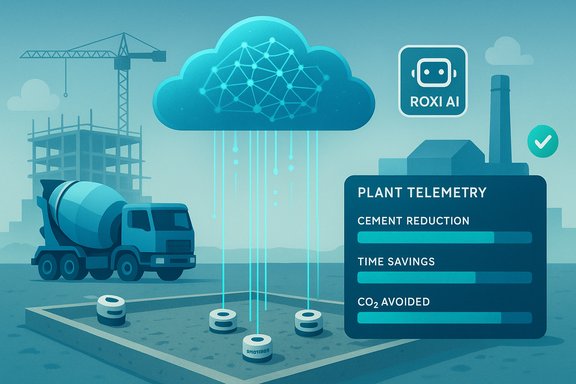
Cloud-based AI telemetry optimizes cement plants, reducing CO2 and saving time.Background​

Concrete and its key ingredient, cement, are among the largest single industrial sources of greenhouse‑gas emissions. Global estimates place cement‑related emissions at roughly 7–8% of annual CO₂, driven both by fuel combustion in kilns and the calcination chemical reaction that releases CO₂ when limestone is converted to clinker. Reducing the carbon embedded in concrete is therefore central to any credible construction‑sector decarbonization strategy. The concrete industry, however, is conservative by nature. Mixes are often over‑designed—more cement than strictly necessary is added to hedge against variability in raw materials, transport, and on‑site conditions. That safety margin works, but it also locks millions of tons of avoidable CO₂ into buildings and infrastructure every year. Technology companies have identified a practical leverage point: if you can measure the in‑place behavior of concrete and reliably predict strength in real time, you can safely trim cement content and tighten schedules. Giatec set out to do exactly that.

Overview: What Giatec built​

From sensors to optimization engines​

Giatec’s product ecosystem connects three technical layers:
  • Embedded sensors (SmartRock®) that measure concrete temperature and derive strength maturity in‑situ, eliminating much of the wait and variability associated with lab cylinder break tests.
  • In‑transit and plant telemetry (MixPilot and SmartMix™) that consolidate data across batching, truck transport, and placement to provide an end‑to‑end picture of mix behavior from plant to pour.
  • An AI core (Roxi™) trained on Giatec’s consolidated dataset, which recommends mix optimizations, detects anomalies, and predicts strength with a view to minimizing cement while meeting performance requirements.
This combination creates a closed‑loop optimization system: sensor readings from the jobsite flow into the cloud, AI compares those readings against thousands of historical mixes, and producers can then adjust proportions in the plant or accept lower cement contents with confidence.

The data advantage​

Giatec reports that Roxi is trained on over 300,000 unique mix designs, 2,000 raw materials from 1,500 plants across 20 countries, and data covering 75 million cubic meters of concrete. That scale is the foundation for the platform’s predictive claims: large, diverse datasets reduce model brittleness and make suggestions more robust across geographies and materials. These dataset claims are repeated across Giatec product materials and Microsoft’s customer story about the partnership.

How Microsoft technologies scale the solution​

Giatec chose Microsoft Azure and associated services to host its intelligent concrete platform. The implementation highlights include:
  • Azure IoT Hub to ingest real‑time telemetry from SmartRock and MixPilot devices.
  • Azure Databricks for large‑scale analytics and model training on the aggregated concrete dataset.
  • Power BI for operational dashboards and executive reporting.
  • Azure Document Intelligence and Azure OpenAI for automating extraction of lab and field reports, reducing manual data entry and accelerating feedback loops.
Giatec’s engineering leaders say building on managed cloud services lets their teams focus on product features and AI models instead of infrastructure plumbing—accelerating time to market and improving resilience when scaling to new regions. That arrangement is a common engineering tradeoff in modern industrial software: offload core cloud management to a hyperscaler so product teams can iterate faster.

Measurable outcomes Giatec and Microsoft report​

Giatec and Microsoft publish several concrete figures that form the core of the platform’s business case:
  • CO₂ reductions: Giatec’s Microsoft customer story reports 2.5 million tons of carbon emissions reduced through deployed optimizations. This is presented as a cumulative, company‑reported outcome.
  • Cement reductions: The AI‑driven SmartMix platform and Roxi are billed as able to cut cement usage by up to 20% in many applications; Giatec customer examples show single‑case reductions as high as 27% on specific mixes.
  • Time and labor savings: SmartRock maturity monitoring can reduce waiting and lab‑test delays—Giatec and Microsoft state that contractors typically save half a day to a day per pour, translating to roughly $10,000 in labor and schedule savings per pour in many projects. This figure is framed both as an industry average and as company messaging tied to specific project examples.
  • Profit margin improvements: Giatec’s materials claim that SmartMix optimizations can raise producers’ profit margins by 50–100% in favourable cases by lowering material cost (cement is often ~30% of mix cost and material is ~60% of total cost). These are modeled or customer‑reported outcomes rather than independently audited industry averages.
Caveat: several of the most eye‑catching numbers—particularly the 2.5 million tons of CO₂ reduced and the "up to 100%" profit improvement—originate in Giatec/Microsoft communications. Independent validation of these aggregated, platform‑wide totals is not publicly available; they should be treated as company‑reported metrics unless confirmed by third‑party audits or academic/industry evaluations. The specific examples (e.g., 27% cement reduction for a named customer) are verifiable as case studies published by Giatec.

Why the approach works: technical and commercial strengths​

1. Maturity monitoring replaces slow, destructive tests​

The ASTM maturity method (often used in conjunction with embedded temperature sensors) provides a non‑destructive, in‑place prediction of early‑age strength. By embedding sensors like SmartRock, teams get continuous strength estimates and can expedite formwork removal, tensioning, or successive trades without waiting for lab cylinder breaks. The practical result is fewer schedule stoppages and lower direct testing costs. Giatec documents show projects eliminating routine break testing once maturity monitoring is trusted.

2. Scale and diversity of training data​

Roxi’s training on hundreds of thousands of mixes and millions of cubic meters of concrete gives it exposure to a wide spread of raw materials, climates, and operational practices—reducing the risk of narrow, overfitted recommendations and increasing confidence for producers operating in diverse markets. Large datasets also make it possible to quantify likely savings across many similar mixes automatically.

3. Closed loop from plant to jobsite​

Integrating batch‑plant telemetry (SmartMix), truck/mix monitoring (MixPilot), and embedded sensors (SmartRock) enables true traceability for each truck and batch. When an AI recommendation is accepted at the plant, outcomes are observed on site—enabling continuous learning and model recalibration. This closed‑loop architecture is what turns isolated sensor readings into verifiable performance improvements.

4. Partnership leverage and market access​

Strategic partnerships—Giatec’s announced collaborations and distribution agreements—accelerate adoption. The use of mainstream cloud services like Azure also reduces enterprise procurement friction and positions Giatec to link into corporate sustainability reporting systems and controls.

Key risks, limitations, and areas demanding scrutiny​

Data quality and representativeness​

AI is only as good as the data it learns from. Regional variations in cement chemistry, supplementary cementitious materials (SCMs) like fly ash or slag, aggregate mineralogy, water quality, and local climate mean that models trained on one region’s data may underperform elsewhere. Even with 300k mixes, blind spots remain—particularly for rare mixes or emerging low‑carbon binders. Producers must validate recommendations with controlled trials before wide rollout.

Regulatory and contractual acceptance​

Many public and private projects still specify cylinder break tests or prescriptive cement contents as contractual deliverables. Shifting to maturity‑based acceptance or AI‑driven mix changes requires explicit client buy‑in and sometimes regulatory updates. Although maturity methods are referenced in standards, acceptance varies by jurisdiction and project type; this limits immediate, broad substitution of cylinder tests with sensor‑based readouts.

Model explainability and liability​

When an AI recommends reducing cement content, who bears responsibility if a structure later underperforms? Producers and engineers will need transparent, auditable model outputs and conservative guardrails to avoid over‑reliance on a black‑box suggestion—especially for safety‑critical structural elements. Explainability tools, professional engineering oversight, and staged pilots are essential risk mitigations.

Cybersecurity and cloud dependency​

Pushing operational control and quality data into the cloud improves visibility but also introduces cybersecurity and availability risks. An attacker that tampers with sensor feeds or batch parameters could cause material failures or safety incidents. Similarly, cloud outages or costly egress/processing fees are real operational concerns for producers that will increasingly rely on online services. Robust encryption, identity management, and fail‑safe local controls are mandatory.

Measurement uncertainty and sensor reliability​

Embedded sensors simplify monitoring, but they must be installed, calibrated, and maintained correctly. Misplaced sensors, damaged probes, or calibration drift can corrupt model inputs and lead to incorrect recommendations. Giatec’s SmartRock Pro and self‑calibrating innovations aim to mitigate some of these issues, but field quality control remains a frontline requirement.

Overpromising on aggregate impact​

Company and vendor claims aggregating CO₂ reductions across many projects are compelling marketing, but they require transparent methodologies: how were baselines set, what assumptions were applied, how were lifecycle emissions and rebound effects counted? The headline figure of 2.5 million tons CO₂ reported by Microsoft/Giatec is a company‑reported cumulative total; independent verification would strengthen the credibility of such claims. Treat aggregated impact numbers as directional until audited.

Adoption strategy: practical steps for contractors and producers​

  • Start with a pilot program on low‑risk, high‑volume mixes to build confidence in maturity monitoring and SmartMix recommendations.
  • Run side‑by‑side cylinder tests and maturity predictions for at least one full project cycle to calibrate models locally and document comparative performance.
  • Define contractual acceptance criteria with clients and engineers—include provisions for AI‑assisted mixes and explicit thresholds for when manual tests remain required.
  • Implement cybersecurity and data governance policies: encrypt telematics data, segregate critical control systems, and retain local fallback capabilities in case cloud services are unavailable.
  • Measure outcomes and publish transparent KPIs: cement reduction (kg/m³), time saved per pour (hours), CO₂ avoided (tCO₂), and impact on margins—ideally verified by an independent third party.

Policy and industry implications​

Wider adoption of AI‑assisted mix optimization can help national decarbonization objectives—but only if procurement rules, building codes, and public clients adapt to accept maturity‑based or sensor‑verified performance. Regulators and standards bodies should prioritize:
  • Updating acceptance criteria to explicitly include validated sensor/maturity methods.
  • Defining audit protocols for vendor‑reported CO₂ savings and requiring transparent baselines and lifecycle accounting.
  • Supporting interoperability standards so sensor, batch, and mix‑design systems can integrate across vendors and regions.
Public procurement can accelerate adoption by giving credit for verified embodied‑carbon reductions, creating demand pull for lower‑carbon mixes and the monitoring systems that enable them.

Case evidence: what the data shows today​

  • Giatec customer stories and technical materials document site‑level examples where maturity monitoring removed the need for routine break‑testing, enabling accelerated schedules and direct savings on testing and crew‑time. Example project writeups show multi‑hour schedule gains leading to significant labor savings when repeated across floors in a high‑rise.
  • SmartMix case studies report single‑mix cement reductions of 13–27% in early adopters, highlighting that actual savings depend heavily on the initial degree of over‑design, the availability of SCMs, and local regulatory flexibility. These are concrete, verifiable examples published by the vendor.
  • Academic work and independent research recognize the promise of ML and Bayesian optimization for discovering low‑carbon concrete mixes; published experiments have produced lab‑validated formulations with lower greenhouse‑gas intensity while meeting compressive strength targets. Such studies complement vendor claims and show that the underlying engineering approach is scientifically plausible.

Final assessment: promise and guardrails​

Giatec’s integration of sensors, cloud analytics, and AI exemplifies how industrial IoT and machine learning can address a concrete, measurable climate problem in the built environment. The technical design—sensors for continuous in‑place measurement, a large inter‑plant dataset for generalizable models, and cloud tools for operational scale—follows best practices for deploying AI in industrial settings, and early results and case studies suggest meaningful savings are achievable. Microsoft Azure’s toolset lowers the engineering bar for scaling and helps with enterprise compatibility and reporting. However, the industry must apply healthy skepticism. Aggregate CO₂ savings and headline profit multipliers reported by vendors are company‑reported and depend on assumptions that should be independently audited. Operational risks—data quality, sensor failure, regulatory acceptance, cybersecurity, and contractual liability—must be managed with explicit controls, pilot iterations, and transparent KPIs. AI should supplement, not replace, professional engineering judgment and established standards until sufficient independent evidence and regulatory frameworks justify broader substitution.

What the next 24 months will likely bring​

  • Broader vendor adoption of integrated sensor‑to‑AI stacks and deeper tie‑ins with plant management systems to enable near‑real‑time mix adjustments.
  • Increased industry partnerships and consolidations as established materials companies and ready‑mix producers seek fast routes to lower embodied carbon—Giatec’s alliances illustrate that path.
  • Growth in standards work and public procurement pilots to validate sensor‑based acceptance and verified carbon accounting.
  • Heightened scrutiny and calls for independent audits of claimed CO₂ savings and economic benefits, especially for headline aggregate numbers.

Conclusion​

Giatec’s platform—powered by Azure and reinforced by a large, domain‑specific dataset—demonstrates a practical route to reduce concrete’s environmental impact while improving schedule and margin performance. The technical ingredients are sound: maturity sensors, closed‑loop telematics, and AI trained on diverse mixes can safely reduce cement and speed construction when deployed correctly. The business case is persuasive for producers and contractors willing to run disciplined pilots, accept transparent validation, and invest in the governance and cybersecurity needed for cloud‑based operations.
The urgent policy and commercial imperative is to move from isolated pilots to standardized, verifiable practices: clear acceptance rules, independent verification of emissions reductions, and procurement incentives that reward verified embodied‑carbon improvements. When those guardrails exist, AI‑enabled concrete optimization can shift from promising pilot to industry baseline—and materially help lower one of the construction sector’s largest sources of emissions.
Source: Microsoft Transforming concrete with Microsoft AI: Giatec’s journey to a greener, smarter industry | Microsoft Customer Stories
 

Back
Top