

Microsoft spent the first full week of May 2026 showing off Windows 11 performance work, a modernized Run dialog, Insider build polish, Xbox Mode experiments, and new controls over local AI model downloads while Windows and Xbox users kept arguing that the company still had not earned back trust. That tension is the story. Microsoft is not suddenly beloved because it shipped a better launcher, and the community is not irrational because it remembers years of half-finished ideas, forced defaults, broken promises, and hardware cutoffs. The lesson is more uncomfortable for both sides: progress is real, but perception is now part of the product.
For years, Windows users have had a familiar complaint: Microsoft could build grand cloud strategies, AI platforms, subscription bundles, and console ecosystems, yet somehow leave ancient bits of Windows feeling neglected. The old Run dialog was a perfect symbol of that imbalance. It was useful, fast, and old enough to feel like a fossil embedded in the shell.
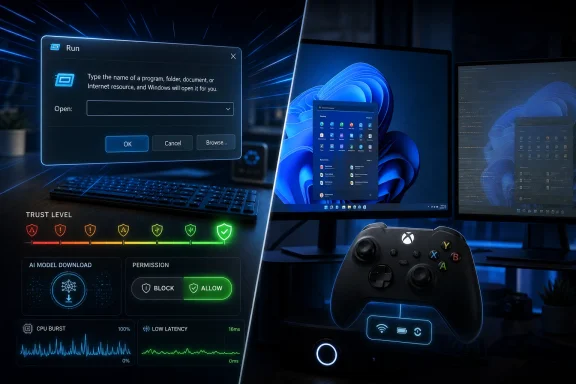
That is why the new Run experience matters more than its modest surface area suggests. A keyboard launcher is not a moonshot feature. It is not Copilot, Game Pass, or a new Windows release. It is the kind of thing power users touch every day, and when it feels cared for, users notice.
Microsoft’s new Run box appears to draw from the same lineage as PowerToys Command Palette, moving toward a faster, cleaner, more capable command surface. That is exactly the kind of investment longtime Windows users have been asking for: less spectacle, more polish. It says someone inside Redmond remembered that Windows is not only a platform for services but a tool people use under deadline.
The same pattern shows up in the reported Low Latency Profile work. If Windows 11 can temporarily push CPU frequency during app launches, system flyouts, and context menus, the payoff is not a benchmark vanity trophy. It is the feeling that the machine is responding when the user acts. Responsiveness is emotional as much as technical; a computer that hesitates teaches its owner to distrust it.
This is why the week feels different. The improvements are not just feature additions. They are corrections to a product culture that too often seemed comfortable shipping rough edges and calling them modern.
Windows 11 arrived with a stricter hardware line than many users expected, particularly around TPM and supported CPUs. Microsoft’s case was security. Users’ experience was that working PCs were suddenly treated as second-class citizens. Even now, years later, that decision colors how people interpret every new Windows 11 improvement.
The Steam hardware survey numbers sharpen the point. Windows 11 may now dominate among Steam users, but a meaningful share of Windows gamers remain on Windows 10 in 2026. Some are there by choice. Some are there because the upgrade path involves buying hardware they do not otherwise need. To those users, a snappier Start menu on Windows 11 can sound less like progress and more like a reminder that the improvements are being delivered behind a gate.
Microsoft also trained users to be suspicious by repeatedly blurring the line between operating system improvements and ecosystem leverage. Browser prompts, Microsoft account pressure, OneDrive nudges, Start menu recommendations, ads in system surfaces, and Copilot placement all created a sense that Windows was being optimized not only for users but for Microsoft’s funnel. Once that perception sets in, even good work has to fight through it.
That is the debt Microsoft is paying now. A useful Run dialog does not erase years of irritation. A promising latency mode does not undo the feeling that Windows 11 sometimes changes for Microsoft’s priorities before it changes for users’ needs.
The problem is that PC gamers are exquisitely sensitive to anything that feels like a console compromise imposed on PC hardware. A full-screen, controller-friendly interface makes sense on a handheld or living-room PC. But when that mode blanks or underuses a secondary monitor, the experience stops feeling like an elegant console layer and starts feeling like a feature designed around the wrong desk.
Dual-monitor users are not a niche in the enthusiast world. They are streamers, Discord users, guide readers, hardware monitors, media multitaskers, and people who simply expect a PC to remain a PC even when it puts on an Xbox jacket. If Xbox Mode cannot make use of that space, the criticism is not petty. It is a reminder that Microsoft’s gaming future has to respect what makes the PC distinct.
That does not mean Xbox Mode is doomed. Early modes often start narrow, and performance-focused designs sometimes make tradeoffs that frustrate users before they mature. But the reaction illustrates the challenge Microsoft faces: the company cannot ask PC gamers to trust the Xbox brand on Windows while giving them reasons to suspect Windows is being simplified around console assumptions.
The Xbox community’s distrust also has its own long memory. Studio closures, strategy pivots, inconsistent messaging, hardware uncertainty, and Game Pass economics have all left fans jumpy. When Microsoft says it is fixing fundamentals, many users hear an overdue admission rather than a promise.
Low Latency Profile, if it ships broadly and behaves well, is an example of the right kind of OS-level intelligence. It does not require the user to learn a new brand. It does not demand a subscription. It does not put a chatbot in the way of an old workflow. It makes the system respond more quickly at moments where delay is most visible.
The technical tradeoff will matter. Short CPU bursts can improve perceived performance, but Microsoft will need to prove it can avoid wasteful spikes, heat, fan noise, and battery regressions. A feature like this will earn trust only if it feels invisible in the best way: faster when needed, quiet when not.
The new controls over Chrome and Edge downloading large local AI models point in the same direction. Users are not rejecting all AI because they hate the future. Many are rejecting the feeling that large models, background downloads, and compute-heavy features are being added without meaningful consent. A Windows setting that lets people block automatic local model downloads is a small but important admission that control matters.
This is where Microsoft has a chance to reset the conversation. Not by asking users to be grateful, and not by insisting that every complaint is unfair, but by shipping improvements that make the machine feel more respectful. Windows does not need more sermons about innovation. It needs fewer moments where the user wonders what just happened behind their back.
That does not mean every complaint is smart. Calling every new feature “slop” is lazy. Dismissing performance work because Windows has deeper issues misses the point. Mocking a useful improvement because it did not arrive earlier is emotionally satisfying and analytically thin.
Still, the loudest users often identify the precise places where platform promises collide with lived reality. They notice when File Explorer feels slower than it should. They notice when a new gaming mode ignores a second display. They notice when the OS asks for more hardware, more data, more accounts, or more patience without giving enough back.
Microsoft should want that pressure, even when it is unpleasant. The Windows ecosystem is too broad for Redmond to predict every workflow from inside its own telemetry dashboards. Enthusiasts, sysadmins, gamers, accessibility users, and developers all stress Windows in different ways. Their irritation is often the smoke before the fire.
The danger is not that users complain. The danger is that Microsoft treats complaint volume as a reason to stop listening, while users treat every improvement as too little too late. That feedback loop produces cynicism on both sides, and cynicism is a lousy design partner.
For enthusiasts with newer machines, Windows 11’s improvement curve is finally easier to see. Performance work, shell polish, gaming experiments, and more coherent power-user tools are all signs of a platform becoming more attentive. For users on older but functional PCs, the same story lands differently. They see polish arriving on the other side of a hardware boundary.
That boundary is not purely emotional. Security baselines matter. Firmware security matters. Modern driver models matter. Microsoft has legitimate reasons to prefer a cleaner, more secure hardware floor than the endless compatibility sprawl that defined earlier Windows generations.
But legitimacy is not only about being technically correct. It is about whether users believe the tradeoff was made for them rather than for Microsoft’s support matrix, OEM partners, and future platform strategy. In Windows 11’s case, many never accepted the bargain.
That unresolved argument means every new Windows 11 feature carries extra symbolic weight. A faster launcher becomes a reason to ask why old PCs were left behind. A more responsive shell becomes a reminder that Windows 10 users are nearing the end of the mainstream road. Microsoft is improving the product, but it is doing so atop a foundation many users still contest.
Users have watched AI features spread across operating systems, browsers, office apps, search boxes, developer tools, and hardware marketing. Some of that work is useful. Some is premature. Some feels like a corporate land grab for interface territory. The common thread is that users often feel these systems arrive before consent, clarity, or controls.
A 4GB local model is not invisible to everyone. It matters to people on small SSDs, metered connections, managed fleets, low-end PCs, and machines where every background service is already suspect. Even if the model is intended for privacy-preserving on-device inference, the experience can still feel like another payload users did not ask for.
That is why OS-level blocking matters. It is not anti-AI; it is pro-agency. Microsoft, Google, and every other platform vendor should assume that local AI features need explicit governance, not just marketing copy about privacy and convenience.
Here again, perception trails history. Microsoft’s AI push has often appeared more aggressive than elegant. If the company wants users to believe Windows remains their computer rather than an endpoint for corporate strategy, controls like this need to become normal, visible, and enforceable.
Insider channels are messy by design. They surface experiments, hidden features, regressions, and arguments before the broader public sees them. That makes them easy to mock, but they remain one of Microsoft’s better mechanisms for putting unfinished ideas in front of the people most willing to test them.
The risk is that Windows Insider discoveries increasingly feel like archaeology. Users find hidden toggles, unpublished behavior, feature IDs, and rollout fragments, then construct a narrative before Microsoft has clearly explained the intent. That can create hype, backlash, or both before a feature is even real in the ordinary sense.
Microsoft could reduce some of that chaos with clearer communication. Not every experiment needs a blog post, but features that touch performance, power behavior, AI downloads, gaming modes, or core shell workflows deserve plain-language framing early. If Microsoft does not explain the tradeoffs, the community will, and the community will not always be charitable.
The better Microsoft is visible in these builds: practical, iterative, and willing to refine old surfaces. The worse Microsoft is never far away: opaque, rollout-obsessed, and too comfortable letting users infer strategy from fragments.
A mature Windows community should be able to say that the new Run experience looks promising without pretending Windows Search has been consistently good. It should be able to welcome Low Latency Profile while demanding evidence on thermals, battery life, and actual workloads. It should be able to criticize Xbox Mode’s dual-monitor behavior without declaring the whole project a failure.
Likewise, Microsoft should not require applause before continuing to improve. The reward for fixing neglected features is not instant forgiveness. It is a slightly better chance that users will believe the next fix is real.
The healthiest feedback culture is not positivity. It is proportion. Users should reserve outrage for actual harms, not every feature that arrives in an incomplete preview. Microsoft should reserve defensiveness for actual misinformation, not every complaint that stings because it contains a kernel of truth.
Windows has always lived in that tension. It is the operating system people love enough to customize, curse, repair, defend, replace, reinstall, and complain about for decades. A quiet user base would not necessarily mean satisfaction. It might mean the enthusiasts finally stopped caring.
The concrete lessons are narrow but important:
That means the new Run dialog has to be fast, reliable, and respectful of existing workflows when it reaches ordinary users. Low Latency Profile has to ship with sane defaults and measurable benefits beyond cherry-picked demos. Xbox Mode has to evolve beyond the obvious first version and meet PC gamers where they actually play. AI controls have to remain controls, not temporary concessions before the next wave of forced integration.
For WindowsForum readers, the practical stance is skeptical optimism. Test the builds if you can afford the risk. Watch the power behavior. Check what policies and settings exist for managed systems. Keep pressure on Microsoft where it cuts corners, but do not pretend every fix is meaningless because it arrived late.
Microsoft’s problem is no longer that it never fixes anything. This week shows that it can. The problem is that Windows and Xbox users have learned to judge the company less by a single improvement than by the pattern that follows it, and the next few months will tell us whether this was a genuine course correction or just another brief moment when Redmond remembered that polish is a feature.
Source: Windows Central Microsoft keeps fixing Windows and Xbox but the community keeps complaining
 Microsoft Is Finally Fixing the Small Things It Let Rot
For years, Windows users have had a familiar complaint: Microsoft could build grand cloud strategies, AI platforms, subscription bundles, and console ecosystems, yet somehow leave ancient bits of Windows feeling neglected. The old Run dialog was a perfect symbol of that imbalance. It was useful, fast, and old enough to feel like a fossil embedded in the shell.That is why the new Run experience matters more than its modest surface area suggests. A keyboard launcher is not a moonshot feature. It is not Copilot, Game Pass, or a new Windows release. It is the kind of thing power users touch every day, and when it feels cared for, users notice.
Microsoft’s new Run box appears to draw from the same lineage as PowerToys Command Palette, moving toward a faster, cleaner, more capable command surface. That is exactly the kind of investment longtime Windows users have been asking for: less spectacle, more polish. It says someone inside Redmond remembered that Windows is not only a platform for services but a tool people use under deadline.
The same pattern shows up in the reported Low Latency Profile work. If Windows 11 can temporarily push CPU frequency during app launches, system flyouts, and context menus, the payoff is not a benchmark vanity trophy. It is the feeling that the machine is responding when the user acts. Responsiveness is emotional as much as technical; a computer that hesitates teaches its owner to distrust it.
This is why the week feels different. The improvements are not just feature additions. They are corrections to a product culture that too often seemed comfortable shipping rough edges and calling them modern.
The Community’s Cynicism Did Not Come From Nowhere
It is tempting to look at the reaction to these changes and conclude that Windows users simply enjoy being angry. There is some truth there, especially in the online economy where outrage travels faster than satisfaction. But it is too easy, and too convenient, to treat the complaint machine as irrational noise.Windows 11 arrived with a stricter hardware line than many users expected, particularly around TPM and supported CPUs. Microsoft’s case was security. Users’ experience was that working PCs were suddenly treated as second-class citizens. Even now, years later, that decision colors how people interpret every new Windows 11 improvement.
The Steam hardware survey numbers sharpen the point. Windows 11 may now dominate among Steam users, but a meaningful share of Windows gamers remain on Windows 10 in 2026. Some are there by choice. Some are there because the upgrade path involves buying hardware they do not otherwise need. To those users, a snappier Start menu on Windows 11 can sound less like progress and more like a reminder that the improvements are being delivered behind a gate.
Microsoft also trained users to be suspicious by repeatedly blurring the line between operating system improvements and ecosystem leverage. Browser prompts, Microsoft account pressure, OneDrive nudges, Start menu recommendations, ads in system surfaces, and Copilot placement all created a sense that Windows was being optimized not only for users but for Microsoft’s funnel. Once that perception sets in, even good work has to fight through it.
That is the debt Microsoft is paying now. A useful Run dialog does not erase years of irritation. A promising latency mode does not undo the feeling that Windows 11 sometimes changes for Microsoft’s priorities before it changes for users’ needs.
Xbox Shows the Same Trust Gap in a Different Costume
The Xbox side of the week makes the same argument with a controller in hand. Microsoft’s Xbox Mode for Windows 11 is clearly aimed at a future where the PC becomes a more console-like gaming surface. That is not a bad idea. In fact, it is overdue.The problem is that PC gamers are exquisitely sensitive to anything that feels like a console compromise imposed on PC hardware. A full-screen, controller-friendly interface makes sense on a handheld or living-room PC. But when that mode blanks or underuses a secondary monitor, the experience stops feeling like an elegant console layer and starts feeling like a feature designed around the wrong desk.
Dual-monitor users are not a niche in the enthusiast world. They are streamers, Discord users, guide readers, hardware monitors, media multitaskers, and people who simply expect a PC to remain a PC even when it puts on an Xbox jacket. If Xbox Mode cannot make use of that space, the criticism is not petty. It is a reminder that Microsoft’s gaming future has to respect what makes the PC distinct.
That does not mean Xbox Mode is doomed. Early modes often start narrow, and performance-focused designs sometimes make tradeoffs that frustrate users before they mature. But the reaction illustrates the challenge Microsoft faces: the company cannot ask PC gamers to trust the Xbox brand on Windows while giving them reasons to suspect Windows is being simplified around console assumptions.
The Xbox community’s distrust also has its own long memory. Studio closures, strategy pivots, inconsistent messaging, hardware uncertainty, and Game Pass economics have all left fans jumpy. When Microsoft says it is fixing fundamentals, many users hear an overdue admission rather than a promise.
Performance Polish Beats Platform Theater
The most encouraging part of Microsoft’s week is that several of the highlighted changes are not trying to reinvent computing. They are trying to make Windows feel better. That distinction matters.Low Latency Profile, if it ships broadly and behaves well, is an example of the right kind of OS-level intelligence. It does not require the user to learn a new brand. It does not demand a subscription. It does not put a chatbot in the way of an old workflow. It makes the system respond more quickly at moments where delay is most visible.
The technical tradeoff will matter. Short CPU bursts can improve perceived performance, but Microsoft will need to prove it can avoid wasteful spikes, heat, fan noise, and battery regressions. A feature like this will earn trust only if it feels invisible in the best way: faster when needed, quiet when not.
The new controls over Chrome and Edge downloading large local AI models point in the same direction. Users are not rejecting all AI because they hate the future. Many are rejecting the feeling that large models, background downloads, and compute-heavy features are being added without meaningful consent. A Windows setting that lets people block automatic local model downloads is a small but important admission that control matters.
This is where Microsoft has a chance to reset the conversation. Not by asking users to be grateful, and not by insisting that every complaint is unfair, but by shipping improvements that make the machine feel more respectful. Windows does not need more sermons about innovation. It needs fewer moments where the user wonders what just happened behind their back.
The Loudest Users Are Not Always the Wrong Users
There is an old platform-owner fantasy that the only real obstacle to happiness is a noisy minority. If only users understood the roadmap, the argument goes, they would stop complaining. But communities often complain because they are performing unpaid product management in public.That does not mean every complaint is smart. Calling every new feature “slop” is lazy. Dismissing performance work because Windows has deeper issues misses the point. Mocking a useful improvement because it did not arrive earlier is emotionally satisfying and analytically thin.
Still, the loudest users often identify the precise places where platform promises collide with lived reality. They notice when File Explorer feels slower than it should. They notice when a new gaming mode ignores a second display. They notice when the OS asks for more hardware, more data, more accounts, or more patience without giving enough back.
Microsoft should want that pressure, even when it is unpleasant. The Windows ecosystem is too broad for Redmond to predict every workflow from inside its own telemetry dashboards. Enthusiasts, sysadmins, gamers, accessibility users, and developers all stress Windows in different ways. Their irritation is often the smoke before the fire.
The danger is not that users complain. The danger is that Microsoft treats complaint volume as a reason to stop listening, while users treat every improvement as too little too late. That feedback loop produces cynicism on both sides, and cynicism is a lousy design partner.
Windows 10 Is the Unfinished Argument Under Every Windows 11 Debate
The Windows 10 holdouts remain central to this story because they represent the split between technical progress and social legitimacy. Microsoft can make Windows 11 better every month and still face a user base that remembers being told its hardware, habits, or preferences were out of step with the future.For enthusiasts with newer machines, Windows 11’s improvement curve is finally easier to see. Performance work, shell polish, gaming experiments, and more coherent power-user tools are all signs of a platform becoming more attentive. For users on older but functional PCs, the same story lands differently. They see polish arriving on the other side of a hardware boundary.
That boundary is not purely emotional. Security baselines matter. Firmware security matters. Modern driver models matter. Microsoft has legitimate reasons to prefer a cleaner, more secure hardware floor than the endless compatibility sprawl that defined earlier Windows generations.
But legitimacy is not only about being technically correct. It is about whether users believe the tradeoff was made for them rather than for Microsoft’s support matrix, OEM partners, and future platform strategy. In Windows 11’s case, many never accepted the bargain.
That unresolved argument means every new Windows 11 feature carries extra symbolic weight. A faster launcher becomes a reason to ask why old PCs were left behind. A more responsive shell becomes a reminder that Windows 10 users are nearing the end of the mainstream road. Microsoft is improving the product, but it is doing so atop a foundation many users still contest.
The AI Backlash Has Made Every Background Process Political
The detail about blocking browser-downloaded AI models may sound minor, but it belongs near the center of the debate. In 2026, background AI behavior is not just a performance issue. It is a trust issue.Users have watched AI features spread across operating systems, browsers, office apps, search boxes, developer tools, and hardware marketing. Some of that work is useful. Some is premature. Some feels like a corporate land grab for interface territory. The common thread is that users often feel these systems arrive before consent, clarity, or controls.
A 4GB local model is not invisible to everyone. It matters to people on small SSDs, metered connections, managed fleets, low-end PCs, and machines where every background service is already suspect. Even if the model is intended for privacy-preserving on-device inference, the experience can still feel like another payload users did not ask for.
That is why OS-level blocking matters. It is not anti-AI; it is pro-agency. Microsoft, Google, and every other platform vendor should assume that local AI features need explicit governance, not just marketing copy about privacy and convenience.
Here again, perception trails history. Microsoft’s AI push has often appeared more aggressive than elegant. If the company wants users to believe Windows remains their computer rather than an endpoint for corporate strategy, controls like this need to become normal, visible, and enforceable.
Insider Builds Are Where Microsoft’s Better Instincts Still Compete With Its Worse Ones
The week’s Insider builds also show a healthier Microsoft when viewed charitably. Improvements to touchpad gestures, File Explorer descriptions, voice typing, and education upgrade paths are not headline-grabbing in isolation. Together, they suggest a company tending to the operating system as a lived environment.Insider channels are messy by design. They surface experiments, hidden features, regressions, and arguments before the broader public sees them. That makes them easy to mock, but they remain one of Microsoft’s better mechanisms for putting unfinished ideas in front of the people most willing to test them.
The risk is that Windows Insider discoveries increasingly feel like archaeology. Users find hidden toggles, unpublished behavior, feature IDs, and rollout fragments, then construct a narrative before Microsoft has clearly explained the intent. That can create hype, backlash, or both before a feature is even real in the ordinary sense.
Microsoft could reduce some of that chaos with clearer communication. Not every experiment needs a blog post, but features that touch performance, power behavior, AI downloads, gaming modes, or core shell workflows deserve plain-language framing early. If Microsoft does not explain the tradeoffs, the community will, and the community will not always be charitable.
The better Microsoft is visible in these builds: practical, iterative, and willing to refine old surfaces. The worse Microsoft is never far away: opaque, rollout-obsessed, and too comfortable letting users infer strategy from fragments.
Praise Is Not a Loyalty Oath
The Windows Central column that prompted this discussion asks whether users want to complain or want things to get better. It is a fair provocation, but the answer is not either-or. Good communities do both.A mature Windows community should be able to say that the new Run experience looks promising without pretending Windows Search has been consistently good. It should be able to welcome Low Latency Profile while demanding evidence on thermals, battery life, and actual workloads. It should be able to criticize Xbox Mode’s dual-monitor behavior without declaring the whole project a failure.
Likewise, Microsoft should not require applause before continuing to improve. The reward for fixing neglected features is not instant forgiveness. It is a slightly better chance that users will believe the next fix is real.
The healthiest feedback culture is not positivity. It is proportion. Users should reserve outrage for actual harms, not every feature that arrives in an incomplete preview. Microsoft should reserve defensiveness for actual misinformation, not every complaint that stings because it contains a kernel of truth.
Windows has always lived in that tension. It is the operating system people love enough to customize, curse, repair, defend, replace, reinstall, and complain about for decades. A quiet user base would not necessarily mean satisfaction. It might mean the enthusiasts finally stopped caring.
The Week Microsoft Earned a Little Credit but Not a Blank Check
This particular week deserves more credit than the reflexive backlash allowed. Not because Microsoft solved Windows, and not because Xbox Mode is suddenly a finished bridge between console and PC, but because the direction of travel was unusually sensible.The concrete lessons are narrow but important:
- Microsoft’s new Run experience suggests the company is again willing to modernize old Windows surfaces without stripping away why people used them.
- Low Latency Profile could make Windows 11 feel meaningfully faster if Microsoft proves the CPU bursts do not create unacceptable power, heat, or noise tradeoffs.
- Xbox Mode needs to treat multi-monitor PC setups as first-class scenarios if Microsoft wants gamers to see it as more than a handheld or couch interface.
- Windows 10 holdouts are not merely stubborn; some are responding to hardware requirements, upgrade economics, and years of accumulated distrust.
- AI controls are becoming core operating system trust features, because users increasingly judge platforms by what they can prevent as much as what they can enable.
- The community should acknowledge genuine fixes, but Microsoft has to keep earning that acknowledgment through consistency rather than spectacle.
The Next Windows Fight Will Be About Consistency
The difficult part begins after the good week. Microsoft can generate a few positive headlines with a better Run box, a promising performance profile, and visible Insider polish. Rebuilding confidence requires doing that repeatedly until users stop treating every improvement as an exception.That means the new Run dialog has to be fast, reliable, and respectful of existing workflows when it reaches ordinary users. Low Latency Profile has to ship with sane defaults and measurable benefits beyond cherry-picked demos. Xbox Mode has to evolve beyond the obvious first version and meet PC gamers where they actually play. AI controls have to remain controls, not temporary concessions before the next wave of forced integration.
For WindowsForum readers, the practical stance is skeptical optimism. Test the builds if you can afford the risk. Watch the power behavior. Check what policies and settings exist for managed systems. Keep pressure on Microsoft where it cuts corners, but do not pretend every fix is meaningless because it arrived late.
Microsoft’s problem is no longer that it never fixes anything. This week shows that it can. The problem is that Windows and Xbox users have learned to judge the company less by a single improvement than by the pattern that follows it, and the next few months will tell us whether this was a genuine course correction or just another brief moment when Redmond remembered that polish is a feature.
Source: Windows Central Microsoft keeps fixing Windows and Xbox but the community keeps complaining
