

Microsoft’s Windows roadmap is the subject of another viral wave of reporting—this time claiming a full-numbered successor, widely referred to as “Windows 12” (internal leak name: Hudson Valley Next), will arrive with a ground-up modular architecture, deep, system-level Copilot integration, and hardware-gated AI features that require dedicated NPUs. The story is noisy, consequential, and partially rooted in real initiatives Microsoft has worked on; but it is also a classic example of rumor, partial documentation, and rapid republishing colliding with careful product development timelines. The short version: many of the technical building blocks cited in the reports exist or have been explored, but the leap to a shipped, fully numbered Windows 12 this year — and to the precise claims that accompanied the headlines — is not substantiated by official Microsoft announcements and is actively questioned by veteran Microsoft reporters and company documentation.
Microsoft’s public posture for Windows in recent years has favored incremental platform evolution over sudden, disruptive version jumps. The company has repeatedly signaled that Windows will continue to receive major feature updates while preserving compatibility and servicing models that enterprises can plan for. That background makes the idea of a large, hardware-gated “Windows 12” particularly meaningful to IT teams and consumers: a new major release that requires specialized silicon and a paid AI overlay would change upgrade planning, procurement cycles, and security postures across millions of endpoints. Microsoft’s lifecycle calendar also provides legitimate context for the timing chatter: Windows 10 reached official end of support on October 14, 2025, creating a natural window for migration and vendor messaging.
Yet timeline plausibility is not evidence. Two separate threads of reporting have to be held apart: (1) what Microsoft has publicly documented and shipped (for example, the Copilot+ PC program and its hardware guidance), and (2) what has appeared in leaks, forum archives, and rumor-driven articles that repackage older internal projects or concept work as fresh product plans. Reader prudence is required because elements of both narratives are ts partners are pushing on-device AI and modularity, but that does not automatically translate into a new, fully packaged OS with a firm ship date or hard commercial model.
This design has several attractive technical claims:
Important clarifications:
Source: International Business Times, Singapore Edition Windows 12 May Require AI Chips, Reportedly Coming With Modular Design And AI-First Features
 Background / Overview
Microsoft’s public posture for Windows in recent years has favored incremental platform evolution over sudden, disruptive version jumps. The company has repeatedly signaled that Windows will continue to receive major feature updates while preserving compatibility and servicing models that enterprises can plan for. That background makes the idea of a large, hardware-gated “Windows 12” particularly meaningful to IT teams and consumers: a new major release that requires specialized silicon and a paid AI overlay would change upgrade planning, procurement cycles, and security postures across millions of endpoints. Microsoft’s lifecycle calendar also provides legitimate context for the timing chatter: Windows 10 reached official end of support on October 14, 2025, creating a natural window for migration and vendor messaging.Yet timeline plausibility is not evidence. Two separate threads of reporting have to be held apart: (1) what Microsoft has publicly documented and shipped (for example, the Copilot+ PC program and its hardware guidance), and (2) what has appeared in leaks, forum archives, and rumor-driven articles that repackage older internal projects or concept work as fresh product plans. Reader prudence is required because elements of both narratives are ts partners are pushing on-device AI and modularity, but that does not automatically translate into a new, fully packaged OS with a firm ship date or hard commercial model.
What the reports say — and which parts are verifiable
The headline claims
- A new Microsoft client OS, internally referred to in some leak threads as Hudson Valley Next or simply “Windows 12,” will ship soon.
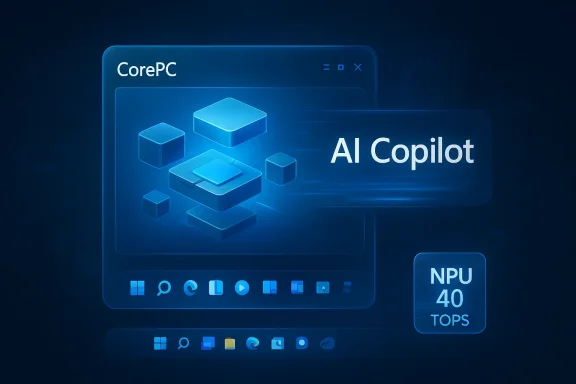
- The OS will be based on a modular architecture sometimes labeled CorePC (or “Core PC”), enabling detachable system modules and faster, less disruptive updates.
- Copilot and other AI capabilities will be integrated at the system core—not mere apps—and some advanced AI features will be provided via subscription.
- The full-featured AI experience will be gated behind hardware: devices must include an NPU delivering roughly 40 TOPS (trillions of operations per second) to run the most advanced on-device features.
- UI/UX changes are expected: floating taskbar, glass-like elements, and desktop optimizations for AI-first workflows.
What we can verify now
- Microsoft has published formal materials that define Copilot+ PCs—a marketing and technical program that distinguishes devices with robust NPUs and advanced on-device AI capabilities. Microsoft’s Copilot+ pages and developer guidance explicitly reference 40+ TOPS NPUs as the performance baseline needed for many of the Copilot+ experiences. That 40‑TOPS figure therefore belongs to Microsoft’s current Copilot+ ecosystem and is not invented out of whole cloth.
- The claim that Windows 10 support ended on October 14, 2025 is official and documented in Microsoft’s lifecycle notices. Enterprises and consumers base migration plans on that date; it’s the factual anchor that makes talk of a subsequent Windows release logically attractive to storymakers.
- Microsoft and hardware partners (Intel, AMD, Qualcomm) are shipping systems and silicon that target the “AI PC” segment; OEMs are labeling new laptops with NPUs and Copilot+ branding. Those product and partner moves are real and ongoing.
What remains unverified or contradicted
- Multiple established reporters and Microsoft-focused outlets have pushed back on the assertion that a fully numbered Windows 12 is scheduled for immediate release. One prominent fact-check argues Microsoft’s focus for the near term is stabilizing and improving Windows 11 rather than shipping a new major version this year; some of the codenames and architectural labels in the viral coverage trace to older projects or internal research that were never shipped as-is. In short: the existence of modular research (CorePC-like efforts) is plausible; the existence of a shipping Windows 12 product with the exact characteristics in those reports is not confirmed.
- The leap from Copilot+ hardware gating (which Microsoft currently applies to select advanced features) to a universal OS-level requirement that denies basic installation or operation on non‑NPU devices has not been substantiated. Microsoft’s Copilot+ pages frame 40+ TOPS as a bar for Copilot+ experiences, not as a bare-metal prerequisite to run the Windows desktop itself. Treat the claim that “Windows 12 will require an NPU to run at all” as a speculative extension rather than documented policy.
Modular architecture: what CorePC would mean — and the precedents
What “CorePC” promises
The modular architecture described in the leaks echoes a long line of Microsoft research and product experiments: Windows Core OS (WCOS), Windows 10X, the Windows Feature Experience Pack, and various attempts to separate the UI and user-facing experiences from the legacy Win32 substrate. The proposed CorePC approach in these reports would partition Windows into more isolated, updateable, and even detachable components: a minimal, trusted core; optional feature modules; and application compatibility layers that could be attached where needed.This design has several attractive technical claims:
- Faster, lower-risk updates because modules are updated independently.
- Smaller OEM images for low-end devices and tailored feature sets for workstations or gaming rigs.
- Reduced attack surface when system functions are separated and read-only at runtime.
- Easier testing and rollback for discrete features without a full OS re‑image.
Historical technical debt and user expectations
Microsoft has tried modularization before, and the practical challenge is Win32 compatibility. Windows is a vast ecosystem with legacy drivers, installers, applications, and enterprise management tooling. Delivering a modular OS that preserves the breadth of Windows software while providing the promised security and update wins is nontrivial; past projects were shelved or absorbed into Windows 11 as incremental improvements rather than as wholesale replacements. That makes CorePC-style modularization plausible in concept, but difficult to execute cleanly in a single release without years of testing and coordinated partner support.AI-first integration and Copilot: assistant as system service vs. optional app
The most impactful part of the rumor set is the claim that Copilot will become a core system service—able to observe activity across the OS, accept natural-language orchestrations of file and workflow tasks, and offer OS-level automation (think: “summarize my last week’s work, collect the relevant docs, and draft a status report”). Microsoft has been steering Windows toward deeper Copilot integration for months, and many Copilot features already interact with system services (search, file indexing, windowing, even Recall in preview). That momentum is real.Important clarifications:
- Microsoft already differentiates “Copilot” (the assistant) from “Copilot+ PC experiences” (hardware-enhanced, on-device features). Some of those enhanced experiences are explicitly tied to Copilot+ hardware and are marketed under that umbrella. Declaring Copilot a system service isn’t implausible — but it carries different privacy, telemetry, and governance implications than an optional app the user can uninstall or disable.
- Several outlets and community threads speculate that advanced Copilot features could be split into tiers, with basic capabilities baked in and advanced or “pro” capabilities behind a subscription. This is a commercial direction Microsoft and many cloud vendors already favor for high-cost inference and personalization services. However, no public Microsoft pricing or packaging for OS-level Copilot subscriptions has been announced; industry coverage that mentions subscriptions traces back to anonymous leak threads and speculative reporting. Flag those claims as commercial speculation.
Hardware gating, NPUs, and the 40 TOPS threshold — why it matters
Microsoft’s Copilot+ program and device documentation explicitly mention NPUs and the 40+ TOPS mark for certain on-device experiences. That specification is the clearest technical anchor among the rumor set: 40 TOPS is a real marketing and technical reference for Copilot+ features. But putting this into context is crucial.- The 40 TOPS figure is tied to specific Copilot+ experiences (local image generation, low-latency translation, advanced audio processing) and to a product class Microsoft and OEMs call Copilot+ PCs. It is not presently presented by Microsoft as a universal requirement to run Windows or to receive security updates.
- NPUs are rapidly evolving. Recent announcements from silicon vendors show mobile and laptop chips approaching or exceeding the 40 TOPS threshold, making more devices Copilot+ eligible without requiring a new-purpose custom chip in every laptop. Still, mainstream desktop and older laptops will frequently lack such NPUs, potentially segmenting feature availability. That segmentation is already happening through Copilot+ feature gating; the DOMINANT question is whether Microsoft will broaden that gating to core OS functionality. Evidence to date does not support that stronger claim.
- For enterprises and device fleets, the Copilot+ distinction creates a new procurement vector: not only CPU, RAM, and storage matter, but also NPU performance. IT teams must assess which workloads truly benefit from on-device NPUs versus cloud-based inference, and whether NPUs should be a purchasing requirement for new endpoints. If Microsoft were to elevate NPU requirements to the OS level, the cost and e‑waste implications would be substantial.
UI and UX redesign rumors — credible or wishful thinking?
Leaked UI concepts—floating taskbars, glass effects, “AI-first” desktop workflows—are seductive and share DNA with Microsoft’s Fluent Design experiments. Designers and concept artists frequently produce plausible mockups, and Microsoft’s own design teams have piloted numerous UI changes in Insider channels.- Some leaked UI concepts referenced in the reporting are likely dated concept work or community mockups that were never engineering-approved. Veteran reporters and internal observers caution against treating polished concept art as a reliable preview of shipping UI. That caveat matters because polished visuals amplify the impression of imminent change even when the underlying engineering plan is absent or different.
- That said, incremental UI changes and feature refinements continue to arrive through Windows 11 Insider channels; expect ongoing aesthetic evolution and feature adjustments rather than a single, dramatic visual reboot in an OS-numbered release—unless Microsoft announces otherwise.
Enterprise impact, compatibility, and the upgrade calculus
If Microsoft were to ship a major Windows release that materially changed hardware baselines or commercial packaging, the enterprise impact would be immediate and complex:- Device refresh cycles would accelerate for organizations that need advanced AI features on endpoint devices.
- Image management, driver testing, and security baselines would require rework to accommodate new modules or partition schemes.
- Licensing and procurement would need to consider subscription overlays—if they materialize—and whether those costs would be charged per-user, per-device, or via cloud entitlements.
Risks and trade-offs — security, privacy, and market fragmentation
The rumor set raises several real risks and trade-offs that are worth analyzing beyond the clickbait headlines:- Security model changes. Modular OS partitions can harden the kernel and core services, but they also increase the complexity of update orchestration. Patch management for micro-modules must be rock-solid to avoid partial patch states or update failures that leave devices unstable. Microsoft’s existing experience with Windows Feature Experience Pack and enablement packages helps, but fragmentation at scale is hard.
- Privacy and telemetry. If Copilot becomes a system-level service with access to broad activity signals (files, windows, input), the privacy model must be explicit, discoverable, and auditable. Enterprises will demand controls for data residency, telemetry opt-outs, and legal compliance. Microsoft has precedent for enterprise controls, but integrating them into pervasive assistant services requires careful transparency and policy tools.
- Market fragmentation. Gating advanced features to Copilot+ hardware creates a two-tier Windows experience. That may accelerate premium hardware sales, but it also risks leaving value-conscious users and many existing devices permanently unable to access new features. Microsoft and OEMs must weigh the commercial upside against the user and regulatory backlash that followed earlier hardware gating controversies (e.g., TPM 2.0 debates for earlier Windows versions).
- Commercial model risk. Introducing subscription gating for core system features is an unpopular narrative among many customers. If Microsoft pursues subscription overlays for advanced AI features, it must be explicit, fair, and avoid creating necessary-function paywalls that customers perceive as nickel-and-diming. At the moment, those subscription claims are speculative and unconfirmed.
OEMs, silicon partners, and the supply chain view
Hardware vendors are already aligning with Microsoft’s Copilot+ messaging. The silicon roadmap (Intel Core Ultra series, AMD Ryzen AI, Qualcomm Snapdragon X-class) is increasingly focused on integrated NPUs and hybrid CPU/GPU/AI stacks.- OEMs have commercial incentive to market “AI-ready” systems because it differentiates models and can command higher price points. That incentive drives faster adoption of NPUs in new laptops and mobile form factors. But the desktop and refresh cycles for enterprise remain variable; many organizations will want to standardize on stable, long-term SKUs rather than chase early AI silicon.
- Supply chain and sustainability considerations matter: if Microsoft or OEMs accelerate hardware gating, customers and governments may raise concerns about accelerated electronic waste and forced obsolescence. That debate will intensify if major OS features are tied to new silicon.
What to watch next — signals that will turn rumor into fact
If Microsoft intends to ship a full-numbered Windows successor with the characteristics described in the rumors, the following primary-source signals would appear in public view and change the conversation swiftly:- Official Microsoft posts or blog announcements using the new product name and a firm release timeframe.
- Developer or partner documentation that lists platform requirements and module/partition architecture details formally.
- OEM partner briefings and data sheets that adopt the new OS branding in launch materials, including enterprise bundle guidance.
- Preview builds in the Windows Insider channels with clear build numbers and release notes that identify the module structure and Copilot service changes.
- Licensing and commercial documents that outline any subscription tiers or paid overlays for advanced AI features.
Practical guidance — what consumers and IT should do now
- For consumers: Don’t delay necessary security upgrades or buy hardware solely because of headline claims. If you want on-device AI capabilities now, evaluate Copilot+ PCs and the features they enable; otherwise continue with standard Windows 11 devices and updates. Keep backups and prioritize storage and TPM/security readiness for future compatibility.
- For enterprises: Treat Windows 11 25H2 and current Copilot+ guidance as your near-term planning surface. Inventory devices for NPU capability only where workload analysis identifies real benefit. Pilot Copilot+ hardware in user groups where low-latency, on-device AI materially improves productivity or compliance. Maintain the normal Windows servicing cadence aimed at October 14, 2025 EOL for Windows 10 migrations.
- For IT procurement: If you will require Copilot+ experiences, specify NPU performance (40+ TOPS where justified) in RFPs and test images with real workloads. Otherwise, avoid blanket NPU requirements that increase costs without delivering measurable outcomes.
Conclusion
The idea of a modular, AI-first Windows is plausible and in many ways consistent with Microsoft’s engineering trajectory: Microsoft and its partners are investing heavily in on-device AI, modular delivery mechanisms, and Copilot-style assistants. At the same time, responsible reporting and enterprise planning demand caution: many of the most incendiary claims — an all-or-nothing OS that refuses to run without a 40 TOPS NPU, or a paid subscription that unlocks essential system functions — remain unverified or have been actively questioned by insiders and experienced Microsoft reporters. The most reliable path forward for readers is to separate the verifiable pieces (Copilot+ hardware guidance and Windows 10 lifecycle facts) from the speculative ones (a guaranteed Windows 12 shipping window, mandatory NPU for the OS itself, or concrete subscription models). Watch for official Microsoft documentation, partner product pages, and Insider build announcements to move these conversations from rumor to fact. Until then, plan pragmatically: migrate off Windows 10 where necessary, pilot AI-capable hardware where it delivers value, and keep skepticism about one-off, sensationalized reports that conflate speculation with confirmed roadmaps.Source: International Business Times, Singapore Edition Windows 12 May Require AI Chips, Reportedly Coming With Modular Design And AI-First Features
