

Microsoft’s public acknowledgment of an unfolding user revolt over Windows’ AI-first direction marks an unusual and consequential moment for the desktop: after Windows 10’s formal end-of-support on October 14, 2025, an accelerating and highly visible migration to Linux and other alternatives has been fueled less by nostalgia than by sharp objections to forced upgrades, perceived privacy invasions, and what many users describe as unwanted AI bloat. Microsoft’s executive-level mea culpa — a pledge to listen and “fix” the experience — arrives against a backdrop of concrete defections, heated forum threads, and record downloads for Linux distributions positioned as Windows replacements.
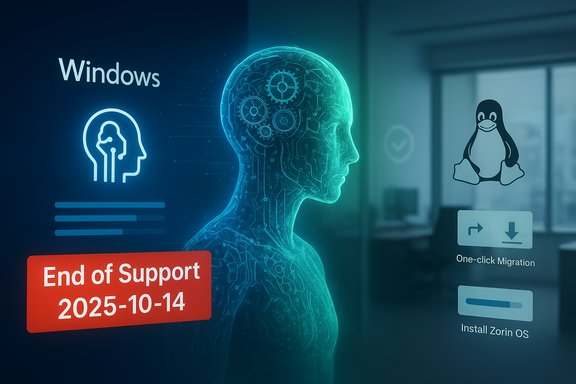
In September–November 2025 Microsoft tightened its engineering focus around an “agentic OS” concept — an operating system that surfaces persistent, context-aware AI agents capable of taking actions on behalf of users. The phrase, used publicly by Windows leadership as a preview of Microsoft Ignite messaging, touched off intense online backlash from power users, developers, and privacy advocates who fear the loss of predictability, the creep of telemetry, and the emergence of always-on background automation. Conversations that began on X and enthusiast forums quickly spilled into mainstream tech coverage and community boards, turning a product marketing phrase into a major trust test for the platform. Simultaneously, Microsoft ended mainstream support for Windows 10 on October 14, 2025, a hard calendar event that forced many users and organizations to choose between upgrading to Windows 11 (with its more stringent hardware gates), buying Extended Security Updates, or finding another path. That deadline provided the immediate catalyst for measurable interest in Linux distributions — not merely as a hobbyist curiosity but as a serious option to avoid hardware churn, loss of privacy control, and persistent in-OS nudges.
Source: WebProNews Microsoft’s Windows Reckoning: AI Backlash Fuels Linux Exodus
 Background / Overview
In September–November 2025 Microsoft tightened its engineering focus around an “agentic OS” concept — an operating system that surfaces persistent, context-aware AI agents capable of taking actions on behalf of users. The phrase, used publicly by Windows leadership as a preview of Microsoft Ignite messaging, touched off intense online backlash from power users, developers, and privacy advocates who fear the loss of predictability, the creep of telemetry, and the emergence of always-on background automation. Conversations that began on X and enthusiast forums quickly spilled into mainstream tech coverage and community boards, turning a product marketing phrase into a major trust test for the platform. Simultaneously, Microsoft ended mainstream support for Windows 10 on October 14, 2025, a hard calendar event that forced many users and organizations to choose between upgrading to Windows 11 (with its more stringent hardware gates), buying Extended Security Updates, or finding another path. That deadline provided the immediate catalyst for measurable interest in Linux distributions — not merely as a hobbyist curiosity but as a serious option to avoid hardware churn, loss of privacy control, and persistent in-OS nudges. What happened: the backlash, the admission, and the migration signal
The “agentic OS” line and why it detonated
A brief post from Microsoft’s Windows leadership describing Windows as “evolving into an agentic OS” landed poorly. For many experienced users “agentic” signalled autonomy — software that acts on its own initiative — and that implication collided with long-standing grievances about in-OS prompts, telemetry, and aggressive feature rollouts. Forums distilled the reaction into a handful of concrete concerns: regression in day-to-day polish, intrusive upsell and cloud nudges, and the specter of an OS that remembers (and acts on) user context without robust, auditable controls. The intensity of the response was such that replies were closed on the original post, and the issue became a major PR headache rather than a niche developer preview.Microsoft’s public pivot — “we care” and “we know we have work to do”
In direct replies and public comments, Windows leadership acknowledged the fallout and promised to prioritize stability, reliability, and developer workflows. Statements like “we care deeply about developers” and promises to “listen” and “fix” were aimed at damage control, but for some users these words arrived too late. The admission is notable — a large platform vendor publicly recognising that a strategic AI pivot had outpaced user trust — and it signals that Microsoft is weighing how to keep its AI roadmap without alienating long-time users.The migration indicators: downloads, forum traffic, and tools
Within days of the Windows 10 support cutoff, several indicators showed heightened activity for Linux distributions and migration tooling. Zorin OS timed a major release (Zorin OS 18) to coincide with the cutoff and publicly reported rapid uptake, claiming six-figure download figures in the first days and a large share of installs originating from Windows systems. Community trackers, mirrors, and forum traffic confirmed spikes in ISO downloads and “how-to” questions about migration. Meanwhile, new or newly-visible migration utilities — such as the community-built Operese project — appeared on forums and social platforms, promising streamlined transfers of files and settings from Windows to Linux. These are early but material signs of a migration wave, showing curiosity turning into real migration attempts.Technical context: what Microsoft is building — and what users fear
Copilot ecosystem, Copilot+ PCs, and hardware gating
Microsoft’s vision for richer on-device AI centers on the Copilot family and a hardware tier branded “Copilot+ PCs.” These machines are marketed to include NPUs and specific performance characteristics that support local model inference. Public engineering notes and OEM guidance frequently cite NPU performance targets in the “tens of TOPS” range — figures often summarized as 40+ TOPS for richer local experiences — though TOPS is a coarse metric that varies by model architecture and workload. The hardware story creates two tensions: it accelerates device refresh cycles for users who want the full feature set, and it locks out older hardware that would otherwise be safe and usable on Linux.Recall and persistent snapshots: privacy by design or risk vector?
Recall — an experimental feature designed to archive short-term snapshots and make them searchable by context — has been the most visible privacy lightning rod. Critics highlighted the risk of automated screenshots containing sensitive content; researchers and privacy-first vendors pushed back, implementing blocks and prompting Microsoft to rework the feature’s defaults and protections. Microsoft’s public documentation and product teams emphasise encryption, local-only storage, Windows Hello gating, and developer APIs for filtering, but the initial rollout and the feature’s implications for on-device surveillance remain central to why many users are opting out or fleeing the platform. The controversy shows how a technically solvable feature can become a governance problem without transparent, auditable controls and clear defaults that prioritise user choice.The UX tradeoff: automation vs. predictability
Agentic features promise fewer clicks, faster task completion, and new accessibility modes for users who benefit from proactive assistance. But for long-time desktop users the paramount value of an OS is predictability: consistent menus, reliable updates, and a minimal surface for intrusion. The backlash has made visible the tension at the heart of modern platform design: automation that takes initiative requires new governance models — opt-in defaults, fine-grained auditing, and tools for rollback — otherwise it will be perceived as coercive and risky.The Linux migration wave: scope, drivers, and limits
Who’s switching and why
Data from communities, distro developers, and anecdotal reports point to a stratified migration profile:- Home users and budget households seeking to extend hardware life and avoid upgrade costs.
- Privacy-conscious users and developers rejecting cloud-tethered defaults and intrusive features.
- Students, institutions, and small organizations weighing Linux (or ChromeOS Flex) to avoid hardware refresh cycles.
- Hobbyists and gamers who are now more incentivized because Proton/Steam compatibility has matured.
Zorin OS 18 and the “gateway” strategy
Zorin OS 18’s launch is a textbook example of timing and product positioning: a Windows-like desktop, one-click migration aids, and built-in web-app and OneDrive integrations reduce friction for switchers. The Zorin Group reported rapid adoption numbers after launch, which community trackers and press outlets corroborated as a record uptake for the project. While downloads don’t equal long-term retention, the volume and the Windows-origin share hint at more than temporary curiosity. For many first-time Linux users, Zorin’s gateway design lowers the learning hurdle.Migration tooling: Operese and the emergent ecosystem
Tools like Operese — a community-driven Windows-to-Linux migration utility — exemplify a new class of migration enablers: in-place transfer of files, app mappings, and basic settings with minimal manual intervention. Operese is young and alpha-quality in places, but community interest is high because the manual steps involved in migrating apps, re-establishing workflows, and recovering data remain the biggest friction points. As these tools mature, they will lower the technical bar further and convert more tests into permanent migrations.Practical limits and second-order hurdles
Linux’s growth is practical, not panacea: driver support for niche hardware, anti-cheat compatibility for certain multiplayer titles, and familiarity with essential Windows-only desktop apps remain real obstacles. Enterprises and regulated industries have migration costs, app dependencies, and certification needs that make wholesale switches rare. The migration wave is meaningful because it’s visible and sustained — not because it dethrones Windows overnight.Strengths of the Linux alternative and why it appeals now
- Control and transparency: Users can audit packages and opt out of telemetry by default.
- Reduced upgrade economics: Linux extends the usable life of older hardware, avoiding expensive TPM or CPU upgrades.
- Lean performance: Many distros and desktop environments are less resource-intensive than a stock Windows 11 with integrated Copilot services.
- Strong community support: Active forums, migration guides, and distro-specific assistants accelerate on-ramp.
- Maturing application compatibility: Proton and container/VM tooling meaningfully reduce the gap for many games and apps.
Risks and caveats — to users, businesses, and Microsoft
For users considering Linux
- App compatibility: Expect edge cases. Some professional-grade Windows-only software and anti-cheat systems remain less compatible.
- Learning curve: Real-world productivity carryover can require retooling or finding equivalent workflows.
- Support model: Community-driven support is excellent, but it differs from vendor SLAs — important for businesses.
For Microsoft
- Market share pressure: A sustained erosion among power users and budget-conscious consumers creates a visible vulnerability.
- Trust deficit: Rebuilding trust requires demonstrable changes — not only softer messaging but concrete product adjustments, governance promises, and transparent telemetry pipelines.
- Regulatory scrutiny: Agentic features combined with data collection increase regulatory risks in privacy-focused jurisdictions.
For the broader ecosystem
- Fragmentation risk: A credible alternative to Windows on the desktop increases heterogeneity in development testing and distribution models.
- Opportunity for open-source projects: Migration spike fosters investment and talent flows into Linux projects, accelerating usability and compatibility improvements.
What Microsoft can (and must) do next
- Ship a true power-user mode: a durable, low-noise configuration with minimal prompts, easy telemetry controls, and predictable update behavior.
- Make agentic features strictly opt-in with auditable memory controls and revocable permissions for any agentic action.
- Publish independent benchmarks and transparent mechanisms for NPU claims and Copilot+ certifications so customers can evaluate hardware tradeoffs reliably.
- Strengthen developer-focused promises: better compatibility modes, explicit guarantees for developer tools, and clearer rollback paths for features that degrade workflows.
- Engage third-party auditors for privacy and security proofs around features like Recall, and maintain a clear, user-first default posture.
Practical guidance for readers (short checklist)
- Inventory your devices: check Windows 11 compatibility (TPM 2.0, CPU support, RAM/storage).
- For unsupported devices: try a live Linux USB session from a friendly distro (Zorin OS, Linux Mint, Ubuntu).
- Backup first: always image disks and export user data before attempting migrations.
- Test critical apps: use Wine/Proton, VMs, or cloud-hosted Windows to confirm compatibility.
- Tighten privacy settings: if staying on Windows 11, audit Copilot, Recall, and telemetry settings; enable Windows Hello and encryption where features require them.
- For enterprises: pilot alternatives on a representative fleet before broad rollout, and evaluate Total Cost of Ownership vs. hardware refresh.
Conclusion: a pivotal desktop moment
The post–Windows 10 landscape is not a single, irreversible tectonic shift — Windows still dominates desktops worldwide — but the current episode is a powerful market signal. Microsoft’s AI ambitions for an “agentic OS” are technically plausible and strategically defensible, but they collided with a social contract problem: users expect predictability, respect for privacy, and clear opt-in governance for autonomy-taking features. The combination of a hard support deadline, hardware-gating for Windows 11, visible privacy controversies (like Recall), and polished Linux alternatives converged to create a migration window that vendors and communities have readily exploited. How Microsoft responds — by demonstrating product discipline, transparent governance, and durable power-user controls — will determine whether this moment becomes a temporary stumble or the beginning of a longer-term share loss to alternatives that promise simplicity and control. Ultimately, the debate is less about whether AI belongs in operating systems and more about how it should be introduced: with explicit consent, auditable memory, and defaults that privilege user agency. The choices Microsoft makes next will either rebuild trust — or accelerate a multi-year migration that reshapes the desktop landscape.Source: WebProNews Microsoft’s Windows Reckoning: AI Backlash Fuels Linux Exodus
