

Windows Autopatch tenants should use Allow for ordinary, eligible endpoints only when update ownership, baseline-reboot tolerance, and fallback-reboot handling are documented. Device populations with exceptional operational or validation requirements should receive an explicit Windows quality update policy. If ownership or prerequisites remain unresolved, use Block temporarily, assign an owner, and define the evidence required to remove the block.
The factual foundation is narrow but important: the tenant default affects eligible devices that are outside a Windows quality update policy. Devices assigned to such a policy follow that policy’s hotpatch setting instead, while existing deferrals and update-ring controls remain respected. Microsoft made the tenant-level Allow and Block choices available on April 1, 2026, gave organizations until May 11, 2026, before deployments, and began applying the default with the May 2026 Windows security update.
WindowsForum recommends classifying the fleet into three testable populations before choosing a tenant setting:
That creates two distinct forms of governance:
WindowsForum’s reports on the May 2026 change consistently highlighted that Microsoft was making hotpatch the default behavior for eligible Windows Autopatch devices rather than requiring administrators to opt in device by device. The practical consequence is that policy absence becomes meaningful. An eligible device outside a quality-update policy is not neutral; it inherits the tenant decision.
The first inventory question is therefore not “How many devices are managed?” It is “Which eligible devices are outside a Windows quality update policy?” Those devices define the actual scope of the tenant default.
This can include newly enrolled systems, temporary groups, migration populations, or devices removed from a policy assignment. Those examples should be treated as inventory hypotheses to verify, not as proof that a particular tenant contains such gaps.
Before allowing eligible devices to inherit the default, identify the team and policy authority responsible for quality-update behavior. This is especially important wherever responsibilities are divided among Intune, Windows Autopatch, Configuration Manager, WSUS-related processes, or other administrative teams.
The recommendation is organizational rather than a claim about product-level conflict mechanics. Do not assume that the existence of multiple tools proves a technical conflict. Instead, establish:
WindowsForum’s coverage framed the rollout as an administrative opt-out decision, but the more durable lesson is about assignment governance. The tenant switch exposes devices whose quality-update behavior was previously left implicit.
WindowsForum recommends an explicit Allow policy when a population may use hotpatch but requires stronger evidence of intentional admission than tenant inheritance provides. Examples can include formally piloted groups, devices subject to special validation, or populations whose change records must identify a specific control.
An explicit Block policy is appropriate when a defined population must not inherit a broader tenant Allow decision. This permits ordinary devices to receive the default while preserving a deliberate exception for systems with different operational requirements.
The distinction is not simply technical. An explicit policy should answer governance questions that the tenant fallback cannot answer by itself:
Administrators should also avoid assuming that membership in an update ring answers the hotpatch question. The supplied facts establish that existing deferrals and update rings remain respected, while the tenant default applies outside Windows quality update policies. Those controls have related but different roles: one can continue to govern timing while the other determines whether hotpatch is allowed for the assigned population.
This is the reboot fact that belongs in planning, user communication, and validation. It should not be expanded into an unsupported taxonomy of every ineligibility, fallback, or failure condition.
For operational planning, administrators should communicate two supported expectations:
A fleet should therefore not inherit Allow merely because users dislike restarts. The responsible team must also confirm that the fleet can accept the baseline restart condition. Devices with unusually restricted reboot opportunities may need an explicit policy and a population-specific change plan even if they are otherwise candidates for hotpatch.
Do not promise users that enrollment in hotpatch means a device will never restart for Windows servicing. The supported claim is narrower and conditional on the current baseline.
A device’s hotpatch source and its deployment timing are separate questions:
The rollout review should therefore preserve established ring and deferral analysis. Administrators do not need to redesign those controls merely because the tenant default changed, but they do need to document how the hotpatch choice fits alongside them.
WindowsForum recommends recording the quality-update-policy decision and existing timing control as separate fields in the fleet inventory. That provides clearer evidence than a single “hotpatch enabled” column, which says little about assignment source, ownership, or timing.
For each pilot population, capture:
WindowsForum recommends that pilot selection follow the same three-way classification used for production:
Useful exit criteria include:
The review should also identify what would return a population to Block. For example, a fleet may require reevaluation if ownership changes, its reboot restrictions change, or its policy assignment becomes unclear. These are WindowsForum recommendations for change control, not claims about automatic Microsoft service behavior.
Inventory devices outside quality-update policies first. Classify them as ordinary, exception, or unresolved. Set tenant Allow where the inheritance conditions are met, or temporary Block where they are not. Create explicit policies for exceptions, verify baseline readiness and reboot acceptance, and reassess every blocked group against its named exit conditions.
The factual foundation is narrow but important: the tenant default affects eligible devices that are outside a Windows quality update policy. Devices assigned to such a policy follow that policy’s hotpatch setting instead, while existing deferrals and update-ring controls remain respected. Microsoft made the tenant-level Allow and Block choices available on April 1, 2026, gave organizations until May 11, 2026, before deployments, and began applying the default with the May 2026 Windows security update.
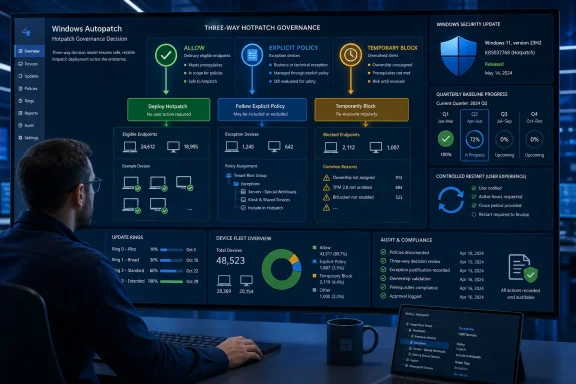 The Three-Way Decision Framework
WindowsForum recommends classifying the fleet into three testable populations before choosing a tenant setting:- Ordinary population — inherit Allow. Use inherited Allow only when all three conditions are documented:
- Intune or Windows Autopatch owns the population’s quality-update behavior.
- The population can accept the restart required when a device is not on the current quarterly baseline.
- A named team owns communications and handling when the expected restart-free outcome is not available.
- Exception population — use an explicit policy. Assign an explicit Windows quality update policy when a population needs a deliberate Allow or Block decision because of specialized validation, operational sensitivity, restricted reboot windows, or formal change-control requirements.
- Unresolved population — use temporary Block. Block inheritance when the organization cannot yet identify the policy authority, confirm prerequisites, accept baseline restarts, or name the team responsible for the outcome. Every blocked population should have an owner, validation plan, and exit criteria.
The Default Applies Only Outside Quality-Update Policies
The most useful fact in Microsoft’s rollout is its scope. The tenant default applies to eligible devices that are not assigned to a Windows quality update policy. If a device is assigned to one, the hotpatch setting in that policy controls the device instead.That creates two distinct forms of governance:
- Inherited governance: An eligible, policy-unassigned device receives the tenant’s Allow or Block decision.
- Explicit governance: A policy-assigned device follows the hotpatch choice made in its Windows quality update policy.
WindowsForum’s reports on the May 2026 change consistently highlighted that Microsoft was making hotpatch the default behavior for eligible Windows Autopatch devices rather than requiring administrators to opt in device by device. The practical consequence is that policy absence becomes meaningful. An eligible device outside a quality-update policy is not neutral; it inherits the tenant decision.
The first inventory question is therefore not “How many devices are managed?” It is “Which eligible devices are outside a Windows quality update policy?” Those devices define the actual scope of the tenant default.
This can include newly enrolled systems, temporary groups, migration populations, or devices removed from a policy assignment. Those examples should be treated as inventory hypotheses to verify, not as proof that a particular tenant contains such gaps.
Policy Absence Must Have an Owner
A tenant-level Allow setting can be useful for ordinary endpoints because it avoids requiring a separate exception-style policy for every standard employee device. That benefit depends on the unassigned population being intentional and understood.Before allowing eligible devices to inherit the default, identify the team and policy authority responsible for quality-update behavior. This is especially important wherever responsibilities are divided among Intune, Windows Autopatch, Configuration Manager, WSUS-related processes, or other administrative teams.
The recommendation is organizational rather than a claim about product-level conflict mechanics. Do not assume that the existence of multiple tools proves a technical conflict. Instead, establish:
- Which team is accountable for the quality-update result.
- Which policy or service represents the approved decision.
- Who can explain why a device is outside a Windows quality update policy.
- Who accepts the possibility of a baseline cumulative update and restart.
- Who decides whether an unresolved population can move from Block to Allow or to an explicit policy.
WindowsForum’s coverage framed the rollout as an administrative opt-out decision, but the more durable lesson is about assignment governance. The tenant switch exposes devices whose quality-update behavior was previously left implicit.
Use Explicit Policies for Exceptions
An explicit Windows quality update policy is appropriate whenever a device population requires a decision attributable to a named configuration and owner.WindowsForum recommends an explicit Allow policy when a population may use hotpatch but requires stronger evidence of intentional admission than tenant inheritance provides. Examples can include formally piloted groups, devices subject to special validation, or populations whose change records must identify a specific control.
An explicit Block policy is appropriate when a defined population must not inherit a broader tenant Allow decision. This permits ordinary devices to receive the default while preserving a deliberate exception for systems with different operational requirements.
The distinction is not simply technical. An explicit policy should answer governance questions that the tenant fallback cannot answer by itself:
- Why is this population treated differently?
- Who approved the hotpatch choice?
- Which devices are intended to be included?
- What validation evidence is required?
- When will the decision be reviewed?
- What conditions permit a blocked population to move to Allow?
Administrators should also avoid assuming that membership in an update ring answers the hotpatch question. The supplied facts establish that existing deferrals and update rings remain respected, while the tenant default applies outside Windows quality update policies. Those controls have related but different roles: one can continue to govern timing while the other determines whether hotpatch is allowed for the assigned population.
Hotpatch Reduces Restarts but Does Not Remove Baseline Reboots
The supported reboot condition is straightforward: a device must be on the current quarterly baseline before later hotpatch months can avoid restarts. A device that is not on that baseline receives a baseline cumulative update and must restart before subsequent hotpatch updates can provide the expected restart reduction.This is the reboot fact that belongs in planning, user communication, and validation. It should not be expanded into an unsupported taxonomy of every ineligibility, fallback, or failure condition.
For operational planning, administrators should communicate two supported expectations:
- A device on the required baseline may receive an applicable hotpatch without an update-required restart.
- A device not on the current baseline must receive the baseline cumulative update and restart before later hotpatch months can avoid restarts.
A fleet should therefore not inherit Allow merely because users dislike restarts. The responsible team must also confirm that the fleet can accept the baseline restart condition. Devices with unusually restricted reboot opportunities may need an explicit policy and a population-specific change plan even if they are otherwise candidates for hotpatch.
Do not promise users that enrollment in hotpatch means a device will never restart for Windows servicing. The supported claim is narrower and conditional on the current baseline.
Existing Deployment Timing Still Matters
Microsoft’s model preserves existing deferrals and update-ring controls. That means the hotpatch decision should not be treated as a replacement for staged deployment governance.A device’s hotpatch source and its deployment timing are separate questions:
- Is the device assigned to a Windows quality update policy?
- If so, what does that policy specify for hotpatch?
- If not, is the eligible device inheriting tenant Allow or Block?
- What existing deferrals or update-ring controls govern deployment timing?
The rollout review should therefore preserve established ring and deferral analysis. Administrators do not need to redesign those controls merely because the tenant default changed, but they do need to document how the hotpatch choice fits alongside them.
WindowsForum recommends recording the quality-update-policy decision and existing timing control as separate fields in the fleet inventory. That provides clearer evidence than a single “hotpatch enabled” column, which says little about assignment source, ownership, or timing.
A One-Page Implementation Checklist
The following checklist is WindowsForum guidance for converting the May 2026 default into a controlled operational decision.1. Define the tenant-default population
- Inventory devices outside Windows quality update policies.
- Determine which of those devices are eligible for the tenant default.
- Record the administrative owner for the resulting quality-update behavior.
- Identify populations whose absence from a policy is intentional.
- Flag populations whose assignment state cannot yet be explained.
2. Classify each population
Assign every relevant group to one of three categories:- Ordinary: Suitable for inherited Allow.
- Exception: Requires an explicit Allow or Block policy.
- Unresolved: Requires temporary Block while ownership or prerequisites are investigated.
3. Test the conditions for inherited Allow
Before classifying a population as ordinary, confirm that:- Intune or Windows Autopatch quality-update ownership is documented.
- The team accepts the baseline cumulative update and required restart when devices are not current.
- Existing deferrals and update rings remain suitable.
- A named owner is responsible for rollout validation.
- Support and communications owners understand that restart avoidance depends on baseline readiness.
4. Create explicit treatment for exceptions
For each exception population:- Choose explicit Allow or explicit Block.
- Document the operational reason.
- Name the policy owner and device owner.
- Define the intended membership.
- Record required validation evidence.
- Set a review date or review event.
- State the criteria for changing or retiring the policy.
5. Put controls around temporary Block
For each blocked unresolved population:- Name the missing prerequisite or ownership decision.
- Assign a person or team to resolve it.
- Define the evidence needed to reconsider Block.
- Set a review date.
- Decide whether the eventual destination is inherited Allow, explicit Allow, or explicit Block.
6. Validate by population
WindowsForum recommends a population-based pilot rather than relying only on a random tenant percentage. The pilot should represent the operational groups that will actually inherit Allow or receive an explicit policy.For each pilot population, capture:
- Whether the device is outside or inside a Windows quality update policy.
- Whether its hotpatch choice is inherited or explicit.
- Which team owns quality-update behavior.
- Whether baseline readiness has been verified.
- Whether the baseline-restart condition is acceptable.
- Which existing deferral or ring governs deployment timing.
- What evidence demonstrates an acceptable result.
7. Complete change control
The change record should state:- The tenant setting being selected.
- The eligible, policy-unassigned population affected by that setting.
- The exception populations covered by explicit policies.
- The unresolved populations remaining blocked.
- The owner of each population.
- The accepted baseline-restart condition.
- The evidence required to close the rollout.
- The date or event that triggers reassessment.
Pilot Design Should Reflect Operational Differences
Tenant-wide averages can conceal important differences among populations. A successful result for standard employee laptops does not automatically validate a specialized fleet with different reboot windows or approval requirements.WindowsForum recommends that pilot selection follow the same three-way classification used for production:
- An ordinary population that is expected to inherit Allow.
- An exception population governed by an explicit policy.
- An unresolved or previously blocked population being evaluated against named exit criteria.
- Was the hotpatch choice inherited from the tenant or supplied by an explicit policy?
- Was that source intentional?
- Was the device on the required baseline?
- If a baseline cumulative update was required, was the restart acceptable?
- Did existing deferrals and ring behavior remain consistent with the rollout plan?
- Did the assigned owner receive enough evidence to approve broader use?
Change Control Should Define Exit Criteria
“Block until ready” is too vague for a durable plan. A blocked population needs named conditions that can be tested.Useful exit criteria include:
- Quality-update ownership has been assigned to a named team.
- The relevant policy authority has been documented.
- The population’s membership has been inventoried.
- The decision between inherited and explicit governance has been made.
- Baseline readiness has been checked.
- The required baseline restart is operationally acceptable.
- Existing deferrals and update-ring behavior have been reviewed.
- A pilot has produced the evidence required by the change owner.
- Support and communications responsibilities have been assigned.
The review should also identify what would return a population to Block. For example, a fleet may require reevaluation if ownership changes, its reboot restrictions change, or its policy assignment becomes unclear. These are WindowsForum recommendations for change control, not claims about automatic Microsoft service behavior.
Frequently Asked Questions
Should every Windows Autopatch tenant select Allow?
No. Allow is appropriate for ordinary, eligible devices outside a Windows quality update policy when ownership, baseline-reboot acceptance, and support handling are documented. Exceptions should use an explicit policy, while unresolved populations should remain temporarily blocked.Does tenant Allow override a Windows quality update policy?
No. Devices assigned to a Windows quality update policy follow that policy’s hotpatch setting. The tenant default applies to eligible devices outside those policies.Do existing update rings and deferrals stop applying?
No. Existing deferrals and update-ring controls remain respected. Administrators should document the hotpatch decision and deployment-timing controls separately.Does hotpatch eliminate Windows restarts?
No. Devices not on the current quarterly baseline receive a baseline cumulative update and must restart before later hotpatch months can avoid restarts. Hotpatch reduces update-required restarts after the necessary baseline is in place.Should specialized devices inherit tenant Allow?
Not automatically. If a population has special validation, reboot, operational, or change-control requirements, WindowsForum recommends assigning an explicit quality-update policy so that its decision has a named owner and documented scope.When is temporary Block appropriate?
Use temporary Block when quality-update ownership, policy authority, prerequisite state, baseline-reboot acceptance, or validation requirements remain unresolved. The block should have a responsible owner, review date, required evidence, and exit criteria.What should organizations inventory first?
Start with devices outside Windows quality update policies. That population defines the scope of the tenant default among eligible devices.How should co-managed or multi-team environments approach the decision?
Identify the team and policy authority responsible for quality-update behavior before allowing unassigned eligible devices to inherit the tenant default. Do not infer a product conflict merely because multiple management systems exist; resolve administrative ownership first.What dates matter for the rollout?
Microsoft made the Allow and Block tenant controls available on April 1, 2026. Organizations had until May 11, 2026, before deployments, and the default began with the May 2026 Windows security update.Final Decision Table
| Fleet characteristics | Tenant setting | Explicit quality-update-policy setting | Required owner | Validation evidence | Exit criteria for Block |
|---|---|---|---|---|---|
| Ordinary eligible endpoints outside a quality-update policy; Intune or Autopatch ownership documented; baseline restart accepted; existing timing controls understood | Allow | None required for inherited behavior | Quality-update service owner | Inventory confirms intended unassigned scope; baseline readiness and reboot acceptance recorded; ring or deferral ownership documented | Not applicable unless ownership or assignment later becomes unclear |
| Population may use hotpatch but requires named assignment, formal approval, or population-specific evidence | Allow for ordinary devices | Explicit Allow for the exception population | Policy owner and fleet owner | Intended membership, approval, baseline readiness, reboot acceptance, and pilot result documented | If temporarily blocked during validation: approve pilot evidence and confirm ownership |
| Population must not inherit broader tenant Allow because of specialized operational, validation, or reboot requirements | Allow for ordinary devices | Explicit Block for the exception population | Fleet owner and change authority | Business reason, intended membership, review trigger, and responsible team documented | Reassess only when operational requirements change and a new Allow decision is approved |
| Eligible policy-unassigned devices whose quality-update owner or authority cannot be identified | Temporary Block | Undecided until ownership is resolved | Named remediation owner | Inventory of affected devices and documented authority decision | Identify the responsible team, document policy authority, and choose inherited Allow, explicit Allow, or explicit Block |
| Population whose baseline readiness or acceptance of the required baseline restart is unresolved | Temporary Block | Undecided or temporary explicit Block if isolation is required | Endpoint operations owner | Baseline readiness review and written acceptance of the reboot condition | Confirm readiness, approve reboot handling, and complete a representative pilot |
| Mixed tenant containing ordinary, exception, and unresolved populations | Allow only if unresolved groups are isolated; otherwise temporary Block | Explicit Allow or Block for each exception | Tenant owner plus named population owners | Complete policy-gap inventory, classification, ownership record, baseline review, and change approval | Isolate exceptions, resolve unassigned ownership, verify baseline readiness, and approve support responsibilities |
References
- Primary source: learn.microsoft.com
Windows Autopatch - Frequently Asked Questions (FAQ) | Microsoft Learn
Answers to frequently asked questions about Windows Autopatch.learn.microsoft.com - Independent coverage: techcommunity.microsoft.com
- Primary source: WindowsForum
Windows Autopatch Hotpatch Default May 2026: Opt Out Guide | Windows Forum
Microsoft is turning on hotpatch security updates by default in Windows Autopatch for eligible devices starting with the May 2026 Patch Tuesday—effectively...windowsforum.com
