

Mozilla’s new Over the Edge 2.0 report says Windows 10 and Windows 11 still put material obstacles in front of users who download a rival browser, make it their default, or try to keep it that way. The most consequential finding for Windows users is not another Edge pop-up: researchers say a Windows Backup migration from Windows 10 to Windows 11 can leave an existing default-browser choice behind and restore Microsoft Edge as the default instead.
The report, published by Mozilla on July 14, 2026, was written by deceptive-design researcher Harry Brignull and technology design ethicist Cennydd Bowles. Mozilla commissioned the work, but says the researchers independently documented the journeys, screenshots, and methodology. Their testing covered Windows 10 and Windows 11 in the United States, United Kingdom, India, and Germany, the latter used as a stand-in for the European Economic Area.
Microsoft’s long-standing position is that Windows users can install any browser and set it as default. That remains technically true. Mozilla’s argument is narrower, and more uncomfortable: a choice is not fully free simply because a settings page eventually permits it when the operating system, browser, search engine, backup process, and AI assistant repeatedly steer the user elsewhere.
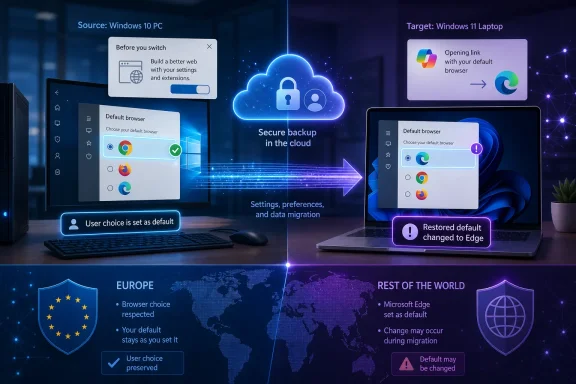
The report’s Windows Backup test is the issue that should command the most attention from admins and enthusiasts planning hardware refreshes or Windows 10 retirement projects. The researchers configured a Windows 10 PC with a non-Edge browser installed and selected as the system default, backed it up, and restored that backup onto a Windows 11 machine.
According to Over the Edge 2.0, the alternative browser did not arrive through the restore, while Edge became the default browser. Mozilla describes that result as a silent reset of a prior user decision rather than a neutral limitation of application migration.
There is an important distinction here. A backup service not reinstalling every third-party Win32 application is not, by itself, surprising; many applications require separate deployment, licensing, or compatibility checks. But if Windows restores a user environment and applies Edge as the default when the competing application is absent, it produces a predictable commercial outcome: the user’s established browser choice no longer survives the transition.
That matters especially after Windows 10 reached end of support on October 14, 2025. Organizations moving users to Windows 11 should not assume that browser preference is an incidental detail that will sort itself out after migration. Default application associations, browser deployment, and first-run behavior need to be explicitly included in the migration plan.
For managed environments, the practical mitigation is familiar: deploy the approved browser through Intune, Configuration Manager, Group Policy, or another endpoint-management platform, then enforce or configure the required HTTP, HTTPS, HTML, and PDF associations. Microsoft’s own Edge enterprise documentation also exposes policies that let administrators control whether Edge checks or prompts to become the default browser. The lesson is not that every organization must suppress Edge; it is that browser defaults should be treated as a configuration item, not a personal preference that will necessarily persist across a device move.
One cited example appears when a user visits Google’s Chrome download page through Edge. Microsoft can present an oversized comparison message emphasizing that both browsers use Chromium-based technology. Microsoft is plainly entitled to market its own browser and to run ads against competitors’ names. Mozilla’s complaint is that this particular intervention appears inside the browsing path to a competitor’s download page, not as an ordinary ad placement offered on equal terms to any advertiser.
The report characterizes that pattern as visual interference and obstruction: friction deliberately added at the moment a user attempts to act on a browser choice. Its authors identify several related categories across their testing, including trick wording, preselected options, nagging, and forced action.
The terminology may sound academic, but the behavior is recognizable to anyone who has deployed or reset a consumer Windows PC. A person selecting “keep using Chrome” or “set Firefox as default” may face an extra recommendation, a differently weighted button, a reminder during setup, or a path that leads back to Edge for certain Microsoft-owned experiences. None of these elements independently blocks browser installation. Together, Mozilla argues, they alter the practical meaning of “default.”
That is the point Microsoft will likely contest. The company can reasonably say Edge messages describe real features, its Chromium foundation is relevant information, and Windows must preserve integration points for its own services. The report does not establish that every recommendation is deceptive. It makes a cumulative-design argument: Microsoft controls the operating system and browser surfaces, so its repeated use of defaults, prompts, and custom presentation has a different effect than a conventional browser vendor’s marketing campaign.
Microsoft’s current Windows developer documentation makes the technical mechanism clear. Normal
For users, this is less about ideological browser loyalty than workflow consistency. A link opened from an assistant can split sessions, passwords, profiles, extensions, bookmarks, and security tooling across browsers. In a business setting, it can also complicate conditional-access expectations, browser-based data controls, extension deployment, and help-desk troubleshooting.
Mozilla also raises a data-governance concern. Its researchers argue that separate Windows and Edge consent prompts can form a “pipeline” that expands the data available for personalization and advertising, potentially including activity associated with other browsers. The report frames this as a risk arising from consent design rather than claiming proof of a particular data transfer in every tested configuration. That distinction matters, particularly for IT teams evaluating Windows telemetry and Microsoft account settings alongside browser policy.
That difference broadly aligns with changes Microsoft publicly announced for the European Economic Area under the European Union’s Digital Markets Act. Microsoft said in 2023 and 2024 that EEA users would be able to uninstall Edge, retain their existing default browser through Windows updates, avoid certain Edge-default recommendations, and no longer encounter unique Edge banner promotions when using Bing or Edge to seek a rival browser.
Mozilla acknowledges that these changes improved the experience, while arguing they do not go far enough. The report says harmful patterns remain inside the EEA, but its core conclusion is difficult for Microsoft to sidestep: the company has already demonstrated that it can ship a less coercive browser-choice experience when regulation requires it.
The comparison also weakens the idea that aggressive Edge steering is technically necessary to keep Windows coherent, secure, or supportable. If the EEA build can preserve defaults through updates and reduce browser-specific promotion, comparable behavior elsewhere is a product-policy decision.
For Microsoft, the immediate test is straightforward. It can respond with specifics: whether Windows Backup will restore or preserve third-party default-browser choices, whether Copilot will consistently honor the system default for ordinary web links, and whether the EEA’s browser-choice safeguards will be extended globally.
Until then, Windows 10-to-Windows 11 migration plans should include a deliberate browser deployment and default-association step. The report’s central warning is that a browser preference can be changed without a user ever opening the Default apps page—and that is exactly the kind of surprise administrators should remove before it reaches a production rollout.
The report, published by Mozilla on July 14, 2026, was written by deceptive-design researcher Harry Brignull and technology design ethicist Cennydd Bowles. Mozilla commissioned the work, but says the researchers independently documented the journeys, screenshots, and methodology. Their testing covered Windows 10 and Windows 11 in the United States, United Kingdom, India, and Germany, the latter used as a stand-in for the European Economic Area.
Microsoft’s long-standing position is that Windows users can install any browser and set it as default. That remains technically true. Mozilla’s argument is narrower, and more uncomfortable: a choice is not fully free simply because a settings page eventually permits it when the operating system, browser, search engine, backup process, and AI assistant repeatedly steer the user elsewhere.
 The Windows Backup finding turns a prompt problem into a migration problem
The report’s Windows Backup test is the issue that should command the most attention from admins and enthusiasts planning hardware refreshes or Windows 10 retirement projects. The researchers configured a Windows 10 PC with a non-Edge browser installed and selected as the system default, backed it up, and restored that backup onto a Windows 11 machine.According to Over the Edge 2.0, the alternative browser did not arrive through the restore, while Edge became the default browser. Mozilla describes that result as a silent reset of a prior user decision rather than a neutral limitation of application migration.
There is an important distinction here. A backup service not reinstalling every third-party Win32 application is not, by itself, surprising; many applications require separate deployment, licensing, or compatibility checks. But if Windows restores a user environment and applies Edge as the default when the competing application is absent, it produces a predictable commercial outcome: the user’s established browser choice no longer survives the transition.
That matters especially after Windows 10 reached end of support on October 14, 2025. Organizations moving users to Windows 11 should not assume that browser preference is an incidental detail that will sort itself out after migration. Default application associations, browser deployment, and first-run behavior need to be explicitly included in the migration plan.
For managed environments, the practical mitigation is familiar: deploy the approved browser through Intune, Configuration Manager, Group Policy, or another endpoint-management platform, then enforce or configure the required HTTP, HTTPS, HTML, and PDF associations. Microsoft’s own Edge enterprise documentation also exposes policies that let administrators control whether Edge checks or prompts to become the default browser. The lesson is not that every organization must suppress Edge; it is that browser defaults should be treated as a configuration item, not a personal preference that will necessarily persist across a device move.
Downloading Chrome can still mean navigating an Edge sales pitch
Mozilla’s researchers also revisit the more visible layer of the browser-choice fight: the messages shown when someone tries to download Chrome, Firefox, or another competitor from within Edge and Bing.One cited example appears when a user visits Google’s Chrome download page through Edge. Microsoft can present an oversized comparison message emphasizing that both browsers use Chromium-based technology. Microsoft is plainly entitled to market its own browser and to run ads against competitors’ names. Mozilla’s complaint is that this particular intervention appears inside the browsing path to a competitor’s download page, not as an ordinary ad placement offered on equal terms to any advertiser.
The report characterizes that pattern as visual interference and obstruction: friction deliberately added at the moment a user attempts to act on a browser choice. Its authors identify several related categories across their testing, including trick wording, preselected options, nagging, and forced action.
The terminology may sound academic, but the behavior is recognizable to anyone who has deployed or reset a consumer Windows PC. A person selecting “keep using Chrome” or “set Firefox as default” may face an extra recommendation, a differently weighted button, a reminder during setup, or a path that leads back to Edge for certain Microsoft-owned experiences. None of these elements independently blocks browser installation. Together, Mozilla argues, they alter the practical meaning of “default.”
That is the point Microsoft will likely contest. The company can reasonably say Edge messages describe real features, its Chromium foundation is relevant information, and Windows must preserve integration points for its own services. The report does not establish that every recommendation is deceptive. It makes a cumulative-design argument: Microsoft controls the operating system and browser surfaces, so its repeated use of defaults, prompts, and custom presentation has a different effect than a conventional browser vendor’s marketing campaign.
Copilot exposes the limits of the default-browser setting
The AI portion of the report broadens the dispute beyond setup screens and browser banners. Mozilla says Copilot can open links in Edge even when the user has designated another browser as Windows’ default.Microsoft’s current Windows developer documentation makes the technical mechanism clear. Normal
http and https links are intended to open in the user’s default browser, but Windows also supports a microsoft-edge: URI scheme that launches Edge regardless of the default-browser setting. That does not prove that every Copilot link is improperly handled; it does show why a default-browser choice is only as strong as the URI and application pathways Microsoft chooses to use.For users, this is less about ideological browser loyalty than workflow consistency. A link opened from an assistant can split sessions, passwords, profiles, extensions, bookmarks, and security tooling across browsers. In a business setting, it can also complicate conditional-access expectations, browser-based data controls, extension deployment, and help-desk troubleshooting.
Mozilla also raises a data-governance concern. Its researchers argue that separate Windows and Edge consent prompts can form a “pipeline” that expands the data available for personalization and advertising, potentially including activity associated with other browsers. The report frames this as a risk arising from consent design rather than claiming proof of a particular data transfer in every tested configuration. That distinction matters, particularly for IT teams evaluating Windows telemetry and Microsoft account settings alongside browser policy.
Europe shows that Windows can behave differently
The strongest evidence in Mozilla’s report is regional rather than rhetorical. The researchers found fewer Edge-promoting interventions in Germany and the wider European Economic Area than in the U.S., India, and, in several instances, the U.K.That difference broadly aligns with changes Microsoft publicly announced for the European Economic Area under the European Union’s Digital Markets Act. Microsoft said in 2023 and 2024 that EEA users would be able to uninstall Edge, retain their existing default browser through Windows updates, avoid certain Edge-default recommendations, and no longer encounter unique Edge banner promotions when using Bing or Edge to seek a rival browser.
Mozilla acknowledges that these changes improved the experience, while arguing they do not go far enough. The report says harmful patterns remain inside the EEA, but its core conclusion is difficult for Microsoft to sidestep: the company has already demonstrated that it can ship a less coercive browser-choice experience when regulation requires it.
The comparison also weakens the idea that aggressive Edge steering is technically necessary to keep Windows coherent, secure, or supportable. If the EEA build can preserve defaults through updates and reduce browser-specific promotion, comparable behavior elsewhere is a product-policy decision.
The next Windows migration should include browser choice
This report is not a finding by a regulator, and Mozilla is not a disinterested party: Firefox competes directly with Edge. Its conclusions should be read as a commissioned investigation, not as a final legal judgment. Yet the evidence is more useful than the usual browser-share debate because it focuses on reproducible user journeys across Windows versions and regions.For Microsoft, the immediate test is straightforward. It can respond with specifics: whether Windows Backup will restore or preserve third-party default-browser choices, whether Copilot will consistently honor the system default for ordinary web links, and whether the EEA’s browser-choice safeguards will be extended globally.
Until then, Windows 10-to-Windows 11 migration plans should include a deliberate browser deployment and default-association step. The report’s central warning is that a browser preference can be changed without a user ever opening the Default apps page—and that is exactly the kind of surprise administrators should remove before it reaches a production rollout.
References
- Primary source: eTeknix
Published: 2026-07-15T16:12:05+00:00
Loading…
www.eteknix.com - Official source: blogs.microsoft.com
Microsoft testing Windows updates to comply with the DMA and beyond - EU Policy Blog
Microsoft has been deeply engaged with the European Commission to ensure that we fulfill our new obligations under new regulations. As the March 2024 deadline for compliance rapidly approaches, we have reached an important milestone for Windows.blogs.microsoft.com - Related coverage: computerweekly.com
Study reveals Microsoft tactics to lure Windows users | Computer Weekly
The Edge browser may have a small market share, but research commissioned by Firefox shows how Microsoft muscles in.www.computerweekly.com - Official source: learn.microsoft.com
Loading…
learn.microsoft.com - Official source: microsoft.com
- Official source: cdn-dynmedia-1.microsoft.com