

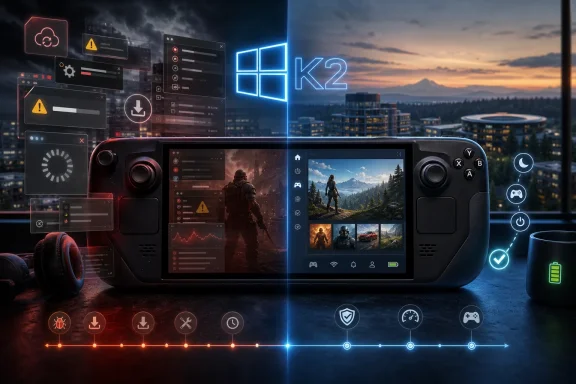
Microsoft has reportedly begun an internal Windows K2 initiative in Redmond to improve Windows 11's gaming performance, reliability, and user experience, treating SteamOS-class efficiency and a slower, quality-first update cadence as the new standard for future Windows development in 2026. That is not a new Windows version so much as a confession that Windows itself has become the bottleneck Microsoft can no longer explain away. For years, Windows gaming’s greatest strength was inevitability: if you played on PC, you played on Windows. K2 matters because it suggests Microsoft finally understands that inevitability is not the same thing as loyalty.
Windows still owns PC gaming by any normal market-share measure. Steam’s hardware survey continues to show Windows as the overwhelming default, with Linux still a small minority despite its recent surge. Game developers target Windows first, GPU vendors tune for it, anti-cheat systems mostly expect it, and every storefront from Steam to Epic to Battle.net to the Xbox app has been built around it.
But market dominance can hide product rot for a long time. The question is not whether Windows runs the most games; it does. The question is whether Windows feels like the best environment for playing them, especially on the new class of handheld PCs where every background process, overlay, update service, driver hiccup, and UI detour costs battery life, frames, or patience.
That is where SteamOS has changed the argument. Valve did not beat Windows by supporting every game, every launcher, and every edge-case peripheral. It beat Windows in the places handheld gaming exposes most brutally: resume behavior, controller-first navigation, low overhead, coherent updates, and the sense that the operating system exists to get out of the way.
This is why the reported Windows K2 initiative lands with more weight than the usual “Windows is getting better for gaming” promise. Microsoft is not facing a raw compatibility crisis. It is facing a confidence crisis, and confidence is much harder to patch.
The Steam Deck changed the psychology of that bargain. It made Linux gaming feel less like a hobbyist workaround and more like a finished consumer experience. Proton did not make every game work, and anti-cheat remains a recurring barrier, but Valve proved that a carefully managed software layer could make PC gaming feel appliance-like without becoming a closed console.
That comparison is brutal for Windows handhelds. On paper, a Windows handheld should be the ultimate compatibility device. In practice, too many of them have shipped feeling like small laptops forced into a console costume, complete with desktop pop-ups, tiny touch targets, clashing vendor utilities, and updates that behave as if the user has all afternoon to babysit firmware, app packages, GPU drivers, and Windows itself.
The result is that SteamOS has become more than an operating system. It has become a benchmark for restraint. It asks a simple question Windows has avoided for too long: what if the best gaming OS is the one the player notices least?
Windows 11 has often seemed caught between two competing mandates. One mandate says the OS must be a stable, boring platform for work, games, schools, enterprises, creators, and developers. The other says it must be a delivery vehicle for Microsoft’s strategic obsessions, especially AI, cloud services, account integration, and monetizable surfaces.
Users can feel when the second mandate wins. They may not phrase it in platform-strategy terms, but they notice when the Start menu changes again, when recommendations creep into system surfaces, when settings move around, when updates require restarts at the wrong time, or when an AI feature receives more executive oxygen than basic performance complaints.
K2 appears to be Microsoft trying to rebalance those incentives. If the reporting is accurate, the company wants a higher bar for changes, more emphasis on fundamentals, and a renewed focus on enthusiasts who once served as Windows’ unpaid evangelists. That is a telling audience to chase, because enthusiasts are often the first to detect when a platform has stopped respecting them.
Microsoft eventually reworked and delayed Recall, adding stronger protections and changing parts of the rollout. But the damage was not limited to Recall itself. The episode reinforced a broader perception that Microsoft had become too willing to bolt ambitious AI experiences onto Windows first and answer basic trust questions second.
For gamers, Recall was not primarily about gaming performance. It was evidence of a product culture problem. If Microsoft could misjudge the privacy optics of a screen-snapshot memory tool, why should users assume it was making careful calls about background services, telemetry, power behavior, or update timing?
This is where K2’s reported quality-first posture becomes meaningful. The point is not that Microsoft should stop building new Windows features. The point is that Windows has to earn the right to add visible layers by proving the invisible layers are under control.
Handheld PCs are not forgiving. They compress the entire Windows experience into a small screen, a controller, a battery, a thermal envelope, and a use case defined by quick sessions. Suddenly, the old Windows assumption — that there is always a keyboard, always a pointer, always a power outlet, always enough performance headroom — collapses.
That is why devices like the ROG Ally, Lenovo Legion Go family, and newer Xbox-branded handheld efforts matter beyond their unit sales. They are stress tests for Windows as a consumer gaming platform. If Windows cannot feel elegant on a handheld, it risks looking like the wrong tool for the next major form factor in PC gaming.
Microsoft has already tried to answer this with Xbox-style full-screen experiences, Game Bar improvements, handheld compatibility work, and Auto Super Resolution efforts. These are real moves, and some are promising. But they still sit on top of Windows, which means the deeper platform has to cooperate.
A launcher shell cannot fully hide a desktop OS that wakes up to do desktop OS things. The update stack, driver model, input system, power management, scheduler, graphics pipeline, and store fragmentation all still matter. K2’s challenge is to fix the floor, not just repaint the lobby.
The recent rollout to Xbox Ally devices also shows why a slower cadence can be healthy. Shipping a feature late is frustrating, but shipping it broken on gaming hardware would be worse. Gamers are not kind to theoretical benefits when the frame-time graph stutters.
Still, Auto SR also illustrates the trap Microsoft must avoid. A splashy feature cannot compensate for an OS that wastes power elsewhere. Upscaling a game while background services chew through battery, notifications interrupt sessions, or driver packages arrive unpredictably is not a holistic gaming strategy.
The best version of K2 would treat Auto SR as one component in a broader discipline. The worst version would use it as another headline feature while leaving the underlying Windows experience just as messy as before. Microsoft has spent too much of the Windows 11 era mistaking feature count for product quality.
That breadth is a competitive moat. It is also why Windows feels heavy. Every subsystem that makes Windows indispensable to one audience can become overhead for another.
For gaming, this creates a design paradox. Microsoft cannot simply strip Windows down into a console OS without losing the openness that makes PC gaming valuable. But if it refuses to create stronger gaming-first modes, better defaults, and cleaner separation between foreground play and background maintenance, it leaves SteamOS to define what modern PC gaming convenience looks like.
The winning path is not to make Windows less Windows. It is to make Windows more context-aware. A gaming handheld in full-screen mode should not behave like an enterprise laptop waiting for policy updates. A desktop in a ranked match should not behave like a productivity workstation between meetings. The OS should understand intent and get quieter accordingly.
Valve did the hard platform work Microsoft once could dismiss as impossible. Proton made compatibility feel ordinary for a huge slice of the Steam catalog. Steam Deck made Linux gaming visible at retail scale. Community distributions like Bazzite showed that players want console-like PC gaming experiences outside Valve’s own hardware.
This puts Microsoft in an uncomfortable position. Windows does not have to lose majority share for the narrative to change. If Linux becomes the place where handheld gaming feels smoother, lighter, and more respectful, then Windows becomes the compatibility fallback rather than the aspirational experience.
That is a dangerous brand inversion. Microsoft wants Windows to be the default because it is best, not merely because everything still supports it. K2 appears to be an attempt to recover that distinction before a small shift in taste becomes a larger shift in developer priorities.
A handheld that gets slightly fewer frames but wakes instantly, updates cleanly, navigates with a controller, suspends reliably, and avoids desktop clutter may feel faster than a technically more compatible device that keeps throwing the user back into Windows maintenance mode. Performance is not just the number in the corner. It is the absence of interruptions.
This is where Windows has historically struggled. It can be extremely fast on the right hardware, with the right driver, in the right game, after the right updates, with the right background state. But gaming devices increasingly compete on predictability, not peak capability.
Microsoft’s K2 work, if real and sustained, should therefore be judged by frame pacing, battery drain, suspend and resume reliability, update friction, input consistency, and how often a player has to leave the gaming shell to fix something. Those are not glamorous benchmarks. They are the benchmarks that decide whether a device feels loved or merely supported.
For years, Microsoft could afford to annoy enthusiasts because the alternatives were weak. macOS was not a general-purpose PC gaming platform. Linux required too many compromises. Consoles were closed. Windows remained the center of gravity.
That has changed just enough to matter. The Steam Deck gave enthusiasts a credible gaming alternative. Apple silicon made macOS performance impossible to ignore, even if gaming support remains uneven. Cloud gaming, console-PC crossplay, and handheld PCs have all blurred the old lines around where play happens.
K2’s reported emphasis on rebuilding trust with fans is not nostalgia. It is risk management. If the people who once defended Windows now recommend Bazzite for handhelds, macOS for laptops, and Windows only when forced, Microsoft has a narrative problem that no Copilot button can solve.
Gamers are not domain admins, but they experience a consumer version of the same pain. They want to know that an update will not break performance the night before a raid, a tournament, a trip, or a long-awaited launch. They want driver improvements without roulette. They want features without surprise regressions.
Microsoft often treats consumer Windows as the place where change can move faster. But gaming is now too large, too competitive, and too hardware-sensitive for that mindset. A Windows handheld is an appliance in the user’s mind, even if it is architecturally a PC.
K2 should borrow more from enterprise discipline than consumer growth hacking. Test more. Stage more carefully. Communicate clearly. Make rollback boring. Treat regressions as trust failures, not merely support tickets.
If Windows feels fast, stable, private, and respectful, AI features can look like useful acceleration. If Windows feels cluttered, pushy, and unpredictable, the same features look like surveillance, overhead, or marketing. The technology may be identical; the trust context changes everything.
That is why K2 may be more important to Microsoft’s AI future than another Copilot demo. Users do not object to intelligence in an operating system when it solves a problem they actually have. They object when intelligence feels like an excuse to add complexity before fixing reliability.
Gaming is a useful proving ground because it is brutally honest. An AI feature that improves performance, reduces latency, or extends battery life will be welcomed. An AI feature that consumes resources, adds prompts, or exists mainly to advertise the platform will be mocked. Gamers do not need Windows to sound futuristic; they need it to stop interrupting the present.
But Xbox cannot merely be a shell. If it is just an app launcher over the same Windows rough edges, users will notice. The more console-like the interface becomes, the more jarring it is when the user is dumped into a desktop dialog, an OEM updater, a Microsoft Store dependency, or a driver panel that expects a mouse.
The deeper question is whether Xbox on Windows can become a standard of behavior. When a device enters gaming mode, background activity should quiet down. Updates should respect sessions. Controller input should work everywhere it reasonably can. Power profiles should become legible. Game installs and cloud saves should feel unified even when stores remain separate.
That is difficult because Windows’ openness means Microsoft cannot control everything. But it can control enough to raise the baseline. K2 will matter if it gives the Xbox layer authority over the parts of Windows that most often ruin the illusion.
To be fair, maintaining Windows at global scale is an absurd engineering challenge. The hardware matrix is vast, the software ecosystem is ancient and alive, and Microsoft has to patch security flaws while preserving compatibility with applications nobody inside Redmond has thought about in years. Nobody should pretend this is easy.
But difficulty does not absolve Microsoft of product judgment. Users do not care that an update pipeline is complex when their game stutters after Patch Tuesday. They do not care that AI is strategically important when the OS feels slower. They do not care that telemetry helps diagnose problems when they feel like unpaid testers.
A slower, higher-quality cadence would be a major cultural correction. Not because fewer updates are inherently better, but because every visible Windows change now arrives against a background of skepticism. Microsoft needs fewer “look what’s new” moments and more “nothing broke” months.
K2 could determine whether that launch feels like a reset or a rebrand. If Microsoft spends the next year making Windows 11 measurably better — quieter, faster, cleaner, less intrusive, more reliable for gaming — then a future Windows release can inherit goodwill. If not, Windows 12 risks being received as another vehicle for features users did not ask for.
The lesson of Windows 11 is that visual polish and hardware requirements do not create trust by themselves. The OS launched with a cleaner look but also with controversial requirements, missing taskbar behaviors, and years of incremental changes that left some users feeling managed rather than empowered. A future Windows has to do better than looking modern.
For gaming, the test is sharper. Windows 12 cannot simply promise better gaming because Windows has always been the gaming OS. It will have to prove that Microsoft has learned from SteamOS, handheld PCs, and the backlash to Windows 11’s more aggressive tendencies.
If a Windows handheld still needs a debloat guide on day one, K2 has not gone far enough. If gamers still postpone updates out of fear, K2 has not gone far enough. If the best advice for a smoother handheld experience remains “install a Linux-based gaming OS,” K2 has not gone far enough.
This does not mean Windows has to beat SteamOS in every test. It probably cannot, given the breadth of Windows’ mission. But it must narrow the experiential gap while preserving the compatibility advantage that made Windows dominant in the first place.
That is the strategic opportunity. Windows does not need to become SteamOS. It needs to become the version of itself that SteamOS has embarrassed it into remembering: fast, flexible, quiet, and centered on the person playing the game.
Microsoft still has the library, the developers, the driver ecosystem, the OEM reach, and the Xbox brand. What it needs now is humility: the willingness to make Windows less needy, less noisy, and less impressed with its own feature roadmap. The future of Windows gaming will not be won by proving that Linux remains smaller or that SteamOS still has compatibility gaps; it will be won if Microsoft can make the default feel deliberate again.
Source: IGN Microsoft Reportedly Kicking Off 'Windows K2' Initiative to Make Windows 11 a Better Operating System for Gaming
 Microsoft’s Gaming Problem Is No Longer About Game Support
Windows still owns PC gaming by any normal market-share measure. Steam’s hardware survey continues to show Windows as the overwhelming default, with Linux still a small minority despite its recent surge. Game developers target Windows first, GPU vendors tune for it, anti-cheat systems mostly expect it, and every storefront from Steam to Epic to Battle.net to the Xbox app has been built around it.But market dominance can hide product rot for a long time. The question is not whether Windows runs the most games; it does. The question is whether Windows feels like the best environment for playing them, especially on the new class of handheld PCs where every background process, overlay, update service, driver hiccup, and UI detour costs battery life, frames, or patience.
That is where SteamOS has changed the argument. Valve did not beat Windows by supporting every game, every launcher, and every edge-case peripheral. It beat Windows in the places handheld gaming exposes most brutally: resume behavior, controller-first navigation, low overhead, coherent updates, and the sense that the operating system exists to get out of the way.
This is why the reported Windows K2 initiative lands with more weight than the usual “Windows is getting better for gaming” promise. Microsoft is not facing a raw compatibility crisis. It is facing a confidence crisis, and confidence is much harder to patch.
SteamOS Turned Efficiency Into a Consumer Feature
For decades, PC gamers tolerated Windows because the bargain was obvious. You got the broadest library, the latest drivers, modding freedom, multiple stores, and full access to the underlying machine. The cost was friction: restarts, background tasks, device-management weirdness, overlays fighting overlays, and settings panes that seemed designed for a keyboard-and-mouse desktop even when the hardware was shaped like a console.The Steam Deck changed the psychology of that bargain. It made Linux gaming feel less like a hobbyist workaround and more like a finished consumer experience. Proton did not make every game work, and anti-cheat remains a recurring barrier, but Valve proved that a carefully managed software layer could make PC gaming feel appliance-like without becoming a closed console.
That comparison is brutal for Windows handhelds. On paper, a Windows handheld should be the ultimate compatibility device. In practice, too many of them have shipped feeling like small laptops forced into a console costume, complete with desktop pop-ups, tiny touch targets, clashing vendor utilities, and updates that behave as if the user has all afternoon to babysit firmware, app packages, GPU drivers, and Windows itself.
The result is that SteamOS has become more than an operating system. It has become a benchmark for restraint. It asks a simple question Windows has avoided for too long: what if the best gaming OS is the one the player notices least?
K2 Is a Philosophy Shift, Not a Product Name
The most important thing about Windows K2, as reported, is that it is not supposed to be a single release with a clean marketing banner. That makes it harder to sell but potentially more important. Microsoft’s problem is not one missing feature; it is the cumulative effect of too many features arriving before the foundation felt trustworthy.Windows 11 has often seemed caught between two competing mandates. One mandate says the OS must be a stable, boring platform for work, games, schools, enterprises, creators, and developers. The other says it must be a delivery vehicle for Microsoft’s strategic obsessions, especially AI, cloud services, account integration, and monetizable surfaces.
Users can feel when the second mandate wins. They may not phrase it in platform-strategy terms, but they notice when the Start menu changes again, when recommendations creep into system surfaces, when settings move around, when updates require restarts at the wrong time, or when an AI feature receives more executive oxygen than basic performance complaints.
K2 appears to be Microsoft trying to rebalance those incentives. If the reporting is accurate, the company wants a higher bar for changes, more emphasis on fundamentals, and a renewed focus on enthusiasts who once served as Windows’ unpaid evangelists. That is a telling audience to chase, because enthusiasts are often the first to detect when a platform has stopped respecting them.
Recall Cast a Long Shadow Over Windows Trust
No recent Windows feature better explains the need for K2 than Recall. Microsoft pitched it as a flagship Copilot+ PC experience: a searchable memory of user activity built from periodic snapshots. The reaction was immediate and predictable, because a feature that records what a user sees on screen is not merely a convenience feature. It is a security, privacy, compliance, and trust event.Microsoft eventually reworked and delayed Recall, adding stronger protections and changing parts of the rollout. But the damage was not limited to Recall itself. The episode reinforced a broader perception that Microsoft had become too willing to bolt ambitious AI experiences onto Windows first and answer basic trust questions second.
For gamers, Recall was not primarily about gaming performance. It was evidence of a product culture problem. If Microsoft could misjudge the privacy optics of a screen-snapshot memory tool, why should users assume it was making careful calls about background services, telemetry, power behavior, or update timing?
This is where K2’s reported quality-first posture becomes meaningful. The point is not that Microsoft should stop building new Windows features. The point is that Windows has to earn the right to add visible layers by proving the invisible layers are under control.
The Handheld PC Exposed Every Windows Compromise
Desktop gaming rigs are forgiving. They have wall power, large monitors, full keyboards, high-TDP CPUs, discrete GPUs, and users who are accustomed to tinkering. A background process that steals a few watts or a settings dialog that needs a mouse is annoying, but it is rarely existential.Handheld PCs are not forgiving. They compress the entire Windows experience into a small screen, a controller, a battery, a thermal envelope, and a use case defined by quick sessions. Suddenly, the old Windows assumption — that there is always a keyboard, always a pointer, always a power outlet, always enough performance headroom — collapses.
That is why devices like the ROG Ally, Lenovo Legion Go family, and newer Xbox-branded handheld efforts matter beyond their unit sales. They are stress tests for Windows as a consumer gaming platform. If Windows cannot feel elegant on a handheld, it risks looking like the wrong tool for the next major form factor in PC gaming.
Microsoft has already tried to answer this with Xbox-style full-screen experiences, Game Bar improvements, handheld compatibility work, and Auto Super Resolution efforts. These are real moves, and some are promising. But they still sit on top of Windows, which means the deeper platform has to cooperate.
A launcher shell cannot fully hide a desktop OS that wakes up to do desktop OS things. The update stack, driver model, input system, power management, scheduler, graphics pipeline, and store fragmentation all still matter. K2’s challenge is to fix the floor, not just repaint the lobby.
Auto SR Shows the Promise and the Trap
Auto Super Resolution is exactly the kind of feature Microsoft wants to showcase in the AI PC era. In theory, it can use local hardware to upscale games and improve performance without every developer manually implementing a game-specific solution. On handhelds and lower-power PCs, that sounds like the right kind of AI: practical, local, measurable, and tied to frames rather than vibes.The recent rollout to Xbox Ally devices also shows why a slower cadence can be healthy. Shipping a feature late is frustrating, but shipping it broken on gaming hardware would be worse. Gamers are not kind to theoretical benefits when the frame-time graph stutters.
Still, Auto SR also illustrates the trap Microsoft must avoid. A splashy feature cannot compensate for an OS that wastes power elsewhere. Upscaling a game while background services chew through battery, notifications interrupt sessions, or driver packages arrive unpredictably is not a holistic gaming strategy.
The best version of K2 would treat Auto SR as one component in a broader discipline. The worst version would use it as another headline feature while leaving the underlying Windows experience just as messy as before. Microsoft has spent too much of the Windows 11 era mistaking feature count for product quality.
Windows’ Strength Is Also Its Drag
It is easy to say Windows should become more like SteamOS, but that understates the difficulty. SteamOS succeeds partly because it has a narrower mission. Windows has to support corporate endpoint security, legacy Win32 applications, obscure peripherals, assistive technologies, multiple storefronts, professional software, developer workflows, and decades of compatibility promises.That breadth is a competitive moat. It is also why Windows feels heavy. Every subsystem that makes Windows indispensable to one audience can become overhead for another.
For gaming, this creates a design paradox. Microsoft cannot simply strip Windows down into a console OS without losing the openness that makes PC gaming valuable. But if it refuses to create stronger gaming-first modes, better defaults, and cleaner separation between foreground play and background maintenance, it leaves SteamOS to define what modern PC gaming convenience looks like.
The winning path is not to make Windows less Windows. It is to make Windows more context-aware. A gaming handheld in full-screen mode should not behave like an enterprise laptop waiting for policy updates. A desktop in a ranked match should not behave like a productivity workstation between meetings. The OS should understand intent and get quieter accordingly.
Linux Does Not Need to Win Big to Hurt Microsoft
The Linux share on Steam remains small compared with Windows, but the direction matters. Passing 5 percent on Steam is not a mass exodus, and it does not mean the average Windows gamer is about to install Arch, Bazzite, or ChimeraOS this weekend. But it does mean the old assumption that Linux gaming is irrelevant has expired.Valve did the hard platform work Microsoft once could dismiss as impossible. Proton made compatibility feel ordinary for a huge slice of the Steam catalog. Steam Deck made Linux gaming visible at retail scale. Community distributions like Bazzite showed that players want console-like PC gaming experiences outside Valve’s own hardware.
This puts Microsoft in an uncomfortable position. Windows does not have to lose majority share for the narrative to change. If Linux becomes the place where handheld gaming feels smoother, lighter, and more respectful, then Windows becomes the compatibility fallback rather than the aspirational experience.
That is a dangerous brand inversion. Microsoft wants Windows to be the default because it is best, not merely because everything still supports it. K2 appears to be an attempt to recover that distinction before a small shift in taste becomes a larger shift in developer priorities.
The Real Benchmark Is Not Average FPS
When people compare Windows and SteamOS, the conversation often collapses into frame rates. That is understandable, because frames are measurable. But the more important metric is experience consistency.A handheld that gets slightly fewer frames but wakes instantly, updates cleanly, navigates with a controller, suspends reliably, and avoids desktop clutter may feel faster than a technically more compatible device that keeps throwing the user back into Windows maintenance mode. Performance is not just the number in the corner. It is the absence of interruptions.
This is where Windows has historically struggled. It can be extremely fast on the right hardware, with the right driver, in the right game, after the right updates, with the right background state. But gaming devices increasingly compete on predictability, not peak capability.
Microsoft’s K2 work, if real and sustained, should therefore be judged by frame pacing, battery drain, suspend and resume reliability, update friction, input consistency, and how often a player has to leave the gaming shell to fix something. Those are not glamorous benchmarks. They are the benchmarks that decide whether a device feels loved or merely supported.
Enthusiasts Became Microsoft’s Warning System
Windows enthusiasts occupy a strange place in Microsoft’s ecosystem. They are not always representative of mainstream users, but they are often early indicators of resentment. When power users complain about bloat, broken defaults, forced account flows, advertising-like surfaces, or AI intrusions, they are usually describing problems that later reach ordinary users in less technical language.For years, Microsoft could afford to annoy enthusiasts because the alternatives were weak. macOS was not a general-purpose PC gaming platform. Linux required too many compromises. Consoles were closed. Windows remained the center of gravity.
That has changed just enough to matter. The Steam Deck gave enthusiasts a credible gaming alternative. Apple silicon made macOS performance impossible to ignore, even if gaming support remains uneven. Cloud gaming, console-PC crossplay, and handheld PCs have all blurred the old lines around where play happens.
K2’s reported emphasis on rebuilding trust with fans is not nostalgia. It is risk management. If the people who once defended Windows now recommend Bazzite for handhelds, macOS for laptops, and Windows only when forced, Microsoft has a narrative problem that no Copilot button can solve.
Enterprise Lessons Apply to Gaming More Than Microsoft Admits
Sysadmins know the cost of update volatility. A patch that fixes one issue but breaks VPN connectivity, printing, authentication, or a line-of-business app can consume more labor than the original vulnerability. That is why enterprises prize rings, deferrals, telemetry, rollback options, and predictability.Gamers are not domain admins, but they experience a consumer version of the same pain. They want to know that an update will not break performance the night before a raid, a tournament, a trip, or a long-awaited launch. They want driver improvements without roulette. They want features without surprise regressions.
Microsoft often treats consumer Windows as the place where change can move faster. But gaming is now too large, too competitive, and too hardware-sensitive for that mindset. A Windows handheld is an appliance in the user’s mind, even if it is architecturally a PC.
K2 should borrow more from enterprise discipline than consumer growth hacking. Test more. Stage more carefully. Communicate clearly. Make rollback boring. Treat regressions as trust failures, not merely support tickets.
The AI PC Needs a Better Windows Before It Needs More AI
Microsoft’s AI ambitions are not going away. Copilot+ PCs, NPUs, local inference, AI-assisted search, image features, and gaming enhancements like Auto SR are now central to the company’s Windows strategy. The problem is that AI features land differently on a platform users already distrust.If Windows feels fast, stable, private, and respectful, AI features can look like useful acceleration. If Windows feels cluttered, pushy, and unpredictable, the same features look like surveillance, overhead, or marketing. The technology may be identical; the trust context changes everything.
That is why K2 may be more important to Microsoft’s AI future than another Copilot demo. Users do not object to intelligence in an operating system when it solves a problem they actually have. They object when intelligence feels like an excuse to add complexity before fixing reliability.
Gaming is a useful proving ground because it is brutally honest. An AI feature that improves performance, reduces latency, or extends battery life will be welcomed. An AI feature that consumes resources, adds prompts, or exists mainly to advertise the platform will be mocked. Gamers do not need Windows to sound futuristic; they need it to stop interrupting the present.
Microsoft Must Decide Whether Xbox Is a Shell or a Standard
The Xbox brand gives Microsoft a way to make Windows gaming feel more coherent. A full-screen Xbox mode, unified library, controller navigation, handheld compatibility labels, cloud saves, Game Pass integration, and system-level performance tuning could become a compelling layer across Windows PCs. In theory, this is Microsoft’s answer to SteamOS.But Xbox cannot merely be a shell. If it is just an app launcher over the same Windows rough edges, users will notice. The more console-like the interface becomes, the more jarring it is when the user is dumped into a desktop dialog, an OEM updater, a Microsoft Store dependency, or a driver panel that expects a mouse.
The deeper question is whether Xbox on Windows can become a standard of behavior. When a device enters gaming mode, background activity should quiet down. Updates should respect sessions. Controller input should work everywhere it reasonably can. Power profiles should become legible. Game installs and cloud saves should feel unified even when stores remain separate.
That is difficult because Windows’ openness means Microsoft cannot control everything. But it can control enough to raise the baseline. K2 will matter if it gives the Xbox layer authority over the parts of Windows that most often ruin the illusion.
The Old Windows Cadence Has Run Out of Excuses
Windows as a service promised continuous improvement. In practice, it often trained users to brace for churn. New features appeared, disappeared, moved, or changed shape; control panels overlapped with Settings; consumer prompts crept into system surfaces; and quality varied enough that even routine updates became objects of suspicion.To be fair, maintaining Windows at global scale is an absurd engineering challenge. The hardware matrix is vast, the software ecosystem is ancient and alive, and Microsoft has to patch security flaws while preserving compatibility with applications nobody inside Redmond has thought about in years. Nobody should pretend this is easy.
But difficulty does not absolve Microsoft of product judgment. Users do not care that an update pipeline is complex when their game stutters after Patch Tuesday. They do not care that AI is strategically important when the OS feels slower. They do not care that telemetry helps diagnose problems when they feel like unpaid testers.
A slower, higher-quality cadence would be a major cultural correction. Not because fewer updates are inherently better, but because every visible Windows change now arrives against a background of skepticism. Microsoft needs fewer “look what’s new” moments and more “nothing broke” months.
Windows 12 Is the Shadow Hanging Over K2
The IGN piece gestures toward Windows 12, and that is the obvious horizon. Microsoft has not needed to rush a new Windows brand while Windows 11 is still absorbing the Windows 10 transition, but the company will eventually want a new banner for AI PCs, new silicon, new security models, and whatever comes next in the Xbox-PC convergence story.K2 could determine whether that launch feels like a reset or a rebrand. If Microsoft spends the next year making Windows 11 measurably better — quieter, faster, cleaner, less intrusive, more reliable for gaming — then a future Windows release can inherit goodwill. If not, Windows 12 risks being received as another vehicle for features users did not ask for.
The lesson of Windows 11 is that visual polish and hardware requirements do not create trust by themselves. The OS launched with a cleaner look but also with controversial requirements, missing taskbar behaviors, and years of incremental changes that left some users feeling managed rather than empowered. A future Windows has to do better than looking modern.
For gaming, the test is sharper. Windows 12 cannot simply promise better gaming because Windows has always been the gaming OS. It will have to prove that Microsoft has learned from SteamOS, handheld PCs, and the backlash to Windows 11’s more aggressive tendencies.
The K2 Scorecard Belongs to Players, Not Microsoft
Microsoft will be tempted to measure K2 by internal quality bars, reduced crash rates, engagement metrics, feature adoption, and partner readiness. Those measures matter, but they are not the whole story. The real scorecard will be written in forums, Discord servers, Steam reviews, YouTube handheld comparisons, and the recommendations enthusiasts give their friends.If a Windows handheld still needs a debloat guide on day one, K2 has not gone far enough. If gamers still postpone updates out of fear, K2 has not gone far enough. If the best advice for a smoother handheld experience remains “install a Linux-based gaming OS,” K2 has not gone far enough.
This does not mean Windows has to beat SteamOS in every test. It probably cannot, given the breadth of Windows’ mission. But it must narrow the experiential gap while preserving the compatibility advantage that made Windows dominant in the first place.
That is the strategic opportunity. Windows does not need to become SteamOS. It needs to become the version of itself that SteamOS has embarrassed it into remembering: fast, flexible, quiet, and centered on the person playing the game.
Redmond’s Gaming Reset Comes Down to a Few Non-Negotiables
The reported K2 initiative gives Microsoft a chance to turn a defensive moment into a platform reset. But the bar is concrete, not poetic; gamers will judge the work by what changes in their hands, not what changes in internal planning decks.- Windows gaming devices need fewer interruptions from updates, background tasks, overlays, and services while a game is running.
- Handheld PCs need a controller-first experience that does not collapse the moment a system dialog, driver utility, or store dependency appears.
- Microsoft needs to treat SteamOS as a usability and efficiency benchmark, not merely as a compatibility rival with a smaller library.
- AI gaming features such as Auto Super Resolution need to produce practical benefits without becoming another layer of resource use or marketing noise.
- The next major Windows release needs to inherit a repaired Windows 11 foundation rather than use a new name to outrun old complaints.
Microsoft still has the library, the developers, the driver ecosystem, the OEM reach, and the Xbox brand. What it needs now is humility: the willingness to make Windows less needy, less noisy, and less impressed with its own feature roadmap. The future of Windows gaming will not be won by proving that Linux remains smaller or that SteamOS still has compatibility gaps; it will be won if Microsoft can make the default feel deliberate again.
Source: IGN Microsoft Reportedly Kicking Off 'Windows K2' Initiative to Make Windows 11 a Better Operating System for Gaming
