

Windows Movie Maker has resurfaced in an unofficial Internet Archive upload, prompting a familiar comparison with Windows 11’s built-in Clipchamp: the old editor may be obsolete, but it remains fundamentally offline-first. Windows Central reports that the Movie Maker 6.0 installer was uploaded on June 30 and has reportedly been tested on Windows 7, Windows 10, and Windows 11.
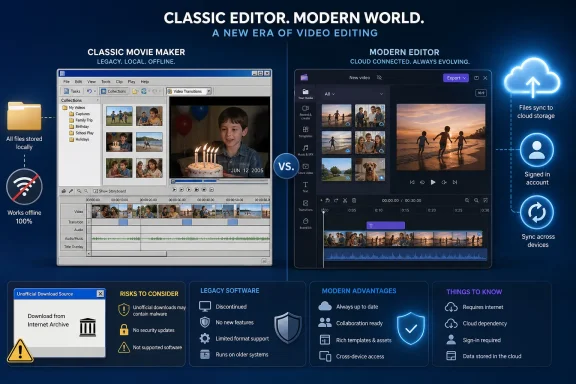
The timing matters because Clipchamp’s storage model has changed. Microsoft now requires personal Clipchamp projects to be saved through OneDrive for continued editing. Source media can still originate on local storage, and Clipchamp processes media locally, but the editable project itself depends on an active OneDrive connection and cloud-backed project files.
That is the practical advantage Movie Maker users remember. A simple home-video project could live in a local folder, be edited without an account or sync service, and remain usable when the PC was offline. It was limited, dated, and never intended for current codecs or high-resolution workflows, but it had few moving parts.
Microsoft describes the OneDrive integration as a way to automatically save projects and make them available across devices. There is a catch: Microsoft’s own troubleshooting guidance says Clipchamp requires OneDrive to be active to create and access personal editing projects. Users can archive project material locally, but that does not restore the old model of opening and editing a wholly local project whenever they want.
For a Windows consumer tool, that is a meaningful distinction. A quick trim, slideshow, screen recording, or family-video assembly job should not necessarily involve a Microsoft account’s cloud-storage entitlement. The requirement is also awkward for machines deliberately kept offline, accounts with constrained OneDrive storage, and admins who disable or tightly manage consumer cloud syncing.
Clipchamp has clear advantages over Movie Maker, including modern templates, effects, stock media, screen recording, AI-assisted features, and support for contemporary export options. Microsoft also positions it as Windows’ official video editor. But those features do not answer the basic request for a lightweight local editor.
That makes it a poor choice for managed environments or users who cannot independently validate an old executable. It also means there will be no security fixes, compatibility guarantees, or support if an installation breaks after a Windows update. Anyone experimenting should scan the file, verify its provenance where possible, and avoid using it for important or sensitive work.
Clipchamp is still the safer supported option, but its OneDrive dependency leaves a gap for Windows users who simply want local, offline video editing.
The timing matters because Clipchamp’s storage model has changed. Microsoft now requires personal Clipchamp projects to be saved through OneDrive for continued editing. Source media can still originate on local storage, and Clipchamp processes media locally, but the editable project itself depends on an active OneDrive connection and cloud-backed project files.
That is the practical advantage Movie Maker users remember. A simple home-video project could live in a local folder, be edited without an account or sync service, and remain usable when the PC was offline. It was limited, dated, and never intended for current codecs or high-resolution workflows, but it had few moving parts.
 Clipchamp’s cloud requirement is the real complaint
Microsoft describes the OneDrive integration as a way to automatically save projects and make them available across devices. There is a catch: Microsoft’s own troubleshooting guidance says Clipchamp requires OneDrive to be active to create and access personal editing projects. Users can archive project material locally, but that does not restore the old model of opening and editing a wholly local project whenever they want.For a Windows consumer tool, that is a meaningful distinction. A quick trim, slideshow, screen recording, or family-video assembly job should not necessarily involve a Microsoft account’s cloud-storage entitlement. The requirement is also awkward for machines deliberately kept offline, accounts with constrained OneDrive storage, and admins who disable or tightly manage consumer cloud syncing.
Clipchamp has clear advantages over Movie Maker, including modern templates, effects, stock media, screen recording, AI-assisted features, and support for contemporary export options. Microsoft also positions it as Windows’ official video editor. But those features do not answer the basic request for a lightweight local editor.
The Movie Maker download comes with a warning
Windows Movie Maker is not back as a supported Microsoft product. Microsoft ended support for Windows Essentials, including Movie Maker, on January 10, 2017, and says downloads offered elsewhere are not sanctioned by the company. The Internet Archive item is a community upload, not a Microsoft-hosted installer.That makes it a poor choice for managed environments or users who cannot independently validate an old executable. It also means there will be no security fixes, compatibility guarantees, or support if an installation breaks after a Windows update. Anyone experimenting should scan the file, verify its provenance where possible, and avoid using it for important or sensitive work.
Clipchamp is still the safer supported option, but its OneDrive dependency leaves a gap for Windows users who simply want local, offline video editing.
References
- Primary source: Windows Central
Published: 2026-07-14T15:00:46+00:00
Windows Movie Maker still beats Clipchamp in an important way | Windows Central
Microsoft’s modern video editor forces you into the cloud, but a nostalgic trip to the Internet Archive offers a better, offline alternative.www.windowscentral.com - Official source: learn.microsoft.com
Where to download original Windows Movie Maker? - Microsoft Q&A
I would like to use the old movie maker to help with making videos. There are a lot of features that I prefer to use.learn.microsoft.com - Related coverage: windowsforum.com
Windows Movie Maker 6.0 Returns on Internet Archive—Community Upload, Real Nostalgia | Windows Forum
A community-uploaded Windows Movie Maker 6.0 installer appeared on the Internet Archive on June 30, 2026, after X user Katie said the classic Microsoft...windowsforum.com - Related coverage: windowsreport.com
Classic Windows Movie Maker Resurfaces for Windows 11 Users
Windows Movie Maker 6.0 has resurfaced online, giving nostalgic users a way to try Microsoft’s classic video editor again. windowsreport.com
- Related coverage: pcworld.com
You can install classic Windows Movie Maker on Windows 11. Here's how | PCWorld
A free download lets you install the classic Windows Movie Maker on Windows 11, and it uses 97 percent less RAM than Clipchamp.www.pcworld.com - Related coverage: etc.usf.edu
What is Windows Movie Maker? » Images » Windows » Tech Ease
What is Windows Movie Maker? » Images » Windows » Tech Ease: NOTE: As of January 10, 2017, Microsoft ceased to support Windows Movie Maker. The Windows Movie Maker application will continue to function, however, and can still be used by those who prefer it. We are maintaining...etc.usf.edu
