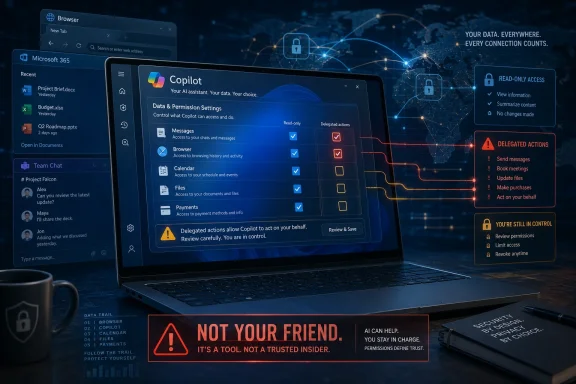
On June 20, 2026, reporting based on a Bloomberg interview amplified Signal Foundation president Meredith Whittaker’s warning that AI chatbots and agents should not be treated as friends, confidants, or trusted custodians of private life. Her argument is not merely that chatbots hallucinate or that people anthropomorphize software too easily. It is that the industry’s preferred future for AI requires the very thing privacy engineering has spent decades trying to minimize: broad, persistent, intimate access to everything a person does on a device.
That is why Whittaker’s warning lands especially hard for Windows users. Microsoft’s Copilot strategy, like Google’s Gemini push and OpenAI’s ChatGPT ecosystem, is no longer just about a text box that answers questions. The destination is an assistant that can see, remember, act, transact, and move across apps — and the moment an assistant becomes an actor, not a tool, the privacy bargain changes.
The consumer AI industry has spent the last three years teaching users to talk to machines as if they were people. The interface is casual, the tone is warm, the branding leans heavily on companionship, and the product pitch increasingly slides from productivity into emotional availability. That has been useful marketing because it lowers the psychological barrier to disclosure.
Whittaker’s objection is that this friendliness is not neutral. A chatbot that feels like a patient listener is also a data interface, and a data interface operated by a platform company is embedded in an economic and technical system with incentives of its own. The issue is not whether a model has feelings. It is whether users behave as if it does, and whether companies benefit when they do.
There is a world of difference between asking a model to reformat a memo and asking it to help process a breakup, plan medical decisions, explain a family dispute, or manage spending. The former is a bounded task. The latter creates a dossier.
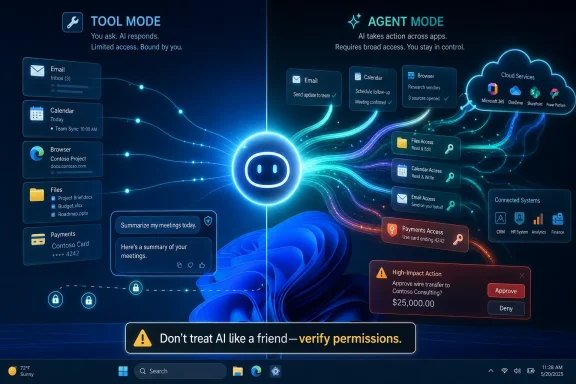
That distinction matters because the industry is trying to graduate from chatbots to agents. A chatbot responds. An agent does. It can book travel, compare insurance, summarize messages, schedule meetings, read screens, manage files, and perhaps one day buy the Christmas gifts Microsoft’s AI leadership has publicly imagined. To perform those jobs well, the agent needs context. Context is the polite product word for access.
But encryption has always had a boundary. It protects data in transit and, depending on implementation, at rest. It does not protect a message after it has been displayed on an unlocked device, copied into another app, captured by malware, exported by a backup tool, or read aloud to an assistant with permission to observe the screen.
That is the threat model Whittaker is pointing at. If an AI assistant sits at the operating-system layer with permission to inspect app content, summarize conversations, and act across services, it can bypass encryption without technically breaking it. The cryptography remains intact, but the privacy guarantee is hollowed out at the endpoint.
For Windows users, this is not an abstract design puzzle. Modern operating systems are increasingly built around cross-app indexing, cloud sync, identity integration, telemetry, screen-aware assistance, and convenience features that blur the line between local computation and remote intelligence. Each feature may be defensible in isolation. In aggregate, they create a surface area that looks very different from the old model of “my app talks securely to your app.”
The backdoor debate usually imagines governments demanding a special key. The agentic AI debate introduces a softer version: users may be nudged into voluntarily granting a general-purpose assistant the practical equivalent of privileged access. That is not a backdoor in the legal sense. It may be worse in the operational sense, because it is normalized as convenience.
There is genuine utility here. Anyone who has used AI well for summarizing a long document, generating a first draft of a script, translating meeting notes into action items, or explaining a confusing error message knows the tool can be useful. The honest critique of AI cannot pretend that the technology is worthless.
But utility is not the same as trustworthiness. The more useful an assistant becomes, the more it wants to know. The more it knows, the more damage it can do if its permissions are too broad, its retention policies too loose, its outputs too confidently wrong, or its surrounding ecosystem too hungry for monetization.
This is the awkward part for Microsoft. Windows is not a toy platform. It is the workbench for schools, hospitals, governments, law firms, factories, engineering teams, small businesses, and home users who have no dedicated security staff. When Microsoft embeds AI affordances into that environment, it is not merely shipping a feature. It is changing the default assumptions of the world’s most widely used desktop operating system.
That does not mean Copilot is malware, nor does it mean every AI feature is a surveillance scheme. It does mean Microsoft has a higher burden than a novelty chatbot vendor. Windows users need to know what is local, what is cloud-processed, what is retained, what is used for training, what an administrator can disable, what a user can delete, and what permissions an assistant actually has.
To buy gifts well, an assistant needs a budget, access to payment methods, knowledge of recipients, shipping addresses, purchase histories, preferences, family relationships, calendars, browser activity, and perhaps private messages that reveal what someone wants or already owns. A human spouse, sibling, or friend might know some of that. A software agent would need to derive it from systems.
That is why Whittaker’s response is so sharp. The transaction is not just “buy a gift.” It is “read enough of my life to infer what gift should be bought, then act using my identity and money.” At that point, the assistant is no longer a clever autocomplete box. It is an authorized intermediary between the user and the world.
Security teams have a name for that kind of power: privilege. Privilege is supposed to be narrow, auditable, revocable, and justified. Consumer AI wants privilege to feel ambient.
The Windows ecosystem has learned this lesson repeatedly. Browser extensions became dangerous when users granted them broad access without understanding the implications. Password managers became high-value targets precisely because they were useful vaults. Remote monitoring tools turned toxic when abused. Macro automation helped offices run — and helped malware spread. Every convenience layer eventually becomes part of the attack surface.
AI agents will be no different. They may be more dangerous because they combine access, interpretation, and action in one package.
That confusion benefits vendors. People disclose more to systems they perceive as sympathetic. They forgive errors more readily when the interface feels conversational. They may accept vague explanations from a chatbot that they would reject from a form, a database, or a call-center script.
The danger is not that the machine secretly has feelings. The danger is that the user does.
This is especially acute with vulnerable users: children, isolated adults, people in distress, workers under pressure, and anyone trying to make sense of a bureaucratic or emotional problem. A chatbot can simulate patience indefinitely. That does not make it a friend, a therapist, a lawyer, a doctor, or a fiduciary.
For IT professionals, the same confusion appears in another form: automation bias. If an AI assistant summarizes an incident, proposes a PowerShell command, recommends a policy change, or interprets a security alert, the output may arrive wrapped in confidence. The human operator may then become a reviewer of machine-generated momentum rather than the author of the decision.
The workplace risk is therefore not only data leakage. It is judgment leakage. Thinking gets outsourced one small convenience at a time.
For writers, developers, analysts, and students, the danger is not that AI produces nothing of value. The danger is that it produces something acceptable quickly enough to crowd out the harder process of forming an original position. A mediocre paragraph delivered instantly can beat a better idea that needs an hour of discomfort to emerge.
Windows power users know this dynamic from every productivity shortcut ever invented. Templates save time, but they also standardize thought. Autocomplete accelerates coding, but it can smuggle in assumptions. Search engines expand knowledge, but they also reward whatever is indexed and optimized.
Generative AI intensifies that pattern because it does not merely retrieve. It synthesizes with the voice of authority. The output often feels like a conclusion even when it is only a remix.
That matters for communities like WindowsForum.com because technical culture depends on the opposite habit: testing, arguing, reproducing, documenting, and refusing to accept a clean answer just because it sounds right. The best forum threads are messy because real troubleshooting is messy. A chatbot summary can be useful, but it should not replace the hard-earned skepticism that keeps systems honest.
Every enterprise AI deployment eventually runs into the same questions. Which data sources can the model reach? Are permissions inherited correctly? Can the assistant surface documents a user technically has access to but should not realistically discover? Are prompts and responses logged? Can administrators audit actions? Does the vendor train on customer data? What happens when a user asks the assistant to summarize private HR material, legal work product, source code, or customer records?
These are not edge cases. They are the deployment.
Microsoft has spent years building compliance, identity, and management controls around its cloud stack, and that gives it advantages over less mature vendors. But the fundamental tension remains. AI becomes more useful when it crosses silos, and enterprise security is built around the disciplined maintenance of silos.
That is why “just use your existing permissions model” is not a complete answer. Existing permissions are often messy, overbroad, inherited from old projects, or tolerated because discovery was difficult. AI changes discovery. It can turn forgotten access into surfaced intelligence.
The result is a new kind of data loss prevention problem. Sensitive information may not be exfiltrated as a file. It may be paraphrased into a chat response, summarized into a meeting brief, or used to support a recommendation that reveals more than the user should know.
That has consequences for Windows management. Administrators will need controls that are more granular than a simple on/off switch. They will need to distinguish between local AI features, cloud-connected assistants, screen analysis, file indexing, cross-app automation, browser context, clipboard access, and the ability to initiate transactions or send messages.
Consumers need a version of the same clarity. A privacy dialog that says an assistant can “improve your experience” is not meaningful consent. A toggle buried under a friendly brand name is not informed control. If the assistant can read messages, inspect pages, remember preferences, or act on the user’s behalf, the interface should say so plainly.
The old permission model is also inadequate because AI permissions are cumulative. A camera permission lets an app use the camera. A contacts permission lets it read contacts. An AI assistant with camera, screen, browser, mail, calendar, files, payments, and memory is not just a bundle of permissions. It is a behavioral map.
Whittaker’s critique is powerful because it reframes AI safety away from science-fiction autonomy and toward ordinary permission creep. The disaster scenario is not necessarily a rogue superintelligence. It is a helpful assistant that everyone installed, everyone trusted, and nobody could fully inspect.
Signal’s model is austere by design. It collects little because it is built around the premise that data not collected cannot be stolen, subpoenaed, mined, repurposed, or fed into a model. That philosophy clashes with the AI industry’s appetite for context. It also clashes with advertising businesses, personalization engines, and cloud platforms that treat data exhaust as strategic fuel.
The mainstream platform companies will argue that users can have both: helpful AI and strong privacy. Sometimes they can. On-device models, minimized retention, enterprise isolation, transparent logging, and strict permission boundaries can reduce risk. But “can” is doing a lot of work.
The business model matters. A company that profits from knowing more about users will face different temptations than a nonprofit messenger built to know almost nothing. A platform that sells productivity subscriptions may have more alignment with customers than an ad network, but even subscription businesses want engagement, lock-in, telemetry, and feature adoption.
That is why users should be wary of privacy promises expressed only in branding language. The meaningful questions are operational. What data enters the system? Where is it processed? Who can access it? How long is it kept? Can it be deleted? Can the feature be disabled without breaking the product? Is the answer different for consumer, business, education, and government accounts?
Cybercriminals do not need a perfect AI agent to cause harm. They need users to become comfortable pasting bank details, one-time codes, personal documents, medical records, or private correspondence into systems they do not understand. They need assistants that make phishing more fluent, scams more personalized, and social engineering cheaper.
The risk is not limited to less mature digital markets. The United States, Europe, India, and Central Asia all face versions of the same problem: consumer convenience is outrunning consumer comprehension. The more an assistant feels like a private helper, the more likely users are to forget that it may be a cloud service governed by terms, policies, logs, integrations, and business incentives.
For diaspora families, cross-border businesses, and multilingual communities, the stakes are even more complicated. AI translation and summarization can be genuinely empowering, especially when official services are hard to navigate. But those same tasks often involve the most sensitive documents people possess.
The safest rule is boring because good security advice usually is: do not give an AI system information you would not be comfortable handing to an unknown service provider. That does not mean never use AI. It means stop pretending the chat window is a diary.
A sensible approach starts by separating low-risk tasks from high-risk ones. Reformatting public text, generating sample code for a toy project, brainstorming names, summarizing non-sensitive documentation, or explaining a generic error message are very different from uploading tax records, private chats, legal documents, unreleased source code, company credentials, or medical histories.
The next step is to treat AI tools like any other privileged software. Review settings. Read enterprise documentation. Disable features that do not fit the environment. Avoid granting blanket access when a narrower workflow will do. Do not confuse a familiar brand with a security review.
In managed Windows environments, administrators should assume users will experiment with AI even when policy says they should not. Shadow AI is the new shadow IT. Blocking everything may be unrealistic, but ignoring it is worse.
The organizations that handle this well will not be the ones with the loudest AI strategy decks. They will be the ones that build clear internal rules, provide approved tools, configure retention and access controls, train users on concrete examples, and audit actual usage. AI governance cannot live in a PDF nobody reads.
AI companies want users to start from desire. Imagine what this could do for you. Imagine how much time it could save. Imagine an assistant that knows you deeply. Privacy advocates want users to start from boundaries. What does it need to know? What can it do? What happens if it is wrong? Who else benefits from this access?
Those are not anti-technology questions. They are engineering questions.
Windows itself became successful because it turned computers into general-purpose tools. The AI industry now wants to place a general-purpose interpreter and actor on top of that general-purpose machine. That may produce real gains. It also demands a seriousness that the “AI friend” marketing language actively undermines.
The right metaphor is not friendship. It is delegation. Delegation requires scope, accountability, and revocation. A friend may know your secrets because of trust. A tool should know only what it needs because of design.
That distinction is the line users and administrators should defend. AI as a formatting engine, search aid, coding helper, accessibility tool, or draft generator can be valuable. AI as an always-on companion with access to identity, money, messages, and memory is a different bargain entirely.
The near-term discipline is simple:
Whittaker’s warning will not stop Microsoft, OpenAI, Google, Anthropic, Meta, or anyone else from racing toward more capable assistants. Nor should the lesson be that AI has no place on Windows machines, phones, or enterprise desktops. The lesson is that the next phase of AI is a permissions fight disguised as a productivity upgrade, and users who understand that now will be better prepared for the moment when the chatbot stops answering from a box and starts asking for the keys.
That is why Whittaker’s warning lands especially hard for Windows users. Microsoft’s Copilot strategy, like Google’s Gemini push and OpenAI’s ChatGPT ecosystem, is no longer just about a text box that answers questions. The destination is an assistant that can see, remember, act, transact, and move across apps — and the moment an assistant becomes an actor, not a tool, the privacy bargain changes.
 The Friendly Chatbot Is the Soft Launch for the Privileged Agent
The consumer AI industry has spent the last three years teaching users to talk to machines as if they were people. The interface is casual, the tone is warm, the branding leans heavily on companionship, and the product pitch increasingly slides from productivity into emotional availability. That has been useful marketing because it lowers the psychological barrier to disclosure.Whittaker’s objection is that this friendliness is not neutral. A chatbot that feels like a patient listener is also a data interface, and a data interface operated by a platform company is embedded in an economic and technical system with incentives of its own. The issue is not whether a model has feelings. It is whether users behave as if it does, and whether companies benefit when they do.
There is a world of difference between asking a model to reformat a memo and asking it to help process a breakup, plan medical decisions, explain a family dispute, or manage spending. The former is a bounded task. The latter creates a dossier.
That distinction matters because the industry is trying to graduate from chatbots to agents. A chatbot responds. An agent does. It can book travel, compare insurance, summarize messages, schedule meetings, read screens, manage files, and perhaps one day buy the Christmas gifts Microsoft’s AI leadership has publicly imagined. To perform those jobs well, the agent needs context. Context is the polite product word for access.
Encryption Protects the Pipe, Not the Person Holding the Phone
Signal’s position in this debate is not incidental. End-to-end encryption is designed around a simple promise: messages are readable by the sender and recipient, not by the service provider or anyone watching the network in between. It is one of the few consumer technologies that gives ordinary people protection against both criminals and institutions.But encryption has always had a boundary. It protects data in transit and, depending on implementation, at rest. It does not protect a message after it has been displayed on an unlocked device, copied into another app, captured by malware, exported by a backup tool, or read aloud to an assistant with permission to observe the screen.
That is the threat model Whittaker is pointing at. If an AI assistant sits at the operating-system layer with permission to inspect app content, summarize conversations, and act across services, it can bypass encryption without technically breaking it. The cryptography remains intact, but the privacy guarantee is hollowed out at the endpoint.
For Windows users, this is not an abstract design puzzle. Modern operating systems are increasingly built around cross-app indexing, cloud sync, identity integration, telemetry, screen-aware assistance, and convenience features that blur the line between local computation and remote intelligence. Each feature may be defensible in isolation. In aggregate, they create a surface area that looks very different from the old model of “my app talks securely to your app.”
The backdoor debate usually imagines governments demanding a special key. The agentic AI debate introduces a softer version: users may be nudged into voluntarily granting a general-purpose assistant the practical equivalent of privileged access. That is not a backdoor in the legal sense. It may be worse in the operational sense, because it is normalized as convenience.
Microsoft’s Copilot Dream Runs Straight Into the Privacy Wall
Microsoft has been clear about its ambition to make Copilot a deeply integrated assistant across Windows, Microsoft 365, Edge, and consumer services. The company’s argument is straightforward: knowledge work is fragmented, users waste time switching contexts, and an assistant that can understand what is on screen or inside a workflow can reduce friction.There is genuine utility here. Anyone who has used AI well for summarizing a long document, generating a first draft of a script, translating meeting notes into action items, or explaining a confusing error message knows the tool can be useful. The honest critique of AI cannot pretend that the technology is worthless.
But utility is not the same as trustworthiness. The more useful an assistant becomes, the more it wants to know. The more it knows, the more damage it can do if its permissions are too broad, its retention policies too loose, its outputs too confidently wrong, or its surrounding ecosystem too hungry for monetization.
This is the awkward part for Microsoft. Windows is not a toy platform. It is the workbench for schools, hospitals, governments, law firms, factories, engineering teams, small businesses, and home users who have no dedicated security staff. When Microsoft embeds AI affordances into that environment, it is not merely shipping a feature. It is changing the default assumptions of the world’s most widely used desktop operating system.
That does not mean Copilot is malware, nor does it mean every AI feature is a surveillance scheme. It does mean Microsoft has a higher burden than a novelty chatbot vendor. Windows users need to know what is local, what is cloud-processed, what is retained, what is used for training, what an administrator can disable, what a user can delete, and what permissions an assistant actually has.
The Christmas-Gift Example Is Not Cute; It Is the Whole Problem
The example of an AI assistant buying Christmas presents sounds charming because it is domestic, low-stakes, and relatable. It also compresses the entire privacy problem into one seemingly harmless errand.To buy gifts well, an assistant needs a budget, access to payment methods, knowledge of recipients, shipping addresses, purchase histories, preferences, family relationships, calendars, browser activity, and perhaps private messages that reveal what someone wants or already owns. A human spouse, sibling, or friend might know some of that. A software agent would need to derive it from systems.
That is why Whittaker’s response is so sharp. The transaction is not just “buy a gift.” It is “read enough of my life to infer what gift should be bought, then act using my identity and money.” At that point, the assistant is no longer a clever autocomplete box. It is an authorized intermediary between the user and the world.
Security teams have a name for that kind of power: privilege. Privilege is supposed to be narrow, auditable, revocable, and justified. Consumer AI wants privilege to feel ambient.
The Windows ecosystem has learned this lesson repeatedly. Browser extensions became dangerous when users granted them broad access without understanding the implications. Password managers became high-value targets precisely because they were useful vaults. Remote monitoring tools turned toxic when abused. Macro automation helped offices run — and helped malware spread. Every convenience layer eventually becomes part of the attack surface.
AI agents will be no different. They may be more dangerous because they combine access, interpretation, and action in one package.
The Real AI Risk Is Not Consciousness but Confusion
Whittaker’s rejection of AI consciousness is more than philosophical housekeeping. It is a practical safety measure. The industry’s loose language around “friends,” “companions,” “reasoning,” and “understanding” encourages users to misread statistical systems as social entities.That confusion benefits vendors. People disclose more to systems they perceive as sympathetic. They forgive errors more readily when the interface feels conversational. They may accept vague explanations from a chatbot that they would reject from a form, a database, or a call-center script.
The danger is not that the machine secretly has feelings. The danger is that the user does.
This is especially acute with vulnerable users: children, isolated adults, people in distress, workers under pressure, and anyone trying to make sense of a bureaucratic or emotional problem. A chatbot can simulate patience indefinitely. That does not make it a friend, a therapist, a lawyer, a doctor, or a fiduciary.
For IT professionals, the same confusion appears in another form: automation bias. If an AI assistant summarizes an incident, proposes a PowerShell command, recommends a policy change, or interprets a security alert, the output may arrive wrapped in confidence. The human operator may then become a reviewer of machine-generated momentum rather than the author of the decision.
The workplace risk is therefore not only data leakage. It is judgment leakage. Thinking gets outsourced one small convenience at a time.
“Average of the Internet” Is a Creative Warning, Not Just an Insult
Whittaker’s reported comment that she does not want machines to do her thinking points to a less discussed cost of generative AI. These systems are good at producing plausible composites of existing language. That is exactly why they are useful for formatting, summarizing, and drafting. It is also why they can flatten taste.For writers, developers, analysts, and students, the danger is not that AI produces nothing of value. The danger is that it produces something acceptable quickly enough to crowd out the harder process of forming an original position. A mediocre paragraph delivered instantly can beat a better idea that needs an hour of discomfort to emerge.
Windows power users know this dynamic from every productivity shortcut ever invented. Templates save time, but they also standardize thought. Autocomplete accelerates coding, but it can smuggle in assumptions. Search engines expand knowledge, but they also reward whatever is indexed and optimized.
Generative AI intensifies that pattern because it does not merely retrieve. It synthesizes with the voice of authority. The output often feels like a conclusion even when it is only a remix.
That matters for communities like WindowsForum.com because technical culture depends on the opposite habit: testing, arguing, reproducing, documenting, and refusing to accept a clean answer just because it sounds right. The best forum threads are messy because real troubleshooting is messy. A chatbot summary can be useful, but it should not replace the hard-earned skepticism that keeps systems honest.
The Enterprise Version of This Problem Is Already Familiar
Corporate IT does not need Whittaker to explain that data access is risk. Administrators live inside that reality every day. The novelty is that AI vendors are asking organizations to relax old instincts in the name of productivity.Every enterprise AI deployment eventually runs into the same questions. Which data sources can the model reach? Are permissions inherited correctly? Can the assistant surface documents a user technically has access to but should not realistically discover? Are prompts and responses logged? Can administrators audit actions? Does the vendor train on customer data? What happens when a user asks the assistant to summarize private HR material, legal work product, source code, or customer records?
These are not edge cases. They are the deployment.
Microsoft has spent years building compliance, identity, and management controls around its cloud stack, and that gives it advantages over less mature vendors. But the fundamental tension remains. AI becomes more useful when it crosses silos, and enterprise security is built around the disciplined maintenance of silos.
That is why “just use your existing permissions model” is not a complete answer. Existing permissions are often messy, overbroad, inherited from old projects, or tolerated because discovery was difficult. AI changes discovery. It can turn forgotten access into surfaced intelligence.
The result is a new kind of data loss prevention problem. Sensitive information may not be exfiltrated as a file. It may be paraphrased into a chat response, summarized into a meeting brief, or used to support a recommendation that reveals more than the user should know.
The Endpoint Becomes the Battlefield Again
For much of the cloud era, security debates focused on servers, identity providers, SaaS platforms, and network controls. AI agents pull attention back to the endpoint. If an assistant can see what the user sees and do what the user does, the endpoint becomes the place where policy either holds or collapses.That has consequences for Windows management. Administrators will need controls that are more granular than a simple on/off switch. They will need to distinguish between local AI features, cloud-connected assistants, screen analysis, file indexing, cross-app automation, browser context, clipboard access, and the ability to initiate transactions or send messages.
Consumers need a version of the same clarity. A privacy dialog that says an assistant can “improve your experience” is not meaningful consent. A toggle buried under a friendly brand name is not informed control. If the assistant can read messages, inspect pages, remember preferences, or act on the user’s behalf, the interface should say so plainly.
The old permission model is also inadequate because AI permissions are cumulative. A camera permission lets an app use the camera. A contacts permission lets it read contacts. An AI assistant with camera, screen, browser, mail, calendar, files, payments, and memory is not just a bundle of permissions. It is a behavioral map.
Whittaker’s critique is powerful because it reframes AI safety away from science-fiction autonomy and toward ordinary permission creep. The disaster scenario is not necessarily a rogue superintelligence. It is a helpful assistant that everyone installed, everyone trusted, and nobody could fully inspect.
Privacy Cannot Survive as a Luxury Setting
One of the uncomfortable implications of Whittaker’s warning is that privacy cannot be treated as a boutique feature for people who know where to click. If the default future of computing is agentic, then privacy has to be architectural.Signal’s model is austere by design. It collects little because it is built around the premise that data not collected cannot be stolen, subpoenaed, mined, repurposed, or fed into a model. That philosophy clashes with the AI industry’s appetite for context. It also clashes with advertising businesses, personalization engines, and cloud platforms that treat data exhaust as strategic fuel.
The mainstream platform companies will argue that users can have both: helpful AI and strong privacy. Sometimes they can. On-device models, minimized retention, enterprise isolation, transparent logging, and strict permission boundaries can reduce risk. But “can” is doing a lot of work.
The business model matters. A company that profits from knowing more about users will face different temptations than a nonprofit messenger built to know almost nothing. A platform that sells productivity subscriptions may have more alignment with customers than an ad network, but even subscription businesses want engagement, lock-in, telemetry, and feature adoption.
That is why users should be wary of privacy promises expressed only in branding language. The meaningful questions are operational. What data enters the system? Where is it processed? Who can access it? How long is it kept? Can it be deleted? Can the feature be disabled without breaking the product? Is the answer different for consumer, business, education, and government accounts?
The Uzbekistan Angle Is Really the Global Angle
The source article’s warning to users in Uzbekistan is worth broadening rather than treating as a local aside. In any country where digital payments, messaging apps, e-government services, and social platforms are rapidly becoming part of daily life, AI assistants introduce a new channel for fraud, coercion, and accidental disclosure.Cybercriminals do not need a perfect AI agent to cause harm. They need users to become comfortable pasting bank details, one-time codes, personal documents, medical records, or private correspondence into systems they do not understand. They need assistants that make phishing more fluent, scams more personalized, and social engineering cheaper.
The risk is not limited to less mature digital markets. The United States, Europe, India, and Central Asia all face versions of the same problem: consumer convenience is outrunning consumer comprehension. The more an assistant feels like a private helper, the more likely users are to forget that it may be a cloud service governed by terms, policies, logs, integrations, and business incentives.
For diaspora families, cross-border businesses, and multilingual communities, the stakes are even more complicated. AI translation and summarization can be genuinely empowering, especially when official services are hard to navigate. But those same tasks often involve the most sensitive documents people possess.
The safest rule is boring because good security advice usually is: do not give an AI system information you would not be comfortable handing to an unknown service provider. That does not mean never use AI. It means stop pretending the chat window is a diary.
The Windows User’s Privacy Problem Is Now a Workflow Problem
For Windows enthusiasts, the practical question is not whether to reject AI wholesale. That train has left the station. The question is how to use it without surrendering the habits that make personal computing personal.A sensible approach starts by separating low-risk tasks from high-risk ones. Reformatting public text, generating sample code for a toy project, brainstorming names, summarizing non-sensitive documentation, or explaining a generic error message are very different from uploading tax records, private chats, legal documents, unreleased source code, company credentials, or medical histories.
The next step is to treat AI tools like any other privileged software. Review settings. Read enterprise documentation. Disable features that do not fit the environment. Avoid granting blanket access when a narrower workflow will do. Do not confuse a familiar brand with a security review.
In managed Windows environments, administrators should assume users will experiment with AI even when policy says they should not. Shadow AI is the new shadow IT. Blocking everything may be unrealistic, but ignoring it is worse.
The organizations that handle this well will not be the ones with the loudest AI strategy decks. They will be the ones that build clear internal rules, provide approved tools, configure retention and access controls, train users on concrete examples, and audit actual usage. AI governance cannot live in a PDF nobody reads.
Whittaker’s Warning Gives Windows Users a Better Default Posture
The most useful part of Whittaker’s intervention is that it restores a healthy default: skepticism. Not panic, not nostalgia, not refusal to touch the new thing. Skepticism.AI companies want users to start from desire. Imagine what this could do for you. Imagine how much time it could save. Imagine an assistant that knows you deeply. Privacy advocates want users to start from boundaries. What does it need to know? What can it do? What happens if it is wrong? Who else benefits from this access?
Those are not anti-technology questions. They are engineering questions.
Windows itself became successful because it turned computers into general-purpose tools. The AI industry now wants to place a general-purpose interpreter and actor on top of that general-purpose machine. That may produce real gains. It also demands a seriousness that the “AI friend” marketing language actively undermines.
The right metaphor is not friendship. It is delegation. Delegation requires scope, accountability, and revocation. A friend may know your secrets because of trust. A tool should know only what it needs because of design.
The Assistant Can Be Useful Without Being Intimate
The immediate lesson is not to uninstall every chatbot or sneer at everyone who uses one. Plenty of serious people use AI in bounded, careful ways. Whittaker herself reportedly allows for narrow utility, such as formatting documents, while rejecting the idea that a model should become a thinking partner or emotional confidant.That distinction is the line users and administrators should defend. AI as a formatting engine, search aid, coding helper, accessibility tool, or draft generator can be valuable. AI as an always-on companion with access to identity, money, messages, and memory is a different bargain entirely.
The near-term discipline is simple:
- Users should avoid entering passwords, payment details, private messages, health records, legal documents, or sensitive work material into consumer chatbots unless they fully understand the service’s data handling rules.
- Administrators should treat AI assistants as privileged applications and manage them with the same seriousness applied to remote access tools, browser extensions, and cloud storage clients.
- Organizations should test whether AI search and summarization expose stale permissions, confidential documents, or information users should not realistically discover.
- Vendors should provide plain-language controls that distinguish local processing, cloud processing, retention, training use, screen access, memory, and cross-app action.
- Everyone should resist language that describes chatbots as friends, therapists, or conscious partners, because that framing encourages precisely the over-disclosure that makes the systems risky.
Whittaker’s warning will not stop Microsoft, OpenAI, Google, Anthropic, Meta, or anyone else from racing toward more capable assistants. Nor should the lesson be that AI has no place on Windows machines, phones, or enterprise desktops. The lesson is that the next phase of AI is a permissions fight disguised as a productivity upgrade, and users who understand that now will be better prepared for the moment when the chatbot stops answering from a box and starts asking for the keys.
References
- Primary source: zamin.uz
Published: 2026-06-20T20:58:17.756804
Signal CEO Warns: AI Chatbots Are Not Your Friends – Zamin.uz, 21.06.2026
Signal messenger president Meredith Whittaker has issued a serious statement regarding the dangers of over-reliance on AI… – Zamin.uz, 21.06.2026zamin.uz - Related coverage: bloomberg.com
- Related coverage: computerworld.com
AI chatbots are not your friends – Computerworld
Lonely people are turning to AI chatbots for friendship and romance, but it's an emotional trap. www.computerworld.com
- Related coverage: windowscentral.com
Mark Zuckerberg says Meta is creating AI friends for humans | Windows Central
Meta CEO Mark Zuckerberg envisions AI friends, enabling social interactions between humans and chatbots.www.windowscentral.com - Related coverage: cyberinsider.com
Signal president warns AI agents are making encryption irrelevant
Signal president Meredith Whittaker said AI agents embedded within operating systems are eroding the practical security guarantees of E2EE.cyberinsider.com - Related coverage: techcrunch.com
Health expert warns of leaning too heavily on AI for social connections | TechCrunch
With the rise of AI companions who serve as online friends or romantic interests, experts are questioning how the technology affects our real-world socialtechcrunch.com