

Microsoft has extended post-quantum cryptography into Active Directory Certificate Services, enabling Windows Server 2025 environments with current updates to issue ML-DSA certificates while Windows also gains hybrid post-quantum TLS key exchange support for future-resistant secure communications. That is more than a checkbox in the crypto stack. It moves the quantum-readiness conversation from academic standards and developer APIs into the certificate machinery that many enterprises use every day. The hard part now is not whether Windows can speak post-quantum cryptography; it is whether organizations can govern, test, and migrate their trust infrastructure without breaking the systems that already depend on it.
For years, post-quantum cryptography has lived in a strange state of urgency without deployment. Security teams were told that quantum computers could someday undermine RSA and elliptic-curve cryptography, while the practical response was mostly to inventory algorithms, watch standards bodies, and wait for vendors to ship something usable. Microsoft’s latest Windows work changes the tone because it touches two places where theory becomes infrastructure: TLS and certificates.
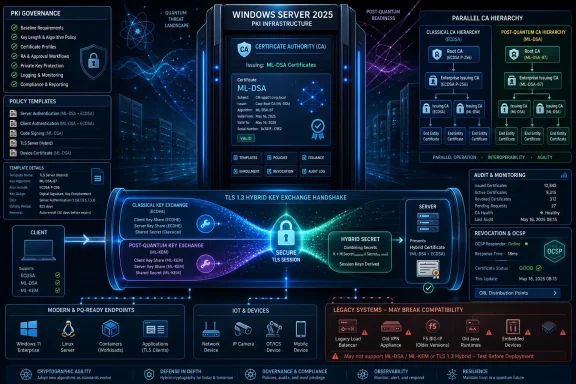
The TLS change is about data in motion. Windows is adding post-quantum TLS hybrid key exchange support to the platform TLS stack, pairing classical key exchange with ML-KEM, the NIST-standardized module-lattice key encapsulation mechanism. The point of a hybrid design is deliberately conservative: keep today’s trusted cryptography while adding a quantum-resistant component, so the connection is not betting everything on a new primitive or an old one.
The ADCS change is about trust itself. Active Directory Certificate Services is the deeply embedded PKI engine behind certificate issuance in many Windows-centric enterprises, from domain authentication and device enrollment to code signing and internal web services. When ADCS can issue ML-DSA certificates, post-quantum cryptography is no longer just an API that developers may choose to call; it becomes part of the enterprise trust fabric administrators already manage.
That distinction matters. A cryptographic algorithm is only useful at scale when it fits into enrollment, templates, revocation, auditing, policy, and lifecycle management. Microsoft is signaling that quantum-safe migration will not be handled as a one-off application rewrite, but as a platform transition that reaches the same consoles, policies, and certificate stores administrators already use.
That is why post-quantum TLS is aimed less at today’s commodity phishing crews and more at long-horizon adversaries. Diplomatic communications, legal archives, health records, intellectual property, source code, military data, and financial transaction histories do not all lose value next quarter. Some secrets have a shelf life measured in careers, patents, litigation windows, or national security cycles.
Classical TLS protects sessions using cryptographic assumptions that remain strong against conventional computers. A sufficiently capable quantum computer running Shor’s algorithm, however, would threaten widely deployed public-key systems such as RSA and elliptic-curve cryptography. Symmetric encryption is affected differently, but the key establishment layer is where the captured-session problem becomes acute.
Hybrid key exchange is the industry’s bridge across that uncertainty. By combining a conventional algorithm such as X25519 or an elliptic-curve group with ML-KEM, Windows can help establish session secrets that are not dependent on a single cryptographic family. If the post-quantum algorithm survives future scrutiny, it protects against quantum attack; if a flaw is found in the newer construction, the classical half still provides the security organizations rely on today.
This is why Microsoft’s choice is more pragmatic than dramatic. The company is not declaring that the quantum apocalypse has arrived. It is saying that migration timelines for large infrastructure are long enough that waiting for a crisis would be irresponsible.
Microsoft’s documentation now frames ADCS post-quantum support around ML-DSA, the NIST-standardized Module-Lattice-Based Digital Signature Algorithm. ML-DSA is for signatures, not encryption or key exchange, which means its first role in ADCS is certificate signing, code signing, authentication certificates, and OCSP response signing. That limitation is important because it prevents a common misunderstanding: ML-DSA certificates do not magically make every encrypted workflow quantum-safe.
The supported ML-DSA parameter sets — ML-DSA-44, ML-DSA-65, and ML-DSA-87 — give administrators different tradeoffs between security margin and certificate size. Higher parameter sets produce larger public keys and signatures, which sounds abstract until those objects begin moving through enrollment agents, certificate stores, smart card workflows, TLS handshakes, monitoring tools, and inspection appliances. Post-quantum cryptography is not free; it shifts costs into bandwidth, storage, processing, compatibility, and operational testing.
The other sober detail is that existing certification authorities cannot simply be upgraded in place to become ML-DSA CAs. Microsoft’s guidance calls for newly installed ML-DSA CAs and encourages parallel hierarchy testing. That may frustrate administrators hoping for a checkbox migration, but it is the safer design. A CA hierarchy is too foundational to mutate casually, especially when relying parties may not yet understand the new algorithms.
This is where the enterprise story becomes familiar. The technology arrives first as a parallel path, then as a pilot, then as a limited production deployment for high-value use cases. The old PKI does not disappear; it coexists with a new one until applications, devices, libraries, middleware, and auditors catch up.
Those are related, but not interchangeable. A TLS session can use a certificate for authentication and a separate key exchange mechanism for deriving encryption keys. If the certificate signature is quantum-vulnerable but the key exchange is hybrid, the session has improved confidentiality against harvest-now-decrypt-later attacks but may still have long-term authentication questions. If the certificate is ML-DSA-signed but the key exchange is classical, the identity proof may be more future-resistant while the captured session could still be at risk.
That is why the transition will be layered. Organizations will need to think in terms of crypto-agility, a phrase that has been overused in security slide decks but is useful here. The goal is not to replace one algorithm with another and declare victory. The goal is to make cryptographic dependencies visible, configurable, replaceable, and testable.
Microsoft’s current Windows trajectory reflects that layered reality. PQC primitives arrived in foundational cryptographic libraries and APIs. Certificate functions gained support for importing, exporting, and validating post-quantum certificates. TLS hybrid key exchange is moving into the Windows TLS stack. ADCS is now beginning to issue post-quantum certificates directly. Each step matters because each removes one more excuse for organizations to postpone serious planning.
The risk is that the marketing version of this story gets ahead of the deployment reality. A Windows environment with PQC-capable APIs is not automatically quantum-safe. A server with an ML-DSA CA is not automatically protecting every application. A hybrid TLS group enabled in a test ring does not mean legacy network devices, proxies, inspection tools, and non-Windows clients are ready for production.
Certificate size is the first practical issue. ML-DSA signatures are much larger than classical ECDSA signatures, and composite certificates can be larger still. That can expose assumptions in software that quietly expected certificates and chains to remain within familiar bounds. The bugs may not appear in Windows itself; they may appear in load balancers, VPN concentrators, Java keystores, mobile device agents, printer firmware, EDR products, or homegrown line-of-business applications.
Protocol negotiation is the second issue. Hybrid TLS depends on both sides of a connection and the path between them tolerating the offered groups and handshake sizes. A modern Windows client and server may behave correctly while an intervening security appliance decides the handshake looks unfamiliar. Enterprises that decrypt and inspect TLS traffic for data loss prevention or threat detection will need to test whether their inspection stack understands the new negotiation patterns.
Trust validation is the third issue. Pure post-quantum certificates require relying parties to understand the post-quantum signature algorithm. Composite approaches require understanding the composite format and validating both components. In a heterogeneous environment, that means Windows readiness is necessary but insufficient. Linux services, Kubernetes ingress controllers, Java runtimes, OpenSSL versions, browsers, mobile operating systems, and embedded devices all become part of the same migration map.
This is why Microsoft’s emphasis on familiar management tools is important but not decisive. Group Policy, MDM, Intune, PowerShell, CNG, and certificate templates can make Windows deployment manageable. They cannot make the rest of the enterprise ecosystem magically compatible. The value of native Windows support is that it gives administrators a controlled place to start.
Code signing is one logical early test because it has long-lived trust implications. Software signed today may need to be trusted years from now, and signature forgery in a future quantum scenario would be catastrophic for supply-chain integrity. But code signing also has complex verification paths, timestamping considerations, build-system integrations, and endpoint enforcement rules. That makes it a useful proving ground precisely because it will reveal hidden dependencies.
Internal TLS is another candidate, especially for services that protect sensitive long-lived data. The trick is to separate internet-facing experimentation from controlled internal pilots. A lab web service using ML-DSA certificates and hybrid TLS can teach administrators a great deal without exposing customers or critical workflows to compatibility failures.
OCSP and revocation workflows deserve special attention. Certificates are only as operationally useful as the systems that can validate their status. If an organization can issue ML-DSA certificates but cannot reliably publish, sign, retrieve, and validate revocation information, it has built a demo rather than a PKI.
The newness of the standards also argues for restraint. NIST has standardized key post-quantum algorithms, but deployment profiles, protocol conventions, composite formats, and vendor support are still maturing. Early adopters should treat this phase as engineering reconnaissance: find the edges, document the failures, and build organizational muscle before compliance pressure or threat intelligence forces a rushed migration.
That is the significance of putting PQC into CNG and certificate functions. Developers who build for Windows should not need to bundle experimental cryptographic libraries for every use case. Administrators should not need a separate PKI product just to begin testing post-quantum certificate issuance. Security teams should not need to choose between theoretical readiness and operational manageability.
There is also a governance angle. Enterprises do not migrate cryptography one application at a time because a security architect read a good paper. They migrate when platform vendors, auditors, regulators, cloud providers, and procurement requirements converge. Native Windows support gives procurement and compliance teams something concrete to ask vendors: Do you support ML-DSA certificates? Do you tolerate hybrid TLS groups? Do your agents validate post-quantum chains? Do your appliances break when certificate sizes increase?
That pressure will matter. Many organizations still do not have a complete inventory of where public-key cryptography is used. Certificates appear in web servers, Wi-Fi authentication, VPNs, device management, email protection, database connections, container registries, signing pipelines, RDP gateways, SCEP enrollment, and third-party SaaS integrations. The post-quantum migration will punish teams that treat PKI as a background service rather than a living dependency graph.
Microsoft can make the Windows side easier, but it cannot remove the need for discovery. The organizations that benefit most from these features will be the ones that use the preview and early availability period to build inventories, test policies, and identify brittle systems. The organizations that wait for a regulatory deadline will discover, as always, that cryptography is easy to mandate and hard to retrofit.
Microsoft’s implementation follows the industry’s broad preference for hybrid transition strategies. That is sensible because cryptographic history teaches humility. New algorithms need deployment experience, analysis, and time. Classical algorithms are threatened by future quantum computers, but they are also deeply studied and operationally proven. Hybrid designs acknowledge both realities.
Composite certificates sit in the same philosophical space. By combining classical and post-quantum signatures, they can preserve confidence as ecosystems transition. The tradeoff is complexity. Relying parties must understand the composite format, validate the components correctly, and avoid downgrade or policy confusion. In security engineering, “both must validate” is a strong property only if every implementation agrees on what both means.
There is also a policy question that enterprises will need to settle internally. Which systems require quantum-safe treatment first? Which data has a confidentiality lifetime long enough to justify early migration? Which certificates need post-quantum signatures because their trust period extends far into the future? Which legacy systems are too fragile to touch until vendors update them?
Those questions are not answered by Microsoft shipping support. They are answered by risk owners, architects, administrators, developers, and procurement teams working from a shared inventory. The product feature is the opening move, not the migration plan.
That is how cryptographic transitions become real. TLS 1.2, TLS 1.3, SHA-1 deprecation, certificate lifetime reductions, and stronger code-signing requirements all followed the same broad pattern. First comes the standards work, then platform support, then early incompatibilities, then policy pressure, then reluctant cleanup of forgotten systems.
The difference this time is that the threat is prospective rather than immediately observable for most defenders. No administrator can point to a practical large-scale quantum attack against their internal PKI today. That makes postponement tempting. But the harvest-now-decrypt-later model weakens the usual excuse because the damage may be created before the breaking capability exists.
Windows admins should therefore treat PQC as a continuity project, not an emergency patch. It belongs beside identity modernization, backup resilience, certificate hygiene, and incident response readiness. The most valuable work in 2026 may be the least flashy: knowing which certificates exist, what they protect, how long the data must remain confidential, and which systems will break when cryptography changes.
 Microsoft Moves Quantum Readiness Out of the Lab
For years, post-quantum cryptography has lived in a strange state of urgency without deployment. Security teams were told that quantum computers could someday undermine RSA and elliptic-curve cryptography, while the practical response was mostly to inventory algorithms, watch standards bodies, and wait for vendors to ship something usable. Microsoft’s latest Windows work changes the tone because it touches two places where theory becomes infrastructure: TLS and certificates.The TLS change is about data in motion. Windows is adding post-quantum TLS hybrid key exchange support to the platform TLS stack, pairing classical key exchange with ML-KEM, the NIST-standardized module-lattice key encapsulation mechanism. The point of a hybrid design is deliberately conservative: keep today’s trusted cryptography while adding a quantum-resistant component, so the connection is not betting everything on a new primitive or an old one.
The ADCS change is about trust itself. Active Directory Certificate Services is the deeply embedded PKI engine behind certificate issuance in many Windows-centric enterprises, from domain authentication and device enrollment to code signing and internal web services. When ADCS can issue ML-DSA certificates, post-quantum cryptography is no longer just an API that developers may choose to call; it becomes part of the enterprise trust fabric administrators already manage.
That distinction matters. A cryptographic algorithm is only useful at scale when it fits into enrollment, templates, revocation, auditing, policy, and lifecycle management. Microsoft is signaling that quantum-safe migration will not be handled as a one-off application rewrite, but as a platform transition that reaches the same consoles, policies, and certificate stores administrators already use.
The Real Threat Is Stored Traffic With a Long Memory
The phrase harvest now, decrypt later can sound like vendor theater until you map it to actual data. An attacker who records encrypted traffic today may not need to break it today. If the information remains valuable for years or decades, the attacker only needs cryptographic progress to arrive before the data’s secrecy expires.That is why post-quantum TLS is aimed less at today’s commodity phishing crews and more at long-horizon adversaries. Diplomatic communications, legal archives, health records, intellectual property, source code, military data, and financial transaction histories do not all lose value next quarter. Some secrets have a shelf life measured in careers, patents, litigation windows, or national security cycles.
Classical TLS protects sessions using cryptographic assumptions that remain strong against conventional computers. A sufficiently capable quantum computer running Shor’s algorithm, however, would threaten widely deployed public-key systems such as RSA and elliptic-curve cryptography. Symmetric encryption is affected differently, but the key establishment layer is where the captured-session problem becomes acute.
Hybrid key exchange is the industry’s bridge across that uncertainty. By combining a conventional algorithm such as X25519 or an elliptic-curve group with ML-KEM, Windows can help establish session secrets that are not dependent on a single cryptographic family. If the post-quantum algorithm survives future scrutiny, it protects against quantum attack; if a flaw is found in the newer construction, the classical half still provides the security organizations rely on today.
This is why Microsoft’s choice is more pragmatic than dramatic. The company is not declaring that the quantum apocalypse has arrived. It is saying that migration timelines for large infrastructure are long enough that waiting for a crisis would be irresponsible.
ADCS Is Where the Announcement Becomes Enterprise Reality
The ADCS portion of the news is the more consequential piece for many Windows shops because certificates are where cryptographic intent becomes operational dependency. An internal CA is not just a signing box. It is a policy authority, an identity factory, a compliance artifact, and often a single point of organizational muscle memory.Microsoft’s documentation now frames ADCS post-quantum support around ML-DSA, the NIST-standardized Module-Lattice-Based Digital Signature Algorithm. ML-DSA is for signatures, not encryption or key exchange, which means its first role in ADCS is certificate signing, code signing, authentication certificates, and OCSP response signing. That limitation is important because it prevents a common misunderstanding: ML-DSA certificates do not magically make every encrypted workflow quantum-safe.
The supported ML-DSA parameter sets — ML-DSA-44, ML-DSA-65, and ML-DSA-87 — give administrators different tradeoffs between security margin and certificate size. Higher parameter sets produce larger public keys and signatures, which sounds abstract until those objects begin moving through enrollment agents, certificate stores, smart card workflows, TLS handshakes, monitoring tools, and inspection appliances. Post-quantum cryptography is not free; it shifts costs into bandwidth, storage, processing, compatibility, and operational testing.
The other sober detail is that existing certification authorities cannot simply be upgraded in place to become ML-DSA CAs. Microsoft’s guidance calls for newly installed ML-DSA CAs and encourages parallel hierarchy testing. That may frustrate administrators hoping for a checkbox migration, but it is the safer design. A CA hierarchy is too foundational to mutate casually, especially when relying parties may not yet understand the new algorithms.
This is where the enterprise story becomes familiar. The technology arrives first as a parallel path, then as a pilot, then as a limited production deployment for high-value use cases. The old PKI does not disappear; it coexists with a new one until applications, devices, libraries, middleware, and auditors catch up.
Hybrid TLS Solves a Different Problem Than Post-Quantum Certificates
It is tempting to treat “post-quantum Windows” as one feature, but TLS hybrid key exchange and ADCS ML-DSA issuance address different layers of the stack. TLS hybrid key exchange protects the establishment of session secrets for data in transit. ML-DSA certificates provide quantum-resistant digital signatures for identity and trust validation.Those are related, but not interchangeable. A TLS session can use a certificate for authentication and a separate key exchange mechanism for deriving encryption keys. If the certificate signature is quantum-vulnerable but the key exchange is hybrid, the session has improved confidentiality against harvest-now-decrypt-later attacks but may still have long-term authentication questions. If the certificate is ML-DSA-signed but the key exchange is classical, the identity proof may be more future-resistant while the captured session could still be at risk.
That is why the transition will be layered. Organizations will need to think in terms of crypto-agility, a phrase that has been overused in security slide decks but is useful here. The goal is not to replace one algorithm with another and declare victory. The goal is to make cryptographic dependencies visible, configurable, replaceable, and testable.
Microsoft’s current Windows trajectory reflects that layered reality. PQC primitives arrived in foundational cryptographic libraries and APIs. Certificate functions gained support for importing, exporting, and validating post-quantum certificates. TLS hybrid key exchange is moving into the Windows TLS stack. ADCS is now beginning to issue post-quantum certificates directly. Each step matters because each removes one more excuse for organizations to postpone serious planning.
The risk is that the marketing version of this story gets ahead of the deployment reality. A Windows environment with PQC-capable APIs is not automatically quantum-safe. A server with an ML-DSA CA is not automatically protecting every application. A hybrid TLS group enabled in a test ring does not mean legacy network devices, proxies, inspection tools, and non-Windows clients are ready for production.
The Compatibility Tax Will Be Paid in Old Appliances and Forgotten Apps
Every major cryptographic transition eventually runs into the same graveyard: unsupported clients, brittle middleware, TLS interception boxes, firmware that never gets updated, and enterprise applications whose vendor disappeared five years ago. Post-quantum cryptography will be no different, except the objects are larger and the ecosystem is less mature.Certificate size is the first practical issue. ML-DSA signatures are much larger than classical ECDSA signatures, and composite certificates can be larger still. That can expose assumptions in software that quietly expected certificates and chains to remain within familiar bounds. The bugs may not appear in Windows itself; they may appear in load balancers, VPN concentrators, Java keystores, mobile device agents, printer firmware, EDR products, or homegrown line-of-business applications.
Protocol negotiation is the second issue. Hybrid TLS depends on both sides of a connection and the path between them tolerating the offered groups and handshake sizes. A modern Windows client and server may behave correctly while an intervening security appliance decides the handshake looks unfamiliar. Enterprises that decrypt and inspect TLS traffic for data loss prevention or threat detection will need to test whether their inspection stack understands the new negotiation patterns.
Trust validation is the third issue. Pure post-quantum certificates require relying parties to understand the post-quantum signature algorithm. Composite approaches require understanding the composite format and validating both components. In a heterogeneous environment, that means Windows readiness is necessary but insufficient. Linux services, Kubernetes ingress controllers, Java runtimes, OpenSSL versions, browsers, mobile operating systems, and embedded devices all become part of the same migration map.
This is why Microsoft’s emphasis on familiar management tools is important but not decisive. Group Policy, MDM, Intune, PowerShell, CNG, and certificate templates can make Windows deployment manageable. They cannot make the rest of the enterprise ecosystem magically compatible. The value of native Windows support is that it gives administrators a controlled place to start.
ADCS Administrators Get a Pilot Project, Not a Mandate
For most organizations, the right response is not to rebuild the production PKI this quarter. It is to create a credible test path. That means standing up a parallel CA hierarchy, issuing ML-DSA certificates for constrained scenarios, measuring compatibility, and documenting where certificate validation fails.Code signing is one logical early test because it has long-lived trust implications. Software signed today may need to be trusted years from now, and signature forgery in a future quantum scenario would be catastrophic for supply-chain integrity. But code signing also has complex verification paths, timestamping considerations, build-system integrations, and endpoint enforcement rules. That makes it a useful proving ground precisely because it will reveal hidden dependencies.
Internal TLS is another candidate, especially for services that protect sensitive long-lived data. The trick is to separate internet-facing experimentation from controlled internal pilots. A lab web service using ML-DSA certificates and hybrid TLS can teach administrators a great deal without exposing customers or critical workflows to compatibility failures.
OCSP and revocation workflows deserve special attention. Certificates are only as operationally useful as the systems that can validate their status. If an organization can issue ML-DSA certificates but cannot reliably publish, sign, retrieve, and validate revocation information, it has built a demo rather than a PKI.
The newness of the standards also argues for restraint. NIST has standardized key post-quantum algorithms, but deployment profiles, protocol conventions, composite formats, and vendor support are still maturing. Early adopters should treat this phase as engineering reconnaissance: find the edges, document the failures, and build organizational muscle before compliance pressure or threat intelligence forces a rushed migration.
The Windows Platform Is Becoming the Migration Vehicle
Microsoft’s advantage in this transition is not that it invented post-quantum cryptography. It is that Windows sits at an unusually powerful junction of enterprise identity, endpoint management, server workloads, and developer APIs. If the company can make PQC available through normal Windows abstractions, it can reduce the number of bespoke migrations customers must perform.That is the significance of putting PQC into CNG and certificate functions. Developers who build for Windows should not need to bundle experimental cryptographic libraries for every use case. Administrators should not need a separate PKI product just to begin testing post-quantum certificate issuance. Security teams should not need to choose between theoretical readiness and operational manageability.
There is also a governance angle. Enterprises do not migrate cryptography one application at a time because a security architect read a good paper. They migrate when platform vendors, auditors, regulators, cloud providers, and procurement requirements converge. Native Windows support gives procurement and compliance teams something concrete to ask vendors: Do you support ML-DSA certificates? Do you tolerate hybrid TLS groups? Do your agents validate post-quantum chains? Do your appliances break when certificate sizes increase?
That pressure will matter. Many organizations still do not have a complete inventory of where public-key cryptography is used. Certificates appear in web servers, Wi-Fi authentication, VPNs, device management, email protection, database connections, container registries, signing pipelines, RDP gateways, SCEP enrollment, and third-party SaaS integrations. The post-quantum migration will punish teams that treat PKI as a background service rather than a living dependency graph.
Microsoft can make the Windows side easier, but it cannot remove the need for discovery. The organizations that benefit most from these features will be the ones that use the preview and early availability period to build inventories, test policies, and identify brittle systems. The organizations that wait for a regulatory deadline will discover, as always, that cryptography is easy to mandate and hard to retrofit.
The Standards Are Settling, but the Deployment Story Is Still Young
NIST’s standardization of ML-KEM and ML-DSA gave vendors the confidence to move from experiments to implementation. That was the necessary first step. The next phase is less glamorous: deciding how these algorithms appear in certificates, TLS handshakes, APIs, management consoles, and audit evidence.Microsoft’s implementation follows the industry’s broad preference for hybrid transition strategies. That is sensible because cryptographic history teaches humility. New algorithms need deployment experience, analysis, and time. Classical algorithms are threatened by future quantum computers, but they are also deeply studied and operationally proven. Hybrid designs acknowledge both realities.
Composite certificates sit in the same philosophical space. By combining classical and post-quantum signatures, they can preserve confidence as ecosystems transition. The tradeoff is complexity. Relying parties must understand the composite format, validate the components correctly, and avoid downgrade or policy confusion. In security engineering, “both must validate” is a strong property only if every implementation agrees on what both means.
There is also a policy question that enterprises will need to settle internally. Which systems require quantum-safe treatment first? Which data has a confidentiality lifetime long enough to justify early migration? Which certificates need post-quantum signatures because their trust period extends far into the future? Which legacy systems are too fragile to touch until vendors update them?
Those questions are not answered by Microsoft shipping support. They are answered by risk owners, architects, administrators, developers, and procurement teams working from a shared inventory. The product feature is the opening move, not the migration plan.
The First Quantum-Safe Windows Projects Should Be Boring
The best early deployments will not look heroic. They will look like careful Windows administration. A small lab hierarchy. A few ML-DSA templates. A test web service. A code-signing experiment. A client ring running the required Windows builds. A packet capture. A failed appliance. A vendor ticket. A revised policy.That is how cryptographic transitions become real. TLS 1.2, TLS 1.3, SHA-1 deprecation, certificate lifetime reductions, and stronger code-signing requirements all followed the same broad pattern. First comes the standards work, then platform support, then early incompatibilities, then policy pressure, then reluctant cleanup of forgotten systems.
The difference this time is that the threat is prospective rather than immediately observable for most defenders. No administrator can point to a practical large-scale quantum attack against their internal PKI today. That makes postponement tempting. But the harvest-now-decrypt-later model weakens the usual excuse because the damage may be created before the breaking capability exists.
Windows admins should therefore treat PQC as a continuity project, not an emergency patch. It belongs beside identity modernization, backup resilience, certificate hygiene, and incident response readiness. The most valuable work in 2026 may be the least flashy: knowing which certificates exist, what they protect, how long the data must remain confidential, and which systems will break when cryptography changes.
The Practical WindowsForum Read on Microsoft’s Quantum Turn
Microsoft’s announcement is important because it gives Windows-heavy organizations a native place to begin, but it should be read as the start of a migration era rather than the end of a security problem. The concrete value is not instant quantum immunity. It is that administrators can now test post-quantum certificates and hybrid TLS behavior inside the management model they already know.- Windows Server 2025 environments with the required updates can begin evaluating ADCS support for ML-DSA certificate issuance through newly built CA hierarchies.
- Existing certification authorities should not be treated as in-place upgrade candidates for post-quantum signing; parallel PKI testing is the safer path.
- Hybrid TLS key exchange addresses long-term confidentiality risks for data in transit, while ML-DSA certificates address post-quantum digital signatures and trust validation.
- ML-DSA is a signature algorithm, so it does not replace ML-KEM or other key-establishment mechanisms for encrypted session protection.
- Larger keys, larger signatures, and newer certificate formats will expose compatibility issues in legacy applications, appliances, agents, and non-Windows systems.
- The organizations best positioned for quantum-safe migration will be the ones that inventory cryptographic dependencies before regulators, customers, or incidents force the issue.
References
- Primary source: Quantum Zeitgeist
Published: 2026-06-04T07:40:28.099064
ADCS Now Generates Post-Quantum Certificates For Windows
ADCS Now Generates Post-Quantum Certificates for Windows. Read the full story at Quantum Zeitgeist.quantumzeitgeist.com - Official source: learn.microsoft.com
Post-Quantum Cryptography in AD CS overview - Windows Server | Microsoft Learn
Learn about Post-Quantum Cryptography support in Active Directory Certificate Services, including algorithms available today and those planned for future releases.learn.microsoft.com - Official source: techcommunity.microsoft.com
Post-Quantum Cryptography Comes to Windows Insiders and Linux | Microsoft Community Hub
Introduction As the digital landscape continues to evolve, the emergence of quantum computing presents both significant opportunities and challenges.... techcommunity.microsoft.com
- Official source: microsoft.com
Post-Quantum TLS - Microsoft Research
Given the importance of TLS and its vulnerability to future quantum attacks, it is important to begin to plan for post-quantum TLS.www.microsoft.com - Related coverage: techradar.com
What the post-quantum shift means for your security strategy | TechRadar
Preparing TLS security for the post-quantum erawww.techradar.com
