

On May 3, 2026, The Register used its Kettle podcast to argue that Microsoft’s recent Windows troubles — aggressive Copilot promotion, second-chance setup prompts, buggy patches, and user-hostile product decisions — have forced Satya Nadella and Windows chief Pavan Davuluri into a public reset. The real story is not that Microsoft has annoyed users before; it is that the irritation now cuts across consumers, gamers, developers, and enterprise administrators at the same time. Redmond is promising to return to fundamentals, but fundamentals are precisely what its most loyal customers believe have been sacrificed.
Microsoft’s problem is not a single bad update, a single AI feature, or a single tone-deaf prompt. It is accumulation. Windows users have spent years being told that the next layer of Microsoft integration would be useful, optional, intelligent, and respectful, only to find that “optional” often means “declinable for now,” and “intelligent” often means “another place where Copilot appears before the user asked for it.”
That is why the latest mea culpa lands with a thud as much as a promise. Nadella’s reported language about doing foundational work to “win back fans” is unusually frank by Microsoft standards, but it also confirms what many users have been saying for months: the company has been losing the plot at the level of everyday trust.
Windows is not merely another Microsoft product. It is the company’s civic infrastructure, the operating layer beneath schools, small businesses, hospitals, studios, home PCs, labs, and government offices. When Microsoft treats that layer as an advertising surface, an AI distribution channel, or an experiment in forced engagement, users do not experience it as strategy. They experience it as trespass.
The frustration is sharper because Microsoft knows better. This is the company that rebuilt its developer reputation with Visual Studio Code, GitHub, Windows Subsystem for Linux, and a more pragmatic approach to open source. It learned, at least for a while, that goodwill compounds. Now Windows users are watching that goodwill get spent like a marketing budget.
There is nothing inherently wrong with AI assistance in an operating system. A genuinely useful local assistant that can change settings, summarize documents with consent, automate repetitive tasks, and respect boundaries would be a meaningful evolution of the desktop. The backlash is not against intelligence. It is against presumption.
Microsoft’s Copilot strategy has often felt less like adding a tool and more like converting Windows into a funnel. The company has repeatedly blurred the distinction between an operating system feature, a cloud service, a subscription upsell, and a brand campaign. That may make sense in a quarterly product review. It makes less sense to the person who just wants File Explorer to stop misbehaving.
The company appears to have recognized at least part of the damage. Reports that Windows leadership is reconsidering “unnecessary” Copilot appearances are important because they concede the central point: not every text box, context menu, or legacy app needs to be an AI beachhead. Sometimes Notepad should be Notepad. Sometimes Paint should be Paint.
But restraint is harder than rollout. Microsoft’s internal incentives still favor visible AI insertion because AI is where investor attention, product roadmaps, and executive messaging converge. Pulling back from that instinct requires more than a blog post. It requires product managers to be rewarded for not shipping the prompt, not adding the button, and not hijacking a workflow that already worked.
This matters because setup is not a neutral moment. The user is trying to get into their machine. Microsoft is trying to shape the account model, cloud attachment, telemetry posture, browser defaults, backup behavior, and service adoption of that machine. The conflict is obvious, and users are not imagining it.
Windows 11 already lives under a cloud of suspicion around Microsoft account pressure, Edge nudges, default app friction, OneDrive prompts, and “recommended” experiences that just happen to align with Microsoft’s commercial priorities. The second-chance prompt is not outrageous in isolation. It is outrageous because it arrives in a long line of prompts that train users to distrust the word “recommended.”
Enterprise administrators see the same pattern through a different lens. A consumer may grumble and click past a prompt. An IT department has to document it, suppress it, explain it, test it, and reassure users that the standard image has not been tampered with. In managed environments, Microsoft’s enthusiasm becomes someone else’s ticket queue.
That is the hidden tax in modern Windows administration. Every clever nudge from Redmond becomes a help desk article, a policy review, a registry hunt, an Intune setting, or a PowerShell workaround. Microsoft can call these experiences engagement. Admins call them drift.
Windows servicing has always involved tradeoffs. The ecosystem is vast, hardware diversity is brutal, drivers are uneven, and the security threat landscape gives Microsoft little room to delay fixes indefinitely. No serious observer should pretend that shipping monthly updates to hundreds of millions of PCs is easy.
But that argument only goes so far. Microsoft has spent years moving Windows toward continuous delivery, cumulative updates, feature enablement packages, cloud-tuned rollouts, and telemetry-informed remediation. The bargain was that this model would make Windows more secure and more responsive without turning users into unpaid beta testers. When update regressions pile up, the bargain looks broken.
The most damaging bugs are not always the most widespread. A recovery environment input failure, a Remote Desktop regression, or a compatibility block affecting a specific class of devices may hit a minority of users, but it hits precisely the kind of users who maintain the trust fabric around Windows: admins, power users, repair technicians, enthusiasts, and business support teams. Those people are the informal sales force for the platform. They are also the first to notice when the floorboards creak.
Microsoft’s official known-issues pages are more transparent than the bad old days, and Known Issue Rollback has been a meaningful improvement. But transparency after the fact is not the same as confidence before deployment. The test for Windows quality is not whether Microsoft can publish a workaround. It is whether administrators feel safe installing the update without spending the morning reading forums like a storm forecast.
In that environment, every Windows 11 annoyance carries extra weight. Users are not simply evaluating a new operating system on its merits. Many feel they are being pushed off an operating system they liked and onto one that nags more, changes more, and appears increasingly designed around Microsoft’s strategic priorities rather than their own.
This is where Microsoft’s “win back fans” language becomes revealing. Fans are not the same as customers. Customers may stay because they have line-of-business apps, Active Directory dependencies, Microsoft 365 contracts, gaming libraries, driver needs, or muscle memory. Fans stay because they believe the product is on their side.
Windows 11 has customers. The open question is whether it has enough fans left to defend it when the next wave of AI integration arrives. Enthusiast goodwill matters because Windows has always depended on a peculiar coalition: gamers, sysadmins, developers, OEMs, hobbyists, enterprise buyers, and ordinary users who simply want continuity. When those groups complain in harmony, Microsoft should listen.
The company’s challenge is compounded by hardware politics. Copilot+ PCs gave Microsoft and its partners a shiny AI-era story, but they also split the Windows experience into tiers. Some features require NPUs, some require newer silicon, some require cloud services, and some are withheld or disabled in managed contexts. The result is a platform that can feel simultaneously overbearing and fragmented.
When GitHub wobbles, or when Copilot becomes a source of friction rather than delight, Microsoft’s problem spreads from desktop annoyance to platform credibility. Developers are unusually sensitive to trust violations because their tools are extensions of their working memory. A flaky repository host, a degraded coding assistant, or a workflow change that seems optimized for monetization can trigger outsized backlash for good reason.
There is a deeper tension here. Microsoft wants AI to be ambient, integrated, and monetizable across the stack. Developers want tools that are fast, predictable, inspectable, and subordinate to their intent. Those goals can align, but only if Microsoft treats AI as a power tool rather than a product placement strategy.
GitHub Copilot succeeded initially because it solved a real problem in a real workflow. It did not need to take over the operating system shell to prove its value. That lesson seems strangely absent from parts of Microsoft’s Windows strategy, where the company sometimes acts as though presence itself is proof of usefulness.
The best Microsoft products of the past decade earned their place by being better than the alternatives. The worst Microsoft experiences relied on bundling, defaults, and persistence. Users can tell the difference, and developers can tell it faster than most.
But Microsoft has been here before. The company has repeatedly announced listening tours, feedback improvements, quality initiatives, and renewed attention to fundamentals. Windows users have learned to judge these moments not by rhetoric but by what disappears: the nag that does not ship, the ad that does not appear, the toggle that stays put, the update that does not break the obvious thing.
Pavan Davuluri’s role is more operational and therefore more consequential. Windows needs a product leader willing to say no inside Microsoft, not merely empathize outside it. Saying no to an AI insertion, a growth prompt, a forced onboarding flow, or a rushed servicing milestone is harder than acknowledging user frustration after the fact.
The uncomfortable truth is that Microsoft’s Windows problem is partly a governance problem. The operating system is expected to serve too many internal masters: security, Azure identity, Microsoft 365, Edge, Bing, Copilot, OEM partnerships, gaming, ads, compliance, accessibility, and enterprise management. A coherent user experience requires someone to arbitrate those demands in favor of the person at the keyboard.
That is why “fundamentals” is the right word and also a dangerous one. It sounds humble, but it can become a placeholder. Fundamentals are not a mood. They are measurable commitments: fewer regressions, clearer defaults, faster rollback, less promotional surface area, better policy controls, fewer surprise prompts, and a start menu that behaves like infrastructure rather than inventory.
This is not conservatism for its own sake. Stability is a security feature. Predictability reduces misconfiguration. Boring endpoints are easier to support, audit, insure, and recover. A surprise Copilot prompt on a home PC may be irritating; a surprise workflow change in a regulated environment can become a compliance conversation.
Microsoft knows this, which is why its enterprise tooling has improved in many areas. Intune, Autopatch, Windows Update for Business, policy-based controls, and release health dashboards are all attempts to make the modern servicing model governable. The problem is that management tools often arrive as compensation for product choices that created the management burden in the first place.
The best version of Windows for business would not require admins to fight the consumer version at every turn. It would have a clean separation between user-requested features and Microsoft-promoted experiences. It would assume that silence is a virtue. It would make every AI or cloud integration obvious, controllable, reversible, and off by default in contexts where policy demands it.
That is the standard Microsoft should be held to. Not because AI is bad. Not because change is bad. Because Windows is too important to be governed by engagement metrics masquerading as design.
The Nadella era softened Microsoft’s image because the company became more interoperable, more developer-friendly, and less openly combative. But the underlying corporate muscle memory never vanished. Microsoft still knows the value of defaults. It still understands the power of bundling. It still has a unique ability to turn a platform dependency into a distribution advantage.
That does not make Microsoft uniquely villainous. Apple, Google, Amazon, and Meta all use ecosystem control to steer users toward strategic outcomes. What makes Microsoft different is Windows’ role as general-purpose computing substrate. A Mac user bought into Apple’s vertical model. A Chromebook user bought into Google’s web-first bargain. A Windows user often bought a PC from someone else and expects the OS to behave like a neutral layer.
That expectation may be idealized, but it is powerful. Windows won the world by being the messy, compatible, hardware-diverse platform where users could do almost anything. If Microsoft turns that platform into a curated engagement surface, it risks damaging the very pluralism that made Windows durable.
The irony is that Microsoft’s AI ambitions would benefit from more humility. Users are more likely to embrace Copilot if they trust Windows. They are more likely to trust Windows if Microsoft stops using it to force Copilot into places it has not earned. The shortest path to AI adoption may be fewer AI prompts.
That proof will not come from another keynote. It will come from months of dull competence. Fewer regressions. Cleaner updates. Less nagging. More respect for local accounts, chosen browsers, chosen defaults, and managed policies. A Copilot experience that feels like a tool waiting to be summoned, not a salesperson waiting to interrupt.
The hardest part is that Microsoft must accept that some of its most valuable Windows improvements will be invisible to investors. A Start menu with less promotional clutter does not look like an AI breakthrough. A patch cycle with fewer emergency fixes does not demo well. A setup flow that asks fewer questions may reduce service attachment. But those are exactly the kinds of choices that rebuild trust.
If Microsoft wants users to believe the reset is real, it should start by making Windows quieter. Not stagnant, not abandoned, not anti-AI — quieter. A mature operating system should not need to keep proving that it is exciting. It should prove that it is dependable.
Source: theregister.com Microsoft promises to do better, but it has a long way to go
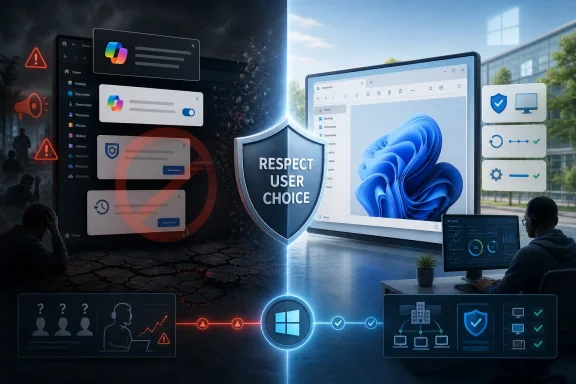 Microsoft Discovers That Windows Users Still Have Memories
Microsoft’s problem is not a single bad update, a single AI feature, or a single tone-deaf prompt. It is accumulation. Windows users have spent years being told that the next layer of Microsoft integration would be useful, optional, intelligent, and respectful, only to find that “optional” often means “declinable for now,” and “intelligent” often means “another place where Copilot appears before the user asked for it.”That is why the latest mea culpa lands with a thud as much as a promise. Nadella’s reported language about doing foundational work to “win back fans” is unusually frank by Microsoft standards, but it also confirms what many users have been saying for months: the company has been losing the plot at the level of everyday trust.
Windows is not merely another Microsoft product. It is the company’s civic infrastructure, the operating layer beneath schools, small businesses, hospitals, studios, home PCs, labs, and government offices. When Microsoft treats that layer as an advertising surface, an AI distribution channel, or an experiment in forced engagement, users do not experience it as strategy. They experience it as trespass.
The frustration is sharper because Microsoft knows better. This is the company that rebuilt its developer reputation with Visual Studio Code, GitHub, Windows Subsystem for Linux, and a more pragmatic approach to open source. It learned, at least for a while, that goodwill compounds. Now Windows users are watching that goodwill get spent like a marketing budget.
Copilot Became the Symbol Because It Was Everywhere
Copilot is not the whole controversy, but it has become the mascot for it. Microsoft has pushed AI into Windows, Edge, Office, Paint, Notepad, search, screenshots, and taskbar-adjacent workflows with the confidence of a company that believes distribution is destiny. The problem is that Windows users tend to notice when a feature arrives with more executive urgency than user demand.There is nothing inherently wrong with AI assistance in an operating system. A genuinely useful local assistant that can change settings, summarize documents with consent, automate repetitive tasks, and respect boundaries would be a meaningful evolution of the desktop. The backlash is not against intelligence. It is against presumption.
Microsoft’s Copilot strategy has often felt less like adding a tool and more like converting Windows into a funnel. The company has repeatedly blurred the distinction between an operating system feature, a cloud service, a subscription upsell, and a brand campaign. That may make sense in a quarterly product review. It makes less sense to the person who just wants File Explorer to stop misbehaving.
The company appears to have recognized at least part of the damage. Reports that Windows leadership is reconsidering “unnecessary” Copilot appearances are important because they concede the central point: not every text box, context menu, or legacy app needs to be an AI beachhead. Sometimes Notepad should be Notepad. Sometimes Paint should be Paint.
But restraint is harder than rollout. Microsoft’s internal incentives still favor visible AI insertion because AI is where investor attention, product roadmaps, and executive messaging converge. Pulling back from that instinct requires more than a blog post. It requires product managers to be rewarded for not shipping the prompt, not adding the button, and not hijacking a workflow that already worked.
The Second-Chance Setup Screen Says the Quiet Part Out Loud
The so-called second-chance out-of-box experience is a perfect example of why Windows users are skeptical. It is framed as helpful: a way to revisit setup choices, enable recommended services, connect accounts, configure backups, and discover features. In practice, these screens often feel like Microsoft asking the same question again because it disliked the first answer.This matters because setup is not a neutral moment. The user is trying to get into their machine. Microsoft is trying to shape the account model, cloud attachment, telemetry posture, browser defaults, backup behavior, and service adoption of that machine. The conflict is obvious, and users are not imagining it.
Windows 11 already lives under a cloud of suspicion around Microsoft account pressure, Edge nudges, default app friction, OneDrive prompts, and “recommended” experiences that just happen to align with Microsoft’s commercial priorities. The second-chance prompt is not outrageous in isolation. It is outrageous because it arrives in a long line of prompts that train users to distrust the word “recommended.”
Enterprise administrators see the same pattern through a different lens. A consumer may grumble and click past a prompt. An IT department has to document it, suppress it, explain it, test it, and reassure users that the standard image has not been tampered with. In managed environments, Microsoft’s enthusiasm becomes someone else’s ticket queue.
That is the hidden tax in modern Windows administration. Every clever nudge from Redmond becomes a help desk article, a policy review, a registry hunt, an Intune setting, or a PowerShell workaround. Microsoft can call these experiences engagement. Admins call them drift.
Patch Quality Is Where Patience Goes to Die
If Copilot is the symbol, patch quality is the substance. Users can ignore an unwanted AI button more easily than a broken recovery environment, a failed cumulative update, a degraded Remote Desktop session, a gaming performance regression, or a device that suddenly behaves differently after Patch Tuesday. Reliability is not glamorous, but it is the foundation on which every other Microsoft ambition depends.Windows servicing has always involved tradeoffs. The ecosystem is vast, hardware diversity is brutal, drivers are uneven, and the security threat landscape gives Microsoft little room to delay fixes indefinitely. No serious observer should pretend that shipping monthly updates to hundreds of millions of PCs is easy.
But that argument only goes so far. Microsoft has spent years moving Windows toward continuous delivery, cumulative updates, feature enablement packages, cloud-tuned rollouts, and telemetry-informed remediation. The bargain was that this model would make Windows more secure and more responsive without turning users into unpaid beta testers. When update regressions pile up, the bargain looks broken.
The most damaging bugs are not always the most widespread. A recovery environment input failure, a Remote Desktop regression, or a compatibility block affecting a specific class of devices may hit a minority of users, but it hits precisely the kind of users who maintain the trust fabric around Windows: admins, power users, repair technicians, enthusiasts, and business support teams. Those people are the informal sales force for the platform. They are also the first to notice when the floorboards creak.
Microsoft’s official known-issues pages are more transparent than the bad old days, and Known Issue Rollback has been a meaningful improvement. But transparency after the fact is not the same as confidence before deployment. The test for Windows quality is not whether Microsoft can publish a workaround. It is whether administrators feel safe installing the update without spending the morning reading forums like a storm forecast.
The Windows 10 Deadline Turned Every Mistake Into Leverage
The timing could hardly be more sensitive. Windows 10’s mainstream support runway ended in October 2025, forcing millions of users and organizations to decide whether to move to Windows 11, pay for extended support, replace hardware, or rethink their desktop strategy. That transition was always going to be politically difficult because Windows 11 raised hardware requirements and left older but functional PCs behind.In that environment, every Windows 11 annoyance carries extra weight. Users are not simply evaluating a new operating system on its merits. Many feel they are being pushed off an operating system they liked and onto one that nags more, changes more, and appears increasingly designed around Microsoft’s strategic priorities rather than their own.
This is where Microsoft’s “win back fans” language becomes revealing. Fans are not the same as customers. Customers may stay because they have line-of-business apps, Active Directory dependencies, Microsoft 365 contracts, gaming libraries, driver needs, or muscle memory. Fans stay because they believe the product is on their side.
Windows 11 has customers. The open question is whether it has enough fans left to defend it when the next wave of AI integration arrives. Enthusiast goodwill matters because Windows has always depended on a peculiar coalition: gamers, sysadmins, developers, OEMs, hobbyists, enterprise buyers, and ordinary users who simply want continuity. When those groups complain in harmony, Microsoft should listen.
The company’s challenge is compounded by hardware politics. Copilot+ PCs gave Microsoft and its partners a shiny AI-era story, but they also split the Windows experience into tiers. Some features require NPUs, some require newer silicon, some require cloud services, and some are withheld or disabled in managed contexts. The result is a platform that can feel simultaneously overbearing and fragmented.
GitHub and Developer Trust Are Part of the Same Story
The Register’s framing also points beyond Windows. GitHub instability and Copilot controversy matter because Microsoft’s modern reputation rests heavily on developers. The Nadella-era Microsoft worked hard to become the company developers could tolerate, then respect, then in many cases prefer. GitHub was the crown jewel of that reversal.When GitHub wobbles, or when Copilot becomes a source of friction rather than delight, Microsoft’s problem spreads from desktop annoyance to platform credibility. Developers are unusually sensitive to trust violations because their tools are extensions of their working memory. A flaky repository host, a degraded coding assistant, or a workflow change that seems optimized for monetization can trigger outsized backlash for good reason.
There is a deeper tension here. Microsoft wants AI to be ambient, integrated, and monetizable across the stack. Developers want tools that are fast, predictable, inspectable, and subordinate to their intent. Those goals can align, but only if Microsoft treats AI as a power tool rather than a product placement strategy.
GitHub Copilot succeeded initially because it solved a real problem in a real workflow. It did not need to take over the operating system shell to prove its value. That lesson seems strangely absent from parts of Microsoft’s Windows strategy, where the company sometimes acts as though presence itself is proof of usefulness.
The best Microsoft products of the past decade earned their place by being better than the alternatives. The worst Microsoft experiences relied on bundling, defaults, and persistence. Users can tell the difference, and developers can tell it faster than most.
Nadella’s Promise Is Necessary but Not Sufficient
Satya Nadella’s public posture matters because Microsoft’s culture follows signals from the top. If the CEO says quality and core users matter, teams will repeat the phrase, decks will be updated, and some priorities will shift. That is not nothing.But Microsoft has been here before. The company has repeatedly announced listening tours, feedback improvements, quality initiatives, and renewed attention to fundamentals. Windows users have learned to judge these moments not by rhetoric but by what disappears: the nag that does not ship, the ad that does not appear, the toggle that stays put, the update that does not break the obvious thing.
Pavan Davuluri’s role is more operational and therefore more consequential. Windows needs a product leader willing to say no inside Microsoft, not merely empathize outside it. Saying no to an AI insertion, a growth prompt, a forced onboarding flow, or a rushed servicing milestone is harder than acknowledging user frustration after the fact.
The uncomfortable truth is that Microsoft’s Windows problem is partly a governance problem. The operating system is expected to serve too many internal masters: security, Azure identity, Microsoft 365, Edge, Bing, Copilot, OEM partnerships, gaming, ads, compliance, accessibility, and enterprise management. A coherent user experience requires someone to arbitrate those demands in favor of the person at the keyboard.
That is why “fundamentals” is the right word and also a dangerous one. It sounds humble, but it can become a placeholder. Fundamentals are not a mood. They are measurable commitments: fewer regressions, clearer defaults, faster rollback, less promotional surface area, better policy controls, fewer surprise prompts, and a start menu that behaves like infrastructure rather than inventory.
Enterprise IT Wants Boredom, Not Wonder
For enterprise IT, the ideal Windows release is often boring. It installs cleanly, respects policy, leaves defaults alone, avoids consumer cruft, documents changes in advance, and does not make the help desk learn a new vocabulary every month. Microsoft’s consumer-facing desire to make Windows feel alive frequently collides with the enterprise desire to make it stay still.This is not conservatism for its own sake. Stability is a security feature. Predictability reduces misconfiguration. Boring endpoints are easier to support, audit, insure, and recover. A surprise Copilot prompt on a home PC may be irritating; a surprise workflow change in a regulated environment can become a compliance conversation.
Microsoft knows this, which is why its enterprise tooling has improved in many areas. Intune, Autopatch, Windows Update for Business, policy-based controls, and release health dashboards are all attempts to make the modern servicing model governable. The problem is that management tools often arrive as compensation for product choices that created the management burden in the first place.
The best version of Windows for business would not require admins to fight the consumer version at every turn. It would have a clean separation between user-requested features and Microsoft-promoted experiences. It would assume that silence is a virtue. It would make every AI or cloud integration obvious, controllable, reversible, and off by default in contexts where policy demands it.
That is the standard Microsoft should be held to. Not because AI is bad. Not because change is bad. Because Windows is too important to be governed by engagement metrics masquerading as design.
The Old Microsoft Never Really Left
There is a familiar pattern in Microsoft history. The company builds indispensable platforms, uses that indispensability to push adjacent products, triggers backlash, retreats just enough, and then repeats the cycle when a new strategic priority emerges. In the 1990s it was the browser. In the 2010s it was cloud accounts and telemetry. In the 2020s it is AI.The Nadella era softened Microsoft’s image because the company became more interoperable, more developer-friendly, and less openly combative. But the underlying corporate muscle memory never vanished. Microsoft still knows the value of defaults. It still understands the power of bundling. It still has a unique ability to turn a platform dependency into a distribution advantage.
That does not make Microsoft uniquely villainous. Apple, Google, Amazon, and Meta all use ecosystem control to steer users toward strategic outcomes. What makes Microsoft different is Windows’ role as general-purpose computing substrate. A Mac user bought into Apple’s vertical model. A Chromebook user bought into Google’s web-first bargain. A Windows user often bought a PC from someone else and expects the OS to behave like a neutral layer.
That expectation may be idealized, but it is powerful. Windows won the world by being the messy, compatible, hardware-diverse platform where users could do almost anything. If Microsoft turns that platform into a curated engagement surface, it risks damaging the very pluralism that made Windows durable.
The irony is that Microsoft’s AI ambitions would benefit from more humility. Users are more likely to embrace Copilot if they trust Windows. They are more likely to trust Windows if Microsoft stops using it to force Copilot into places it has not earned. The shortest path to AI adoption may be fewer AI prompts.
The Repair Job Starts With Things Microsoft Chooses Not to Ship
Microsoft’s path out of this is not mysterious. It is just difficult. The company has to prove, repeatedly and visibly, that Windows serves the user before it serves Microsoft’s quarterly narrative.That proof will not come from another keynote. It will come from months of dull competence. Fewer regressions. Cleaner updates. Less nagging. More respect for local accounts, chosen browsers, chosen defaults, and managed policies. A Copilot experience that feels like a tool waiting to be summoned, not a salesperson waiting to interrupt.
The hardest part is that Microsoft must accept that some of its most valuable Windows improvements will be invisible to investors. A Start menu with less promotional clutter does not look like an AI breakthrough. A patch cycle with fewer emergency fixes does not demo well. A setup flow that asks fewer questions may reduce service attachment. But those are exactly the kinds of choices that rebuild trust.
If Microsoft wants users to believe the reset is real, it should start by making Windows quieter. Not stagnant, not abandoned, not anti-AI — quieter. A mature operating system should not need to keep proving that it is exciting. It should prove that it is dependable.
Redmond’s Trust Deficit Is Now the Product Requirement
The useful thing about this latest backlash is that it gives Microsoft a clear scorecard. Users are not asking for mystery. They are asking for restraint, stability, and respect.- Microsoft’s public promise to refocus on fundamentals will matter only if it results in fewer intrusive prompts and fewer update regressions over the next several release cycles.
- Copilot can become a strength for Windows only if Microsoft stops treating every surface as a place to advertise it.
- The second-chance setup experience illustrates a larger trust problem because it makes declined choices feel temporary rather than final.
- Enterprise administrators need Microsoft to make Windows more predictable by default, not merely more configurable after unwanted experiences appear.
- Windows 11’s reputation now depends less on feature velocity than on whether Microsoft can make ordinary users and power users feel that the operating system is once again working for them.
Source: theregister.com Microsoft promises to do better, but it has a long way to go
