

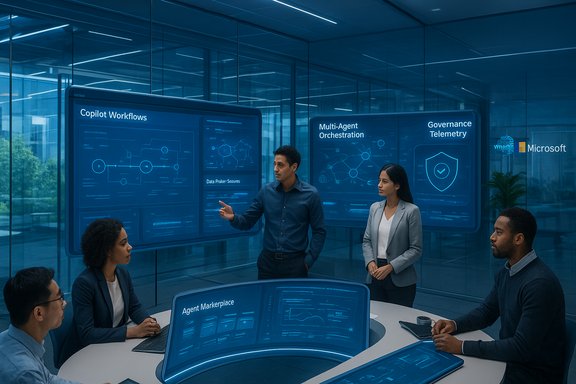
Wipro’s three‑year strategic tie‑up with Microsoft — announced Dec. 12, 2025 — positions the two companies to accelerate enterprise adoption of agentic AI by combining Wipro’s consulting‑led delivery and vertical IP with Microsoft’s cloud, Copilot family and orchestration tooling, and by opening a Microsoft Innovation Hub inside Wipro’s Partner Labs in Bengaluru. The public commitments are large: Wipro says it will deploy over 50,000 Microsoft Copilot licenses internally and upskill 25,000+ employees on Microsoft Cloud and GitHub technologies as part of a “Client Zero” posture, while Microsoft’s broader India program includes a US$17.5 billion investment pledge for AI and cloud infrastructure that creates a strategic backdrop for this alliance.
Background / Overview
The collaboration was announced through Wipro’s press materials and amplified across major outlets during Microsoft’s India AI events in early December 2025. The pact runs three years and is explicitly framed to create “Frontier Firms” — enterprises that embed copilots and multi‑agent workflows into core operations rather than running isolated experiments. The two partners will co‑develop industry‑specific copilots and AI agents across Financial Services, Retail, Manufacturing, Healthcare & Life Sciences, Airports and other regulated verticals. This is not an R&D grant or a single product announcement. It is a layered go‑to‑market and operational pact: Microsoft supplies the cloud, model hosting, governance primitives and Copilot/agent tooling; Wipro supplies industry IP (NetOxygen, Wealth AI, Falcon Supply Chain), systems integration experience and scale delivery. The new Microsoft Innovation Hub in Bengaluru is pitched as the physical and virtual runway for client workshops, rapid prototyping, governance assessments and access to an Agent Marketplace of pre‑built agents.What’s in the deal — the headline commitments
- A formal, three‑year strategic partnership for co‑development and commercialization of AI‑driven, industry‑specific copilots and agents.
- Launch of a Microsoft Innovation Hub located inside Wipro’s Partner Labs in Bengaluru for co‑innovation, immersive client sprints and Agent Marketplace demonstrations.
- Integration of Wipro Intelligence™ and vertical IP (NetOxygen, Wealth AI, Falcon Supply Chain) with Microsoft’s stack: Azure, Microsoft 365 Copilot, GitHub Copilot and Azure AI Foundry/Copilot Studio.
- Public scale and skilling targets: 50,000+ Microsoft Copilot licenses deployed internally at Wipro and 25,000+ Wipro employees to be upskilled on Microsoft Cloud and GitHub technologies as part of Client Zero. These are presented as strategic commitments to accelerate productization and GTM.
The technology stack: how this will be built
Core layers
- Azure: cloud hosting, data fabric, compute for model training/inference, and sovereign tenancy options in India.
- Microsoft 365 Copilot: the primary productivity surface and front door for knowledge‑worker copilots and enterprise workflows.
- GitHub Copilot: developer productivity tooling to accelerate engineering, CI/CD and delivery of agents.
- Azure AI Foundry / Copilot Studio: model lifecycle, routing, agent orchestration, provenance and governance telemetry for multi‑agent workflows.
- Wipro Intelligence™ and vertical IP: domain data models, connectors and prebuilt processes (NetOxygen, Wealth AI, Falcon Supply Chain) to reduce integration lift into ERPs, core banking systems and manufacturing execution systems.
The Innovation Hub’s practical role
The Hub is designed as both a technical lab and commercial showroom. It will enable:- immersive client workshops and scenario labs that simulate production data and governance constraints;
- rapid prototyping of industry copilots and agent workflows;
- demonstrations of Wipro’s Agent Marketplace and pre‑built agents;
- validation of sovereign‑processing setups, identity integration (Microsoft Entra / Azure AD) and human‑in‑the‑loop controls.
Why the scale matters — and what it actually means
Public commitments — like Wipro’s 50,000+ Copilot licenses — are strategically important because they signal both buying power and a living lab for productization. When large SIs adopt a platform internally (“Client Zero”), they can convert lessons learned into repeatable offerings for customers. Microsoft also packaged several SIs together, projecting more than 200,000 collective Copilot seats across Cognizant, Infosys, TCS and Wipro, which amplifies the market signal. However, license counts are not the same as meaningful activation or production usage. Multiple industry observers point out that these figures should be treated as purchase and deployment commitments rather than immediate proof of deep, audited adoption. Enterprises and regulators will demand activation metrics, usage dashboards, audit logs and evidence of business outcomes to accept claims of productivity or risk reduction.Strengths: where this partnership could deliver real value
- Speed to market: Combining Wipro’s vertical accelerators with Microsoft’s platform reduces engineering time for domain copilots, accelerating pilot‑to‑production timelines.
- Commercial credibility: A visible Innovation Hub plus large internal seat commitments gives buyers demonstrable references and a concrete place to validate governance and SLA claims.
- Governance primitives: Microsoft’s Copilot Studio / Azure AI Foundry includes provenance, routing and lifecycle controls that enterprise risk teams require before approving production deployments.
- Sovereignty and capacity: Microsoft’s US$17.5B India investment expands hyperscale capacity and in‑country processing options—important for regulated sectors that need data residency or low latency.
Risks and operational challenges — what can go wrong
- Activation risk: Buying licenses does not guarantee business value. Without tightly defined KPIs and onboarding programs, seats may remain underused. Treat headline seat numbers as intent, not proof.
- Vendor concentration and lock‑in: A tightly coupled stack (Azure + Microsoft Copilot + Wipro IP) can accelerate delivery but increases dependence on a single hyperscaler and SI. Procurement teams should require portability and data export guarantees.
- Governance and compliance gaps: Agents that act across systems require registries, least‑privilege execution roles, explainability artifacts, and auditable human‑in‑the‑loop checkpoints—absent these, risk exposure grows rapidly.
- TCO surprises: Productionizing agentic AI involves inference costs, vector DB storage, orchestration overhead, and engineering maintenance. Underestimating recurring cloud inference spend is common.
- Bias, safety and regulatory scrutiny: Regulated verticals (banking, healthcare, airports) will require model cards, documented training data lineage and robust incident response playbooks. These are often the last things implemented.
Practical technical implications for enterprise architects
Enterprises evaluating joint offerings from Wipro + Microsoft should explicitly plan for:- Identity & Data Fabric: Integrate Copilots with Microsoft Entra / Azure AD and enforce least‑privilege access for agents. Ensure data cataloguing so agents use governed context.
- Agent Registry & Governance: Treat agents like microservices—implement registries, versioning, SLAs, and audit trails. Use Copilot Studio observability where available.
- Human‑in‑the‑loop & Escalation: For decision‑critical workflows, design deterministic escalation paths to human reviewers and maintain immutable logs for regulatory inquiries.
- MLOps & Cost Controls: Standardize CI/CD for model updates, automatic drift detection, and implement inference cost dashboards tied to business KPIs.
- Interoperability: Insist on connectors and APIs that allow migration/extraction of data and logic if the go‑to‑market changes or a different cloud stack is preferred.
An enterprise playbook: how to evaluate Wipro + Microsoft offerings (actionable checklist)
- Define the business outcome and a narrow first pilot KPI (e.g., claims triage time reduction of X% within 90 days).
- Require a staging proof with realistic data residency and human‑in‑the‑loop tests in the Innovation Hub before any production rollout.
- Ask for activation dashboards that show weekly active users, task completion rates, error rates and audit logs for at least three months of usage.
- Insist on explicit SLAs and runbooks for drift, security incidents and model rollback, plus contractual portability clauses for data and model code.
- Require an identity and least‑privilege architecture plan (Entra/Azure AD integration) with role‑based access for every agent.
- Forecast TCO including expected inference cost at target scale, vector DB storage, logging retention and engineering maintenance headcount.
- Build a cross‑functional sign‑off matrix (Legal, Security, Compliance, Business Owner, IT) and run a tabletop incident scenario.
Commercial and market implications
Wipro’s move is part of a broader, coordinated push by Microsoft to industrialize Copilot adoption through a partner ecosystem. By naming multiple SIs as “Frontier Firms” and backing them with a major India investment, Microsoft creates a channel to convert platform investment into enterprise consumption. This has three immediate market effects:- It accelerates the vendor consolidation trend in enterprise AI, favoring hyperscaler + SI bundles for large regulated customers.
- It raises the bar for competitive differentiation: SIs without comparable Copilot partnerships will need deeper vertical IP or niche specialisms to compete.
- It intensifies auditability and procurement demands from large buyers who will now insist on measurable activation and governance evidence before expanding deployments.
What’s verified — and what to treat cautiously
Verified by Wipro’s press release and Microsoft’s announcements:- The three‑year partnership and the establishment of a Microsoft Innovation Hub within Wipro’s Partner Labs in Bengaluru.
- The technology stack referenced (Azure, Microsoft 365 Copilot, GitHub Copilot, Azure AI Foundry) and the focus on industry verticals such as Financial Services, Retail, Manufacturing and Healthcare.
- Deployment of “over 50,000” Copilot licenses: this figure is repeatedly stated in press materials and partner briefings, but license counts are purchase/deployment targets and should be verified by activation and usage metrics before being accepted as a measure of internal productivity change.
- Upskilling of 25,000+ employees: similarly a material commitment, but outcomes (certifications earned, hands‑on readiness, billable delivery capacity) require independent verification.
A realistic timeline and success metrics to expect
For enterprises considering pilots with Wipro/Microsoft built copilots, a pragmatic rollout looks like:- 0–3 months: discovery, business KPIs, data access consent and sandbox provisioning (Innovation Hub workshop).
- 3–6 months: prototype agent in sandbox, governance checks, human‑in‑the‑loop design and early user testing.
- 6–12 months: limited production with measurable KPIs (e.g., task automation rate, error rate, time saved), cost modeling and initial ROI reporting.
- 12–24 months: scale rollout across business units if activation metrics and governance evidence are satisfactory; continuous monitoring and cost optimization thereafter.
Final analysis — why this matters to CIOs and vendors
The Wipro–Microsoft pact is an archetype of the new hyperscaler + SI playbook for industrializing AI: platform investment, partner IP and a physical co‑innovation runway. For CIOs, it creates a compelling vendor choice for rapidly standing up regulated, Copilot‑backed workflows with strong governance tooling. For Wipro it is a credible route to productize internal modernization as monetizable offerings; for Microsoft it increases enterprise consumption and argues the case for in‑country processing and sovereign options.Yet the announcement is only the start. The real test — for Wipro, Microsoft and their customers — will be activation, auditable governance, and sustained business outcomes rather than headline seat counts. Enterprises that treat this new generation of offerings as another SaaS procurement will be disappointed; those that require measurable pilots, governance evidence and cost transparency will find a faster path to safe production.
Across the industry, the next 6–18 months of published activation metrics, independent customer case studies and regulatory feedback will determine whether these grand partner pacts are durable templates for enterprise transformation or simply high‑profile staged commitments.
Conclusion
Wipro and Microsoft’s three‑year collaboration and the new Microsoft Innovation Hub in Bengaluru represent a significant stride toward industrializing Copilot‑driven workflows at enterprise scale. The combination of platform, partner and physical co‑innovation space provides clear advantages for rapid prototyping and buyer confidence. However, the industry must insist on activation evidence, robust governance, clear TCO models and portability protections before treating license counts and skilling targets as de facto measures of success. When executed with discipline, the partnership may accelerate meaningful AI adoption in regulated industries; executed without those guardrails, it risks amplifying operational cost and systemic exposure rather than delivering consistent business value.
Source: ETV Bharat Wipro, Microsoft Ink 3-Year AI Partnership; Launch Innovation Hub In Bengaluru
