
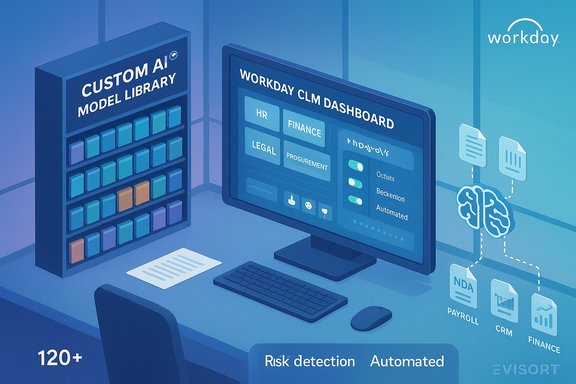
Workday’s move to add a Custom AI Model Library to its Contract Intelligence Agent — a collection of more than 120 pre-built, domain-focused models powered by Evisort — signals a clear shift from generic automation toward specialized, deployable contract intelligence that legal, HR, finance, and procurement teams can use immediately to speed review, surface risk, and extract business-critical terms. The announcement frames this as a plug‑and‑play expansion of Workday Contract Lifecycle Management (CLM): models are categorized by contract type and business function, are available to deploy with a click, and can be refined via no‑code feedback loops — a combination designed to shrink manual review time and bring contract analytics into everyday business workflows.
Workday’s Contract Intelligence Agent — part of Workday CLM and now explicitly powered by Evisort technology — has been positioned as the company’s bridge between legal document management and enterprise operations. The new Custom AI Model Library is the latest extension of that strategy: instead of relying on a small set of general extraction models, Workday is offering a broad catalog of domain‑tuned models that target specific clauses, line items, and industry scenarios across HR, finance, sales, procurement, and verticals such as healthcare and construction. The capability is presented as immediately deployable (no long training cycles required) with optional iterative refinement using customer feedback. This launch builds on Workday’s earlier strategic relationship and transaction activity with Evisort: Workday signed the definitive agreement to acquire Evisort to bring contract‑focused LLMs and extraction capabilities into its product portfolio — an acquisition that provides both the IP and the training data lineage that make a multi‑model library plausible. That acquisition context underpins why Workday now claims a deep catalog of contract models instead of a handful of generic extractors. The announcement was amplified across financial and tech press, noting the library’s headline figure — 120+ pre-built AI models — and stressing the practical outcomes Workday aims for: earlier risk detection, faster reviews, and less manual redaction or tagging for high‑volume contract repositories. Independent coverage confirms the figure and product positioning.
Two independent vendor and press sources corroborate the 120+ number and the packaging approach, suggesting the count is an accurate representation of the initial library size. However, the practical value depends on model accuracy on a customer’s specific contracts and on the ease of model fine‑tuning in real deployments.
Source: Cloud Wars Workday Launches Custom AI Model Library for Contract Intelligence
 Background / Overview
Workday’s Contract Intelligence Agent — part of Workday CLM and now explicitly powered by Evisort technology — has been positioned as the company’s bridge between legal document management and enterprise operations. The new Custom AI Model Library is the latest extension of that strategy: instead of relying on a small set of general extraction models, Workday is offering a broad catalog of domain‑tuned models that target specific clauses, line items, and industry scenarios across HR, finance, sales, procurement, and verticals such as healthcare and construction. The capability is presented as immediately deployable (no long training cycles required) with optional iterative refinement using customer feedback. This launch builds on Workday’s earlier strategic relationship and transaction activity with Evisort: Workday signed the definitive agreement to acquire Evisort to bring contract‑focused LLMs and extraction capabilities into its product portfolio — an acquisition that provides both the IP and the training data lineage that make a multi‑model library plausible. That acquisition context underpins why Workday now claims a deep catalog of contract models instead of a handful of generic extractors. The announcement was amplified across financial and tech press, noting the library’s headline figure — 120+ pre-built AI models — and stressing the practical outcomes Workday aims for: earlier risk detection, faster reviews, and less manual redaction or tagging for high‑volume contract repositories. Independent coverage confirms the figure and product positioning. What Workday announced — the product in plain terms
The new Custom AI Model Library — what it contains
- 120+ pre-built models, organized by contract type and business function (Employment Agreements, Lease Agreements, Data Privacy, Sales & Revenue Operations, Insurance, Construction and more). These models are marketed as trained for common clause extraction, clause summarization, risk flagging, and line‑item extraction.
- No-code refinement loop: customers can publish a chosen model into their tenant and then refine it with feedback, which Workday/Evisort say will improve model accuracy without code. This is presented as a usability feature intended to let legal and business users tune outcomes without ML engineering cycles.
- Pre-trained, industry-aware models for vertical use cases (e.g., healthcare privacy obligations, construction lien and insurance provisions), enabling faster application in regulated or highly specialized domains.
- Integration into Workday CLM and downstream workflows, so extracted contract data can feed HR, finance, procurement, and CRM systems or dashboards that measure obligations, renewals, and cost exposure.
The stated outcomes
Workday and press coverage emphasize several measurable outcomes:- Faster contract reviews and turnarounds.
- Earlier detection of risky provisions or missing clauses.
- Lower manual effort for extracting key dates, payments, renewal terms, and privacy/security obligations.
- Ability to surface contract insights across enterprise functions (legal, HR, finance, sales).
How it works technically (and what’s realistic)
Core mechanics
Workday’s offering is built on a layered approach:- Pre-trained contract models that identify specific data elements (e.g., renewal date, indemnity language, payment schedule).
- Domain filters that choose which model(s) to apply for a given contract corpus (supplier agreements vs. sales agreements, for example).
- No-code publishing and feedback that lets end users approve or correct extractions and thereby refine model accuracy in a tenant‑specific way.
- Integration with enterprise workflows so extracted fields are written to CLM metadata, reported in analytics, and used to trigger downstream tasks (notifications, obligation tracking, or finance reconciliations).
What the “120+ models” claim really means
The “120+” number should be read as a catalog count — each model represents a specific extraction or classification task (e.g., “termination for convenience clause”, “data residency obligation”, “Governing Law extraction for US states”). That breadth is useful because real legal teams often need many narrowly scoped extractors rather than one monolithic model that tries to do everything.Two independent vendor and press sources corroborate the 120+ number and the packaging approach, suggesting the count is an accurate representation of the initial library size. However, the practical value depends on model accuracy on a customer’s specific contracts and on the ease of model fine‑tuning in real deployments.
Use cases and business impact
Immediate, high-value scenarios
- High-volume contract review: procurement teams and legal ops can run triage across thousands of supplier contracts to find non‑standard clauses and quickly flag contracts requiring legal review.
- Renewal and revenue protection: sales and revenue operations can extract renewal terms and pricing schedules to prevent revenue leakage and enforce correct billing.
- Regulatory compliance and privacy: data privacy and security teams can rapidly identify cross‑border transfer clauses, data processing obligations, and customer consent language.
- M&A and due diligence: pre-built models that scan for change‑of‑control, indemnities, and assignment clauses speed early diligence stages.
Operational benefits
- Reduced manual tagging and extraction time for contract repositories.
- More consistent metadata across CLM fields, improving downstream automation accuracy.
- Faster legal triage; legal teams can focus on high‑risk items instead of routine extraction work.
Measurable KPIs to track
- Time to first pass review (baseline vs. model-enabled).
- Percentage of contracts correctly auto‑tagged (precision/recall for critical fields).
- Number of legal hours redirected from extraction to negotiation.
- Reduction in missed renewals or revenue leakage incidents.
Competitive landscape — where this sits against other CLM vendors
Contract intelligence is now a crowded, fast‑moving space. Competitors such as Icertis, DocuSign (CLM / Agreement Cloud), and specialist vendors (Pramata, Evisort — now under Workday — FairPact, Sirion) offer overlapping capabilities: clause extraction, obligation management, and AI copilots tuned for contract workflows. Several competitors emphasize proprietary model stacks or integrations with Azure OpenAI and proprietary data lakes to deliver domain accuracy. Icertis, for example, markets a Vera AI foundation and specific Copilot-style tools that likewise aim to bring contract intelligence into business processes. Where Workday’s approach differentiates:- Tight integration with Workday CLM and HR/finance systems, which matters when contract data must feed payroll, procurement, or revenue recognition workflows.
- Breadth of pre-built models across functions and verticals, intended to reduce the time-to-value for non-legal users.
- The Evisort IP and model lineage, which provides a contract-focused LLM and extraction toolkit that Workday can productize across its customer base.
Strengths: what’s genuinely valuable about this launch
- Domain specialization at scale: pre-built, contract‑specific models reduce the need to train models from scratch and are more likely to catch legal nuances than generic LLMs used out-of-the-box.
- No-code refinement empowers legal ops and business users to improve accuracy without long ML cycles, speeding iteration and adoption.
- Integration into enterprise workflows (CLM metadata, dashboards, HR/finance connectors) turns extracted data into action, not just insight. This is where contract intelligence creates measurable value.
- Backed by Evisort IP and acquisition: Evisort’s contract LLM and extraction stack provide provenance and an engineering foundation that helps explain how Workday can ship so many models at once.
- Cross-functional coverage: targeting HR, finance, legal, sales, and IT increases adoption potential and drives ROI across functions rather than siloed legal savings.
Risks and caveats — what buyers must evaluate carefully
- Model accuracy and hallucinations: contract AI can produce plausible but wrong extractions or summaries (hallucinations). Legal and compliance teams demand defensible, repeatable extraction — a known problem across the market that requires robust validation, provenance metadata, and human review for high‑impact use cases. Multiple industry analyses and vendor cautions highlight this as a key operational risk.
- Data privacy, residency, and exposure: Contracts carry sensitive PII, pricing, and strategic terms. Enterprise procurement must verify where inference runs, whether third‑party model providers see raw content, and how long training/feedback data is retained. For regulated sectors, data residency and auditability can be a gating factor.
- Cost of deployment and inference: running many models at scale — especially if they require frequent invocations for ongoing monitoring or for large repositories — can become expensive. Organizations should assess metering models, potential additional charges (model inference, Copilot credits, or per‑agent fees), and engineering costs for connectors and governance. Analysis of enterprise AI rollout costs warns of hidden operational expenses beyond license fees.
- Governance and auditability: extracting legal obligations is useful only when the process is auditable. Enterprises must demand model versioning, provenance tracking (which model produced which extraction and when), and the ability to freeze or roll back models if errors appear. These controls are operationally heavy but required for legal defensibility.
- Vendor lock‑in and portability: deep integration with Workday’s CLM and Evisort‑based models could create switching costs. Procurement teams should evaluate exportability of extracted metadata, the ability to replicate models elsewhere, and contract terms that protect customers if pricing or terms change. Vendor claims about cross‑cloud interoperability and guaranteed outcomes should be validated in pilot phases.
- Organizational readiness: the technology is only a fraction of the change. Successful adoption requires playbooks, cross‑functional governance (legal, security, finance), training, and a clear human‑in‑the‑loop policy for sign‑off on critical clauses. Without organizational discipline, the risk is not underperforming productivity gains but creating new operational liabilities.
Practical evaluation checklist for IT, Legal Ops, and Procurement
- Pilot scope: start with a bounded, high‑volume, low‑risk use case (e.g., supplier renewals or NDAs) to measure precision and time savings.
- Accuracy tests: run A/B extraction checks comparing human annotation to model outputs (measure precision, recall per field).
- Provenance & logging: confirm model versioning, extraction audit trails, and retention policies for feedback data.
- Data handling: validate where inference occurs (tenant vs. vendor cloud), encryption at rest/in transit, and data retention/usage terms.
- Cost model: estimate monthly inference costs for expected workload and clarify any variable metering (e.g., per‑extraction or per‑model charges).
- Escalation & HITL: define thresholds where human review is mandatory (e.g., any change to payment terms or indemnity language).
- Exit & portability: ensure metadata and extracted fields can be exported in standard formats for migration or audit.
Realistic expectations: what a successful pilot looks like
- A 30–60 day pilot that demonstrates:
-
80% precision on critical fields (e.g., renewal dates, termination clauses) for a specific corpus.
- Measurable reduction in first‑pass human review time (target 40–60% time saved for low‑risk contracts).
- Clean integration of extracted fields into Workday dashboards or downstream systems with correct cost center attribution.
- Clear governance playbook that ties model outputs to human approvals and incident response for mis‑extractions.
Strategic implications for large enterprises
- Speed vs. control tradeoff: the library is a win for speed — broad model catalogs let teams move from proof‑of‑concept to pilot faster. But scaling requires governance, model lifecycle management, and careful cost control.
- Platform consolidation pressure: organizations heavily invested in Workday for HR/finance may find the integrated CLM + model library an attractive way to centralize contract intelligence and reporting — but this same consolidation can amplify lock‑in.
- Market standardization potential: if Workday’s model library proves commercially successful and Evisort’s LLM provides repeatable accuracy, other CLM vendors will accelerate domain model catalogs and no‑code tuning features, quickly making model libraries table stakes.
Final assessment — opportunity tempered by operational reality
Workday’s Custom AI Model Library is a meaningful step toward making contract intelligence practical at enterprise scale. The combination of pre-built, domain-specific models, no-code refinement, and integration into Workday CLM, backed by Evisort’s contract expertise, materially reduces time‑to‑value compared with building bespoke contract models from scratch. The vendor’s claim of 120+ models is supported by multiple independent summaries and Workday’s own announcement, and the acquisition of Evisort helps explain the speed and breadth of this product launch. At the same time, success will be determined less by the headline model count and more by the enterprise’s ability to:- Validate model accuracy on its contracts,
- Establish human‑in‑the‑loop standards for legal defensibility,
- Control inference costs and data exposure,
- Implement robust provenance, logging, and model lifecycle governance.
Bottom line — what IT and Legal Ops leaders should do next
- Approve a focused pilot (30–60 days) using one or two high‑volume contract types and measure precision & time saved.
- Insist on model provenance, versioning, and audit logs as contractual terms before broad deployment.
- Require a clear cost estimate for ongoing inference at projected volumes and include cost caps or smoothing in procurement conversations.
- Prepare governance playbooks and human review thresholds to prevent overreliance on automated outputs for high‑impact clauses.
- Build migration/export tests before production rollout to protect against vendor lock‑in.
Source: Cloud Wars Workday Launches Custom AI Model Library for Contract Intelligence
