

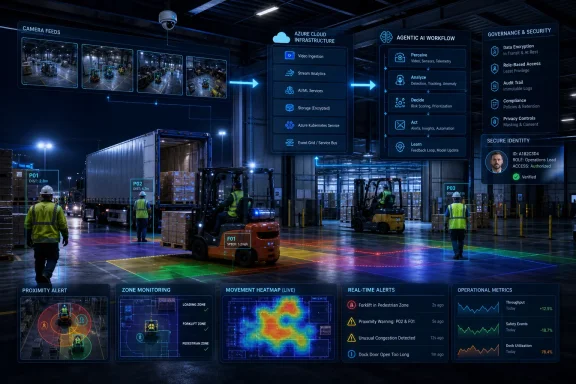
Microsoft’s Bay Area team on June 17, 2026 profiled Worlds, a company led by founder and CEO Dave Copps that uses existing cameras, sensors, Azure infrastructure, and AI agents to convert physical operations in warehouses, facilities, fleets, and job sites into real-time intelligence. The pitch is not merely that another startup has found a clever use for computer vision. It is that enterprise AI is starting to move from documents, chats, and dashboards into the messy places where work, risk, and money actually move. If Worlds is right, the next frontier for business automation is not another copilot window; it is the camera feed over the loading dock.
For the last three years, the public conversation around AI has been dominated by text boxes. Workers ask a model to summarize a meeting, draft a report, write some code, or query a pile of documents. That matters, but it also reveals the narrowness of the first enterprise AI wave: it has largely been trapped inside the already-digitized parts of the business.
Worlds is aiming at the opposite problem. Industrial firms, logistics operators, manufacturers, energy companies, and retailers already have cameras, badge systems, IoT sensors, vehicle telemetry, and operational data scattered across their estates. Much of it is technically recorded, but little of it is understood in time to matter.
That distinction is the core of the company’s argument. A camera archive is not intelligence. A sensor log is not a workflow. A video clip reviewed after a forklift near-miss may help explain what went wrong, but it does not prevent the next one unless it can be converted into an operational signal while the event is unfolding.
Worlds’ platform attempts to turn that raw physical data into a live, structured representation of what is happening in the real world. Microsoft’s write-up frames the company as part of a broader shift toward “physical AI,” a category that sounds buzzy until you remember that most organizations still run their physical operations with a strange mix of cameras, clipboards, tribal knowledge, and after-the-fact reporting.
Worlds says its platform connects to existing cameras and sensors, then transforms real-world activity into a stream of structured intelligence. In practical terms, that means identifying objects, tracking movement, recognizing patterns, measuring activity against rules, and feeding those observations into enterprise workflows.
The idea is not new in every component. Computer vision has been used in industrial safety, retail analytics, security, and manufacturing quality control for years. The more interesting claim is architectural: Worlds is positioning itself less as a point solution and more as a layer between physical reality and the systems that manage the business.
That is why Copps’ line about not being “an add-on” matters. The company wants to be part of the operational architecture, not a dashboard someone checks when something goes wrong. If the physical world can be modeled continuously, then enterprise systems can begin to respond to it continuously.
This is also where the WindowsForum audience should pay attention. The most important enterprise software shifts are rarely announced as desktop features. They arrive first as changes in back-end architecture, identity, cloud integration, compliance, monitoring, and workflow automation. Eventually, those shifts determine what frontline workers see on tablets, what supervisors see in Teams, what analysts see in Power BI, and what IT is asked to secure.
A warehouse floor generates data differently from a SharePoint library. It is continuous, noisy, spatial, and contextual. It includes motion, proximity, zones, vehicles, people, equipment, timing, exceptions, and safety risks. Turning that into usable intelligence requires ingestion, model deployment, storage, streaming, event handling, identity, permissions, and integration with business systems — exactly the sort of plumbing hyperscalers like Microsoft want to provide.
Worlds’ Azure alignment therefore works on two levels. For Worlds, Azure gives the company a familiar enterprise foundation, including scalable infrastructure, security posture, customer procurement channels, and integration paths into Microsoft-heavy environments. For Microsoft, Worlds is a concrete example of AI workloads that go beyond copilots and into operations.
That matters because Microsoft’s AI strategy increasingly depends on convincing customers that AI is not just a productivity feature bundled into Microsoft 365. It wants AI to become a platform layer across industries. A company that can take camera feeds from a warehouse or sensor streams from a facility and route them into live automation helps make that case.
The Microsoft Marketplace angle is also important. Enterprise buyers may like innovation, but they like approved procurement vehicles even more. A platform that appears inside the Microsoft commercial ecosystem can ride existing contracts, governance processes, and vendor-management comfort. That does not eliminate deployment risk, but it lowers friction.
In a warehouse, that could mean monitoring vehicle activity continuously instead of relying on supervisors to catch unsafe behavior. In a facility, it could mean detecting whether a restricted zone is occupied, whether a truck entered the wrong area, or whether a process step happened out of sequence. On a job site, it could mean identifying hazards as they emerge rather than after an injury report.
These are not glamorous use cases, but they are exactly where enterprise AI either proves itself or becomes another executive toy. Safety, uptime, throughput, loss prevention, compliance, and utilization are measurable. If an AI system reduces incidents, shortens investigations, or improves asset flow, it becomes budgetable.
The behavioral aspect may be even more important than the technical one. Continuous visibility changes how teams act. A workplace where unsafe vehicle behavior is detected in real time is different from one where footage is reviewed only after a complaint. Workers and supervisors adapt to the presence of measurement, for better and sometimes for worse.
That “sometimes” matters. The same system that improves safety can also feel like surveillance. The difference depends on governance, transparency, retention policies, access controls, labor relationships, and whether the technology is deployed to help workers or merely to score them. Worlds and Microsoft emphasize augmentation, but implementation will decide whether employees experience it that way.
That is both a strength and a warning. The strength is that physical operations are too varied for generic software to understand out of the box. A loading dock, refinery, fulfillment center, transit hub, and manufacturing line may all use cameras and sensors, but the meaning of an event depends on local context.
The warning is that services-heavy deployment can complicate scale. If every customer requires deep customization, margins tighten and rollout timelines lengthen. Worlds’ challenge is to turn site-specific learning into reusable patterns without flattening the complexity that made customization necessary in the first place.
This is where the phrase “agentic AI” risks doing too much work. AI agents are useful only if they can perceive correctly, reason within constraints, trigger appropriate actions, and fail safely. In a physical environment, a false positive can stop work unnecessarily, while a false negative can miss a safety risk. The cost of being wrong is not the same as generating a bad paragraph.
That is why enterprise-grade architecture is not marketing garnish here. Physical AI needs auditability, permissions, data boundaries, integration reliability, and rollback paths. If the system is going to trigger workflows in real time, IT and operations leaders will want to know exactly what it saw, what it inferred, what it did, and who approved the policy behind that action.
Worlds’ stated emphasis on using existing customer data and enterprise systems gives buyers a useful starting point, but not a complete answer. Companies still need to define what is collected, how long it is retained, whether individuals are identifiable, how model outputs are stored, and who can search or replay operational history.
The temptation will be to treat “existing cameras” as a permission slip. After all, if the cameras were already there, what has changed? The answer is everything. A camera that records passively is different from a system that detects, labels, tracks, and triggers action continuously.
This is the same pattern that has played out across enterprise monitoring. Logs were once mostly forensic artifacts. Then security platforms turned them into real-time detection systems. Endpoint telemetry went from troubleshooting data to behavioral analytics. Physical AI applies a similar shift to the built environment.
IT leaders should therefore expect physical AI projects to involve more than facilities and operations. Security, legal, HR, compliance, privacy, labor relations, and networking teams will all have stakes. If those conversations happen only after deployment, the project has already gone wrong.
Worlds’ platform sits in the lineage of the digital twin but pushes toward a more active version. If cameras and sensors can update the state of a facility in real time, the twin becomes less like a diagram and more like an operating surface. That is where automation becomes more plausible.
The phrase “observable and programmable” is doing a lot of conceptual work. In software, observability changed how teams run complex systems. Metrics, logs, traces, alerts, and automation gave administrators a way to understand and respond to distributed systems that no human could watch manually. Worlds is arguing that physical operations need an equivalent stack.
The analogy is powerful, but imperfect. Software systems are built to emit signals. Physical spaces are not. Lighting changes, objects occlude each other, cameras fail, sensors drift, humans behave unpredictably, and local context matters. Making the physical world observable requires interpretation, not just instrumentation.
Still, the direction is clear. The more physical operations become machine-readable, the more they can be connected to planning systems, ticketing systems, safety systems, scheduling tools, ERP platforms, and collaboration software. That is where a Microsoft-aligned company has an obvious strategic advantage.
A language model can help users ask better questions of operational data. A supervisor might want to know why loading delays increased during the night shift, whether a particular safety zone has repeated violations, or what changed before a production slowdown. If the physical AI layer has structured the world well enough, the LLM can become an interface to operational reality rather than a chatbot floating above it.
But the LLM should not be mistaken for the core sensing layer. It does not see the warehouse. It consumes representations created by other systems. If those representations are incomplete, biased, delayed, or wrong, the language layer will confidently explain a distorted reality.
That is why the fusion of physical AI and LLMs must be handled carefully. The model that chats with a manager should be constrained by the system of record, the confidence level of detections, and the policies governing what actions can be taken. In physical operations, a fluent explanation is less valuable than a reliable signal.
The best version of this architecture is not a general-purpose AI boss. It is a disciplined chain: sensors observe, perception models classify, spatial systems contextualize, rules and agents evaluate, business systems act, and humans supervise. The LLM becomes a translator and accelerator, not a magic authority.
Many organizations that would buy a platform like Worlds already live inside Microsoft identity, Microsoft security tooling, Teams, SharePoint, Power BI, Dynamics, Azure, and Windows endpoints. Even if the inference pipeline runs in Azure or at the edge, the human workflow may land in Microsoft’s ecosystem. Alerts become Teams messages, reports become Power BI dashboards, approvals run through Power Platform, and access control maps back to Entra ID.
Edge computing is another likely pressure point. Physical AI cannot always afford round-trip latency to a distant cloud region, and some customers will have bandwidth, sovereignty, or reliability constraints. That creates demand for hybrid architectures that process video or sensor data closer to the source while still integrating with cloud management and analytics.
This is not a Windows desktop story in the traditional sense. It is a Microsoft-stack story. The devices on the floor may be cameras, gateways, rugged tablets, kiosks, or industrial PCs. The management challenge will be familiar: patching, certificates, network segmentation, role-based access, logging, endpoint security, and lifecycle control.
Administrators should also think about data gravity. Once a company starts converting physical activity into structured operational data, that data becomes valuable to many systems. It will be pulled into analytics, compliance reviews, training programs, insurance conversations, and performance management. The platform that owns the first clean representation of physical reality gains leverage.
That competition is healthy because the category is still unsettled. In some environments, cameras will be enough. In others, LiDAR, radar, thermal imaging, RFID, machine telemetry, or environmental sensors will be necessary. Privacy-sensitive spaces may reject camera-heavy approaches. Highly dynamic sites may need sensor fusion.
The danger for buyers is ending up with a patchwork of narrow systems that each solve one problem but do not share a coherent model of the operation. One tool tracks forklifts. Another monitors access zones. Another handles safety incidents. Another feeds dashboards. Before long, the “intelligent facility” becomes a pile of disconnected alerts.
Worlds’ platform argument is designed to counter that fragmentation. By positioning itself as an intelligence layer that can work across sensors and use cases, the company is selling optionality. That is attractive to enterprises that do not want every new operational question to become a new vendor search.
The risk is that platform claims are easy to make and hard to prove. Real platforms become more valuable as more use cases attach to them. Pretend platforms become expensive middleware. Worlds will need customer evidence, repeatable deployment patterns, and clear integrations to show which side of that line it occupies.
That is what Microsoft can offer through Azure, Marketplace, and co-sell motions. For a company like Worlds, the Microsoft ecosystem can shorten the distance between innovation and enterprise acceptance. A buyer that would hesitate to onboard an unknown AI vendor may be more willing to consider one deployed on Azure and transacted through familiar channels.
There is a trade-off. The closer a startup aligns with a hyperscaler, the more its story becomes entangled with that hyperscaler’s strategy. Worlds benefits from Microsoft’s enterprise reach, but it also has to maintain credibility as an open physical AI platform rather than a Microsoft-only adjunct.
For customers, that distinction matters. Industrial environments are heterogeneous by nature. They contain old cameras, new sensors, specialized operational systems, legacy networks, and vendor-specific equipment. A physical AI platform must meet that reality, not pretend the world is already standardized.
Microsoft’s best role here is not to make every physical AI workload Azure-exclusive. It is to make Azure a credible control plane for organizations that need scale, governance, and integration. Worlds appears to understand that the value proposition is enhancement, not replacement.
A safety system that alerts a supervisor before a collision risk is augmentation. A monitoring system that quietly builds punitive productivity scores without context is something else. A tool that helps investigate incidents quickly can improve fairness if it replaces rumor and selective memory with evidence. It can also become oppressive if evidence is collected without limits or interpreted without appeal.
This is why the “physical AI” wave needs better governance language than the generative AI wave had at launch. Companies learned, painfully, that feeding sensitive documents into models raised questions about data leakage, permissions, and hallucination. Physical AI raises those questions plus surveillance, workplace power, and bodily privacy.
The best deployments will be explicit about purpose. They will define whether the system is for safety, compliance, throughput, maintenance, or security. They will limit secondary uses. They will document how detections are validated. They will give humans a way to challenge or contextualize machine-generated conclusions.
If Worlds can help customers implement that kind of disciplined operational AI, the technology could be genuinely useful. If the market races toward invisible workplace scoring, the backlash will be deserved.
No one should confuse a Microsoft partner profile with proof that physical AI has solved its hardest problems. The hard problems are deployment, governance, trust, false detections, worker acceptance, and integration with the stubbornly heterogeneous systems that run real facilities. But Worlds is pointing at the right fault line: enterprises have spent decades making software observable while leaving the physical world comparatively opaque. The companies that close that gap carefully — with real-time intelligence, defensible governance, and human-centered operations — will define the next phase of AI far more than another chatbot ever could.
 Enterprise AI Is Leaving the Browser Tab
For the last three years, the public conversation around AI has been dominated by text boxes. Workers ask a model to summarize a meeting, draft a report, write some code, or query a pile of documents. That matters, but it also reveals the narrowness of the first enterprise AI wave: it has largely been trapped inside the already-digitized parts of the business.Worlds is aiming at the opposite problem. Industrial firms, logistics operators, manufacturers, energy companies, and retailers already have cameras, badge systems, IoT sensors, vehicle telemetry, and operational data scattered across their estates. Much of it is technically recorded, but little of it is understood in time to matter.
That distinction is the core of the company’s argument. A camera archive is not intelligence. A sensor log is not a workflow. A video clip reviewed after a forklift near-miss may help explain what went wrong, but it does not prevent the next one unless it can be converted into an operational signal while the event is unfolding.
Worlds’ platform attempts to turn that raw physical data into a live, structured representation of what is happening in the real world. Microsoft’s write-up frames the company as part of a broader shift toward “physical AI,” a category that sounds buzzy until you remember that most organizations still run their physical operations with a strange mix of cameras, clipboards, tribal knowledge, and after-the-fact reporting.
The Camera Was Always a Computer Waiting for a Model
The obvious appeal of Worlds’ approach is that it promises to use infrastructure enterprises already own. That is not a minor detail. Hardware refreshes are expensive, operationally disruptive, and politically difficult inside large companies. A technology that says “replace every camera” enters the procurement process with a handicap; one that says “connect what you have” starts the conversation differently.Worlds says its platform connects to existing cameras and sensors, then transforms real-world activity into a stream of structured intelligence. In practical terms, that means identifying objects, tracking movement, recognizing patterns, measuring activity against rules, and feeding those observations into enterprise workflows.
The idea is not new in every component. Computer vision has been used in industrial safety, retail analytics, security, and manufacturing quality control for years. The more interesting claim is architectural: Worlds is positioning itself less as a point solution and more as a layer between physical reality and the systems that manage the business.
That is why Copps’ line about not being “an add-on” matters. The company wants to be part of the operational architecture, not a dashboard someone checks when something goes wrong. If the physical world can be modeled continuously, then enterprise systems can begin to respond to it continuously.
This is also where the WindowsForum audience should pay attention. The most important enterprise software shifts are rarely announced as desktop features. They arrive first as changes in back-end architecture, identity, cloud integration, compliance, monitoring, and workflow automation. Eventually, those shifts determine what frontline workers see on tablets, what supervisors see in Teams, what analysts see in Power BI, and what IT is asked to secure.
Microsoft Sees a Partner That Makes Azure More Than a Model Host
Microsoft’s interest in Worlds is easy to understand. Azure is already where Microsoft wants enterprises to build, deploy, govern, and buy AI systems. But if enterprise AI remains mostly a layer on top of documents and chat, the cloud opportunity is large but bounded. Physical operations expand the addressable surface dramatically.A warehouse floor generates data differently from a SharePoint library. It is continuous, noisy, spatial, and contextual. It includes motion, proximity, zones, vehicles, people, equipment, timing, exceptions, and safety risks. Turning that into usable intelligence requires ingestion, model deployment, storage, streaming, event handling, identity, permissions, and integration with business systems — exactly the sort of plumbing hyperscalers like Microsoft want to provide.
Worlds’ Azure alignment therefore works on two levels. For Worlds, Azure gives the company a familiar enterprise foundation, including scalable infrastructure, security posture, customer procurement channels, and integration paths into Microsoft-heavy environments. For Microsoft, Worlds is a concrete example of AI workloads that go beyond copilots and into operations.
That matters because Microsoft’s AI strategy increasingly depends on convincing customers that AI is not just a productivity feature bundled into Microsoft 365. It wants AI to become a platform layer across industries. A company that can take camera feeds from a warehouse or sensor streams from a facility and route them into live automation helps make that case.
The Microsoft Marketplace angle is also important. Enterprise buyers may like innovation, but they like approved procurement vehicles even more. A platform that appears inside the Microsoft commercial ecosystem can ride existing contracts, governance processes, and vendor-management comfort. That does not eliminate deployment risk, but it lowers friction.
The Operational Promise Is Speed, Not Science Fiction
The most grounded part of the Worlds pitch is not humanoid robots, autonomous factories, or fully self-running enterprises. It is speed. The company argues that organizations can move from incident review to real-time intervention.In a warehouse, that could mean monitoring vehicle activity continuously instead of relying on supervisors to catch unsafe behavior. In a facility, it could mean detecting whether a restricted zone is occupied, whether a truck entered the wrong area, or whether a process step happened out of sequence. On a job site, it could mean identifying hazards as they emerge rather than after an injury report.
These are not glamorous use cases, but they are exactly where enterprise AI either proves itself or becomes another executive toy. Safety, uptime, throughput, loss prevention, compliance, and utilization are measurable. If an AI system reduces incidents, shortens investigations, or improves asset flow, it becomes budgetable.
The behavioral aspect may be even more important than the technical one. Continuous visibility changes how teams act. A workplace where unsafe vehicle behavior is detected in real time is different from one where footage is reviewed only after a complaint. Workers and supervisors adapt to the presence of measurement, for better and sometimes for worse.
That “sometimes” matters. The same system that improves safety can also feel like surveillance. The difference depends on governance, transparency, retention policies, access controls, labor relationships, and whether the technology is deployed to help workers or merely to score them. Worlds and Microsoft emphasize augmentation, but implementation will decide whether employees experience it that way.
The Forward-Deployed Model Admits the Hard Part
Worlds’ use of a Forward Deployed Engineering model is one of the more revealing details in Microsoft’s profile. In plain English, it means the company is not pretending that physical AI is a shrink-wrapped install. Engineers need to work close to the customer environment, tailoring agents, workflows, and models to the messy realities of each site.That is both a strength and a warning. The strength is that physical operations are too varied for generic software to understand out of the box. A loading dock, refinery, fulfillment center, transit hub, and manufacturing line may all use cameras and sensors, but the meaning of an event depends on local context.
The warning is that services-heavy deployment can complicate scale. If every customer requires deep customization, margins tighten and rollout timelines lengthen. Worlds’ challenge is to turn site-specific learning into reusable patterns without flattening the complexity that made customization necessary in the first place.
This is where the phrase “agentic AI” risks doing too much work. AI agents are useful only if they can perceive correctly, reason within constraints, trigger appropriate actions, and fail safely. In a physical environment, a false positive can stop work unnecessarily, while a false negative can miss a safety risk. The cost of being wrong is not the same as generating a bad paragraph.
That is why enterprise-grade architecture is not marketing garnish here. Physical AI needs auditability, permissions, data boundaries, integration reliability, and rollback paths. If the system is going to trigger workflows in real time, IT and operations leaders will want to know exactly what it saw, what it inferred, what it did, and who approved the policy behind that action.
Physical AI Makes the Old Privacy Debate Harder
The privacy implications of physical AI are sharper than the privacy implications of many office copilots. A model that summarizes email may mishandle sensitive information, but a model that analyzes camera feeds can observe bodies, movement, habits, proximity, and behavior. That makes governance unavoidable.Worlds’ stated emphasis on using existing customer data and enterprise systems gives buyers a useful starting point, but not a complete answer. Companies still need to define what is collected, how long it is retained, whether individuals are identifiable, how model outputs are stored, and who can search or replay operational history.
The temptation will be to treat “existing cameras” as a permission slip. After all, if the cameras were already there, what has changed? The answer is everything. A camera that records passively is different from a system that detects, labels, tracks, and triggers action continuously.
This is the same pattern that has played out across enterprise monitoring. Logs were once mostly forensic artifacts. Then security platforms turned them into real-time detection systems. Endpoint telemetry went from troubleshooting data to behavioral analytics. Physical AI applies a similar shift to the built environment.
IT leaders should therefore expect physical AI projects to involve more than facilities and operations. Security, legal, HR, compliance, privacy, labor relations, and networking teams will all have stakes. If those conversations happen only after deployment, the project has already gone wrong.
The Digital Twin Finally Gets a Pulse
For years, vendors have sold the idea of the digital twin: a software representation of a physical asset, facility, or process. The concept was always attractive, but in many deployments the “twin” was more static than alive. It was a model, dashboard, or simulation updated periodically rather than a continuously aware operational system.Worlds’ platform sits in the lineage of the digital twin but pushes toward a more active version. If cameras and sensors can update the state of a facility in real time, the twin becomes less like a diagram and more like an operating surface. That is where automation becomes more plausible.
The phrase “observable and programmable” is doing a lot of conceptual work. In software, observability changed how teams run complex systems. Metrics, logs, traces, alerts, and automation gave administrators a way to understand and respond to distributed systems that no human could watch manually. Worlds is arguing that physical operations need an equivalent stack.
The analogy is powerful, but imperfect. Software systems are built to emit signals. Physical spaces are not. Lighting changes, objects occlude each other, cameras fail, sensors drift, humans behave unpredictably, and local context matters. Making the physical world observable requires interpretation, not just instrumentation.
Still, the direction is clear. The more physical operations become machine-readable, the more they can be connected to planning systems, ticketing systems, safety systems, scheduling tools, ERP platforms, and collaboration software. That is where a Microsoft-aligned company has an obvious strategic advantage.
The LLM Is Not the Brain of the Factory
Copps’ comments about combining large language models with physical AI point to the next phase of the market. The winning systems are unlikely to be pure computer vision stacks or pure language-model interfaces. They will combine perception, context, reasoning, and action.A language model can help users ask better questions of operational data. A supervisor might want to know why loading delays increased during the night shift, whether a particular safety zone has repeated violations, or what changed before a production slowdown. If the physical AI layer has structured the world well enough, the LLM can become an interface to operational reality rather than a chatbot floating above it.
But the LLM should not be mistaken for the core sensing layer. It does not see the warehouse. It consumes representations created by other systems. If those representations are incomplete, biased, delayed, or wrong, the language layer will confidently explain a distorted reality.
That is why the fusion of physical AI and LLMs must be handled carefully. The model that chats with a manager should be constrained by the system of record, the confidence level of detections, and the policies governing what actions can be taken. In physical operations, a fluent explanation is less valuable than a reliable signal.
The best version of this architecture is not a general-purpose AI boss. It is a disciplined chain: sensors observe, perception models classify, spatial systems contextualize, rules and agents evaluate, business systems act, and humans supervise. The LLM becomes a translator and accelerator, not a magic authority.
Windows Shops Will Meet This Through Identity, Edge, and Workflow
For WindowsForum readers, the natural instinct may be to ask where Windows fits into all of this. The answer is not necessarily at the center of the camera feed. It is in the surrounding enterprise fabric.Many organizations that would buy a platform like Worlds already live inside Microsoft identity, Microsoft security tooling, Teams, SharePoint, Power BI, Dynamics, Azure, and Windows endpoints. Even if the inference pipeline runs in Azure or at the edge, the human workflow may land in Microsoft’s ecosystem. Alerts become Teams messages, reports become Power BI dashboards, approvals run through Power Platform, and access control maps back to Entra ID.
Edge computing is another likely pressure point. Physical AI cannot always afford round-trip latency to a distant cloud region, and some customers will have bandwidth, sovereignty, or reliability constraints. That creates demand for hybrid architectures that process video or sensor data closer to the source while still integrating with cloud management and analytics.
This is not a Windows desktop story in the traditional sense. It is a Microsoft-stack story. The devices on the floor may be cameras, gateways, rugged tablets, kiosks, or industrial PCs. The management challenge will be familiar: patching, certificates, network segmentation, role-based access, logging, endpoint security, and lifecycle control.
Administrators should also think about data gravity. Once a company starts converting physical activity into structured operational data, that data becomes valuable to many systems. It will be pulled into analytics, compliance reviews, training programs, insurance conversations, and performance management. The platform that owns the first clean representation of physical reality gains leverage.
The Market Will Punish Narrow Vision Systems
Worlds is not alone in chasing the physical AI opportunity. The market includes computer vision safety vendors, warehouse intelligence platforms, LiDAR-centric spatial intelligence companies, robotics perception stacks, and industrial IoT providers. Some are focused on specific industries; others are trying to become horizontal platforms.That competition is healthy because the category is still unsettled. In some environments, cameras will be enough. In others, LiDAR, radar, thermal imaging, RFID, machine telemetry, or environmental sensors will be necessary. Privacy-sensitive spaces may reject camera-heavy approaches. Highly dynamic sites may need sensor fusion.
The danger for buyers is ending up with a patchwork of narrow systems that each solve one problem but do not share a coherent model of the operation. One tool tracks forklifts. Another monitors access zones. Another handles safety incidents. Another feeds dashboards. Before long, the “intelligent facility” becomes a pile of disconnected alerts.
Worlds’ platform argument is designed to counter that fragmentation. By positioning itself as an intelligence layer that can work across sensors and use cases, the company is selling optionality. That is attractive to enterprises that do not want every new operational question to become a new vendor search.
The risk is that platform claims are easy to make and hard to prove. Real platforms become more valuable as more use cases attach to them. Pretend platforms become expensive middleware. Worlds will need customer evidence, repeatable deployment patterns, and clear integrations to show which side of that line it occupies.
Microsoft’s Co-Sell Machine Turns Startups Into Enterprise Options
Microsoft’s quote from Startup Success Manager Bethany Cordes is polished partner language, but it reflects something real about the enterprise software market. Startups do not win large customers on technical merit alone. They need trust, procurement paths, security answers, account alignment, and someone inside the customer’s existing vendor universe to reduce perceived risk.That is what Microsoft can offer through Azure, Marketplace, and co-sell motions. For a company like Worlds, the Microsoft ecosystem can shorten the distance between innovation and enterprise acceptance. A buyer that would hesitate to onboard an unknown AI vendor may be more willing to consider one deployed on Azure and transacted through familiar channels.
There is a trade-off. The closer a startup aligns with a hyperscaler, the more its story becomes entangled with that hyperscaler’s strategy. Worlds benefits from Microsoft’s enterprise reach, but it also has to maintain credibility as an open physical AI platform rather than a Microsoft-only adjunct.
For customers, that distinction matters. Industrial environments are heterogeneous by nature. They contain old cameras, new sensors, specialized operational systems, legacy networks, and vendor-specific equipment. A physical AI platform must meet that reality, not pretend the world is already standardized.
Microsoft’s best role here is not to make every physical AI workload Azure-exclusive. It is to make Azure a credible control plane for organizations that need scale, governance, and integration. Worlds appears to understand that the value proposition is enhancement, not replacement.
The Real Test Is Whether Workers Become More Capable
Copps’ statement that Worlds wants to make humans more capable rather than less relevant is the right aspiration. It is also the central test. Enterprise AI vendors increasingly talk about augmentation because the alternative sounds politically and socially toxic. But workers will judge the technology by how it is used, not how it is described.A safety system that alerts a supervisor before a collision risk is augmentation. A monitoring system that quietly builds punitive productivity scores without context is something else. A tool that helps investigate incidents quickly can improve fairness if it replaces rumor and selective memory with evidence. It can also become oppressive if evidence is collected without limits or interpreted without appeal.
This is why the “physical AI” wave needs better governance language than the generative AI wave had at launch. Companies learned, painfully, that feeding sensitive documents into models raised questions about data leakage, permissions, and hallucination. Physical AI raises those questions plus surveillance, workplace power, and bodily privacy.
The best deployments will be explicit about purpose. They will define whether the system is for safety, compliance, throughput, maintenance, or security. They will limit secondary uses. They will document how detections are validated. They will give humans a way to challenge or contextualize machine-generated conclusions.
If Worlds can help customers implement that kind of disciplined operational AI, the technology could be genuinely useful. If the market races toward invisible workplace scoring, the backlash will be deserved.
The Loading Dock Becomes the New Dashboard
Worlds’ Microsoft-backed profile offers a useful snapshot of where enterprise AI is heading next: away from demos that summarize documents and toward systems that observe, interpret, and act on the physical business. The practical consequences are already visible.- Enterprises will increasingly try to reuse existing cameras and sensors as AI infrastructure rather than treating them as passive recording devices.
- Azure’s role in AI will expand when physical operations need scalable ingestion, inference, governance, marketplace procurement, and integration with Microsoft business systems.
- Physical AI deployments will require more customization than office copilots because every facility, workflow, camera angle, and safety rule carries local context.
- Privacy and labor governance will become central buying criteria because continuous real-world awareness changes the meaning of workplace monitoring.
- Large language models will be most useful as interfaces to structured operational reality, not as substitutes for the perception systems that create that reality.
- IT teams should expect physical AI projects to touch identity, networking, edge infrastructure, security operations, data retention, and compliance from the first pilot onward.
No one should confuse a Microsoft partner profile with proof that physical AI has solved its hardest problems. The hard problems are deployment, governance, trust, false detections, worker acceptance, and integration with the stubbornly heterogeneous systems that run real facilities. But Worlds is pointing at the right fault line: enterprises have spent decades making software observable while leaving the physical world comparatively opaque. The companies that close that gap carefully — with real-time intelligence, defensible governance, and human-centered operations — will define the next phase of AI far more than another chatbot ever could.
References
- Primary source: The Official Microsoft Blog
Published: 2026-06-18T01:42:08.416856
Turning the physical world into real-time intelligence | Microsoft Bay Area Blog
For decades, organizations have had deep visibility into digital systems, but limited insight into their physical operations. Worlds is changing that. Its platform connects to existing cameras and sensors, transforming real-world activity into a live, structured stream of intelligence. The...blogs.microsoft.com - Official source: microsoft.com
- Related coverage: venturebeat.com
Worlds gets $10 million to help enterprises observe their physical environments with AI | VentureBeat
Worlds, a Dallas-based startup that uses AI to help large organizations monitor their physical spaces, has raised $10 million.venturebeat.com - Official source: download.microsoft.com
- Related coverage: strataworldwide.com
Thank you for taking the time to complete our customer satisfaction survey. Your feedback will help us improve our product/service.
PDF documentwww.strataworldwide.com
- Official source: info.microsoft.com
EN AU CNTNT Whitepaper DigitalTransformation MSFTvisionforAIintheenterprise
PDF documentinfo.microsoft.com
- Official source: cdn-dynmedia-1.microsoft.com
- Official source: marketplace.microsoft.com
Microsoft Marketplace | cloud solutions, AI apps, and agents
marketplace.microsoft.com
- Official source: wwps.microsoft.com
IDC MarketScape: Worldwide Smart, Sustainable Cities IoT Applications Platforms 2023 Vendor Assessment
PDF documentwwps.microsoft.com
