

Global Objects announced on June 3, 2026, that it is entering a multi-year strategic collaboration with Microsoft to build an Azure-hosted, retrieval-grounded generative world model trained on licensed, multimodally scanned physical 3D objects rather than scraped internet video. The claim is not merely that Azure will host another AI workload. It is that the next fight in enterprise AI may be over ground truth—who owns it, who can license it, and whose cloud becomes the default place to operationalize it. For Windows and Azure shops, this is a useful signal: Microsoft’s AI strategy is moving beyond copilots and chat windows into the messy, expensive, sensor-heavy business of modeling the physical world.
The easy way to read the Global Objects announcement is as another Azure partnership in a week full of AI positioning. That would undersell what is actually being proposed. Global Objects is not pitching a larger language model, a better chatbot, or a generic synthetic-data service; it is pitching a corpus of physical objects captured with enough fidelity to matter for robots, industrial systems, digital twins, media production, automotive simulation, and retail product intelligence.
The company says the initial seed corpus will scale to 1.67 million unique licensed objects. That number is less interesting than the adjective attached to it: licensed. The current generative AI market was built on a sprawling argument about whether web-scale scraping was clever engineering, legal arbitrage, or both. Physical AI does not get the same luxury. If an industrial robot learns from an object model that misrepresents weight, friction, articulation, or deformation, the failure is not a weird image artifact. It is a real-world operational hazard.
That is why this deal fits Microsoft’s broader enterprise posture. Redmond has spent the past several years trying to turn AI from a consumer spectacle into an accountable business platform. Azure, Microsoft Fabric, Foundry, Copilot, security tooling, marketplace procurement, and partner channels all point toward the same destination: make AI something procurement officers, compliance teams, developers, and IT administrators can buy, govern, monitor, and renew.
Global Objects gives Microsoft a story in a part of AI where the bottleneck is not primarily GPU supply or model architecture. It is whether the data describes the world accurately enough for machines to act on it. In physical AI, “close enough” is not close enough for very long.
A video of a chair falling over can show motion, texture, and perhaps the likely direction of collapse. It does not reliably encode the chair’s exact mass distribution, joinery, material composition, internal structure, deformation limits, or acoustic signature. A language model may know that glass is brittle and steel is strong, but a robot arm needs more than that if it is deciding how hard to grip, how fast to move, and what failure looks like.
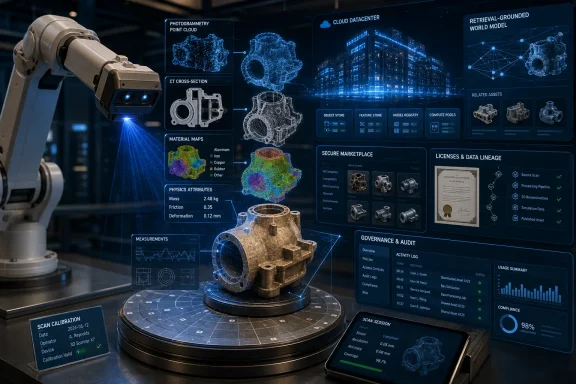
Global Objects is arguing that physical AI needs a different substrate. Its corpus is described as multimodal: high-resolution photogrammetric scans, physically based rendering material maps, CT scans for internal structure, measured weight and density, articulation, friction, deformation behavior, acoustic response, and thermal behavior. In other words, not just what an object looks like, but how it behaves.
That distinction matters because a simulation built on visual plausibility can deceive humans while remaining useless to machines. A synthetic warehouse scene might look convincing on a monitor, but if the objects in it have the wrong physics, it may train a system to succeed in simulation and fail in deployment. The more the AI industry moves from text generation into agentic systems, robotics, industrial control, and autonomous inspection, the more the cost of that mismatch rises.
The phrase “retrieval-grounded generative AI world model” may sound like another marketing compound noun, but the concept is straightforward enough. Rather than asking a model to invent object behavior from statistical patterns alone, the system retrieves relevant measured artifacts from a licensed corpus and uses them to ground generation. It is the same basic instinct behind retrieval-augmented generation for enterprise documents, applied to physical reality.
Microsoft has become very good at turning partner ambition into Azure consumption. The marketplace is not just a storefront; it is a distribution mechanism for enterprise software that needs to be purchased by committees and deployed under policy. For a product category as new as physical AI, that matters. A robotics team may be excited by a dataset; a CIO wants to know how it is bought, audited, integrated, and supported.
This is also where Microsoft’s strategy differs from the old “sell a cloud VM and let the customer figure it out” model. The company is increasingly trying to package Azure as the operating environment for AI systems: data, models, agents, security, compliance, observability, and partner solutions. The Global Objects collaboration slots neatly into that architecture. It gives Azure a differentiated data layer for customers building systems that must reason about the physical world.
For WindowsForum readers, the practical point is that this is not a consumer Windows feature announcement. Nobody should expect a “physical AI” toggle in Settings. The relevance is upstream: Azure is becoming the place where Microsoft wants industrial AI workloads, simulation pipelines, digital twins, robotics tooling, and procurement-approved AI services to converge. Those workloads may surface on Windows workstations, edge devices, mixed-reality setups, or factory systems, but the control plane is increasingly cloud-first.
That is a pointed contrast with the generative AI industry’s unresolved copyright and provenance fights. Text and image models trained on scraped public data have forced courts, regulators, publishers, artists, and software vendors into years of argument over fair use, consent, competition, and compensation. Physical AI vendors would prefer not to repeat that cycle while asking manufacturers, studios, retailers, and automotive firms to build production workflows on top of their data.
The problem is more complex than copyright. A scanned product is not merely a shape; it may reveal design, materials, assembly, tolerances, and sometimes internal structure. That makes provenance, permissions, and access control central to the business model. If a manufacturer contributes object data, it will want to know who can use it, for what purpose, under what license, and with what protections against leakage or reverse engineering.
Microsoft’s presence helps sell that story. Azure is already a known quantity for enterprises that care about identity, access control, regional data residency, compliance certifications, private networking, and security monitoring. That does not automatically make a physical-object corpus safe or risk-free, but it gives buyers a familiar governance vocabulary. It also gives Microsoft another reason to say that enterprise AI is not just about model quality; it is about the managed system around the model.
This is where the collaboration becomes strategically more interesting than the press-release phrasing suggests. If licensed, measured object data becomes a premium input for physical AI, then the owner of the distribution channel and compute environment gets leverage. Microsoft does not need to own every dataset if it can make Azure the place where the valuable datasets become usable.
Global Objects is attacking one part of that problem by making the objects themselves more faithful. If a robot learns from a coffee mug that has correct mass, geometry, friction, and breakage behavior, the resulting policy should be more useful than one trained on a visually convincing but physically generic mug. The same logic applies to factory parts, retail packaging, household goods, tools, automotive components, and film props.
The company’s mention of CT scans is especially notable. Surface scans can produce beautiful 3D assets, but many real-world interactions depend on what is inside the object. A hollow plastic toy, a ceramic cup, a composite component, and a metal tool can look similarly simple from the outside while behaving very differently under force. Internal structure is not a luxury detail when the downstream system must grasp, stack, heat, drop, inspect, or simulate the object.
Acoustic and thermal properties push the idea further. A system that can reason about how an object sounds when struck or how it conducts heat is not just seeing the world; it is beginning to model cross-modal physical behavior. That is valuable for inspection, safety, maintenance, robotics, and immersive media. It is also expensive to capture at scale, which is why a cloud-and-marketplace partner model makes sense.
The cautious interpretation is that this is still an early-stage bet. A 1.67 million object corpus sounds large, but the physical world is effectively infinite in variation. Object condition, manufacturing tolerances, regional variants, aging, damage, assembly state, and context all matter. A dataset can improve simulation without eliminating the need for real-world validation.
This has been visible in Microsoft’s language around agents and enterprise AI systems. The company is trying to make AI part of the operational fabric of organizations rather than a standalone novelty. Physical AI is a natural extension of that effort because it connects models to assets, environments, sensors, workflows, and safety constraints.
For industrial customers, the sales pitch is not “generate a prettier answer.” It is “reduce the cost of modeling the world accurately enough to automate or simulate decisions.” That can mean training robots, building digital twins, reconstructing 3D scenes, validating product behavior, generating synthetic training data, or creating media assets whose physics are traceable rather than guessed.
For Microsoft, these are attractive workloads. They are data-heavy, compute-heavy, storage-heavy, and governance-heavy. They involve long sales cycles and deep integration. They reward cloud platforms that can combine infrastructure, identity, security, analytics, and partner ecosystems. In short, they are the kind of enterprise AI workloads Microsoft understands how to monetize.
High-fidelity 3D assets, simulation environments, robotics tooling, CAD workflows, game engines, industrial visualization, and media production pipelines are all areas where Windows machines still matter. If Global Objects’ data becomes useful across those workflows, Windows users may encounter it through marketplace-procured services, Azure-connected applications, plugins, development environments, or enterprise portals rather than as a native OS feature.
There is also an edge-computing angle. Physical AI systems often cannot rely exclusively on round trips to the cloud. Robots, inspection systems, autonomous equipment, and factory devices need local inference, sensor fusion, and fail-safe behavior. Azure can train, store, govern, and orchestrate; Windows or Windows-adjacent edge systems may still operate as endpoints in mixed environments.
Microsoft has been willing to let the endpoint become more diverse as long as Azure remains central. That is the important shift. The old Microsoft wanted Windows everywhere. The current Microsoft wants identity, management, data, models, and billing to flow through its cloud even when the device layer is heterogeneous.
For IT administrators, that means the skills boundary keeps moving. Managing Windows endpoints is no longer enough in environments adopting AI-heavy operational systems. Teams will need to understand cloud identity, data governance, model access, marketplace procurement, audit trails, API integration, and the security posture of AI services that affect physical operations.
The Global Objects announcement leans on provenance and auditable lineage, which are necessary but not sufficient. Knowing where data came from is useful. Knowing that a model retrieved a measured object rather than inventing one is useful. But production systems will still need validation, monitoring, access control, red-team testing, and clear boundaries around what the AI is allowed to decide.
Security teams should pay attention to the object corpus itself. High-fidelity models of proprietary products, facilities, components, or supply-chain assets may be sensitive. If physical-world datasets become central to automation, they become targets. Attackers may want to steal them, poison them, infer trade secrets from them, or manipulate downstream systems that rely on them.
There is also a supply-chain question. When a customer builds a robotics or digital-twin workflow on top of third-party physical data, Azure services, generative models, and marketplace products, accountability becomes distributed. If the system fails, the root cause may sit in sensor capture, object metadata, model retrieval, simulation assumptions, customer integration, or operator misuse. Enterprise buyers will need contracts and technical controls that reflect that complexity.
This is where Microsoft’s Responsible AI branding will meet harder industrial reality. Frameworks are helpful, but physical deployments need engineering discipline. The market will eventually ask for benchmarks, audit standards, liability models, and repeatable validation methods. Until then, every “ground-truth” claim should be treated as a starting point, not a guarantee.
Microsoft Marketplace gives Global Objects a route into customers that might otherwise hesitate to engage a specialized spatial intelligence vendor. It also gives Microsoft a way to fold another AI category into its commercial machinery. The customer sees a partner solution; Microsoft sees Azure consumption, marketplace traction, and a stronger claim that its cloud is where AI ecosystems become deployable.
That matters because physical AI is unlikely to be a single-vendor market. Customers will use robotics platforms, simulation engines, CAD tools, game engines, industrial IoT systems, sensor vendors, data platforms, and model providers. Microsoft does not need to replace all of them. It needs to become the trusted hub through which enough of them integrate.
The marketplace model also helps Microsoft compete against cloud rivals that are making their own claims around AI infrastructure, robotics, and simulation. Amazon has deep industrial and logistics credibility. Google has AI research depth and mapping-world expertise. Nvidia has become a gravitational force for accelerated computing and simulation. Microsoft’s advantage is the enterprise account relationship, the identity stack, the developer footprint, and the ability to turn partner offerings into purchasable cloud solutions.
Global Objects gives Microsoft another card to play in that contest. It is not the whole deck. But it supports a narrative Azure badly wants: that the future of enterprise AI will be grounded, governed, multimodal, and deployed through Microsoft’s cloud.
The company says it operates facilities in the United States, the United Kingdom, and Hungary, with additional locations coming online beginning in July 2026. That suggests the business depends not just on software but on operational throughput. Scanning, weighing, testing, and characterizing real objects at scale is a logistics problem. The winners in this space may look as much like industrial data manufacturers as software startups.
There is also the question of coverage. A million-plus objects can be impressive and still miss the object a customer actually needs, or fail to capture the exact variant, damaged state, regional SKU, material revision, or assembly configuration that matters. The long-term value of the corpus will depend on how quickly it expands, how accurately it is labeled, how licensing is structured, and how easily customers can combine it with their own proprietary object data.
Another challenge is interoperability. Physical AI customers do not want their ground-truth assets trapped in a bespoke format that only works in one pipeline. They will need exports, APIs, connectors, metadata standards, simulation compatibility, and versioning. Azure can help with the platform layer, but the ecosystem will demand practical integration with the tools engineers and artists already use.
Finally, there is the model-quality question. Retrieval-grounded generation sounds promising, but customers will judge outcomes, not architecture. Does it reduce failed robot training runs? Does it make synthetic data more reliable? Does it improve digital-twin fidelity? Does it shorten media-production workflows? Does it pass audit? Does it save money? The answers will determine whether this becomes infrastructure or just another impressive demo category.
Global Objects is applying that logic to the material world. If the web was the first great training set for generative AI, measured reality may become one of the next. The companies that can capture, license, govern, and retrieve that reality will own a valuable position in the stack.
Microsoft’s role is to make that position enterprise-consumable. Azure supplies scale, security, procurement pathways, developer services, and the credibility of an established cloud platform. Global Objects supplies the specialized data and capture thesis. Customers supply the use cases that will prove whether the combination matters.
For WindowsForum’s audience, the practical takeaway is not that every sysadmin must suddenly become a robotics engineer. It is that AI infrastructure is expanding into domains where IT, operations technology, security, and data governance collide. The teams that understand those intersections will be better prepared than the teams waiting for AI to remain safely inside productivity apps.
 Microsoft Is Buying Into the Data Problem, Not Just the Model Race
The easy way to read the Global Objects announcement is as another Azure partnership in a week full of AI positioning. That would undersell what is actually being proposed. Global Objects is not pitching a larger language model, a better chatbot, or a generic synthetic-data service; it is pitching a corpus of physical objects captured with enough fidelity to matter for robots, industrial systems, digital twins, media production, automotive simulation, and retail product intelligence.The company says the initial seed corpus will scale to 1.67 million unique licensed objects. That number is less interesting than the adjective attached to it: licensed. The current generative AI market was built on a sprawling argument about whether web-scale scraping was clever engineering, legal arbitrage, or both. Physical AI does not get the same luxury. If an industrial robot learns from an object model that misrepresents weight, friction, articulation, or deformation, the failure is not a weird image artifact. It is a real-world operational hazard.
That is why this deal fits Microsoft’s broader enterprise posture. Redmond has spent the past several years trying to turn AI from a consumer spectacle into an accountable business platform. Azure, Microsoft Fabric, Foundry, Copilot, security tooling, marketplace procurement, and partner channels all point toward the same destination: make AI something procurement officers, compliance teams, developers, and IT administrators can buy, govern, monitor, and renew.
Global Objects gives Microsoft a story in a part of AI where the bottleneck is not primarily GPU supply or model architecture. It is whether the data describes the world accurately enough for machines to act on it. In physical AI, “close enough” is not close enough for very long.
The Web Taught Models to Imitate; Objects Must Teach Them to Behave
Internet-scale AI was trained on traces of human expression: text, code, images, video, and audio. That approach produced extraordinary systems, but it also trained them on a representation of the world filtered through cameras, captions, compression, editing, and social context. The web is full of objects, but it is not full of objects as engineers understand them.A video of a chair falling over can show motion, texture, and perhaps the likely direction of collapse. It does not reliably encode the chair’s exact mass distribution, joinery, material composition, internal structure, deformation limits, or acoustic signature. A language model may know that glass is brittle and steel is strong, but a robot arm needs more than that if it is deciding how hard to grip, how fast to move, and what failure looks like.
Global Objects is arguing that physical AI needs a different substrate. Its corpus is described as multimodal: high-resolution photogrammetric scans, physically based rendering material maps, CT scans for internal structure, measured weight and density, articulation, friction, deformation behavior, acoustic response, and thermal behavior. In other words, not just what an object looks like, but how it behaves.
That distinction matters because a simulation built on visual plausibility can deceive humans while remaining useless to machines. A synthetic warehouse scene might look convincing on a monitor, but if the objects in it have the wrong physics, it may train a system to succeed in simulation and fail in deployment. The more the AI industry moves from text generation into agentic systems, robotics, industrial control, and autonomous inspection, the more the cost of that mismatch rises.
The phrase “retrieval-grounded generative AI world model” may sound like another marketing compound noun, but the concept is straightforward enough. Rather than asking a model to invent object behavior from statistical patterns alone, the system retrieves relevant measured artifacts from a licensed corpus and uses them to ground generation. It is the same basic instinct behind retrieval-augmented generation for enterprise documents, applied to physical reality.
Azure Wants to Be the Place Where AI Meets Procurement
The announcement also says GO Scout, the first product in the Global Objects ecosystem, is available in Microsoft Marketplace. That detail may sound secondary, but for enterprise IT it is often the difference between a demo and a deployment. Marketplace availability means the offering can ride through familiar procurement, billing, governance, and vendor-management channels rather than living as a one-off research relationship.Microsoft has become very good at turning partner ambition into Azure consumption. The marketplace is not just a storefront; it is a distribution mechanism for enterprise software that needs to be purchased by committees and deployed under policy. For a product category as new as physical AI, that matters. A robotics team may be excited by a dataset; a CIO wants to know how it is bought, audited, integrated, and supported.
This is also where Microsoft’s strategy differs from the old “sell a cloud VM and let the customer figure it out” model. The company is increasingly trying to package Azure as the operating environment for AI systems: data, models, agents, security, compliance, observability, and partner solutions. The Global Objects collaboration slots neatly into that architecture. It gives Azure a differentiated data layer for customers building systems that must reason about the physical world.
For WindowsForum readers, the practical point is that this is not a consumer Windows feature announcement. Nobody should expect a “physical AI” toggle in Settings. The relevance is upstream: Azure is becoming the place where Microsoft wants industrial AI workloads, simulation pipelines, digital twins, robotics tooling, and procurement-approved AI services to converge. Those workloads may surface on Windows workstations, edge devices, mixed-reality setups, or factory systems, but the control plane is increasingly cloud-first.
Licensed Physical Data Is a Business Model Disguised as a Technical Requirement
The most commercially important word in the announcement may be “licensed.” Global Objects is not simply claiming better scans. It is claiming an IP-clean foundation for physical AI, with data lineage from object capture through model output and alignment with Microsoft’s Responsible AI framework.That is a pointed contrast with the generative AI industry’s unresolved copyright and provenance fights. Text and image models trained on scraped public data have forced courts, regulators, publishers, artists, and software vendors into years of argument over fair use, consent, competition, and compensation. Physical AI vendors would prefer not to repeat that cycle while asking manufacturers, studios, retailers, and automotive firms to build production workflows on top of their data.
The problem is more complex than copyright. A scanned product is not merely a shape; it may reveal design, materials, assembly, tolerances, and sometimes internal structure. That makes provenance, permissions, and access control central to the business model. If a manufacturer contributes object data, it will want to know who can use it, for what purpose, under what license, and with what protections against leakage or reverse engineering.
Microsoft’s presence helps sell that story. Azure is already a known quantity for enterprises that care about identity, access control, regional data residency, compliance certifications, private networking, and security monitoring. That does not automatically make a physical-object corpus safe or risk-free, but it gives buyers a familiar governance vocabulary. It also gives Microsoft another reason to say that enterprise AI is not just about model quality; it is about the managed system around the model.
This is where the collaboration becomes strategically more interesting than the press-release phrasing suggests. If licensed, measured object data becomes a premium input for physical AI, then the owner of the distribution channel and compute environment gets leverage. Microsoft does not need to own every dataset if it can make Azure the place where the valuable datasets become usable.
The Real Target Is the Simulation-to-Reality Gap
Robotics and autonomous systems have long struggled with the sim-to-real gap: models and agents that perform well in simulated environments but degrade when exposed to real-world messiness. Lighting changes, sensor noise, object variance, wear, deformation, occlusion, and unexpected material behavior all conspire against systems trained on simplified worlds.Global Objects is attacking one part of that problem by making the objects themselves more faithful. If a robot learns from a coffee mug that has correct mass, geometry, friction, and breakage behavior, the resulting policy should be more useful than one trained on a visually convincing but physically generic mug. The same logic applies to factory parts, retail packaging, household goods, tools, automotive components, and film props.
The company’s mention of CT scans is especially notable. Surface scans can produce beautiful 3D assets, but many real-world interactions depend on what is inside the object. A hollow plastic toy, a ceramic cup, a composite component, and a metal tool can look similarly simple from the outside while behaving very differently under force. Internal structure is not a luxury detail when the downstream system must grasp, stack, heat, drop, inspect, or simulate the object.
Acoustic and thermal properties push the idea further. A system that can reason about how an object sounds when struck or how it conducts heat is not just seeing the world; it is beginning to model cross-modal physical behavior. That is valuable for inspection, safety, maintenance, robotics, and immersive media. It is also expensive to capture at scale, which is why a cloud-and-marketplace partner model makes sense.
The cautious interpretation is that this is still an early-stage bet. A 1.67 million object corpus sounds large, but the physical world is effectively infinite in variation. Object condition, manufacturing tolerances, regional variants, aging, damage, assembly state, and context all matter. A dataset can improve simulation without eliminating the need for real-world validation.
Microsoft’s AI Stack Is Spreading Outward From the Office
Microsoft’s AI narrative began, at least for many mainstream users, with Copilot in Office, Windows, GitHub, and search. That phase was about productivity, content creation, coding, and knowledge work. The Global Objects collaboration points to a broader ambition: Microsoft wants AI to become infrastructure for industries where the interface is not a document or a chat box, but a machine, a factory, a warehouse, a vehicle, a product catalog, or a rendered world.This has been visible in Microsoft’s language around agents and enterprise AI systems. The company is trying to make AI part of the operational fabric of organizations rather than a standalone novelty. Physical AI is a natural extension of that effort because it connects models to assets, environments, sensors, workflows, and safety constraints.
For industrial customers, the sales pitch is not “generate a prettier answer.” It is “reduce the cost of modeling the world accurately enough to automate or simulate decisions.” That can mean training robots, building digital twins, reconstructing 3D scenes, validating product behavior, generating synthetic training data, or creating media assets whose physics are traceable rather than guessed.
For Microsoft, these are attractive workloads. They are data-heavy, compute-heavy, storage-heavy, and governance-heavy. They involve long sales cycles and deep integration. They reward cloud platforms that can combine infrastructure, identity, security, analytics, and partner ecosystems. In short, they are the kind of enterprise AI workloads Microsoft understands how to monetize.
Windows Is Not the Center of the Story, but It Is Still in the Room
A Windows-centric audience may reasonably ask where this leaves the PC. The answer is that Windows is not the primary battlefield here, but it remains an important client and developer surface. Physical AI workflows often involve engineers, designers, artists, operators, and administrators working from Windows workstations connected to cloud pipelines.High-fidelity 3D assets, simulation environments, robotics tooling, CAD workflows, game engines, industrial visualization, and media production pipelines are all areas where Windows machines still matter. If Global Objects’ data becomes useful across those workflows, Windows users may encounter it through marketplace-procured services, Azure-connected applications, plugins, development environments, or enterprise portals rather than as a native OS feature.
There is also an edge-computing angle. Physical AI systems often cannot rely exclusively on round trips to the cloud. Robots, inspection systems, autonomous equipment, and factory devices need local inference, sensor fusion, and fail-safe behavior. Azure can train, store, govern, and orchestrate; Windows or Windows-adjacent edge systems may still operate as endpoints in mixed environments.
Microsoft has been willing to let the endpoint become more diverse as long as Azure remains central. That is the important shift. The old Microsoft wanted Windows everywhere. The current Microsoft wants identity, management, data, models, and billing to flow through its cloud even when the device layer is heterogeneous.
For IT administrators, that means the skills boundary keeps moving. Managing Windows endpoints is no longer enough in environments adopting AI-heavy operational systems. Teams will need to understand cloud identity, data governance, model access, marketplace procurement, audit trails, API integration, and the security posture of AI services that affect physical operations.
The Security Model Must Catch Up to Machines That Touch Things
Physical AI raises a different risk profile from office productivity AI. A hallucinated paragraph can be embarrassing or legally dangerous. A hallucinated grip strength, simulated collision, or inspection result can damage equipment or injure people. That does not mean every physical AI system is safety-critical, but it does mean the governance bar should be higher than it is for a meeting-summary tool.The Global Objects announcement leans on provenance and auditable lineage, which are necessary but not sufficient. Knowing where data came from is useful. Knowing that a model retrieved a measured object rather than inventing one is useful. But production systems will still need validation, monitoring, access control, red-team testing, and clear boundaries around what the AI is allowed to decide.
Security teams should pay attention to the object corpus itself. High-fidelity models of proprietary products, facilities, components, or supply-chain assets may be sensitive. If physical-world datasets become central to automation, they become targets. Attackers may want to steal them, poison them, infer trade secrets from them, or manipulate downstream systems that rely on them.
There is also a supply-chain question. When a customer builds a robotics or digital-twin workflow on top of third-party physical data, Azure services, generative models, and marketplace products, accountability becomes distributed. If the system fails, the root cause may sit in sensor capture, object metadata, model retrieval, simulation assumptions, customer integration, or operator misuse. Enterprise buyers will need contracts and technical controls that reflect that complexity.
This is where Microsoft’s Responsible AI branding will meet harder industrial reality. Frameworks are helpful, but physical deployments need engineering discipline. The market will eventually ask for benchmarks, audit standards, liability models, and repeatable validation methods. Until then, every “ground-truth” claim should be treated as a starting point, not a guarantee.
The Marketplace Listing Is the Small Detail That Makes the Strategy Real
GO Scout’s availability in Microsoft Marketplace is the least glamorous part of the announcement and possibly the most practical. Enterprise AI does not scale through press releases. It scales when departments can buy it without inventing a procurement process, connect it to existing cloud commitments, and manage it under familiar administrative controls.Microsoft Marketplace gives Global Objects a route into customers that might otherwise hesitate to engage a specialized spatial intelligence vendor. It also gives Microsoft a way to fold another AI category into its commercial machinery. The customer sees a partner solution; Microsoft sees Azure consumption, marketplace traction, and a stronger claim that its cloud is where AI ecosystems become deployable.
That matters because physical AI is unlikely to be a single-vendor market. Customers will use robotics platforms, simulation engines, CAD tools, game engines, industrial IoT systems, sensor vendors, data platforms, and model providers. Microsoft does not need to replace all of them. It needs to become the trusted hub through which enough of them integrate.
The marketplace model also helps Microsoft compete against cloud rivals that are making their own claims around AI infrastructure, robotics, and simulation. Amazon has deep industrial and logistics credibility. Google has AI research depth and mapping-world expertise. Nvidia has become a gravitational force for accelerated computing and simulation. Microsoft’s advantage is the enterprise account relationship, the identity stack, the developer footprint, and the ability to turn partner offerings into purchasable cloud solutions.
Global Objects gives Microsoft another card to play in that contest. It is not the whole deck. But it supports a narrative Azure badly wants: that the future of enterprise AI will be grounded, governed, multimodal, and deployed through Microsoft’s cloud.
The Hard Part Starts After the Announcement
The announcement makes several ambitious claims, and the industry should treat them with interest rather than awe. Building a useful physical-object corpus is not like scraping webpages. It requires capture facilities, calibration, quality control, metadata discipline, rights management, storage, retrieval infrastructure, and customer-specific adaptation.The company says it operates facilities in the United States, the United Kingdom, and Hungary, with additional locations coming online beginning in July 2026. That suggests the business depends not just on software but on operational throughput. Scanning, weighing, testing, and characterizing real objects at scale is a logistics problem. The winners in this space may look as much like industrial data manufacturers as software startups.
There is also the question of coverage. A million-plus objects can be impressive and still miss the object a customer actually needs, or fail to capture the exact variant, damaged state, regional SKU, material revision, or assembly configuration that matters. The long-term value of the corpus will depend on how quickly it expands, how accurately it is labeled, how licensing is structured, and how easily customers can combine it with their own proprietary object data.
Another challenge is interoperability. Physical AI customers do not want their ground-truth assets trapped in a bespoke format that only works in one pipeline. They will need exports, APIs, connectors, metadata standards, simulation compatibility, and versioning. Azure can help with the platform layer, but the ecosystem will demand practical integration with the tools engineers and artists already use.
Finally, there is the model-quality question. Retrieval-grounded generation sounds promising, but customers will judge outcomes, not architecture. Does it reduce failed robot training runs? Does it make synthetic data more reliable? Does it improve digital-twin fidelity? Does it shorten media-production workflows? Does it pass audit? Does it save money? The answers will determine whether this becomes infrastructure or just another impressive demo category.
The Bet Is That Reality Becomes a Premium Dataset
The larger story is that the AI market is fragmenting into layers. General models are becoming more widely available, but high-value data remains scarce, controlled, and domain-specific. Enterprises do not merely need models that can talk; they need systems that understand the documents, workflows, assets, constraints, and physical environments that make their businesses different.Global Objects is applying that logic to the material world. If the web was the first great training set for generative AI, measured reality may become one of the next. The companies that can capture, license, govern, and retrieve that reality will own a valuable position in the stack.
Microsoft’s role is to make that position enterprise-consumable. Azure supplies scale, security, procurement pathways, developer services, and the credibility of an established cloud platform. Global Objects supplies the specialized data and capture thesis. Customers supply the use cases that will prove whether the combination matters.
For WindowsForum’s audience, the practical takeaway is not that every sysadmin must suddenly become a robotics engineer. It is that AI infrastructure is expanding into domains where IT, operations technology, security, and data governance collide. The teams that understand those intersections will be better prepared than the teams waiting for AI to remain safely inside productivity apps.
The Azure Deal Turns Physical AI Into an IT Planning Problem
This collaboration is still early, but it is concrete enough to deserve attention from enterprise technologists who have learned to separate AI theater from procurement reality.- Global Objects and Microsoft are collaborating on an Azure-hosted world model grounded in licensed, multimodally scanned physical objects rather than scraped internet video.
- The initial Global Objects corpus is planned to scale to 1.67 million unique licensed objects, with modalities that include geometry, materials, internal structure, mass, friction, deformation, acoustic behavior, and thermal behavior.
- GO Scout is available through Microsoft Marketplace, which makes the offering easier for enterprise customers to procure and govern through familiar Microsoft channels.
- The strongest technical claim is not prettier 3D generation but better grounding for robotics, simulation, digital twins, industrial AI, media workflows, automotive systems, and retail product intelligence.
- The biggest unresolved risks involve validation, data sensitivity, licensing boundaries, interoperability, and whether measured object data can be kept accurate enough for production physical systems.
- For Windows and Azure professionals, the development is another sign that Microsoft’s AI stack is moving from office productivity toward operational infrastructure.
References
- Primary source: AiThority
Published: Thu, 04 Jun 2026 07:45:38 GMT
Global Objects Announces Strategic Collaboration with Microsoft to Build the Ground-Truth Foundation for Physical AI on Microsoft Azure
Global Objects, Inc. (GO), a spatial intelligence company digitizing the physical world, announced a multi-year strategic collaboration with Microsoft to build a retrieval-groundedaithority.com - Related coverage: innovationopenlab.com
Global Objects Announces Strategic Collaboration with Microsoft to Build the Ground-Truth Foundation for Physical AI on Microsoft Azure
Global Objects, Inc. (GO), a spatial intelligence company digitizing the physical world, today announced a multi-year strategic collaboration with Microsoft to build a retrieval-grounded generative AI...www.innovationopenlab.com - Related coverage: tomshardware.com
Microsoft unveils Project Solara AI, a chip-to-cloud platform built to power a new generation of 'agent-first' enterprise devices — hardware designed to run AI agents instead of traditional apps | Tom's Hardware
Microsoft ditches Windows to build OS on Androidwww.tomshardware.com - Official source: blogs.microsoft.com
AI alone won't change your business. The system running it will. - The Official Microsoft Blog
Become an AI-first enterprise with Microsoft’s agent platform.blogs.microsoft.com - Official source: microsoft.com
Microsoft Cloud & AI Frontier Week — Jun 22-26
Microsoft Cloud & AI Frontier Week — Jun 22-26 (Digital Event)www.microsoft.com
- Official source: azure.microsoft.com
FabCon and SQLCon 2026: Unifying databases and Fabric on a single data platform | Microsoft Azure Blog
Learn how we're combining the power of SQL and Fabric to create a platform that unifies transactional, operational, and analytical data. azure.microsoft.com
- Related coverage: fortune.com
As Microsoft seeks to be AI's center of gravity, CEO Satya Nadella makes the case in San Francisco | Fortune
Microsoft held its annual Build developer conference in SF for the first time in years as the software giant revealed a sweep of product announcements.fortune.com
- Official source: azure-int.microsoft.com
- Official source: marketplace.microsoft.com
Microsoft Marketplace | cloud solutions, AI apps, and agents
marketplace.microsoft.com
- Official source: azuremarketplace.microsoft.com
Microsoft Marketplace | cloud solutions, AI apps, and agents
azuremarketplace.microsoft.com
- Related coverage: ust.com
UST | Microsoft Strategic Partner
UST is proud to be an Microsoft Strategic Partner. UST and Microsoft partnership provides enterprise focus – scalable/mission-critical solutions with flexible engagement models.www.ust.com
- Related coverage: crn.com
- Official source: marketingassets.microsoft.com
