Elon Musk’s social network X suffered a widespread global outage on January 16, 2026 — the second large-scale interruption for the platform in the span of a week — leaving tens of thousands of users unable to load feeds, post, or access X’s AI assistant Grok and triggering renewed questions about the platform’s operational resilience under its current ownership.
Since Elon Musk’s acquisition of Twitter and its rebrand to X, the platform has seen repeated technical incidents that have attracted outsized public attention. In mid‑January 2026 those concerns resurfaced after two separate disruptions within a few days: a large outage earlier in the week and another, larger event on Friday that produced mass reports on outage trackers and intermittent service recovery for many users. Downdetector and independent monitoring services recorded surge spikes in the tens of thousands during the Friday incident, and engineers and network observers logged intermittent HTTP 503 and other server‑side errors as the
This feature unpacks what happened, what the independent telemetry shows, the immediate and downstream impacts, the likely technical avenues investigators are examining, and the broader operational and policy implications for enterprises and everyday users who rely on X for news, customer engagement, and real‑time updates.
Key avenues engineers will investigate:
Until X publishes a formal, detailed post‑mortem that reconciles internal logs with independent monitoring, assertions about root cause or external attribution should be treated as provisional. The technical evidence available publicly supports the conclusion that backend service degradation — not an absolute loss of network connectivity — was the immediate failure mode, and that mitigating similar incidents going forward will require both engineering fixes and improved public communication.
Conclusion
The January outages put X’s operational dependability back under the microscope. Users, enterprises, and regulators have cause to expect more candour, clearer status reporting, and structural engineering changes from a platform whose role in the public information ecosystem continues to grow. Short‑term fixes will restore sessions and timelines; the longer‑term task is reducing systemic fragility so that tomorrow’s breaking news — or a critical public‑safety alert — doesn’t depend on a single point of failure.
Source: LADbible https://www.ladbible.com/news/technology/x-down-for-second-time-in-week-006243-20260116]
 Background
Since Elon Musk’s acquisition of Twitter and its rebrand to X, the platform has seen repeated technical incidents that have attracted outsized public attention. In mid‑January 2026 those concerns resurfaced after two separate disruptions within a few days: a large outage earlier in the week and another, larger event on Friday that produced mass reports on outage trackers and intermittent service recovery for many users. Downdetector and independent monitoring services recorded surge spikes in the tens of thousands during the Friday incident, and engineers and network observers logged intermittent HTTP 503 and other server‑side errors as theThis feature unpacks what happened, what the independent telemetry shows, the immediate and downstream impacts, the likely technical avenues investigators are examining, and the broader operational and policy implications for enterprises and everyday users who rely on X for news, customer engagement, and real‑time updates.
What happened — timeline and symptoms
The visible timeline
- Initial reports from users and outage trackers surfaced around mid‑morning Eastern Time on January 16, 2026, with the peak of reports appearing roughly around 10:00–10:30 a.m. ET. Major outlets and outage aggregators reported tens of thousands of individual incident reports during the peak of the disruption.
- Users described blank feeds, pages that returned “Something went wrong” messages, connection timeouts, and Cloudflare or CDN‑related error pages in some clients. Mobile apps were widely affected as well as desktop web sessions.
- Service began to partially return within about an hour for many users, but intermittent errors and partial functionality persisted into the afternoon for a subset of regions and clients. Independent observers placed the bulk of the visible recovery later in the day.
Observed error signals
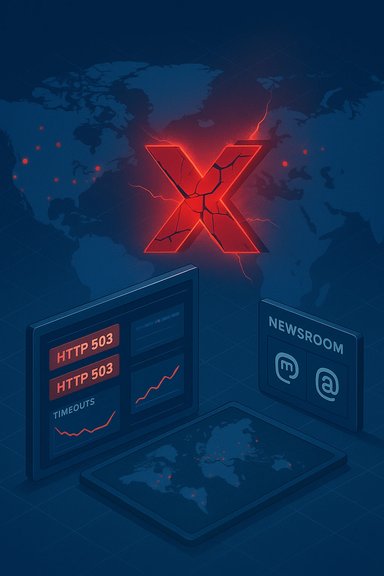
Third‑party telemetry from network observability firms shows the outage manifesting primarily as server‑side failures rather than a pure network reachability problem. ThousandEyes’ public analysis logged HTTP 503 (Service Unavailable) responses and intermittent timeouts when trying to fetch critical application resources — a classic sign that frontend CDNs were reachable but the application backends were returning errors or failing to respond. That pattern points toward backend service degradation or misconfiguration rather than a simple CDN outage.Scale and impact
- Downdetector reported tens of thousands of complaints in the United States at the outage’s peak, with additional spikes reported in the UK, India and other markets. Multiple outlets cited independent trackers placing the U.S. peak in the tens of thousands; global aggregated reports were higher.
- X’s integrated AI assistant Grok and several API‑dependent features also showed degraded availability, increasing the practical impact for users and third‑party tools that rely on X for real‑time signals and conversational services.
- The outage forced many users, journalists, and organizations that rely on X for breaking updates to migrate temporarily to alternative platforms such as Mastodon, Threads and other social networks, increasing load on those services for the duration of the outage. Several outlets observed spikes of content about the outage appearing elsewhere as frustrated users sought alternatives.
Independent analysis: what telemetry tells us
Multiple independent observers converged on a shared set of symptoms: reachability to X’s frontends (CDNs) was generally intact, but critical backend resources timed out, returned HTTP 503/502 errors, or otherwise failed to deliver the JavaScript bundles and API responses required to render a usable timeline. In practical terms that meant users often saw a blank or black screen with the X logo, then a client‑side error message — the hallmark of a backend application issue rather than an ISP or transit problem. ThousandEyes’ step‑by‑step breakdown identified three phases consistent with a backend degradation scenario:- initial partial failures where some resources loaded while others timed out;
- a worsening phase with more widespread 5xx errors and timeouts; and
- a controlled error state as degraded services returned consistent error messages while recovery proceeded.
Possible causes and what engineers will look for
It remains important to be explicit about what is known versus what is hypothesized. Independent telemetry supports a backend degradation diagnosis, but the precise trigger — whether a failed software deployment, a configuration change, resource exhaustion, a cascading dependency failure, or a targeted attack — requires internal logs and forensics to confirm.Key avenues engineers will investigate:
- Recent configuration or code deployments — automated rollouts sometimes allow defective changes to reach production; the mixed error patterns seen by ThousandEyes mirror prior incidents where a bad config caused partial failures.
- Dependency exhaustion or queuing backlogs — sudden rate spikes, failing caches, or overloaded databases can surface as 503s and timeouts, especially when retry storms amplify load. Observers of past large outages point to queue backlog dynamics that prolong recovery.
- Interplay with CDNs and edge services — while CDNs like Cloudflare or Fastly front the platform, problems in the origin layer or in the connectors between edge and origin will appear as the mixed 502/503/504 error pattern seen here. Cloudflare itself posted maintenance and diagnostics during the window that could have been operational context, but the telemetry favored an X origin/backend issue rather than a pure Cloudflare outage.
- Security incident / DDoS — platform owners sometimes attribute outages to attacks; such claims require forensic trace evidence. Historically, high‑volume DDoS attacks can produce symptoms similar to backend exhaustion, but DDoS attribution must be proven carefully with packet‑level and capacity data rather than assumption. No public forensic confirmation of a successful, large‑scale attack was available at the time of reporting.
Public communication and operational transparency
One of the recurring criticisms during high‑impact outages is poor or absent public status communication. For many platforms the status page and engineering updates are the primary way to reassure customers and provide timelines. During the January incidents, X did not immediately publish a detailed public post‑mortem or a clear status link for end users; independent outage monitors and journalists filled that information gap. That opacity fuels speculation and undermines trust, especially for institutions that rely on X for time‑sensitive information. Best practice for platform operators during incidents is simple but demanding:- keep a public, accurate status page;
- post timely interim updates stating what is known and what is being investigated;
- avoid premature attribution until forensic evidence is available; and
- publish a detailed post‑incident report when the investigation concludes.
Why this matters beyond memes and irritation
The practical fallout from repeated short outages is not limited to frustrated users. Consider these real consequences:- Newsrooms and emergency services often use X for real‑time tip lines and alerts; interrupted access can delay information flows during breaking events.
- Businesses and brands that run customer support via X can lose responsiveness during outages, affecting customer service SLAs.
- Developers using X’s APIs for integrations face failed calls and degraded downstream features.
- Regulators and policymakers watch repeated outages as evidence of systemic risk in digital infrastructure and may press for incident reporting requirements or resilience standards.
Immediate mitigation steps for IT teams and community managers
- Maintain alternate channels for critical alerts (SMS, email, other social platforms) and pre‑approve communication templates so messages can be dispatched quickly.
- Test and exercise fallback workflows for breaking news or urgent customer support scenarios that do not rely on a single platform.
- Implement monitoring that tracks not only availability (HTTP 200) but also functional health of APIs and critical JavaScript or manifest resources that power the front end.
- For developers using X APIs, implement robust retry/backoff and graceful degradation — design client behavior that shows cached content instead of fully failing when services respond with 5xx errors.
- Track vendor status pages for CDNs and hosting providers; correlate those signals with your own telemetry to distinguish edge problems from origin backend failures.
Strengths, weaknesses and broader risks
Notable strengths
- X remains a high‑velocity platform for news and public conversation; rapid user reaction to outages often produces quick operational visibility via community reports and alternate platforms.
- The presence of multiple independent monitors (Downdetector, ThousandEyes, NetBlocks and others) helps triangulate event scope and provide empirical evidence to engineering teams.
Key weaknesses and risks
- Operational fragility: repeated outages in a short timeframe increase the probability of reputational damage and user churn.
- Opaque communications: absence of clear status messaging exacerbates speculation and slows coordinated responses from downstream partners.
- Concentration of critical dependencies: reliance on a small set of CDNs, backend services, and a single application control plane creates single points of failure that can cascade broadly when they falter. Independent post‑mortems from hyperscale providers show this is a persistent systemic risk.
Strategic risk for the platform
If outages continue or if the company cannot produce credible, transparent root‑cause analyses and corrective action plans, advertisers, publishers, and institutions may reassess how they allocate scarce attention and budgeted resources. For a platform whose value is tied to immediacy and reach, persistent reliability issues can have outsized strategic consequences.What to watch next
- Official post‑incident report from X: the single most important follow‑up is a detailed incident report that identifies the root cause, mitigation steps, and concrete actions to prevent recurrence. Until that report appears, public narratives are provisional.
- Third‑party forensic confirmation: network observability firms and independent researchers will publish deeper technical analyses; align those with X’s own disclosures to form a complete picture. ThousandEyes’ early analysis points to backend 5xxs; follow‑on analysis could add nuance about which internal subsystems were implicated.
- **Regulatory interest and compliaed outages can trigger inquiries under regional rules such as Europe’s Digital Services Act or other regulatory frameworks that demand incident reporting and post‑incident disclosure.
- Operational changes at X: look for signals that X invests in staged rollouts, canarying, redundancy improvements, or changes to how it configures and validates global changes — measures that directly reduce the risk of cascading failures.
Final assessment
The January 16 outage was not simply an isolated blip: it was the second notable interruption in a single week, and independent telemetry consistently pointed to backend application failures as the proximate symptom (503/502/504 responses and timeouts) rather than a pure CDN or ISP reachability problem. That technical pattern focuses attention on origin systems, recent rollouts or configuration changes, and dependency behaviors that allow small faults to escalate across distributed microservices. From a practical perspective, the incident is a sober reminder that platforms which play critical roles in public conversation and crisis reporting must invest in operational transparency, redundant architectures, and tested fallbacks. For organizations that depend on X, the outage is a prompt to re‑exercise contingency plans, diversify communications channels, and demand clearer incident reporting from upstream providers.Until X publishes a formal, detailed post‑mortem that reconciles internal logs with independent monitoring, assertions about root cause or external attribution should be treated as provisional. The technical evidence available publicly supports the conclusion that backend service degradation — not an absolute loss of network connectivity — was the immediate failure mode, and that mitigating similar incidents going forward will require both engineering fixes and improved public communication.
Conclusion
The January outages put X’s operational dependability back under the microscope. Users, enterprises, and regulators have cause to expect more candour, clearer status reporting, and structural engineering changes from a platform whose role in the public information ecosystem continues to grow. Short‑term fixes will restore sessions and timelines; the longer‑term task is reducing systemic fragility so that tomorrow’s breaking news — or a critical public‑safety alert — doesn’t depend on a single point of failure.
Source: LADbible https://www.ladbible.com/news/technology/x-down-for-second-time-in-week-006243-20260116]