

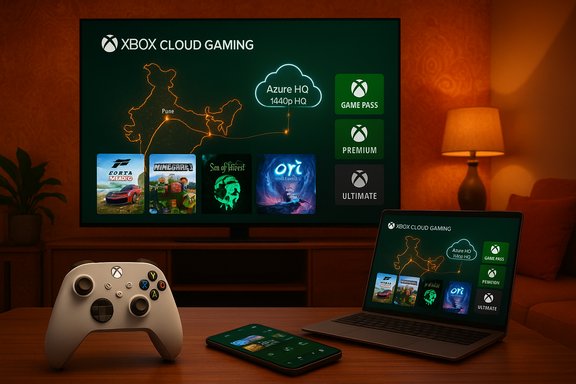
Microsoft’s Xbox Cloud Gaming is officially live in India, giving millions of players across the country immediate access to a streamed library of console and PC games through local Azure capacity and the Xbox Game Pass subscription tiers. The rollout brings the service to Indian devices via the web, Xbox apps on smart TVs, the Xbox PC app, and supported streaming sticks — and it is being delivered from newly activated cloud stacks mapped to Microsoft’s Pune and Chennai Azure regions to reduce latency for Indian players.
Xbox Cloud Gaming (formerly Project xCloud) streams gameplay from remote Xbox‑class hardware in Microsoft Azure datacenters to your device, decoding live video while sending controller inputs back to the datacenter. The feature is integrated into the Game Pass family of subscriptions and has evolved from a beta proof‑of‑concept into a full‑scale distribution channel that Microsoft uses to expand reach without forcing hardware upgrades. Microsoft’s recent upgrades to the service include higher bitrate quality tiers and a new 1440p streaming option for higher plans, which helps narrow the visual gap with competing cloud services. This India activation is more than a territorial checkbox. By running Xbox Cloud Gaming stacks inside Microsoft’s India Azure regions, Microsoft shortens the “first hop” for network traffic, which materially reduces round‑trip time for many Indian ISPs and cities. That lower latency is the single most important improvement for making cloud gaming feel playable for action titles and competitive multiplayer. Early telemetry, community diagnostics, and local reporting all point to meaningful latency wins for players routed to Pune and Chennai nodes.
For Microsoft, India offers scale: more users streaming games yields volume that can amortize cloud costs and justify further local capacity investments — especially if Microsoft pairs the service with telco bundles, ad‑supported funnels, or retail demos to drive trial. Early signals to watch include telco partnerships, ISP peering optimizations, and any local promotional pricing that Microsoft or retail partners announce.
Strengths
Xbox Cloud Gaming in India is available now at xbox.com/play and through supported apps on compatible devices; players should verify their subscription benefits and system compatibility inside their Microsoft account before subscribing.
Source: SSBCrack News Xbox Cloud Gaming Launches in India - SSBCrack News
 Background / Overview
Xbox Cloud Gaming (formerly Project xCloud) streams gameplay from remote Xbox‑class hardware in Microsoft Azure datacenters to your device, decoding live video while sending controller inputs back to the datacenter. The feature is integrated into the Game Pass family of subscriptions and has evolved from a beta proof‑of‑concept into a full‑scale distribution channel that Microsoft uses to expand reach without forcing hardware upgrades. Microsoft’s recent upgrades to the service include higher bitrate quality tiers and a new 1440p streaming option for higher plans, which helps narrow the visual gap with competing cloud services. This India activation is more than a territorial checkbox. By running Xbox Cloud Gaming stacks inside Microsoft’s India Azure regions, Microsoft shortens the “first hop” for network traffic, which materially reduces round‑trip time for many Indian ISPs and cities. That lower latency is the single most important improvement for making cloud gaming feel playable for action titles and competitive multiplayer. Early telemetry, community diagnostics, and local reporting all point to meaningful latency wins for players routed to Pune and Chennai nodes. What’s included in the India launch
Devices and entry points
- Web browsers (xbox.com/play) on Windows, macOS, ChromeOS, Android and iOS (Safari web client on Apple devices) remain the fastest, no‑install route to cloud play.
- Native app endpoints: the Xbox PC app, partner smart TV apps on supported Samsung and LG models, and compatible Amazon Fire TV devices provide living‑room access without a console.
- Windows handhelds and modern laptops can use the Xbox PC app or the browser to stream where supported.
Game Pass tiers and local pricing (what to expect)
Microsoft’s 2025 Game Pass rework introduced tiered pricing and renamed plans globally; India’s rollout maps cloud access into the new Essential / Premium / Ultimate split. Local coverage at launch reported introductory monthly price points commonly cited as:- Essential — ₹499/month (cloud streaming + a smaller curated library)
- Premium — ~₹699/month (expanded library, broader device compatibility)
- Ultimate — ₹1,389/month (full catalog, day‑one first‑party releases, highest quality cloud tiers)
These figures were published by multiple Indian outlets at launch and align with Microsoft’s global repositioning of Game Pass benefits, but regional taxes, promotions, and account conditions can change the final price at purchase — always confirm inside your Microsoft account before subscribing.
The technical picture: Pune and Chennai matter
Why local Azure regions change the experience
Cloud gaming’s UX depends on two network variables: bandwidth and latency. Bandwidth determines how much visual fidelity you can receive; latency (round‑trip time) determines how responsive controls feel. Placing Xbox Cloud Gaming servers inside India’s Azure regions — notably Central India (Pune) and South India (Chennai) — reduces geographic distance and ISP peering hops for many users, lowering ping times and jitter. Community diagnostic tools and hands‑on reports after the activation show sub‑50 ms routing for many metro areas, which converts marginal sessions to playable experiences for a bigger audience.What Microsoft changed on the backend
Over the past year Microsoft migrated cloud stacks to newer server blades and increased the available bitrate profiles for Xbox Cloud Gaming, introducing a high‑quality “HQ” bitrate mode and a 1440p resolution tier for supported devices and subscription levels. These encoding and server upgrades are why a meaningful territory activation like India is practical today: the combination of better encoders, higher bitrates, and localized edges creates the conditions where streamed games can look and feel significantly better than earlier xCloud generations. Not all titles immediately support the top quality tier — that remains gated by per‑title readiness and device codec support.Streaming quality: 1440p and “HQ” bitrate explained
Microsoft’s recent public notes and independent testing indicate that the Xbox Cloud Gaming upgrade brings a select 1440p streaming mode to higher tiers (principally Ultimate) and to specific devices and game titles. This is a step up from the older 1080p/60 and heavily compressed streams that characterized early cloud builds, and in practice yields crisper textures and fewer compression artifacts on large screens. However, the rollout is incremental:- 1440p is currently limited to a subset of games and devices; it’s not guaranteed across the entire Game Pass catalog.
- Higher bitrates and 1440p streams require stronger, more stable broadband — real‑world recommendations remain in the 20–35 Mbps and up range for consistent high‑quality streaming.
- Even with local nodes, network jitter, ISP routing, and home Wi‑Fi quality still determine the subjective experience.
Devices, accessibility and the living room
Microsoft’s device strategy is deliberately broad: the goal is to reach screens players already own. That means:- Mobile (Android/iOS via the browser), laptops and desktops (Edge/Chrome/Safari), and Windows handhelds all work through the web or Xbox PC app.
- Smart TVs: Samsung has long integrated Xbox Cloud Gaming into its Gaming Hub; LG’s webOS integration has been expanding in 2025 and is now part of the TV rollout conversation. Amazon Fire TV devices also support the Xbox app on compatible sticks and boxes.
- Controllers: Xbox Wireless Controller is recommended, but Bluetooth controllers including DualSense and third‑party gamepads work in many contexts (input mapping and haptics vary).
How Xbox Cloud Gaming in India compares to rivals
NVIDIA GeForce Now — the quality benchmark
NVIDIA’s GeForce Now positions itself as the technical top‑end of consumer cloud gaming, leveraging high‑end GPU pods (RTX 4080‑class in the Ultimate tier) and offering ultra‑high bitrates and 4K/120fps streaming in some tiers and apps. That hardware‑first approach typically yields the highest peak visual fidelity and the most aggressive frame‑rate options on compatible clients. For players who prioritize absolute resolution and high frame‑rates on supported displays, GeForce Now remains the benchmark.PlayStation Plus and PlayStation Portal — the platform approach
Sony’s cloud play efforts come via PlayStation Plus (with a Premium catalog) and hardware like the PlayStation Portal handheld. Historically the Portal was a PS5‑centric remote play accessory, but Sony has been iterating on cloud features that let PlayStation Plus Premium subscribers stream select PS5 titles without owning a console in some regions. The Portal’s appeal is ecosystem lock‑in: it’s excellent for PlayStation loyalists but less flexible as a cross‑device mass‑market on‑ramp compared with Xbox’s multi‑device web‑centric approach. Additionally, PlayStation’s cloud catalog and business model differ: Sony can monetize through curated PS Plus catalogs and hardware bundles rather than a broad Game Pass subscription strategy.Where Xbox Cloud Gaming competes
Microsoft’s strengths in this race are:- Content and bundling: Game Pass (day‑one new releases on some tiers) provides a compelling content funnel.
- Device reach: A web‑first approach plus TV OEM partnerships and Windows handhelds make the service broadly accessible.
- Local Azure infrastructure: Activating Pune and Chennai lowers the latency barrier for a vast population that previously had to route to distant edges.
Risks, limits and what to watch
1) Last‑mile variability
Even with local Pune/Chennai servers, the user experience depends on ISP peering, routing, and household Wi‑Fi. Many Indian cities will see clear improvements; some patterns of congested last‑mile networks or poor home Wi‑Fi will still produce stutter or artifacts. Users should prefer wired Ethernet or high‑quality 5 GHz Wi‑Fi and test behavior across ISPs.2) Catalog and title gating
Not every Game Pass title will be cloud‑playable at the highest quality right away. Publishers must enable technical compatibility and Microsoft must gate top tiers by device support. Players should not assume universal 1440p support on day one.3) Price sensitivity and regional economics
India is extremely price‑sensitive. Microsoft’s new Game Pass pricing and tier reshuffle aim to monetize the service sustainably, but balancing revenue with mass adoption will require careful offers, telco or retail bundles, and promotions targeted to Indian consumer expectations. Any misstep in local pricing or benefit mapping could limit mainstream adoption.4) Regulatory and operational contingencies
Operating a consumer cloud service at scale requires ongoing regulatory diligence — data locality, telecom policy, and potential future rules can affect cost and operations. Microsoft already runs Azure regions in India to address many concerns, but policy shifts remain a risk to long‑term operations.What this means for the Indian market
India is among the fastest‑growing gaming regions globally, driven by mobile adoption and falling device costs. Localized cloud gaming transforms the equation by enabling console‑grade experiences on existing phones, TVs, and laptops, lowering the barrier to entry for millions. For developers and publishers, a larger cloud audience can mean more players sampling games through Game Pass and potentially more conversions to purchases, DLC, or sequel interest.For Microsoft, India offers scale: more users streaming games yields volume that can amortize cloud costs and justify further local capacity investments — especially if Microsoft pairs the service with telco bundles, ad‑supported funnels, or retail demos to drive trial. Early signals to watch include telco partnerships, ISP peering optimizations, and any local promotional pricing that Microsoft or retail partners announce.
How to try Xbox Cloud Gaming in India today — quick checklist
- Confirm your Microsoft account and Game Pass subscription tier (Essential/Premium/Ultimate).
- From a modern browser, go to xbox.com/play and sign in to view your cloud‑playable catalog (no install needed).
- Pair a compatible controller (Xbox Wireless Controller recommended) and check network stability (prefer Ethernet or high‑quality 5 GHz Wi‑Fi).
- For TVs, open the Xbox app on a supported Samsung/LG model or the preinstalled partner app on Amazon Fire TV devices and sign in.
- If you want to verify which Azure node you connect to, community diagnostics tools can show edge nodes — use them cautiously and understand they are third‑party utilities.
Short technical troubleshooting tips
- Use wired Ethernet when possible, or a close 5 GHz Wi‑Fi connection.
- Close background sync clients and bandwidth‑hungry apps during gameplay.
- Keep browser and controller firmware up to date; enable hardware media extensions on Windows to unlock HEVC/AV1 decoding paths where prompted.
- If you experience high latency, run a traceroute to verify routing to Pune/Chennai nodes and test with different ISPs or mobile tethering to isolate path issues.
Final analysis — strategic strengths and lingering questions
Microsoft’s activation of Xbox Cloud Gaming in India is a technically grounded and strategically important step that pairs Azure edge capacity with the content leverage of Game Pass. The move addresses one of the main friction points for cloud play in India — geographic latency — and bundles broad device support that suits the country’s device mix. For many players, the ability to stream blockbuster titles without buying a console will be transformative.Strengths
- Local latency wins via Pune and Chennai Azure nodes that make cloud play genuinely playable for many Indian users.
- Device reach and convenience thanks to web‑first access, TV OEM partnerships, and Windows handhelds that reduce adoption friction.
- Content proposition through Game Pass bundling and day‑one releases (on higher tiers) that differentiate Microsoft beyond raw streaming quality.
- Quality parity is nascent: 1440p and HQ bitrates are promising but gated, and full parity across the catalog will take time.
- Price sensitivity in India means Microsoft must carefully calibrate offers and telco bundles to build mass adoption without eroding margins.
- Last‑mile variability remains a gating factor for many households; localized edges help but do not eliminate home Wi‑Fi and ISP routing problems.
Xbox Cloud Gaming in India is available now at xbox.com/play and through supported apps on compatible devices; players should verify their subscription benefits and system compatibility inside their Microsoft account before subscribing.
Source: SSBCrack News Xbox Cloud Gaming Launches in India - SSBCrack News
