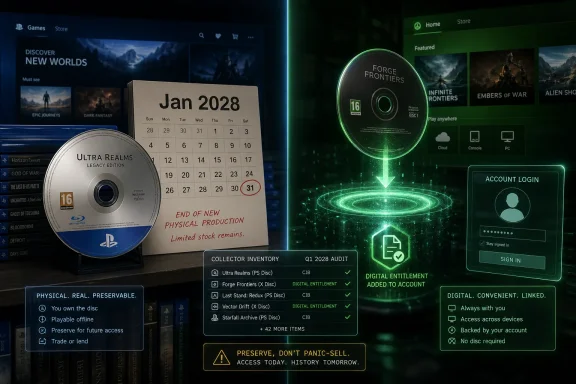
Microsoft’s reportedly in-testing Xbox “Positron” program would let players convert eligible Xbox One and newer game discs into digital entitlements by installing them, a move that arrives as Sony says new PlayStation games will stop shipping on discs in January 2028. That timing is not accidental in the broader market, even if Microsoft has not formally announced Positron or the next Xbox hardware plan. The console business is now trying to solve a problem it created over two decades: how to retire optical media without detonating player trust. If the reports are accurate, Microsoft’s answer is not to save the disc, but to turn it into a receipt.
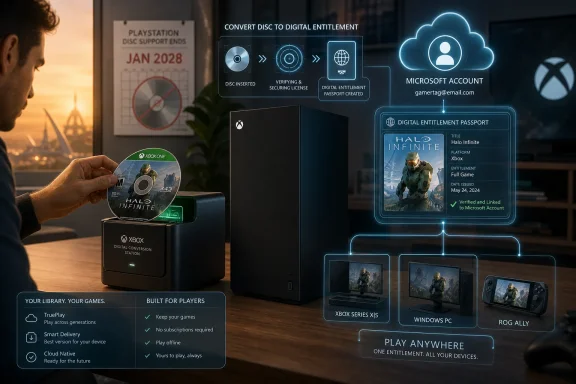
The crucial detail in the new Positron reporting is its apparent simplicity. Earlier hints of a disc-to-digital program invited all the obvious nightmare scenarios: retail verification counters, mail-in schemes, one-time transfer fees, external drives with arcane restrictions, or some modern remix of the Xbox One’s infamous 2013 licensing pitch. Instead, the reported flow is far more ordinary: put the disc in, install the game, and Microsoft associates the entitlement with your account.
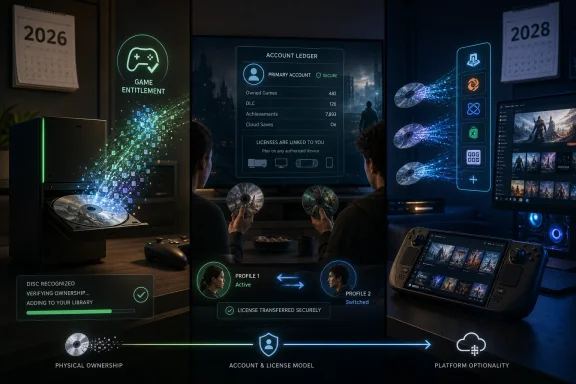
That sounds small because it hides the real shift. A physical Xbox game would no longer be primarily a medium that carries software; it would become an authentication artifact used to create a digital license. Once the account has that license, the game can follow the player into the modern Xbox stack: cloud streaming, handheld Windows devices, Xbox Play Anywhere where supported, and whatever Microsoft ships next.
This is not preservation in the archival sense. It is preservation as platform continuity. Microsoft is not promising that every disc ever pressed will remain independently playable forever; it is reportedly designing a bridge from the disc era into an account-based future.
That distinction matters because it is where the whole argument lives. Positron is being framed as a customer-friendly escape hatch, and in many practical ways it could be exactly that. But it is also a mechanism for finishing the transition away from physical ownership while giving longtime Xbox users a reason not to revolt.
The industry eventually adopted much of that future anyway. Modern console games are routinely installed in full, patched heavily, authenticated online, expanded through digital storefronts, and tied into accounts. The disc still matters, but often less as a self-contained product than as a license key that tells the console the player is allowed to launch what is already on the drive.
The difference now is that Microsoft may be approaching the same destination from the opposite direction. Rather than saying, “Your disc is now subordinate to our licensing system,” Positron appears to say, “Your disc can unlock the same portability digital buyers already get.” That is a much better sales pitch, especially to players who have watched digital libraries become the center of console ecosystems.
Still, the old wound explains why Microsoft has to be careful. Any hint that this system revokes too easily, fails too often, excludes too many games, or quietly pressures users to abandon discs before they are ready will revive the 2013 argument in a more cynical age. Gamers are less naïve now about licensing, delistings, cloud dependence, and storefront closures.
That does not mean PlayStation and Xbox are making identical moves. Sony’s announcement concerns new PlayStation games after a cutoff date, while the biggest unanswered question is what future hardware will do with existing PS4 and PS5 discs. Microsoft, by contrast, appears to be working the other side of the problem: if future Xbox hardware drops the drive, how can existing physical Xbox One and Series libraries be carried forward into the account-based Xbox world?
This is where Positron could become strategically important. It would let Microsoft say, with a straight face, that moving away from built-in disc drives does not have to strand disc buyers. That sentence is easy to write and hard to execute, because every exception will be personal to somebody. The one unsupported favorite game in a collection of a hundred supported titles will still feel like a broken promise.
The rumored limit to Xbox One and newer discs is therefore more than a technical footnote. Xbox’s backward compatibility reputation was built partly on making old Xbox and Xbox 360 games feel unusually alive on newer hardware. If Positron excludes Xbox 360 and original Xbox discs, Microsoft can still claim a meaningful transition path for the last decade of purchases, but not a complete one for the whole Xbox legacy.
That is why disc support is such an awkward fit for the next Xbox. A disc drive is local, mechanical, and tied to one box. Xbox’s current strategy is networked, account-based, and designed to follow the user across devices. A physical disc cannot be inserted into an Xbox Ally-style handheld, a Samsung TV app, a browser session, or a cloud blade in a data center.
Positron would resolve that mismatch by moving proof of ownership from the plastic object to the Microsoft account. The disc would begin the process, but the entitlement would do the traveling. For Microsoft, that is the whole point: the company can honor the customer’s past purchases while making the future hardware less dependent on an optical drive.
There is an obvious business upside, too. A console without a disc drive is simpler to manufacture, easier to design, less exposed to mechanical failure, and more aligned with the digital storefront where platform holders control distribution. It also weakens the used-game market, rental culture, and informal lending habits that made discs feel like property rather than permission.
That tension is why Microsoft cannot present Positron merely as a convenience feature. It is a trust feature. If Xbox wants players to accept a discless future, it needs to show that old purchases become more useful in the new ecosystem, not less.
In theory, this is exactly what a fair disc-to-digital system needs. If Microsoft simply let every disc create permanent digital licenses forever, one physical copy could propagate through dozens of accounts. Publishers would never accept that. If Microsoft locked the disc forever to the first account, it would effectively destroy resale and lending, inviting the same outrage that doomed the Xbox One launch plan.
The reported middle path is more elegant: the disc can apparently move, and the entitlement moves with it. But that elegance depends on reliability and transparency. Players will need to understand whether a disc is already claimed, what happens when accounts are compromised, how family sharing interacts with the system, and whether offline play remains possible after digitization.
Retailers will care as well. Used games are not as central as they once were, but they still exist as a price valve for players and a margin source for stores. A used disc that can carry a digital entitlement forward is still useful. A used disc with ambiguous status is a customer-service grenade.
Microsoft’s challenge is to make all of this feel boring. The best version of Positron is one where nobody has to learn a new vocabulary of revocation, transfer windows, digital custody, and eligibility flags. If the company has to explain the system too much, it has already lost part of the room.
There may be understandable technical reasons for the cutoff. Older discs may lack metadata, cryptographic features, or licensing structures needed for secure account conversion. Even within Xbox One discs, Microsoft has reportedly warned testers that some older media may lack the features required for the system to work.
But users rarely experience technical limits as neutral. They experience them through the shape of their own shelves. If Positron works for a recent blockbuster but not a beloved early Xbox One pressing, the user does not think, “This is a reasonable metadata limitation.” The user thinks, “The program failed on my game.”
That is why the announcement, if it comes, will need a compatibility checker from day one. Microsoft should not let players discover eligibility one disc at a time after buying new hardware. It needs a public database, clear in-console messaging, and a policy for edge cases that does not sound like a shrug.
The company’s backward compatibility program succeeded partly because it set expectations game by game. Positron will need the same discipline. Broad promises will generate headlines; granular truth will determine whether the feature survives contact with real libraries.
For many players, that will be enough. A digital entitlement that unlocks cloud streaming, handheld access, easier reinstalls, and next-gen compatibility may be far more valuable than a disc that only works in one aging console. Convenience has already beaten principle across much of the entertainment industry.
For preservationists and collectors, it will not be enough. A digitized license is still dependent on Microsoft’s systems. If an account is banned, a game is delisted, a publisher withdraws rights, or a future platform changes policy, the customer’s practical access may depend less on the object they bought and more on the service that recognizes it.
Microsoft can mitigate those fears but not eliminate them. It can commit to long-term compatibility, build robust account recovery, keep offline modes alive where possible, and avoid revoking access except when the disc genuinely transfers. What it cannot do is make an account entitlement identical to a physical copy sitting on a shelf.
That is the trade. Positron may be the best consumer-facing version of the industry’s digital transition, but it is still part of that transition. The bargain is not “keep discs forever.” The bargain is “let your disc library survive the moment when the drive disappears.”
That actually strengthens Microsoft’s position. Xbox is not merely competing with PlayStation; it is trying to blur into Windows gaming without losing the console audience. Xbox Play Anywhere, cloud saves, owned-game streaming, and handheld-friendly Windows experiences all make more sense if purchases are digital entitlements rather than plastic-bound licenses.
The Xbox Ally framing makes this especially clear. A handheld Xbox-adjacent Windows device cannot play discs, but it can benefit from digital entitlements attached to a Microsoft account. If Positron turns a shelf of Xbox One and Series discs into a portable library, Microsoft has a story Sony does not yet appear to have told publicly.
The risk is that this story mostly benefits Microsoft’s most engaged customers while confusing everyone else. Enthusiasts understand cross-entitlement, cloud streaming, and platform continuity. A parent who bought used discs for years may not. A casual player may only hear that the next console lacks a drive and assume their collection is dead.
That is why messaging will be as important as engineering. Microsoft has to explain Positron as a bridge, not a trapdoor. The company that once botched this exact category of communication does not get unlimited benefit of the doubt.
Microsoft’s opportunity is narrower and more interesting. Xbox can position itself as the company that accepts the end of discs while doing more work to protect disc buyers. That would fit its broader identity as the platform trying to meet players across devices instead of forcing them into a single box.
But the company must resist the temptation to overclaim. Positron, as reported, is not a universal physical-to-digital amnesty. It does not appear to solve original Xbox or Xbox 360 disc conversion. It may not support every Xbox One disc. It may depend on publisher participation, regional rights, and technical disc features that are invisible to users until the system says no.
The better argument is more modest and more credible: Microsoft can make the next transition less destructive than the last one. It can give physical buyers a path into the cloud-and-handheld future without pretending that nothing has changed. In an industry increasingly comfortable with digital-only defaults, that may be enough to matter.
The messier version is also plausible. Microsoft hesitates, offers an optional external drive, limits Positron to certain regions or publishers, and leaves enough gaps that the feature becomes another Xbox branding puzzle. The company’s recent gaming strategy has often mixed smart infrastructure with muddy communication, and this is not an area where ambiguity helps.
For sysadmins and IT-minded readers, the enterprise analogy is familiar. Physical media gave users a local artifact that felt authoritative. Cloud licensing gives vendors flexibility, reach, and control. Migration tools can reduce pain, but the governance model changes regardless.
That is why the debate around Positron should not be reduced to whether discs are “dead.” They are. The better question is what rights, portability, and recourse survive when the industry stops pretending otherwise.
 Microsoft Is Trying to Make the Disc Disappear Without Making the Library Disappear
The crucial detail in the new Positron reporting is its apparent simplicity. Earlier hints of a disc-to-digital program invited all the obvious nightmare scenarios: retail verification counters, mail-in schemes, one-time transfer fees, external drives with arcane restrictions, or some modern remix of the Xbox One’s infamous 2013 licensing pitch. Instead, the reported flow is far more ordinary: put the disc in, install the game, and Microsoft associates the entitlement with your account.That sounds small because it hides the real shift. A physical Xbox game would no longer be primarily a medium that carries software; it would become an authentication artifact used to create a digital license. Once the account has that license, the game can follow the player into the modern Xbox stack: cloud streaming, handheld Windows devices, Xbox Play Anywhere where supported, and whatever Microsoft ships next.
This is not preservation in the archival sense. It is preservation as platform continuity. Microsoft is not promising that every disc ever pressed will remain independently playable forever; it is reportedly designing a bridge from the disc era into an account-based future.
That distinction matters because it is where the whole argument lives. Positron is being framed as a customer-friendly escape hatch, and in many practical ways it could be exactly that. But it is also a mechanism for finishing the transition away from physical ownership while giving longtime Xbox users a reason not to revolt.
The Ghost of Xbox One Still Haunts Every Licensing Conversation
Microsoft has been here before, and the company knows it. The original Xbox One pitch in 2013 tried to move console gaming toward a world where discs were install media and licenses lived online. The backlash was instant and brutal because Microsoft paired the idea with restrictive check-ins, confusing resale policies, and a tone-deaf assumption that players would accept the trade before the benefits were obvious.The industry eventually adopted much of that future anyway. Modern console games are routinely installed in full, patched heavily, authenticated online, expanded through digital storefronts, and tied into accounts. The disc still matters, but often less as a self-contained product than as a license key that tells the console the player is allowed to launch what is already on the drive.
The difference now is that Microsoft may be approaching the same destination from the opposite direction. Rather than saying, “Your disc is now subordinate to our licensing system,” Positron appears to say, “Your disc can unlock the same portability digital buyers already get.” That is a much better sales pitch, especially to players who have watched digital libraries become the center of console ecosystems.
Still, the old wound explains why Microsoft has to be careful. Any hint that this system revokes too easily, fails too often, excludes too many games, or quietly pressures users to abandon discs before they are ready will revive the 2013 argument in a more cynical age. Gamers are less naïve now about licensing, delistings, cloud dependence, and storefront closures.
Sony’s 2028 Line Turns Xbox’s Rumor Into a Strategy Test
Sony’s decision to end production of physical discs for new PlayStation games in January 2028 changes the context around every Xbox hardware rumor. Until now, a discless next Xbox could be read as a risky Microsoft-specific bet, especially with Xbox hardware already under scrutiny. After Sony’s announcement, the market signal is broader: the console industry is preparing to normalize digital-only distribution for new games.That does not mean PlayStation and Xbox are making identical moves. Sony’s announcement concerns new PlayStation games after a cutoff date, while the biggest unanswered question is what future hardware will do with existing PS4 and PS5 discs. Microsoft, by contrast, appears to be working the other side of the problem: if future Xbox hardware drops the drive, how can existing physical Xbox One and Series libraries be carried forward into the account-based Xbox world?
This is where Positron could become strategically important. It would let Microsoft say, with a straight face, that moving away from built-in disc drives does not have to strand disc buyers. That sentence is easy to write and hard to execute, because every exception will be personal to somebody. The one unsupported favorite game in a collection of a hundred supported titles will still feel like a broken promise.
The rumored limit to Xbox One and newer discs is therefore more than a technical footnote. Xbox’s backward compatibility reputation was built partly on making old Xbox and Xbox 360 games feel unusually alive on newer hardware. If Positron excludes Xbox 360 and original Xbox discs, Microsoft can still claim a meaningful transition path for the last decade of purchases, but not a complete one for the whole Xbox legacy.
Xbox Helix Looks Less Like a Console and More Like a Licensing Layer
The reported Xbox Helix direction has always sounded less like a traditional console generation and more like a unification project. Microsoft has spent years pushing Xbox across console, PC, cloud, handhelds, smart TVs, and subscription bundles. The device under the television still matters, but it is increasingly one endpoint among many.That is why disc support is such an awkward fit for the next Xbox. A disc drive is local, mechanical, and tied to one box. Xbox’s current strategy is networked, account-based, and designed to follow the user across devices. A physical disc cannot be inserted into an Xbox Ally-style handheld, a Samsung TV app, a browser session, or a cloud blade in a data center.
Positron would resolve that mismatch by moving proof of ownership from the plastic object to the Microsoft account. The disc would begin the process, but the entitlement would do the traveling. For Microsoft, that is the whole point: the company can honor the customer’s past purchases while making the future hardware less dependent on an optical drive.
There is an obvious business upside, too. A console without a disc drive is simpler to manufacture, easier to design, less exposed to mechanical failure, and more aligned with the digital storefront where platform holders control distribution. It also weakens the used-game market, rental culture, and informal lending habits that made discs feel like property rather than permission.
That tension is why Microsoft cannot present Positron merely as a convenience feature. It is a trust feature. If Xbox wants players to accept a discless future, it needs to show that old purchases become more useful in the new ecosystem, not less.
The Resale Problem Is Where the Magic Gets Messy
The most intriguing reported Positron detail is also the most complicated: users would lose access if the disc is sold or transferred to another Microsoft account holder. That suggests Microsoft has some way to bind a disc’s identity, signature, or license state to an account and then update that state when another user claims it.In theory, this is exactly what a fair disc-to-digital system needs. If Microsoft simply let every disc create permanent digital licenses forever, one physical copy could propagate through dozens of accounts. Publishers would never accept that. If Microsoft locked the disc forever to the first account, it would effectively destroy resale and lending, inviting the same outrage that doomed the Xbox One launch plan.
The reported middle path is more elegant: the disc can apparently move, and the entitlement moves with it. But that elegance depends on reliability and transparency. Players will need to understand whether a disc is already claimed, what happens when accounts are compromised, how family sharing interacts with the system, and whether offline play remains possible after digitization.
Retailers will care as well. Used games are not as central as they once were, but they still exist as a price valve for players and a margin source for stores. A used disc that can carry a digital entitlement forward is still useful. A used disc with ambiguous status is a customer-service grenade.
Microsoft’s challenge is to make all of this feel boring. The best version of Positron is one where nobody has to learn a new vocabulary of revocation, transfer windows, digital custody, and eligibility flags. If the company has to explain the system too much, it has already lost part of the room.
Compatibility Will Decide Whether Positron Feels Generous or Conditional
The reported exclusion of Xbox 360 discs will disappoint exactly the audience most emotionally invested in physical compatibility. Many Xbox fans bought into the platform because Microsoft treated backward compatibility as a differentiator, not a courtesy. The ability to put an older disc into a newer console and see it work became part of Xbox’s identity during years when the platform badly needed goodwill.There may be understandable technical reasons for the cutoff. Older discs may lack metadata, cryptographic features, or licensing structures needed for secure account conversion. Even within Xbox One discs, Microsoft has reportedly warned testers that some older media may lack the features required for the system to work.
But users rarely experience technical limits as neutral. They experience them through the shape of their own shelves. If Positron works for a recent blockbuster but not a beloved early Xbox One pressing, the user does not think, “This is a reasonable metadata limitation.” The user thinks, “The program failed on my game.”
That is why the announcement, if it comes, will need a compatibility checker from day one. Microsoft should not let players discover eligibility one disc at a time after buying new hardware. It needs a public database, clear in-console messaging, and a policy for edge cases that does not sound like a shrug.
The company’s backward compatibility program succeeded partly because it set expectations game by game. Positron will need the same discipline. Broad promises will generate headlines; granular truth will determine whether the feature survives contact with real libraries.
Digital Ownership Still Means Platform Trust, Not Absolute Control
The uncomfortable truth behind this entire debate is that digital ownership is not ownership in the traditional physical sense. It is a licensed relationship governed by platform accounts, terms of service, regional rights, publisher participation, and infrastructure that must keep operating. Positron does not change that. It expands who gets to participate in that model.For many players, that will be enough. A digital entitlement that unlocks cloud streaming, handheld access, easier reinstalls, and next-gen compatibility may be far more valuable than a disc that only works in one aging console. Convenience has already beaten principle across much of the entertainment industry.
For preservationists and collectors, it will not be enough. A digitized license is still dependent on Microsoft’s systems. If an account is banned, a game is delisted, a publisher withdraws rights, or a future platform changes policy, the customer’s practical access may depend less on the object they bought and more on the service that recognizes it.
Microsoft can mitigate those fears but not eliminate them. It can commit to long-term compatibility, build robust account recovery, keep offline modes alive where possible, and avoid revoking access except when the disc genuinely transfers. What it cannot do is make an account entitlement identical to a physical copy sitting on a shelf.
That is the trade. Positron may be the best consumer-facing version of the industry’s digital transition, but it is still part of that transition. The bargain is not “keep discs forever.” The bargain is “let your disc library survive the moment when the drive disappears.”
The PC Is No Longer the Escape Hatch It Used to Be
A decade ago, frustrated console players could plausibly threaten to move to PC as a protest against platform control. That threat still has emotional force, but it is less clean than it sounds. PC gaming is overwhelmingly digital, storefront-driven, account-based, and dependent on launchers, DRM systems, and online services of its own.That actually strengthens Microsoft’s position. Xbox is not merely competing with PlayStation; it is trying to blur into Windows gaming without losing the console audience. Xbox Play Anywhere, cloud saves, owned-game streaming, and handheld-friendly Windows experiences all make more sense if purchases are digital entitlements rather than plastic-bound licenses.
The Xbox Ally framing makes this especially clear. A handheld Xbox-adjacent Windows device cannot play discs, but it can benefit from digital entitlements attached to a Microsoft account. If Positron turns a shelf of Xbox One and Series discs into a portable library, Microsoft has a story Sony does not yet appear to have told publicly.
The risk is that this story mostly benefits Microsoft’s most engaged customers while confusing everyone else. Enthusiasts understand cross-entitlement, cloud streaming, and platform continuity. A parent who bought used discs for years may not. A casual player may only hear that the next console lacks a drive and assume their collection is dead.
That is why messaging will be as important as engineering. Microsoft has to explain Positron as a bridge, not a trapdoor. The company that once botched this exact category of communication does not get unlimited benefit of the doubt.
The Real Competition Is Over Who Makes Digital Feel Least Hostile
Sony’s 2028 move gives Microsoft an opening, but not a free victory. PlayStation remains culturally dominant in many markets, and Sony can afford a certain amount of consumer grumbling if the games keep coming and the digital store remains convenient. Players often object loudly to platform changes before adapting quietly.Microsoft’s opportunity is narrower and more interesting. Xbox can position itself as the company that accepts the end of discs while doing more work to protect disc buyers. That would fit its broader identity as the platform trying to meet players across devices instead of forcing them into a single box.
But the company must resist the temptation to overclaim. Positron, as reported, is not a universal physical-to-digital amnesty. It does not appear to solve original Xbox or Xbox 360 disc conversion. It may not support every Xbox One disc. It may depend on publisher participation, regional rights, and technical disc features that are invisible to users until the system says no.
The better argument is more modest and more credible: Microsoft can make the next transition less destructive than the last one. It can give physical buyers a path into the cloud-and-handheld future without pretending that nothing has changed. In an industry increasingly comfortable with digital-only defaults, that may be enough to matter.
The Disc Drive Was Always Going to Become a Negotiation
The cleanest version of the next Xbox strategy is now visible. Microsoft ships hardware that may omit a built-in optical drive, leans into cloud and Windows compatibility, and uses Positron to convert eligible modern disc libraries into account entitlements. It sells the move not as subtraction, but as continuity.The messier version is also plausible. Microsoft hesitates, offers an optional external drive, limits Positron to certain regions or publishers, and leaves enough gaps that the feature becomes another Xbox branding puzzle. The company’s recent gaming strategy has often mixed smart infrastructure with muddy communication, and this is not an area where ambiguity helps.
For sysadmins and IT-minded readers, the enterprise analogy is familiar. Physical media gave users a local artifact that felt authoritative. Cloud licensing gives vendors flexibility, reach, and control. Migration tools can reduce pain, but the governance model changes regardless.
That is why the debate around Positron should not be reduced to whether discs are “dead.” They are. The better question is what rights, portability, and recourse survive when the industry stops pretending otherwise.
The Shelf Becomes a Migration Queue
If the reports hold, the practical advice for Xbox owners is not panic, but inventory. The next few years may determine which parts of a physical Xbox library become portable digital entitlements and which remain tied to aging hardware. Microsoft has a chance to make that process unusually humane, but users should still treat the transition as a migration rather than a miracle.- Players with large Xbox One and Xbox Series disc libraries should watch for official eligibility tools before assuming every game will convert.
- Owners of Xbox 360 and original Xbox discs should expect those libraries to remain a separate compatibility problem unless Microsoft announces a broader program.
- A disc-to-digital entitlement could be more useful than a disc on future handhelds, cloud devices, and discless consoles.
- Used-game buyers will need clear proof that a disc can transfer its entitlement cleanly before resale remains trustworthy.
- Microsoft’s biggest advantage will be practical continuity, not philosophical purity about ownership.
References
- Primary source: Windows Central
Published: 2026-07-01T18:42:08.204450
New details emerge on Xbox 'Positron', Microsoft's disc-to-digital program — as it seems likely Xbox Helix will drop discs too | Windows Central
Xbox Helix is likely to be joining PlayStation 5 in dropping discs. A new report describes how Microsoft plans to mitigate the issue.www.windowscentral.com - Related coverage: axios.com
PlayStation physical disc change: Why and when it happens
The move signals a hard lean into the digital age.www.axios.com
- Related coverage: techcrunch.com
Sony to end physical PlayStation game disc production in 2028 | TechCrunch
Sony will stop producing physical discs for all new PlayStation games beginning in 2028, as the company embraces an all-digital future.techcrunch.com - Related coverage: dotesports.com
PlayStation physical discs ending for new games in January 2028
Sony will stop producing physical discs for new PlayStation games from January 2028, with future releases sold digitally through PlayStation Store and retailers.dotesports.com - Related coverage: washingtonpost.com
- Related coverage: rockstarintel.com
PlayStation Announce They'll Stop Making Game Discs Following GTA 6's Launch - RockstarINTEL
PlayStation have announced that they will no longer be producing discs for video games from 2028. Sony’s PlayStation division announced the deeply unpopular change on Wednesday in a blog post. The company say that “customer preferences” along with “broader...rockstarintel.com
- Related coverage: gamepro.de
Sony killt PlayStation-Discs - Spiele sind ab Anfang 2028 nur noch digital erhältlich
Wer ab 2028 PlayStation-Spiele kaufen will, kann das nur noch in digitaler Form tun. Sony hat angekündigt, ab dann keine Discs mehr anbieten zu...www.gamepro.de
- Related coverage: games.gg
PlayStation Goes Digital-Only: What It Means for PS5 and PS6 | GAMES.GG
Sony is ending physical disc production for new PlayStation games. Here's what the shift to digital-only means for PS5 owners and the future of PS6.games.gg - Related coverage: as.com
- Related coverage: xboxachievements.com
Project Helix Could Reportedly Convert Physical Discs to Digital Licenses | XboxAchievements.com
With reports increasingly suggesting that the next Xbox, codenamed Project Helix, could end up launching as an all-digital console without a disc driv...www.xboxachievements.com - Related coverage: insidexbox.de
XBOX Positron: Disc-to-Digital Programm könnte physische Spiele digital absichern
XBOX arbeitet laut einem Bericht angeblich an einem Disc-to-Digital Programm mit dem Codenamen „Positron“. Damit könnten physische XBOX Spiele künftig möglicherweise in digitale Berechtigungen umgewandelt werden. XBOX Positron könnte für dich besonders spannend werden, wenn du noch viele...www.insidexbox.de - Related coverage: play3.de
PS5 & PS6: Sony begräbt die Disc - neue Spiele ab Januar 2028 nur noch digital -
Sony stellt die Weichen für eine rein digitale Zukunft auf PlayStation-Konsolen. Ein heute angekündigtes Datum markiert das Ende der klassischen Spiele-Disc. Die Ankündigung wirft Fragen zur PS6 und zum Umgang mit älteren Datenträgern auf.www.play3.de
- Related coverage: tomsguide.com
PS6 won’t abandon physical games, claims new report | Tom's Guide
It appears that Sony won't abandon physical games for its next-gen console, as a new rumor claims the PS6 will feature a detachable disc drive, similar to the PS5 Slim.www.tomsguide.com - Official source: developer.microsoft.com
- Related coverage: gamespot.com
Microsoft Reaffirms A Next-Gen Xbox Is On The Way - GameSpot
Xbox president Sarah Bond says the company is "hard at work" on the next generation of hardware.www.gamespot.com - Related coverage: xbox.com
Xbox Play Anywhere | Xbox
Games that are Xbox Play Anywhere are yours to play across the Xbox ecosystem on PC and Xbox console at no additional cost.www.xbox.com - Official source: support.microsoft.com
Usage rules for Digital Goods (“Rules”) | Microsoft Support
The license for all games, music, video (movies and TV shows), books, apps, and associated content provided by Microsoft is conditioned upon your compliance with the Terms of Use.support.microsoft.com - Related coverage: news.xbox.com
- Related coverage: techspot.com
Microsoft unlocks Xbox cloud streaming of games you own | TechSpot
Xbox Game Pass Ultimate subscribers can stream 50 of their owned titles via Xbox Cloud Gaming. The initial lineup includes major hits like Cyberpunk 2077, Modern Warfare...www.techspot.com - Related coverage: techradar.com
Xbox is already focused on ‘delivering the largest technical leap you will have ever seen in a hardware generation’ | TechRadar
Xbox president Sarah Bond has teased that the company is planning to reveal some hardware news "this holiday."www.techradar.com - Official source: blogs.windows.com
Xbox Insiders can now see cloud-playable console games through Xbox PC app
To strengthen the library as the go-to destination for Xbox games, it now includes cloud-playable console titles in the Xbox PC app and play history that follows players across devices. Xbox Insiders can now begin to see all their cloud-playable gamblogs.windows.com - Related coverage: gamesradar.com
Xbox isn't going anywhere despite rumors, as Microsoft confirms it's "actively investing in our future first-party consoles" – for now, at least | GamesRadar+
Cloud gaming isn't taking over just yetwww.gamesradar.com - Related coverage: tomshardware.com
Microsoft reportedly mulls ad-infested free Xbox Cloud Gaming plan — Game Pass Ultimate subscriber allegedly catches ad during game loading | Tom's Hardware
Public tests coming very soon.www.tomshardware.com