

Xiaomi’s next flagship tablet family, the Xiaomi Pad 9 series, has reportedly surfaced in HyperOS code and model-number leaks in June 2026, pointing to two models, global availability for at least the standard version, and a possible October 2026 launch window. The important part is not that Xiaomi is already building another Android tablet; that was inevitable. The interesting part is that the leak suggests Xiaomi is treating tablets less like seasonal accessories and more like a repeatable global hardware lane. If accurate, the Pad 9 will arrive into a market where Android tablets are no longer merely cheap iPad alternatives, but increasingly credible productivity machines with chips, displays, and software ambitions to match.
For years, Android tablets have suffered from a credibility problem that was not entirely their fault. The hardware could be handsome, the displays could be excellent, and the prices could undercut Apple, but the broader platform story rarely felt as coherent as the iPad’s. Xiaomi has been one of the companies most willing to exploit that gap: build fast tablets, price them aggressively, and let value-conscious buyers decide how much ecosystem polish they really need.
The leaked Xiaomi Pad 9 details fit neatly into that strategy. According to the report, the standard Pad 9 is associated with the codename “donghai,” while the Pad 9 Pro is tied to “shuntian.” More importantly for buyers outside China, the reported model number “26103RP65G” includes the familiar “G” suffix that usually indicates a global variant.
That single letter matters. Xiaomi often launches devices first in China, then rolls out selected models to global markets later, sometimes with different naming, configurations, or availability. A global model identifier appearing this early suggests the Pad 9 may not be an afterthought for international buyers.
The leak also claims a “2610” prefix, which is being interpreted as an October 2026 launch window. That should be treated as an informed reading of Xiaomi’s model-number convention rather than a confirmed date. Still, if the interpretation holds, Xiaomi would be preparing a relatively brisk follow-up to the Pad 8 series’ global debut earlier in 2026.
A product that launches in October 2026 is not being conceived in October 2026. It is already in testing, already acquiring internal names, already being matched to chipsets, batteries, firmware branches, certification paths, accessory plans, and regional SKU decisions. Leaks like this do not necessarily mean a launch is imminent; they mean the machinery is moving.
For WindowsForum readers, the tablet angle may seem adjacent rather than central. But Xiaomi’s tablet work is part of a larger shift in personal computing: mobile operating systems are creeping upward into tasks that used to require laptops, while Windows laptops are being pushed downward into thinner, longer-lasting, touch-first forms. The competition is no longer simply “tablet versus tablet.” It is whether a $400-to-$700 slab can take enough casual productivity, media, note-taking, travel, and light office work away from the laptop upgrade cycle.
That is why the Pad 9’s rumored positioning matters. If Xiaomi keeps pushing flagship-class Qualcomm silicon into relatively affordable tablets, it is not only competing with Samsung and Apple. It is also nibbling at the low end of the Windows detachable and ultraportable market.
The reported “26103RP65G” model number suggests that Xiaomi is at least preparing a global version of the standard Pad 9. Another reported suffix, “I,” points toward India, though availability can change before release. Xiaomi’s regional device strategy is rarely as simple as one product, everywhere, at the same time.
That matters because Xiaomi’s strongest tablet pitch depends on availability. Enthusiasts may import a Chinese ROM device and live with the compromises, but mainstream buyers and IT departments generally will not. Proper global distribution usually means localized software, warranty support, compatible chargers, regional certifications, and fewer headaches around updates.
A global Pad 9 would also give Xiaomi a better chance to compete in markets where Android tablets are enjoying a second life. Samsung has long carried the premium Android tablet banner, Lenovo has become increasingly competitive in productivity-focused and entertainment tablets, and OnePlus has shown that aggressive pricing can make Android tablets exciting again. Xiaomi’s advantage is that it can often combine strong specs with unusually sharp pricing, if it chooses to.
For the standard Pad 9, Snapdragon 8s Gen 4 would make sense if Xiaomi is aiming for flagship-adjacent performance without flagship pricing. That kind of chip is exactly where modern Android tablets can be most compelling. It is powerful enough for multitasking, high-refresh displays, demanding games, stylus workflows, and desktop-style interfaces, without forcing the device into the price bracket where buyers simply start comparing it to an iPad Pro or a Windows laptop.
The rumored Pad 9 Pro is more interesting and more complicated. A Snapdragon 8 Gen 5-class chip would imply a tablet designed not merely for entertainment, but for sustained performance. That raises questions about thermals, battery life, accessory support, and whether Xiaomi’s software can make productive use of the hardware.
High-end silicon is no longer the limiting factor in Android tablets. The problem is whether the operating system, app ecosystem, and manufacturer software layers can turn that silicon into a machine people rely on. A fast tablet that still feels like a large phone remains a luxury media device. A fast tablet with good multitasking, strong stylus support, keyboard polish, external display behavior, and predictable updates becomes something more threatening.
Tablets spend long stretches as video machines, note-taking surfaces, remote-work screens, gaming devices, and second displays. They also sit idle for days, then get picked up for a long session. A bigger battery can help, but only if the display, chipset, and software power management cooperate.
This is where Xiaomi’s rumored configuration becomes a balancing act. A flagship-class Snapdragon chip and a high-refresh, high-resolution panel can consume the battery advantage quickly. If Xiaomi pursues thinner hardware at the same time, thermal limits may shape real-world performance more than raw benchmark potential.
Still, battery capacity is part of Xiaomi’s value language. A Pad 9 with a larger battery, premium Snapdragon hardware, and global availability would be easy to market. The harder question is whether Xiaomi improves the whole system around it: standby drain, charging behavior, sustained workloads, keyboard battery impact, and update consistency.
Xiaomi has spent the past few years trying to unify its phones, tablets, wearables, smart-home devices, and eventually cars under a broader software identity. HyperOS is not just a launcher or a rebrand of MIUI; it is Xiaomi’s attempt to make its ecosystem feel less fragmented. For tablets, that matters more than it does for phones.
A tablet lives or dies by the quality of the in-between experience. Can you drag content from a phone? Can you resume work across devices? Can you manage windows without fighting the UI? Can a keyboard turn the tablet into a passable writing machine? Can the stylus feel native rather than bolted on?
This is the part of the Pad 9 story that cannot be proven by a codename leak. Xiaomi can ship a powerful tablet, but it must also convince users that HyperOS is a credible productivity environment. Samsung has DeX, Apple has iPadOS and Stage Manager, Microsoft has Windows itself, and Google is still trying to repair Android’s large-screen reputation. Xiaomi’s opportunity is real, but so is the execution risk.
That is the space Android tablets are trying to colonize. They do not have to replace a developer workstation or a managed corporate laptop. They only have to replace the casual second machine, the travel laptop, the couch computer, the student note-taking device, or the personal machine that sits beside a work-issued Windows PC.
Microsoft has seen this pressure from multiple directions. Chromebooks attacked low-cost Windows laptops from one side. iPads attacked premium portable computing from another. Android tablets historically struggled to sustain the same pressure, but better chips, better displays, and more mature multitasking are changing the calculus.
For sysadmins and IT buyers, the result is messy. A user may own a Windows laptop for work, an Android phone, and a Xiaomi or Samsung tablet for everything else. The enterprise endpoint perimeter becomes more personal, more fragmented, and more dependent on identity, browser security, cloud management, and app-level controls rather than old assumptions about one primary PC.
This is where Xiaomi’s reputation is more uneven. The company can produce excellent hardware at aggressive prices, but global update cadence and long-term software polish have not always matched the best of Apple or Samsung. For a phone buyer who upgrades frequently, that may be tolerable. For a tablet buyer hoping to use the same device through years of media, travel, school, or work, it matters more.
The rumored Pad 9 Pro would raise the stakes further. A Pro-branded tablet invites comparison with premium devices that are expected to age gracefully. It also implies accessories: keyboard covers, pens, cases, perhaps desktop-style workflows. If Xiaomi changes dimensions, connectors, magnets, or stylus support too often, it risks making each generation feel isolated.
That is the hidden advantage Apple has built over time. It is not only that iPads are fast. It is that buyers generally understand the accessory ecosystem, software lifecycle, and resale market. Xiaomi does not need to copy that model exactly, but it does need to reduce uncertainty if it wants its flagship tablets to be taken seriously outside enthusiast circles.
That predictability is useful for consumers but dangerous for manufacturers. If everyone knows the next tablet will bring a faster Snapdragon chip, a slightly larger battery, a high-refresh display, and a Pro variant, the question becomes what else the company can say. The spec race alone is no longer enough.
Xiaomi’s best answer would be to make the tablet feel more like a coherent computer. That means the mundane things: better windowing, less awkward keyboard navigation, stronger file handling, more consistent external display support, and fewer app compatibility frustrations. None of those features leaks as cleanly as a battery capacity, but they shape whether the device gets used after the novelty fades.
The company also has to decide how hard it wants to push AI-branded features. Every major device maker is now tempted to describe routine software conveniences as AI breakthroughs. Tablet buyers are likely to be more skeptical. If AI helps with handwriting, summarization, search, translation, photo editing, or cross-device workflows, it may be useful. If it is mostly marketing garnish, it will age badly.
By October, consumers may already be comparing new iPads, Galaxy Tabs, Windows convertibles, and discounted older models. Xiaomi’s usual weapon is price-performance disruption, but global pricing is not always as aggressive as Chinese pricing once taxes, distribution, and regional configurations enter the picture. A Pad 9 that looks unbeatable in China could become merely competitive in Europe or other global markets.
The upside is that Xiaomi can use timing to its advantage if it moves quickly. A tablet with next-generation Qualcomm branding, a large battery, and a global variant could arrive as buyers are thinking about holiday purchases. If the Pad 8 remains on shelves at lower prices, Xiaomi could also create a two-tier lineup that pressures rivals from both directions.
But launch windows derived from model numbers are not launch dates. October 2026 is best understood as a plausible target, not a promise. Firmware evidence can precede delays, regional staging, rebranding, or quiet cancellations. The leak is strong enough to sketch Xiaomi’s plan, not strong enough to close the case.
The more interesting buyer is the enthusiast or professional who wants a tablet to last several years. For that person, waiting may make sense, especially if the Pad 9 brings a larger battery, newer silicon, and broader global support. The risk is that the final product may differ from the leak, cost more than expected, or launch later in some regions.
The rumored standard Pad 9 also complicates the meaning of “Pro.” If the standard model already carries a Snapdragon 8s-class chip and a large battery, it may be the better value for most users. The Pro model will need more than a faster chip to justify itself: a better display, stronger charging, more memory, superior speakers, enhanced stylus features, or productivity-focused software improvements.
That is where Xiaomi’s segmentation will matter. A standard model that is too good can cannibalize the Pro. A Pro model that is too expensive can push buyers toward Samsung, Apple, or even Windows devices. Xiaomi’s challenge is to make the lineup feel deliberate rather than redundant.
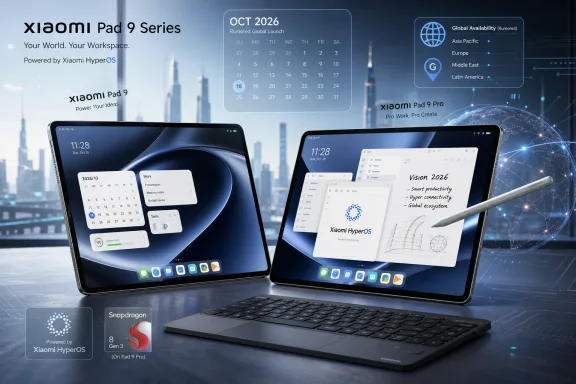 Xiaomi’s Tablet Roadmap Is Starting to Look Less Accidental
For years, Android tablets have suffered from a credibility problem that was not entirely their fault. The hardware could be handsome, the displays could be excellent, and the prices could undercut Apple, but the broader platform story rarely felt as coherent as the iPad’s. Xiaomi has been one of the companies most willing to exploit that gap: build fast tablets, price them aggressively, and let value-conscious buyers decide how much ecosystem polish they really need.The leaked Xiaomi Pad 9 details fit neatly into that strategy. According to the report, the standard Pad 9 is associated with the codename “donghai,” while the Pad 9 Pro is tied to “shuntian.” More importantly for buyers outside China, the reported model number “26103RP65G” includes the familiar “G” suffix that usually indicates a global variant.
That single letter matters. Xiaomi often launches devices first in China, then rolls out selected models to global markets later, sometimes with different naming, configurations, or availability. A global model identifier appearing this early suggests the Pad 9 may not be an afterthought for international buyers.
The leak also claims a “2610” prefix, which is being interpreted as an October 2026 launch window. That should be treated as an informed reading of Xiaomi’s model-number convention rather than a confirmed date. Still, if the interpretation holds, Xiaomi would be preparing a relatively brisk follow-up to the Pad 8 series’ global debut earlier in 2026.
The Pad 8 Is Barely Settled, and the Pad 9 Is Already in View
The oddity here is timing. The Xiaomi Pad 8 series only recently entered global discussion as Xiaomi’s current flagship tablet lineup, and yet the Pad 9 is already surfacing through firmware and database clues. That can make the consumer electronics cycle feel absurdly compressed, but it also reveals how tablet planning actually works.A product that launches in October 2026 is not being conceived in October 2026. It is already in testing, already acquiring internal names, already being matched to chipsets, batteries, firmware branches, certification paths, accessory plans, and regional SKU decisions. Leaks like this do not necessarily mean a launch is imminent; they mean the machinery is moving.
For WindowsForum readers, the tablet angle may seem adjacent rather than central. But Xiaomi’s tablet work is part of a larger shift in personal computing: mobile operating systems are creeping upward into tasks that used to require laptops, while Windows laptops are being pushed downward into thinner, longer-lasting, touch-first forms. The competition is no longer simply “tablet versus tablet.” It is whether a $400-to-$700 slab can take enough casual productivity, media, note-taking, travel, and light office work away from the laptop upgrade cycle.
That is why the Pad 9’s rumored positioning matters. If Xiaomi keeps pushing flagship-class Qualcomm silicon into relatively affordable tablets, it is not only competing with Samsung and Apple. It is also nibbling at the low end of the Windows detachable and ultraportable market.
The Global Model Number Is the Leak’s Real Payload
The chip rumors will get the headlines, because chip names always do. But the global model number is arguably the most consequential detail for actual buyers. A tablet that exists only in China is a curiosity; a tablet with a global SKU can become a purchasing option, a workplace device, a travel machine, or a cheaper alternative to a premium iPad.The reported “26103RP65G” model number suggests that Xiaomi is at least preparing a global version of the standard Pad 9. Another reported suffix, “I,” points toward India, though availability can change before release. Xiaomi’s regional device strategy is rarely as simple as one product, everywhere, at the same time.
That matters because Xiaomi’s strongest tablet pitch depends on availability. Enthusiasts may import a Chinese ROM device and live with the compromises, but mainstream buyers and IT departments generally will not. Proper global distribution usually means localized software, warranty support, compatible chargers, regional certifications, and fewer headaches around updates.
A global Pad 9 would also give Xiaomi a better chance to compete in markets where Android tablets are enjoying a second life. Samsung has long carried the premium Android tablet banner, Lenovo has become increasingly competitive in productivity-focused and entertainment tablets, and OnePlus has shown that aggressive pricing can make Android tablets exciting again. Xiaomi’s advantage is that it can often combine strong specs with unusually sharp pricing, if it chooses to.
Qualcomm Silicon Keeps Android Tablets in the Performance Conversation
The leak claims both Pad 9 models will use Snapdragon processors, with the standard model expected to feature Snapdragon 8s Gen 4 and the Pro model reportedly moving to Snapdragon 8 Gen 5. Those names should still be treated carefully, especially because chipset branding and final product configurations can shift before launch. But the direction is clear enough: Xiaomi wants these tablets to live in the premium performance tier.For the standard Pad 9, Snapdragon 8s Gen 4 would make sense if Xiaomi is aiming for flagship-adjacent performance without flagship pricing. That kind of chip is exactly where modern Android tablets can be most compelling. It is powerful enough for multitasking, high-refresh displays, demanding games, stylus workflows, and desktop-style interfaces, without forcing the device into the price bracket where buyers simply start comparing it to an iPad Pro or a Windows laptop.
The rumored Pad 9 Pro is more interesting and more complicated. A Snapdragon 8 Gen 5-class chip would imply a tablet designed not merely for entertainment, but for sustained performance. That raises questions about thermals, battery life, accessory support, and whether Xiaomi’s software can make productive use of the hardware.
High-end silicon is no longer the limiting factor in Android tablets. The problem is whether the operating system, app ecosystem, and manufacturer software layers can turn that silicon into a machine people rely on. A fast tablet that still feels like a large phone remains a luxury media device. A fast tablet with good multitasking, strong stylus support, keyboard polish, external display behavior, and predictable updates becomes something more threatening.
A Bigger Battery Is a Small Number With Big Implications
The reported battery bump from 9,200mAh on the Xiaomi Pad 8 to 9,720mAh on the Pad 9 is not dramatic on paper. It is roughly the sort of increase that spec sheets like to advertise and reviewers later contextualize. But in tablets, small capacity gains can matter because the usage model is different from phones.Tablets spend long stretches as video machines, note-taking surfaces, remote-work screens, gaming devices, and second displays. They also sit idle for days, then get picked up for a long session. A bigger battery can help, but only if the display, chipset, and software power management cooperate.
This is where Xiaomi’s rumored configuration becomes a balancing act. A flagship-class Snapdragon chip and a high-refresh, high-resolution panel can consume the battery advantage quickly. If Xiaomi pursues thinner hardware at the same time, thermal limits may shape real-world performance more than raw benchmark potential.
Still, battery capacity is part of Xiaomi’s value language. A Pad 9 with a larger battery, premium Snapdragon hardware, and global availability would be easy to market. The harder question is whether Xiaomi improves the whole system around it: standby drain, charging behavior, sustained workloads, keyboard battery impact, and update consistency.
HyperOS Is the Product, Not Just the Skin
The leak reportedly comes from HyperOS code, which is fitting because Xiaomi’s tablet ambitions now depend heavily on software. Hardware leaks tell us what Xiaomi might ship. HyperOS tells us what Xiaomi thinks the device is supposed to become.Xiaomi has spent the past few years trying to unify its phones, tablets, wearables, smart-home devices, and eventually cars under a broader software identity. HyperOS is not just a launcher or a rebrand of MIUI; it is Xiaomi’s attempt to make its ecosystem feel less fragmented. For tablets, that matters more than it does for phones.
A tablet lives or dies by the quality of the in-between experience. Can you drag content from a phone? Can you resume work across devices? Can you manage windows without fighting the UI? Can a keyboard turn the tablet into a passable writing machine? Can the stylus feel native rather than bolted on?
This is the part of the Pad 9 story that cannot be proven by a codename leak. Xiaomi can ship a powerful tablet, but it must also convince users that HyperOS is a credible productivity environment. Samsung has DeX, Apple has iPadOS and Stage Manager, Microsoft has Windows itself, and Google is still trying to repair Android’s large-screen reputation. Xiaomi’s opportunity is real, but so is the execution risk.
The Windows Angle Is the Device Category Xiaomi Is Quietly Pressuring
The Xiaomi Pad 9 is not a Windows device, but it belongs in a Windows conversation because it competes for the same marginal upgrade dollars. Many users do not need a laptop every time they think they do. They need a browser, video calls, email, document edits, messaging, PDFs, media, and a keyboard that works well enough.That is the space Android tablets are trying to colonize. They do not have to replace a developer workstation or a managed corporate laptop. They only have to replace the casual second machine, the travel laptop, the couch computer, the student note-taking device, or the personal machine that sits beside a work-issued Windows PC.
Microsoft has seen this pressure from multiple directions. Chromebooks attacked low-cost Windows laptops from one side. iPads attacked premium portable computing from another. Android tablets historically struggled to sustain the same pressure, but better chips, better displays, and more mature multitasking are changing the calculus.
For sysadmins and IT buyers, the result is messy. A user may own a Windows laptop for work, an Android phone, and a Xiaomi or Samsung tablet for everything else. The enterprise endpoint perimeter becomes more personal, more fragmented, and more dependent on identity, browser security, cloud management, and app-level controls rather than old assumptions about one primary PC.
Xiaomi’s Real Challenge Is Trust, Not Performance
The Pad 9 leak makes Xiaomi’s hardware plan look credible. But hardware credibility is not the same as platform trust. Buyers who keep tablets for four or five years care about updates, battery longevity, accessory continuity, repairability, and whether the software feels abandoned after the first year.This is where Xiaomi’s reputation is more uneven. The company can produce excellent hardware at aggressive prices, but global update cadence and long-term software polish have not always matched the best of Apple or Samsung. For a phone buyer who upgrades frequently, that may be tolerable. For a tablet buyer hoping to use the same device through years of media, travel, school, or work, it matters more.
The rumored Pad 9 Pro would raise the stakes further. A Pro-branded tablet invites comparison with premium devices that are expected to age gracefully. It also implies accessories: keyboard covers, pens, cases, perhaps desktop-style workflows. If Xiaomi changes dimensions, connectors, magnets, or stylus support too often, it risks making each generation feel isolated.
That is the hidden advantage Apple has built over time. It is not only that iPads are fast. It is that buyers generally understand the accessory ecosystem, software lifecycle, and resale market. Xiaomi does not need to copy that model exactly, but it does need to reduce uncertainty if it wants its flagship tablets to be taken seriously outside enthusiast circles.
The Leak Also Shows How Predictable the Flagship Tablet Race Has Become
There is a familiar rhythm to modern device leaks. First come codenames, then model numbers, then chipset claims, then certification filings, then renders, then launch timing, then pricing. By the time a device is announced, much of the surprise has been drained away. The Pad 9 appears to be entering that pipeline now.That predictability is useful for consumers but dangerous for manufacturers. If everyone knows the next tablet will bring a faster Snapdragon chip, a slightly larger battery, a high-refresh display, and a Pro variant, the question becomes what else the company can say. The spec race alone is no longer enough.
Xiaomi’s best answer would be to make the tablet feel more like a coherent computer. That means the mundane things: better windowing, less awkward keyboard navigation, stronger file handling, more consistent external display support, and fewer app compatibility frustrations. None of those features leaks as cleanly as a battery capacity, but they shape whether the device gets used after the novelty fades.
The company also has to decide how hard it wants to push AI-branded features. Every major device maker is now tempted to describe routine software conveniences as AI breakthroughs. Tablet buyers are likely to be more skeptical. If AI helps with handwriting, summarization, search, translation, photo editing, or cross-device workflows, it may be useful. If it is mostly marketing garnish, it will age badly.
The October Window Would Put Xiaomi in a Crowded Hardware Season
A possible October 2026 launch would be strategically plausible. The second half of the year is dense with phone launches, chip announcements, holiday positioning, and back-to-school aftershocks. It is also a risky time for a tablet to stand out.By October, consumers may already be comparing new iPads, Galaxy Tabs, Windows convertibles, and discounted older models. Xiaomi’s usual weapon is price-performance disruption, but global pricing is not always as aggressive as Chinese pricing once taxes, distribution, and regional configurations enter the picture. A Pad 9 that looks unbeatable in China could become merely competitive in Europe or other global markets.
The upside is that Xiaomi can use timing to its advantage if it moves quickly. A tablet with next-generation Qualcomm branding, a large battery, and a global variant could arrive as buyers are thinking about holiday purchases. If the Pad 8 remains on shelves at lower prices, Xiaomi could also create a two-tier lineup that pressures rivals from both directions.
But launch windows derived from model numbers are not launch dates. October 2026 is best understood as a plausible target, not a promise. Firmware evidence can precede delays, regional staging, rebranding, or quiet cancellations. The leak is strong enough to sketch Xiaomi’s plan, not strong enough to close the case.
The Practical Reading Is Clearer Than the Rumor Mill
For anyone considering a Xiaomi tablet now, the Pad 9 leak creates the usual dilemma: buy the current model or wait for the next one. The answer depends less on the leak than on need. If a Pad 8 is available at a good price and meets your requirements, a rumored Pad 9 should not freeze every purchase decision for months.The more interesting buyer is the enthusiast or professional who wants a tablet to last several years. For that person, waiting may make sense, especially if the Pad 9 brings a larger battery, newer silicon, and broader global support. The risk is that the final product may differ from the leak, cost more than expected, or launch later in some regions.
The rumored standard Pad 9 also complicates the meaning of “Pro.” If the standard model already carries a Snapdragon 8s-class chip and a large battery, it may be the better value for most users. The Pro model will need more than a faster chip to justify itself: a better display, stronger charging, more memory, superior speakers, enhanced stylus features, or productivity-focused software improvements.
That is where Xiaomi’s segmentation will matter. A standard model that is too good can cannibalize the Pro. A Pro model that is too expensive can push buyers toward Samsung, Apple, or even Windows devices. Xiaomi’s challenge is to make the lineup feel deliberate rather than redundant.
The Pad 9 Leak Gives Buyers a Map, Not a Destination
The safest way to read this leak is as a map of Xiaomi’s intent. It suggests two models, Snapdragon performance tiers, a larger battery for the standard tablet, and at least some preparation for global release. It does not confirm final specifications, launch markets, pricing, or software support.- Xiaomi appears to be preparing both a standard Pad 9 and a Pad 9 Pro, continuing the two-model structure used by the current flagship tablet line.
- The reported “G” model-number suffix is the strongest sign that at least one Pad 9 variant is being planned for global markets.
- The “2610” model-number prefix points to October 2026 as a plausible launch window, but it should not be treated as an official date.
- The standard Pad 9 is rumored to move to a 9,720mAh battery, a modest but useful increase over the Pad 8’s reported 9,200mAh capacity.
- Snapdragon 8s Gen 4 and Snapdragon 8 Gen 5 rumors suggest Xiaomi wants the Pad 9 family to compete on premium performance, not just price.
- The biggest unanswered question is whether HyperOS can make the hardware feel like a serious productivity platform rather than a fast entertainment slab.
References
- Primary source: Notebookcheck
Published: 2026-06-23T01:50:38.570781
Xiaomi Pad 9 leak points to global release plans and launch window - Notebookcheck News
A new leak has shed light on early details about the Xiaomi Pad 9 series, which is expected to launch as the company's next flagship tablet lineup. The leak points to possible codenames for the new models, along with other early hardware and launch details. www.notebookcheck.net
- Related coverage: ximitime.com
Xiaomi Pad 9 leak suggests it will just rebranded Xiaomi Pad 8 - XimiTime
Xiaomi may already be preparing its next tablet lineup, and the first internal clues point to an interesting strategy. According to findings shared by Kacperximitime.com - Related coverage: igeekphone.com
Xiaomi MI Pad 9 Standard Edition Revealed: Qualcomm Snapdragon 8s Gen4 Chip, 9720mAh Battery
Igeekphone 6/20: Technology media ximitime published a blog post yesterday (June 19), stating that the Xiaomi Tablet 9 is expected to be released in both standard and Pro versions.www.igeekphone.com - Related coverage: mobiledokan.co
Xiaomi Pad 9 Price in Bangladesh 2026, Full Specs & Review | MobileDokan
Xiaomi Pad 9 Price in Bangladesh 2026. Full specification of Xiaomi Pad 9 with ✓Official ✓Unofficial BD Price ✓Rating ✓Review ✓Compare.www.mobiledokan.co - Related coverage: techcare.vn
Rò Rỉ Cấu Hình Xiaomi Pad 9 Series: Phiên Bản Pro Với Chip Snapdragon 8 Gen 5 Flagship, Bản Thường Liệu Có Đủ Sức Cạnh Tranh?
Thị trường máy tính bảng Android sắp chứng kiến sự xuất hiện của hai chiến binh mới đến từ Xiaomi. Theo nguồn tin rò rỉ mới , hãng công nghệ Trung Quốc đang phát triển dòng Xiaomi Pad 9 với hai phiên bản: Pad 9 Pro và Pad 9 tiêu chuẩn. Điều đáng chú ý là cả hai model đều được trang bị chip xử... techcare.vn
- Related coverage: gadgets.beebom.com
Xiaomi Pad 9 Series Surfaces Early but India Still Can’t Have the ‘Pro’ | Beebom Gadgets
Xiaomi is reportedly working on its next tablet lineup the Pad 9 series and is reportedly looking to skip the Pro version in India yet again.gadgets.beebom.com
- Related coverage: us.mobileinto.com
- Related coverage: eshop.hkcsl.com
