

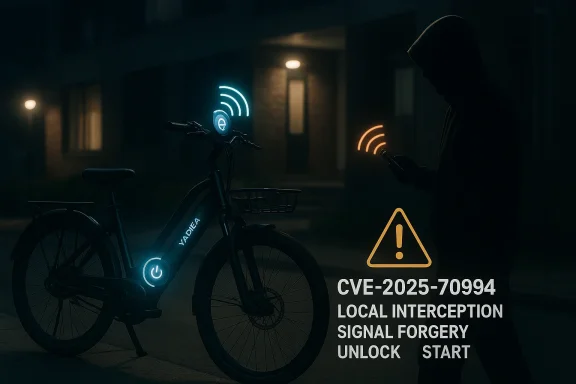
Yadea’s T5 electric bicycle has just become the latest reminder that modern transportation security is no longer limited to cars, trucks, and public transit. According to CISA’s newly published ICS advisory, a weakness in the bicycle’s authentication scheme could let a local attacker intercept a legitimate key-fob transmission, forge a signal, and then unlock and start the bike, creating a clear theft risk. The advisory assigns the issue CVE-2025-70994 with a CVSS 3.1 score of 7.3 and says the affected product range is all versions of the Yadea T5 Electric Bicycle. CISA also notes that the vendor did not respond to coordination attempts, which is rarely a comforting sign for owners or fleet operators.
The disclosure is important not because an electric bicycle suddenly looks like a server, but because it sits at the intersection of consumer convenience, low-cost wireless control, and physical security. The T5’s key-fob workflow is meant to make the bike easy to use, yet that same convenience creates an attack surface whenever radio signals are trusted too much. In practical terms, the issue is not about remote internet abuse or malware installation; it is about an attacker who can be physically nearby, observe legitimate transmission behavior, and then mimic it well enough to defeat the bicycle’s lock-and-start logic. CISA explicitly says the problem is local, not remote, but local does not mean harmless.
This is the kind of vulnerability that often gets underestimated because the outcome sounds modest compared with full device takeover or code execution. But a mobility platform is only as secure as the barriers around theft, tampering, and unauthorized use. When a bicycle can be started without the right assurance that a trusted fob is present, the gap between “locked” and “gone” can be very small. That matters in urban environments, apartment storage areas, garages, and delivery fleets where opportunistic theft is usually a faster path than sophisticated exploitation.
The advisory also places the product in a broad transportation context. CISA classifies the affected sector as Transportation Systems, identifies the company headquarters as China, and says the bicycle is deployed worldwide. Those details are significant because they suggest a product that may be sitting in a large number of consumer and commercial environments, often outside the direct oversight of enterprise security teams. In other words, the attack surface is not just technical; it is logistical and behavioral.
The Yadea T5 issue fits a familiar pattern in connected mobility: the product is not necessarily failing at the mechanical layer, but at the identity layer. The bike is apparently willing to accept forged behavior after an attacker captures a legitimate transmission, which implies the underlying challenge-response or signal validation design is weak enough to be replayed or imitated. That is a classic embedded-security failure, and it is especially painful because the user sees a seamless experience while the attacker sees an opening. Silent convenience often hides brittle trust.
There is also a wider ecosystem concern. Many electric mobility products are sold globally through a combination of direct retail, distributors, and local resellers, which makes coordinated fixes more difficult than in a centralized enterprise deployment. When the vendor does not engage with disclosure efforts, the burden shifts toward owners to detect the risk and compensate as best they can. For consumer products, that usually means there is no patch pipeline in the usual sense, only mitigation through behavior, storage, and physical security.
The CISA advisory notes that no known public exploitation had been reported at the time of publication. That is useful to know, but it should not be read as a safety certificate. In theft-oriented vulnerabilities, public exploitation often lags behind disclosure because the payoff is immediate and the technique is easy to weaponize once understood. The absence of reported abuse is not the same thing as the absence of criminals testing the weakness.
The phrase “signal forgery” is especially important because it suggests the protection logic may be replayable, predictable, or otherwise insufficiently resistant to cloning. In practical terms, that means the attacker does not need to dismantle the bike’s electronics or access hidden diagnostic tools. They just need proximity, patience, and a way to reproduce the observed behavior convincingly enough for the bicycle to accept it. That is a serious design weakness for any vehicle security system.
That makes the vulnerability less glamorous to discuss and more urgent to manage. Owners may not think about cryptographic protocol quality when buying a bike, but they absolutely think about whether the bike can disappear from a rack in seconds. The advisory turns an abstract authentication flaw into a tangible loss scenario, which is exactly why it deserves attention from both consumers and fleet managers.
The practical danger is amplified by the mobility context. Unlike a door lock or a desktop computer, a bicycle can be stolen and moved quickly, often before the victim even notices. Once the asset is gone, recovery becomes a law-enforcement and insurance problem rather than a technical one. That is why a “mere” authentication flaw in a bicycle is still a high-impact issue.
The advisory does not claim public exploitation, but the attack model is straightforward enough that defenders should not wait for proof-of-concept videos to appear. Theft-oriented attacks usually spread through practical demonstration rather than complex malware ecosystems. Once a weakness of this type becomes known in a community, it can quickly move from theoretical to opportunistic.
This is one of those cases where the phrase defense in depth is not just a security slogan. If the bike’s wireless authentication can be fooled, then a secondary mechanical lock or secure storage is not optional nicety; it is the compensating control that preserves ownership. That matters even more for commuters, delivery riders, and shared fleets that may leave bikes in the open for long periods.
The vendor silence also changes how the market should interpret accountability. A coordinated disclosure process is not just about publishing a CVE; it is about ensuring the manufacturer can advise customers on safe handling, patch status, or product redesign. When that communication breaks down, it leaves end users to bridge the gap with their own judgment and physical controls. For a transportation product, that is a serious governance failure.
For consumers, the practical takeaway is that a smart-looking product is still a physical object in the real world. If a security flaw can be exploited locally, then parking habits, storage choices, and secondary locks matter immediately. If the product lacks a timely remediation path, those old-fashioned protections become the difference between inconvenience and loss.
Fleet operators should be even more cautious. A single weak model deployed across many locations can create a theft pattern if the exploit becomes known to organized criminals or opportunistic thieves. For a consumer owner, one stolen bike is painful; for a rental or delivery fleet, repeated losses can become a business model for the attacker. Scale changes the economics of theft.
The advisory also raises a broader consumer-trust issue. Buyers increasingly expect connected mobility gear to offer app integration, keyless convenience, and anti-theft intelligence. But the more a device relies on radio authentication, the more the product’s real security depends on the cryptographic and protocol design that the customer rarely gets to inspect. That tension will only grow as e-bikes become more connected.
There is also a support burden. Fleet managers may be asked to verify device authenticity, change storage procedures, retrain staff, and document compensating controls. Those tasks are easy to underestimate because they do not look like classic cybersecurity work, but they are exactly what a physical-device vulnerability demands. Security and logistics become the same conversation.
Enterprises that allow employees to use company-issued e-bikes should treat this like any other asset-security problem. If the product lacks a reliable patch path, then the organization needs policy controls: secure parking, asset tagging, chain-of-custody expectations, and clear reporting procedures for suspicious behavior. The best response is to assume the bicycle’s built-in authentication should not be the only line of defense.
That is a familiar enterprise lesson dressed in a consumer-product case. Security teams often obsess over patching software they can see, but physical-device risk is frequently an inventory problem first. If you cannot count the units, you cannot protect them consistently.
It will also be worth watching whether this advisory triggers broader scrutiny of wireless key-fob systems in e-bikes and other small vehicles. If a local signal-forgery attack works here, the industry should expect uncomfortable questions about replay resistance, pairing design, and whether convenience-first engineering has outrun security engineering. That debate is only going to get louder as connected transportation keeps growing.
Source: CISA Yadea T5 Electric Bicycle | CISA
 Overview
The disclosure is important not because an electric bicycle suddenly looks like a server, but because it sits at the intersection of consumer convenience, low-cost wireless control, and physical security. The T5’s key-fob workflow is meant to make the bike easy to use, yet that same convenience creates an attack surface whenever radio signals are trusted too much. In practical terms, the issue is not about remote internet abuse or malware installation; it is about an attacker who can be physically nearby, observe legitimate transmission behavior, and then mimic it well enough to defeat the bicycle’s lock-and-start logic. CISA explicitly says the problem is local, not remote, but local does not mean harmless.This is the kind of vulnerability that often gets underestimated because the outcome sounds modest compared with full device takeover or code execution. But a mobility platform is only as secure as the barriers around theft, tampering, and unauthorized use. When a bicycle can be started without the right assurance that a trusted fob is present, the gap between “locked” and “gone” can be very small. That matters in urban environments, apartment storage areas, garages, and delivery fleets where opportunistic theft is usually a faster path than sophisticated exploitation.
The advisory also places the product in a broad transportation context. CISA classifies the affected sector as Transportation Systems, identifies the company headquarters as China, and says the bicycle is deployed worldwide. Those details are significant because they suggest a product that may be sitting in a large number of consumer and commercial environments, often outside the direct oversight of enterprise security teams. In other words, the attack surface is not just technical; it is logistical and behavioral.
Background
Electric bicycles have evolved from niche commuter devices into mainstream personal transportation. That growth has pushed bike makers toward features that used to belong to cars or motorcycles: wireless unlocking, anti-theft modes, mobile apps, proximity-based start systems, and remote assistance. Each of those conveniences creates value, but each also introduces trust decisions that must be implemented correctly. The moment a bike decides to believe a radio signal, the quality of the authentication behind that signal becomes the difference between convenience and vulnerability.The Yadea T5 issue fits a familiar pattern in connected mobility: the product is not necessarily failing at the mechanical layer, but at the identity layer. The bike is apparently willing to accept forged behavior after an attacker captures a legitimate transmission, which implies the underlying challenge-response or signal validation design is weak enough to be replayed or imitated. That is a classic embedded-security failure, and it is especially painful because the user sees a seamless experience while the attacker sees an opening. Silent convenience often hides brittle trust.
There is also a wider ecosystem concern. Many electric mobility products are sold globally through a combination of direct retail, distributors, and local resellers, which makes coordinated fixes more difficult than in a centralized enterprise deployment. When the vendor does not engage with disclosure efforts, the burden shifts toward owners to detect the risk and compensate as best they can. For consumer products, that usually means there is no patch pipeline in the usual sense, only mitigation through behavior, storage, and physical security.
The CISA advisory notes that no known public exploitation had been reported at the time of publication. That is useful to know, but it should not be read as a safety certificate. In theft-oriented vulnerabilities, public exploitation often lags behind disclosure because the payoff is immediate and the technique is easy to weaponize once understood. The absence of reported abuse is not the same thing as the absence of criminals testing the weakness.
What the Vulnerability Means
CVE-2025-70994 is categorized as weak authentication, and the vendor-equipment CVSS score of 7.3 reflects the fact that the flaw can lead to a meaningful integrity impact. CISA’s summary says successful exploitation could let an attacker unlock and start the bicycle, which is a direct path to theft rather than data loss or service disruption. That makes the issue easy to understand and hard to dismiss: if someone can start the bike, they can likely ride it away.Local interception is the key detail
The advisory emphasizes that the attack is not remote. A local attacker must intercept legitimate key-fob transmissions first, and that requirement raises the bar compared with a drive-by internet exploit. But the bar is still low enough to matter in real-world settings where bicycles are parked in public, stored in shared spaces, or used in dense urban areas. Local attacks can be surprisingly scalable when the target is a mass-market product.The phrase “signal forgery” is especially important because it suggests the protection logic may be replayable, predictable, or otherwise insufficiently resistant to cloning. In practical terms, that means the attacker does not need to dismantle the bike’s electronics or access hidden diagnostic tools. They just need proximity, patience, and a way to reproduce the observed behavior convincingly enough for the bicycle to accept it. That is a serious design weakness for any vehicle security system.
Why integrity matters more than confidentiality here
This is not a classic confidentiality breach. The advisory says the impact is on integrity, not data exposure, which is often the more relevant dimension in physical products. If an attacker can change the state of the device, unlock it, or initiate a start sequence, then the security boundary has effectively failed where it matters most. For the owner, the consequence is not stolen secrets; it is stolen property.That makes the vulnerability less glamorous to discuss and more urgent to manage. Owners may not think about cryptographic protocol quality when buying a bike, but they absolutely think about whether the bike can disappear from a rack in seconds. The advisory turns an abstract authentication flaw into a tangible loss scenario, which is exactly why it deserves attention from both consumers and fleet managers.
How an Attacker Could Abuse It
The advisory’s attack narrative is narrow but clear: a local attacker intercepts a legitimate key-fob transmission, forges a signal, and then uses that forged signal to unlock and start the bicycle. That means the first step is observing genuine traffic, not guessing a password or abusing a cloud backend. Once the attacker has seen the right exchange, the weak authentication design gives them a second chance to impersonate the real key.The attack path in plain language
- The attacker gets physically close enough to observe the key-fob exchange.
- A legitimate transmission is captured or inferred.
- The attacker reproduces the signal in a forged form.
- The bike accepts the forged signal as valid.
- The lock is released and the bicycle can be started.
The practical danger is amplified by the mobility context. Unlike a door lock or a desktop computer, a bicycle can be stolen and moved quickly, often before the victim even notices. Once the asset is gone, recovery becomes a law-enforcement and insurance problem rather than a technical one. That is why a “mere” authentication flaw in a bicycle is still a high-impact issue.
Why proximity attacks are so hard to ignore
Proximity-based systems are attractive because they feel intuitive and convenient. They also create a false impression that attackability is low, because the victim assumes an adversary would need expensive equipment or unusual access. In reality, if the product’s radio behavior is weak, an attacker with ordinary field gear and enough knowledge may have a realistic path to compromise. That is exactly the kind of risk that shows up first in crowded parking areas and shared storage facilities.The advisory does not claim public exploitation, but the attack model is straightforward enough that defenders should not wait for proof-of-concept videos to appear. Theft-oriented attacks usually spread through practical demonstration rather than complex malware ecosystems. Once a weakness of this type becomes known in a community, it can quickly move from theoretical to opportunistic.
CISA’s Response and the Vendor Gap
CISA’s advisory is unusually blunt in its mitigation section. The agency says Yadea did not respond to its attempts at coordination, which leaves users without vendor-backed remediation guidance in the advisory itself. That is not ideal in any product category, but it is especially awkward for a consumer mobility device where owners may not know how to validate a firmware fix or whether one even exists.What CISA recommends instead
CISA’s practical advice is simple and, frankly, not very glamorous. Users are encouraged to keep their systems up to date and lock their property securely with external mechanisms. The agency also points users to Yadea’s contact page, but in the absence of vendor cooperation, the real protection comes from reducing reliance on the bicycle’s built-in trust model. That is a sobering message: when embedded authentication is weak, a physical backup lock becomes part of the cybersecurity plan.This is one of those cases where the phrase defense in depth is not just a security slogan. If the bike’s wireless authentication can be fooled, then a secondary mechanical lock or secure storage is not optional nicety; it is the compensating control that preserves ownership. That matters even more for commuters, delivery riders, and shared fleets that may leave bikes in the open for long periods.
The vendor silence also changes how the market should interpret accountability. A coordinated disclosure process is not just about publishing a CVE; it is about ensuring the manufacturer can advise customers on safe handling, patch status, or product redesign. When that communication breaks down, it leaves end users to bridge the gap with their own judgment and physical controls. For a transportation product, that is a serious governance failure.
What the absence of coordination implies
Lack of response does not prove malice or neglect, but it does imply a lower maturity level in security incident handling than customers should want. The best-case interpretation is that the vendor missed or delayed the advisory process. The worst-case interpretation is that the product line has limited security support capacity, which can make future disclosures harder to manage as well. Either way, the risk lands on the owner first.For consumers, the practical takeaway is that a smart-looking product is still a physical object in the real world. If a security flaw can be exploited locally, then parking habits, storage choices, and secondary locks matter immediately. If the product lacks a timely remediation path, those old-fashioned protections become the difference between inconvenience and loss.
Consumer Impact
For everyday riders, the first reaction will likely be disbelief. A bicycle that can be unlocked by signal forgery sounds more like an enthusiast hack than a mainstream security issue, yet that is exactly why these advisories matter. Consumer devices are often adopted on trust, with the buyer assuming the manufacturer has already handled the invisible parts of security correctly. This advisory suggests that assumption may be too generous.Who is most exposed
Owners who park in shared garages, public racks, apartment basements, campus storage rooms, or delivery staging areas should pay attention first. Those are the environments where a local attacker can plausibly observe legitimate use, spend time near the target, and attempt a forged unlock. The more routine the parking behavior, the easier it is for an attacker to blend in.Fleet operators should be even more cautious. A single weak model deployed across many locations can create a theft pattern if the exploit becomes known to organized criminals or opportunistic thieves. For a consumer owner, one stolen bike is painful; for a rental or delivery fleet, repeated losses can become a business model for the attacker. Scale changes the economics of theft.
The advisory also raises a broader consumer-trust issue. Buyers increasingly expect connected mobility gear to offer app integration, keyless convenience, and anti-theft intelligence. But the more a device relies on radio authentication, the more the product’s real security depends on the cryptographic and protocol design that the customer rarely gets to inspect. That tension will only grow as e-bikes become more connected.
Practical consumer precautions
- Use a high-quality external lock every time, even if the built-in lock is engaged.
- Store the bicycle in a locked space whenever possible.
- Avoid leaving the bike unattended in crowded public areas for long periods.
- Treat any unexpected unlocking or start behavior as a serious security warning.
- Contact the vendor about firmware or service updates, even if the advisory suggests response may be limited.
Fleet and Enterprise Impact
The advisory may be aimed at a bicycle, but the implications stretch into the fleet-management and micromobility sectors. Operators who deploy electric bicycles in rental programs, campus fleets, logistics services, or employee transportation schemes have to think about both user convenience and asset loss. A flaw that enables unlock-and-start abuse directly threatens the economics of a shared fleet.Operational consequences
If a fleet depends on physical access controls embedded in the bike, then a weak authentication scheme can undermine the entire operational model. Bikes that are easy to start illegitimately are also harder to track, harder to recover, and more expensive to insure. The issue is not limited to one machine; it affects fleet integrity, utilization, and replacement cycles.There is also a support burden. Fleet managers may be asked to verify device authenticity, change storage procedures, retrain staff, and document compensating controls. Those tasks are easy to underestimate because they do not look like classic cybersecurity work, but they are exactly what a physical-device vulnerability demands. Security and logistics become the same conversation.
Enterprises that allow employees to use company-issued e-bikes should treat this like any other asset-security problem. If the product lacks a reliable patch path, then the organization needs policy controls: secure parking, asset tagging, chain-of-custody expectations, and clear reporting procedures for suspicious behavior. The best response is to assume the bicycle’s built-in authentication should not be the only line of defense.
Why inventory matters
The advisory’s “all versions” finding makes asset discovery especially important. If every Yadea T5 is affected, then the core question is not whether a specific firmware build is vulnerable but whether the organization knows where the bikes are and how they are stored. A missing inventory turns a known vulnerability into an unknowable exposure.That is a familiar enterprise lesson dressed in a consumer-product case. Security teams often obsess over patching software they can see, but physical-device risk is frequently an inventory problem first. If you cannot count the units, you cannot protect them consistently.
Strengths and Opportunities
The good news is that this advisory gives owners a crisp, understandable threat model before there are reports of broad exploitation. That clarity makes it easier to justify compensating controls, particularly when the remediation path depends more on physical security than on technical patching. It also gives the market an opportunity to rethink how low-cost mobility devices should authenticate trusted accessories and what “good enough” means in radio-based access control.- The issue is clearly scoped to a specific product family.
- The attack requires local access, which still allows meaningful risk reduction.
- Owners can immediately add external physical controls.
- Fleet operators can tighten parking and storage policies quickly.
- The advisory raises awareness of bike-level authentication design.
- The disclosure may pressure vendors to improve secure pairing and signal validation.
- Security teams can use the case to review other connected mobility assets.
Risks and Concerns
The biggest concern is that the flaw maps directly to theft, which is a high-probability, high-frequency threat in the real world. Unlike some cybersecurity bugs that require specialized exploitation chains, this one has a straightforward payoff and an easy-to-understand objective. The lack of vendor response only makes the situation more frustrating, because users are left to compensate without clear technical guidance.- The vulnerability enables physical theft rather than just technical compromise.
- Local attackers may only need brief access to the bike’s environment.
- Owners may assume the built-in lock is sufficient when it is not.
- Vendor silence can delay or limit remediation options.
- Shared parking environments make observation and interception easier.
- A broad “all versions” scope increases the number of exposed units.
- Fleet deployments can multiply the impact of a single weak design choice.
Looking Ahead
The next thing to watch is whether Yadea eventually offers a concrete remediation path that goes beyond generic customer support. If the product can be updated, owners will need precise instructions; if it cannot, the market will have to rely on compensating controls indefinitely. Either outcome is important, because security maturity in consumer mobility now depends on how manufacturers handle disclosure after publication, not just on how they design the original product.It will also be worth watching whether this advisory triggers broader scrutiny of wireless key-fob systems in e-bikes and other small vehicles. If a local signal-forgery attack works here, the industry should expect uncomfortable questions about replay resistance, pairing design, and whether convenience-first engineering has outrun security engineering. That debate is only going to get louder as connected transportation keeps growing.
- Check whether the bicycle is stored behind a physical barrier.
- Confirm whether any vendor update path actually exists.
- Review whether other connected mobility devices use similar key-fob logic.
- Monitor for social sharing of proof-of-concept theft techniques.
- Treat new transport products with the same skepticism as other connected endpoints.
Source: CISA Yadea T5 Electric Bicycle | CISA
