

Microsoft on May 19, 2026, assigned CVE-2026-45585 to YellowKey, a publicly disclosed BitLocker security feature bypass affecting Windows 11 24H2, 25H2, 26H1, and Windows Server 2025 systems, and issued mitigation guidance while it prepares a full security update. The uncomfortable part is not that BitLocker’s encryption has suddenly become weak. It is that the trusted recovery machinery around Windows can become the path around it. For administrators, YellowKey is a reminder that disk encryption is only as strong as the pre-boot and recovery assumptions wrapped around it.
The easiest mistake to make with YellowKey is to treat it as a story about broken encryption. That framing is wrong, and it lets the more interesting failure escape scrutiny. BitLocker is not being cracked in the cinematic sense; attackers are not brute-forcing keys or discovering a mathematical weakness in AES.
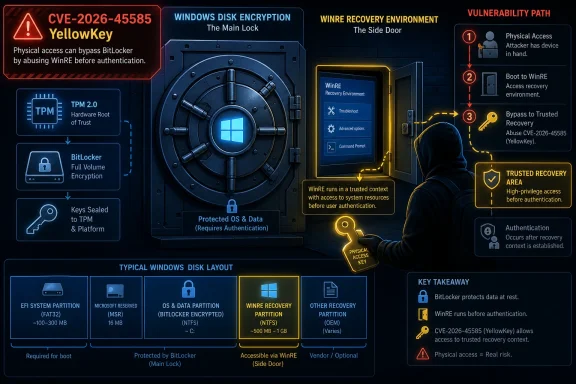
What YellowKey appears to exploit is a gap in the choreography around Windows Recovery Environment, BitLocker, and trusted boot. In other words, the lock may be fine, but the service entrance was trusted too generously. That distinction matters because enterprises often spend years standardizing encryption while leaving recovery flows, firmware settings, and pre-boot behavior as afterthoughts.
Microsoft’s advisory language is unusually pointed. The company acknowledged that proof-of-concept code is public and said the disclosure violated coordinated vulnerability best practices. That is a vendor’s way of saying the clock started before Redmond was ready.
The severity score, 6.8, may look modest beside remote-code-execution bugs that dominate Patch Tuesday headlines. But CVSS can be a poor proxy for the kind of panic a vulnerability causes in the real world. A bug that requires physical access is not internet-scale, but it is precisely the class of bug that matters when a laptop is stolen, seized, left in a hotel room, or handled by someone who should not be trusted.
But physical-access attacks occupy a strange place in enterprise security. They are rare enough to be discounted in many risk meetings, yet common enough to define the threat model for mobile workforces, journalists, executives, developers, government users, and anyone crossing borders with sensitive data. BitLocker exists, in large part, because machines leave controlled environments.
The public reporting around YellowKey indicates that the bypass can be triggered through recovery-time behavior involving Windows RE and FsTx-related recovery handling. Microsoft’s mitigation guidance focuses on preventing the FsTx Auto Recovery Utility from launching automatically inside the recovery image, which is a strong hint about where the trust boundary became too soft.
That is why this bug has generated more unease than its score might suggest. If an attacker can get a vulnerable system into the right recovery path and cause privileged recovery components to do the wrong thing before authentication has meaningfully protected the volume, the old enterprise reassurance — “it’s encrypted, so the data is safe” — becomes less absolute.
That convenience has always carried a caveat. TPM-only BitLocker protects well against casual drive removal and many lost-device scenarios, but it is less comforting against an attacker who can manipulate the machine itself. The more the boot and recovery path can be influenced, the more the TPM’s “known good” judgment becomes a matter of what the platform measured and what it failed to notice.
Microsoft’s recommendation to use TPM plus PIN is therefore not a small footnote. It is the company nudging customers toward a more explicit pre-boot authentication model. A startup PIN changes the economics of the attack because the machine no longer silently unwraps the protection simply because the hardware and measured boot state look acceptable.
That recommendation will not be equally welcome everywhere. TPM+PIN adds friction, and friction is exactly what many organizations spent the last decade trying to remove. But YellowKey makes the old trade-off visible again: a device that unlocks itself is friendlier to users, and sometimes friendlier to attackers with hands on the keyboard.
Microsoft says it is issuing the CVE to provide mitigation guidance until a security update is available. That is the responsible move once exploit details are public, but it also shifts operational burden onto administrators. The mitigation is not a clean “install this update and reboot” affair; it involves modifying Windows Recovery Environment images and reestablishing trust relationships so BitLocker accepts the altered recovery environment.
That is not trivial work in a large fleet. Some organizations have customized recovery partitions, OEM-specific images, Autopilot flows, recovery media policies, and compliance tooling wrapped around standard Windows deployment. A mitigation that touches WinRE is a mitigation that needs testing, documentation, and rollback planning.
This is where the disclosure debate becomes less philosophical. Researchers may argue that public proof-of-concept code forces vendors to act and gives defenders a realistic view of exposure. Vendors may argue that it gives attackers a head start. Administrators, meanwhile, inherit both truths at once.
That gap is familiar to anyone who manages Windows at scale. Between disclosure and patch, security teams must sort devices by exposure, business criticality, travel risk, and configuration. They must decide whether TPM-only devices need emergency policy changes, whether WinRE should be modified now, and whether certain high-risk machines should be pulled from circulation until the picture clears.
There is also a sequencing problem. Changing BitLocker authentication modes can trigger recovery events if done carelessly. Touching recovery images can affect break-glass procedures. Locking down USB or firmware settings can break legitimate support workflows. Security teams can reduce risk, but not without creating operational side effects.
That is the enterprise reality behind a tidy advisory. The mitigation may be technically correct, but deployment is a political and logistical exercise. Every organization must decide whether YellowKey is a fleet-wide emergency, a high-risk-user emergency, or a monitored issue pending Microsoft’s full update.
That power makes them dangerous when assumptions fail. Enterprises often harden Windows itself while treating recovery as a utility belt rather than an attack surface. Endpoint detection agents may not see what happens there. Standard policy enforcement may not apply in the same way. Logging may be incomplete or absent.
This is not unique to Microsoft. Any modern operating system with recovery tooling has to balance repairability against security. Users need a way back from broken boot files, corrupted updates, failed drivers, and damaged system partitions. Attackers need only one trusted recovery path that does more than it should.
YellowKey is therefore less an exotic one-off than a case study in pre-authentication complexity. The more automated and self-healing operating systems become, the more code runs before a user has proved anything. That code needs the same skepticism as the operating system it is trying to rescue.
Modern work has only expanded the number of machines outside trusted spaces. Laptops move through airports, conference rooms, repair shops, shared offices, vehicles, and home desks. Some devices are stolen for resale; others are taken because of who owns them or what data they may contain.
For ordinary consumers, YellowKey may not change daily behavior much. The average thief is still more likely to wipe and resell a laptop than perform a targeted recovery-environment bypass. For executives, developers, lawyers, activists, civil servants, and administrators carrying privileged access, the calculation is different.
Physical access is not a universal threat, but it is a high-consequence one. If your risk model includes targeted device access, then TPM-only BitLocker has always been the beginning of the conversation, not the end of it.
The problem is not that the advice is irrational. The problem is that it asks administrators to perform surgery on a part of Windows most organizations prefer not to touch outside imaging pipelines. WinRE is not a normal application. It is a hidden support layer that many admins encounter only when something has already gone wrong.
The alternative, TPM+PIN, is easier to explain but harder to sell culturally. Users dislike extra boot prompts. Help desks dislike forgotten PINs. Executives dislike anything that slows a laptop during travel. Security teams dislike being told later that a protection was disabled because it was inconvenient.
Yet the hierarchy of mitigations is becoming clearer. If the device matters enough that physical compromise is a serious concern, seamless unlock is probably the wrong default. If the device does not matter that much, the organization should still know it is accepting that trade-off rather than inheriting it accidentally.
Hardware-backed security is persuasive because it sounds anchored in something harder to tamper with than software. The catch is that hardware trust only helps when the software layers interpreting that trust are disciplined. A TPM can release keys based on measurements, but it cannot magically know whether every recovery component is being used in a way Microsoft intended.
This is the uncomfortable middle ground for Windows security. The platform is far more hardened than it was in the Windows 7 era, but it is also more complex. Recovery automation, OEM customization, firmware interactions, update servicing, cloud enrollment, and device encryption all overlap.
YellowKey exposes that complexity at exactly the point where users expect simplicity. They do not ask whether WinRE’s transaction recovery behavior is safe. They ask whether the laptop is encrypted. Microsoft’s answer needs to become more conditional: yes, but configuration and recovery-path hardening matter.
But focusing only on the disclosure drama gives organizations an excuse to avoid the more durable lesson. Even if YellowKey had been quietly reported, privately patched, and calmly rolled into a future cumulative update, the underlying dependency on recovery-environment trust would still matter. The bug would still reveal where BitLocker deployments are brittle.
Microsoft’s criticism of the public release may be justified, but it does not solve the administrative problem. Defenders cannot undisclose exploit code. They can only reduce the number of devices where the technique is useful and tighten assumptions around machines that travel or store sensitive data.
That means auditing BitLocker modes, checking whether TPM-only is the default by convenience rather than risk acceptance, reviewing firmware controls, and treating WinRE as part of the secured platform. The practical lesson is not “never trust researchers” or “never trust Microsoft.” It is that trust boundaries age, and recovery systems deserve threat modeling before an emergency forces it.
The first useful move is classification. Identify systems running affected Windows 11 and Windows Server 2025 versions, then separate TPM-only BitLocker devices from those already using startup authentication. That inventory will tell security teams whether YellowKey is a contained concern or a fleet-wide design problem.
The second move is to look at who carries the devices. A vulnerability requiring physical access is most relevant to people whose machines may be targeted, inspected, stolen, or temporarily handled by strangers. High-risk users should not wait for a perfect enterprise-wide plan if a targeted interim policy can reduce exposure now.
The third move is testing Microsoft’s mitigation in the organization’s own deployment reality. Recovery partitions differ. OEMs differ. Imaging systems differ. A mitigation that works cleanly in a lab can become a support incident if pushed blindly across thousands of endpoints.
YellowKey will probably end, in the narrow sense, with a Microsoft security update and a round of fleet hygiene. The better outcome would be a broader reset in how Windows organizations think about recovery, pre-boot trust, and TPM-only convenience. Encryption remains essential, but it is not a magic field around a device; it is a system of dependencies, and attackers only need one trusted dependency to behave badly.
 Microsoft’s BitLocker Problem Is Really a Recovery-Environment Problem
The easiest mistake to make with YellowKey is to treat it as a story about broken encryption. That framing is wrong, and it lets the more interesting failure escape scrutiny. BitLocker is not being cracked in the cinematic sense; attackers are not brute-forcing keys or discovering a mathematical weakness in AES.What YellowKey appears to exploit is a gap in the choreography around Windows Recovery Environment, BitLocker, and trusted boot. In other words, the lock may be fine, but the service entrance was trusted too generously. That distinction matters because enterprises often spend years standardizing encryption while leaving recovery flows, firmware settings, and pre-boot behavior as afterthoughts.
Microsoft’s advisory language is unusually pointed. The company acknowledged that proof-of-concept code is public and said the disclosure violated coordinated vulnerability best practices. That is a vendor’s way of saying the clock started before Redmond was ready.
The severity score, 6.8, may look modest beside remote-code-execution bugs that dominate Patch Tuesday headlines. But CVSS can be a poor proxy for the kind of panic a vulnerability causes in the real world. A bug that requires physical access is not internet-scale, but it is precisely the class of bug that matters when a laptop is stolen, seized, left in a hotel room, or handled by someone who should not be trusted.
The Attack Model Is Narrow, but the Stakes Are Not
YellowKey is not a remote worm. It does not let a ransomware crew spray the internet and unlock every Windows laptop from across the globe. Its requirement for physical access is real, and that requirement should keep the threat in proportion.But physical-access attacks occupy a strange place in enterprise security. They are rare enough to be discounted in many risk meetings, yet common enough to define the threat model for mobile workforces, journalists, executives, developers, government users, and anyone crossing borders with sensitive data. BitLocker exists, in large part, because machines leave controlled environments.
The public reporting around YellowKey indicates that the bypass can be triggered through recovery-time behavior involving Windows RE and FsTx-related recovery handling. Microsoft’s mitigation guidance focuses on preventing the FsTx Auto Recovery Utility from launching automatically inside the recovery image, which is a strong hint about where the trust boundary became too soft.
That is why this bug has generated more unease than its score might suggest. If an attacker can get a vulnerable system into the right recovery path and cause privileged recovery components to do the wrong thing before authentication has meaningfully protected the volume, the old enterprise reassurance — “it’s encrypted, so the data is safe” — becomes less absolute.
TPM-Only BitLocker Was Always a Convenience Trade-Off
YellowKey lands directly on the long-running compromise at the heart of modern Windows encryption: TPM-only unlock. In that configuration, the Trusted Platform Module releases the key when the platform appears to be in an expected state. Users get seamless boot. Administrators get fewer help-desk tickets. Security teams get encryption at scale.That convenience has always carried a caveat. TPM-only BitLocker protects well against casual drive removal and many lost-device scenarios, but it is less comforting against an attacker who can manipulate the machine itself. The more the boot and recovery path can be influenced, the more the TPM’s “known good” judgment becomes a matter of what the platform measured and what it failed to notice.
Microsoft’s recommendation to use TPM plus PIN is therefore not a small footnote. It is the company nudging customers toward a more explicit pre-boot authentication model. A startup PIN changes the economics of the attack because the machine no longer silently unwraps the protection simply because the hardware and measured boot state look acceptable.
That recommendation will not be equally welcome everywhere. TPM+PIN adds friction, and friction is exactly what many organizations spent the last decade trying to remove. But YellowKey makes the old trade-off visible again: a device that unlocks itself is friendlier to users, and sometimes friendlier to attackers with hands on the keyboard.
The Exploit Disclosure Turned a Vendor Timeline Into an Admin Problem
There is a familiar pattern in security incidents like this. A researcher discloses a working exploit before a patch is ready. The vendor criticizes the disclosure. Defenders are left to decide whether to panic, mitigate, or wait.Microsoft says it is issuing the CVE to provide mitigation guidance until a security update is available. That is the responsible move once exploit details are public, but it also shifts operational burden onto administrators. The mitigation is not a clean “install this update and reboot” affair; it involves modifying Windows Recovery Environment images and reestablishing trust relationships so BitLocker accepts the altered recovery environment.
That is not trivial work in a large fleet. Some organizations have customized recovery partitions, OEM-specific images, Autopilot flows, recovery media policies, and compliance tooling wrapped around standard Windows deployment. A mitigation that touches WinRE is a mitigation that needs testing, documentation, and rollback planning.
This is where the disclosure debate becomes less philosophical. Researchers may argue that public proof-of-concept code forces vendors to act and gives defenders a realistic view of exposure. Vendors may argue that it gives attackers a head start. Administrators, meanwhile, inherit both truths at once.
The Patch Gap Is Where Enterprises Actually Live
Security coverage often treats “patch available” as the point where a story ends. YellowKey is currently more awkward because the patch is not yet the whole story. Microsoft has mitigation guidance, but a full security update is still pending.That gap is familiar to anyone who manages Windows at scale. Between disclosure and patch, security teams must sort devices by exposure, business criticality, travel risk, and configuration. They must decide whether TPM-only devices need emergency policy changes, whether WinRE should be modified now, and whether certain high-risk machines should be pulled from circulation until the picture clears.
There is also a sequencing problem. Changing BitLocker authentication modes can trigger recovery events if done carelessly. Touching recovery images can affect break-glass procedures. Locking down USB or firmware settings can break legitimate support workflows. Security teams can reduce risk, but not without creating operational side effects.
That is the enterprise reality behind a tidy advisory. The mitigation may be technically correct, but deployment is a political and logistical exercise. Every organization must decide whether YellowKey is a fleet-wide emergency, a high-risk-user emergency, or a monitored issue pending Microsoft’s full update.
Recovery Partitions Have Become Part of the Attack Surface
One of the most useful things YellowKey does is drag WinRE into the spotlight. Recovery environments are powerful by design. They repair systems, access disks, manipulate boot state, and run before the normal operating system is fully available.That power makes them dangerous when assumptions fail. Enterprises often harden Windows itself while treating recovery as a utility belt rather than an attack surface. Endpoint detection agents may not see what happens there. Standard policy enforcement may not apply in the same way. Logging may be incomplete or absent.
This is not unique to Microsoft. Any modern operating system with recovery tooling has to balance repairability against security. Users need a way back from broken boot files, corrupted updates, failed drivers, and damaged system partitions. Attackers need only one trusted recovery path that does more than it should.
YellowKey is therefore less an exotic one-off than a case study in pre-authentication complexity. The more automated and self-healing operating systems become, the more code runs before a user has proved anything. That code needs the same skepticism as the operating system it is trying to rescue.
The “Evil Maid” Threat Keeps Getting Less Theoretical
Security people have used the phrase evil maid attack for years to describe an adversary who gets brief physical access to a machine and tampers with it while the owner is away. The term can sound quaint, as if it belongs to conference talks and hotel-room paranoia. YellowKey is a reminder that the model persists because the scenario persists.Modern work has only expanded the number of machines outside trusted spaces. Laptops move through airports, conference rooms, repair shops, shared offices, vehicles, and home desks. Some devices are stolen for resale; others are taken because of who owns them or what data they may contain.
For ordinary consumers, YellowKey may not change daily behavior much. The average thief is still more likely to wipe and resell a laptop than perform a targeted recovery-environment bypass. For executives, developers, lawyers, activists, civil servants, and administrators carrying privileged access, the calculation is different.
Physical access is not a universal threat, but it is a high-consequence one. If your risk model includes targeted device access, then TPM-only BitLocker has always been the beginning of the conversation, not the end of it.
Microsoft’s Mitigation Is Sensible but Operationally Ugly
Microsoft’s main mitigation path reportedly involves mounting the Windows Recovery Environment image, loading the relevant registry hive, removing the automatic launch path for autofstx.exe, committing the modified image, and then ensuring BitLocker trusts the updated recovery environment. Conceptually, that closes the specific recovery behavior YellowKey abuses.The problem is not that the advice is irrational. The problem is that it asks administrators to perform surgery on a part of Windows most organizations prefer not to touch outside imaging pipelines. WinRE is not a normal application. It is a hidden support layer that many admins encounter only when something has already gone wrong.
The alternative, TPM+PIN, is easier to explain but harder to sell culturally. Users dislike extra boot prompts. Help desks dislike forgotten PINs. Executives dislike anything that slows a laptop during travel. Security teams dislike being told later that a protection was disabled because it was inconvenient.
Yet the hierarchy of mitigations is becoming clearer. If the device matters enough that physical compromise is a serious concern, seamless unlock is probably the wrong default. If the device does not matter that much, the organization should still know it is accepting that trade-off rather than inheriting it accidentally.
Windows 11’s Security Story Now Has a Trust Gap
Microsoft has spent the Windows 11 era emphasizing hardware-backed security: TPM 2.0, Secure Boot, virtualization-based protections, measured boot, and a more modern baseline. YellowKey does not invalidate that strategy, but it complicates the marketing.Hardware-backed security is persuasive because it sounds anchored in something harder to tamper with than software. The catch is that hardware trust only helps when the software layers interpreting that trust are disciplined. A TPM can release keys based on measurements, but it cannot magically know whether every recovery component is being used in a way Microsoft intended.
This is the uncomfortable middle ground for Windows security. The platform is far more hardened than it was in the Windows 7 era, but it is also more complex. Recovery automation, OEM customization, firmware interactions, update servicing, cloud enrollment, and device encryption all overlap.
YellowKey exposes that complexity at exactly the point where users expect simplicity. They do not ask whether WinRE’s transaction recovery behavior is safe. They ask whether the laptop is encrypted. Microsoft’s answer needs to become more conditional: yes, but configuration and recovery-path hardening matter.
The Disclosure Fight Should Not Distract From the Configuration Lesson
It is tempting to make YellowKey mainly a story about responsible disclosure. There is plenty to argue about there. Public exploit code before a patch can accelerate harm, and researchers who feel ignored by vendors can turn grievance into operational risk for everyone else.But focusing only on the disclosure drama gives organizations an excuse to avoid the more durable lesson. Even if YellowKey had been quietly reported, privately patched, and calmly rolled into a future cumulative update, the underlying dependency on recovery-environment trust would still matter. The bug would still reveal where BitLocker deployments are brittle.
Microsoft’s criticism of the public release may be justified, but it does not solve the administrative problem. Defenders cannot undisclose exploit code. They can only reduce the number of devices where the technique is useful and tighten assumptions around machines that travel or store sensitive data.
That means auditing BitLocker modes, checking whether TPM-only is the default by convenience rather than risk acceptance, reviewing firmware controls, and treating WinRE as part of the secured platform. The practical lesson is not “never trust researchers” or “never trust Microsoft.” It is that trust boundaries age, and recovery systems deserve threat modeling before an emergency forces it.
The Fleet Decisions That Matter Before the Patch Arrives
For Windows administrators, YellowKey should trigger triage rather than theater. Not every device deserves the same response. A kiosk in a locked office, a developer laptop with production secrets, and a government-issued travel machine do not share the same threat model.The first useful move is classification. Identify systems running affected Windows 11 and Windows Server 2025 versions, then separate TPM-only BitLocker devices from those already using startup authentication. That inventory will tell security teams whether YellowKey is a contained concern or a fleet-wide design problem.
The second move is to look at who carries the devices. A vulnerability requiring physical access is most relevant to people whose machines may be targeted, inspected, stolen, or temporarily handled by strangers. High-risk users should not wait for a perfect enterprise-wide plan if a targeted interim policy can reduce exposure now.
The third move is testing Microsoft’s mitigation in the organization’s own deployment reality. Recovery partitions differ. OEMs differ. Imaging systems differ. A mitigation that works cleanly in a lab can become a support incident if pushed blindly across thousands of endpoints.
YellowKey Turns BitLocker From a Checkbox Into a Design Review
The concrete lessons from YellowKey are not exotic, but they are easy to postpone. The vulnerability forces Windows shops to revisit assumptions that often sit untouched after the first encryption rollout.- Organizations should identify which affected Windows 11 and Windows Server 2025 systems rely on TPM-only BitLocker unlock.
- High-risk users should be prioritized for TPM+PIN or other stronger pre-boot authentication where operationally feasible.
- Administrators should test Microsoft’s WinRE mitigation before broad deployment, especially on devices with customized recovery images.
- Firmware settings, USB access, boot order controls, and recovery workflows should be reviewed as part of the same risk model.
- Lost-device procedures should assume that encryption strength depends on configuration, not merely on whether BitLocker is enabled.
- Security teams should monitor Microsoft’s update guidance closely and plan for a full patch rollout once the permanent fix ships.
YellowKey will probably end, in the narrow sense, with a Microsoft security update and a round of fleet hygiene. The better outcome would be a broader reset in how Windows organizations think about recovery, pre-boot trust, and TPM-only convenience. Encryption remains essential, but it is not a magic field around a device; it is a system of dependencies, and attackers only need one trusted dependency to behave badly.
References
- Primary source: linkedin.com
Published: 2026-05-20T19:00:07.252119
Microsoft Rushes Out Emergency Mitigation For ‘YellowKey’ BitLocker Bypass Vulnerability
Researchers Warn Publicly Released Exploit Could Allow Attackers to Access Encrypted Windows Systems With Physical Access Microsoft Security Response Center has issued an emergency mitigation for a newly disclosed BitLocker bypass vulnerability known as “YellowKey,” after security researchers publicwww.linkedin.com
- Related coverage: windowscentral.com
Microsoft fixes annoying BitLocker lockout — but only for Windows 11, leaving Windows 10 stuck | Windows Central
Windows 11 25H2 users get a BitLocker bug fix, while Windows 10 remains stuck with recovery headaches until Microsoft rolls out a broader solution.www.windowscentral.com - Related coverage: helpnetsecurity.com
Microsoft provides mitigation for "YellowKey" BitLocker bypass flaw (CVE-2026-45585) - Help Net Security
Microsoft is working on a fix for CVE-2026-45585 (aka "Yellowkey"), a vulnerability that can be used to bypass Windows' BitLocker protection.www.helpnetsecurity.com - Related coverage: blackfort-tec.de
YellowKey: Technical Analysis of a Potential BitLocker Recovery Attack | Blackfort Technology
A security researcher has published research describing a potential BitLocker bypass in Windows 11 and Server 2022/2025, requiring physical access and leveraging the Windows Recovery Environment (WinRE) as an attack vector.blackfort-tec.de - Related coverage: securityaffairs.com
Microsoft issues YellowKey mitigation, no patch yet
Microsoft acknowledged the YellowKey BitLocker bypass flaw and released mitigations, urging admins to disable autofstx.exe and enable TPM+PINsecurityaffairs.com
- Related coverage: matricedigitale.it
Microsoft pubblica mitigazioni per YellowKey che bypassa BitLocker su Windows 11 - Matrice Digitale
Microsoft pubblica mitigazioni urgenti per YellowKey, zero-day che aggira BitLocker su Windows 11 e Server 2025.www.matricedigitale.it
- Related coverage: techradar.com
This worrying Microsoft BitLocker backdoor can grant full access to a locked drive — and all you need is a USB stick | TechRadar
Chaotic Eclipse is wreaking havoc across the Windows landscapewww.techradar.com - Related coverage: hackyourmom.com
- Related coverage: europapress.es
Microsoft corrige una vulnerabilidad de día cero en BitLocker de la que hay una prueba de concepto
Microsoft ha mitigado una vulnerabilidad de día cero presente en BitLocker que fue identificada por el...www.europapress.es
- Related coverage: windowsreport.com
Microsoft Rushes to Mitigate Dangerous New “YellowKey” Windows Exploit
Microsoft rushes to mitigate the new “YellowKey” flaw that may bypass BitLocker protections and expose encrypted Windows drives to attackers. windowsreport.com
- Related coverage: pcffm.de
YellowKey-BitLocker-Bypass (05/2026): Wie WinRE, FsTx und FailRelock Windows-11-Geräte gefährden
Im Mai 2026 hat der Sicherheitsforscher Chaotic Eclipse unter dem Namen YellowKey einen öffentlich nachvollziehbaren Proof of Concept für einen BitLocker-Bypass veröffentlicht. Der Angriff betrifft nach Angaben des Forschers Windows 11 sowie Windows Server 2022 und 2025, nicht jedoch Windows 10...www.pcffm.de - Related coverage: tomshardware.com
Microsoft BitLocker-protected drives can now be opened with just some files on a USB stick — YellowKey zero-day exploit demonstrates an apparent backdoor | Tom's Hardware
Also, it's a twofer with the GreenPlasma zero-day local privilege escalation.www.tomshardware.com - Related coverage: cert.gov.vu
Advisory 117 CVE 2026 20805 Microsoft Windows Information Disclosure Vulnerability
PDF documentcert.gov.vu

