

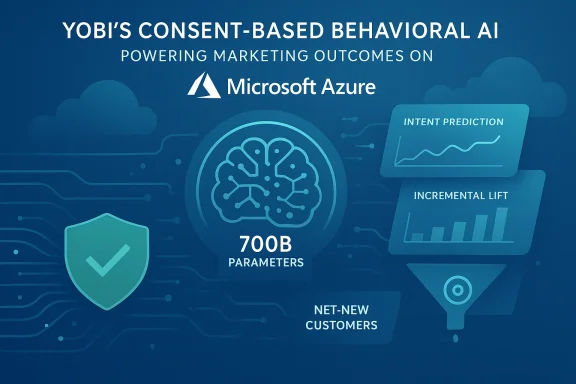
Yobi’s partnership with Microsoft marks a sharp turn in the enterprise AI conversation: away from generic generative assistants and toward predictive behavioral intelligence built on consented data, cloud-scale infrastructure, and measurable business outcomes. The announcement says Yobi is using Microsoft Azure to train a 700B-parameter behavioral foundation model, while Wolverine Worldwide’s Merrell and Saucony brands are already seeing stronger ROI and net-new customer acquisition from the approach. The larger story is not just about one startup and one customer, but about whether enterprises can finally access the kind of intent prediction long dominated by large ad platforms, without abandoning privacy and governance. In that sense, the deal is as much about data rights and platform power as it is about AI.
The article’s central claim is that Yobi has built a behavioral AI system that sits on top of consented consumer data and uses Microsoft Azure as the compute and distribution backbone. That positioning matters because enterprise AI buyers increasingly want models that are not only powerful, but also defensible under privacy and compliance scrutiny. Yobi is framing its model as a way to unlock predictive consumer intelligence for U.S. enterprises that otherwise lack the scale of the biggest digital ad ecosystems.
The partnership also reflects a broader shift in how enterprise AI is being marketed. Instead of selling creativity or convenience, vendors are now selling outcomes: conversion lift, better audience selection, higher return on ad spend, and earlier-funnel reach. The Yobi pitch is that AI should not merely assist marketing teams; it should help them find the right next customer before the customer is already in-market. That is a much more aggressive thesis than classic personalization, and it is one that could change expectations around enterprise marketing technology.
Wolverine Worldwide is the immediate proof point. The company says Yobi has helped Merrell and Saucony reach high-value shoppers at the top of the funnel, producing meaningful net-new customer acquisition and stronger returns than legacy channels. That matters because footwear and apparel are fiercely competitive categories where paid search and social often skim the same audiences again and again. If the results hold, the implications go beyond one brand portfolio and point toward a new class of AI-driven demand generation.
There is, however, a deeper strategic layer here. Microsoft gains another enterprise AI narrative anchored in Azure and in responsible-data messaging, while Yobi gains legitimacy by associating itself with a hyperscaler and by showing a concrete customer outcome. The article suggests Microsoft customers will be able to buy Yobi through Azure Marketplace, which is significant because marketplace distribution can turn a niche capability into a procurement-friendly enterprise product. That distribution model is often the difference between an intriguing demo and a budget line item.
At the same time, the timing aligns with a larger enterprise realization: first-party data is valuable, but not always sufficient. Brands know a lot about their own customers, but they often struggle to infer intent, predict next actions, or identify adjacent audiences at scale. The article argues that Yobi’s behavioral model adds the missing layer by enriching permissioned data with broader behavioral signals. That is an appealing proposition for marketers under pressure to do more with less, especially when acquisition costs remain high.
That matters because behavioral AI at this scale is computationally expensive and operationally complex. Cloud partnership can reduce the burden of provisioning, security, and deployment while giving enterprise customers a procurement path they already understand. For Microsoft, the upside is that Azure becomes associated with a privacy-aware, enterprise-relevant AI use case instead of just generalized model hosting.
The footwear and apparel sector is a useful proving ground because demand is seasonal, brand loyalty matters, and the purchase cycle is not always immediate. A model that can detect interest earlier in the journey could materially improve efficiency. If Yobi’s system helps brands shift spend away from late-stage conversion bidding and toward earlier audience discovery, it could change how marketers think about funnel strategy.
This is a subtle but meaningful shift in AI architecture. A text model can describe consumer behavior; a behavioral model can try to anticipate it. In marketing terms, that means the system is oriented around outcome prediction rather than content generation. It is closer to decision intelligence than to chatbot technology, and that makes it easier to tie directly to revenue metrics.
Yobi’s claim is that it creates privacy-preserving representations that surface intent without exposing personal details. If true, that gives enterprises a way to use behavioral intelligence while keeping sensitive data boundaries intact. It also makes the offering easier to align with internal governance standards, which are becoming increasingly important as AI moves deeper into customer operations.
The competitive logic is simple. If Yobi can offer predictive behavioral intelligence that is both privacy-preserving and operationally useful, then enterprises may no longer need to rely exclusively on the same few dominant channels for performance marketing. That could pressure incumbents to improve their own privacy posture, audience modeling, and measurement transparency. In other words, the partnership is a challenge not just to startups, but to the assumptions of digital marketing itself.
For enterprises, the upside is much clearer. Brands get access to predictive intelligence that could improve campaign efficiency, uncover new audiences, and support better retention strategies. In a budget environment where every marketing dollar is scrutinized, tools that can show measurable uplift will have an easier path to adoption than AI features that sound impressive but do not tie back to revenue.
The other thing to watch is how Microsoft continues to shape the narrative. If Azure becomes the preferred home for specialized enterprise AI models like Yobi’s, Microsoft can reinforce the idea that its cloud is not only for general-purpose compute, but for business-specific intelligence. That would be a meaningful strategic win in a market where differentiation is increasingly about domain depth, not just model scale.
What happens next will likely depend on execution rather than rhetoric.
Source: AiThority Yobi Partners with Microsoft on Enterprise AI Model for Predictive Behavioral Intelligence
 Overview
The article’s central claim is that Yobi has built a behavioral AI system that sits on top of consented consumer data and uses Microsoft Azure as the compute and distribution backbone. That positioning matters because enterprise AI buyers increasingly want models that are not only powerful, but also defensible under privacy and compliance scrutiny. Yobi is framing its model as a way to unlock predictive consumer intelligence for U.S. enterprises that otherwise lack the scale of the biggest digital ad ecosystems.The partnership also reflects a broader shift in how enterprise AI is being marketed. Instead of selling creativity or convenience, vendors are now selling outcomes: conversion lift, better audience selection, higher return on ad spend, and earlier-funnel reach. The Yobi pitch is that AI should not merely assist marketing teams; it should help them find the right next customer before the customer is already in-market. That is a much more aggressive thesis than classic personalization, and it is one that could change expectations around enterprise marketing technology.
Wolverine Worldwide is the immediate proof point. The company says Yobi has helped Merrell and Saucony reach high-value shoppers at the top of the funnel, producing meaningful net-new customer acquisition and stronger returns than legacy channels. That matters because footwear and apparel are fiercely competitive categories where paid search and social often skim the same audiences again and again. If the results hold, the implications go beyond one brand portfolio and point toward a new class of AI-driven demand generation.
There is, however, a deeper strategic layer here. Microsoft gains another enterprise AI narrative anchored in Azure and in responsible-data messaging, while Yobi gains legitimacy by associating itself with a hyperscaler and by showing a concrete customer outcome. The article suggests Microsoft customers will be able to buy Yobi through Azure Marketplace, which is significant because marketplace distribution can turn a niche capability into a procurement-friendly enterprise product. That distribution model is often the difference between an intriguing demo and a budget line item.
Why This Matters Now
Enterprise marketing has spent years trying to balance personalization with privacy. Third-party cookies are fading, regulations are tightening, and consumers are more alert to how their behavioral data is used. In that environment, a model built on consented data and packaged as privacy-preserving intelligence has a much easier story to tell than one built on opaque tracking. Yobi is clearly trying to position itself as the ethical alternative to the old surveillance-adjacent advertising playbook.At the same time, the timing aligns with a larger enterprise realization: first-party data is valuable, but not always sufficient. Brands know a lot about their own customers, but they often struggle to infer intent, predict next actions, or identify adjacent audiences at scale. The article argues that Yobi’s behavioral model adds the missing layer by enriching permissioned data with broader behavioral signals. That is an appealing proposition for marketers under pressure to do more with less, especially when acquisition costs remain high.
The consent advantage
A major part of Yobi’s pitch is that the data foundation is consented, which is a meaningful distinction in the current AI climate. Consent does not solve every privacy issue, but it does provide a cleaner legal and ethical basis for enterprise use. For buyers, that can reduce friction with legal, compliance, and procurement teams, all of which increasingly demand a clear explanation of where AI training data comes from and how it is used.- Consent can improve enterprise trust.
- Consent can simplify procurement conversations.
- Consent can reduce reputational risk.
- Consent makes model governance easier to explain.
- Consent does not eliminate all privacy concerns.
The Microsoft Azure Layer
Microsoft Azure is not just a hosting choice here; it is a strategic validator. By building on Azure, Yobi inherits the credibility of a major cloud platform and also gains access to the tooling and scale needed to train large proprietary models. The article specifically says Azure enables Yobi to train 700B parameter models, which is a statement as much about infrastructure ambition as about marketing.That matters because behavioral AI at this scale is computationally expensive and operationally complex. Cloud partnership can reduce the burden of provisioning, security, and deployment while giving enterprise customers a procurement path they already understand. For Microsoft, the upside is that Azure becomes associated with a privacy-aware, enterprise-relevant AI use case instead of just generalized model hosting.
Why hyperscaler alignment matters
Hyperscaler alignment often determines whether a startup is seen as a toy or a platform. In enterprise software, buyers usually prefer technologies that plug into familiar security, billing, and identity systems. Azure Marketplace distribution gives Yobi a route into that world, which may be more valuable than a standalone sales motion.- Marketplace availability reduces buying friction.
- Azure branding can increase buyer confidence.
- Integrated billing helps procurement.
- Cloud-native deployment can accelerate rollout.
- Platform alignment can shorten enterprise sales cycles.
Wolverine Worldwide as the Test Case
Wolverine Worldwide is the clearest example of how the partnership is supposed to work in practice. The company’s Merrell and Saucony brands reportedly used Yobi’s AI in 2025 to target high-value shoppers at the top of the funnel, improving new customer acquisition and generating returns that beat legacy channels. That is a strong proof point because it speaks directly to enterprise marketing’s favorite metric: incremental lift.The footwear and apparel sector is a useful proving ground because demand is seasonal, brand loyalty matters, and the purchase cycle is not always immediate. A model that can detect interest earlier in the journey could materially improve efficiency. If Yobi’s system helps brands shift spend away from late-stage conversion bidding and toward earlier audience discovery, it could change how marketers think about funnel strategy.
Top-of-funnel economics
The article’s argument is that most dominant digital platforms are optimized for buyers who are already close to purchase. That is a powerful machine for harvesting demand, but it can also trap brands inside a cycle where they keep paying to re-capture customers who were already likely to convert. Yobi’s pitch is that it can identify net-new audiences earlier and create actual incremental growth.- Early-funnel targeting can widen addressable demand.
- Net-new customer acquisition is often more valuable than repeat capture.
- Incremental lift is harder to fake than raw impressions.
- Better audience discovery can improve lifetime value.
- Legacy channels often over-index on lower-funnel efficiency.
Behavioral AI Versus LLMs
One of the most interesting parts of the article is the way it distinguishes Yobi’s model from a standard large language model. According to the piece, LLMs are trained on text, while Yobi’s behavioral foundation model is trained on real-world actions such as purchases, store visits, and marketing conversions. That distinction is important because the model’s job is not to generate language, but to infer intent.This is a subtle but meaningful shift in AI architecture. A text model can describe consumer behavior; a behavioral model can try to anticipate it. In marketing terms, that means the system is oriented around outcome prediction rather than content generation. It is closer to decision intelligence than to chatbot technology, and that makes it easier to tie directly to revenue metrics.
Different model, different purpose
The article’s framing echoes a wider enterprise trend: companies are beginning to value specialized AI models that fit one business problem very well, rather than generic models that can do many things adequately. That is especially true in marketing, where signal quality matters more than conversational fluency. If the model can identify likely buyers, the business gains leverage; if it only produces polished text, the ROI is much harder to prove.- Text models generate content.
- Behavioral models infer intent.
- Outcome models optimize business KPIs.
- Domain-specific training improves relevance.
- Precision matters more than generality in marketing.
The Privacy and Trust Question
The article repeatedly emphasizes privacy, consent, and ethical access. That is not just good messaging; it is essential to the business model. Behavioral intelligence can quickly become controversial if buyers or consumers feel the system is too invasive, too opaque, or too close to the surveillance-ad tech playbook that many organizations now want to move beyond.Yobi’s claim is that it creates privacy-preserving representations that surface intent without exposing personal details. If true, that gives enterprises a way to use behavioral intelligence while keeping sensitive data boundaries intact. It also makes the offering easier to align with internal governance standards, which are becoming increasingly important as AI moves deeper into customer operations.
Why trust is a product feature
Trust is no longer an afterthought in enterprise AI. It is part of the product itself, because buyers are evaluating not only what a system can do, but also how it handles data, how it explains decisions, and how it fits into compliance frameworks. Yobi’s partnership with Microsoft appears designed to make trust more legible by tying the product to Azure, consented data, and enterprise marketplace distribution.- Trust lowers buyer resistance.
- Transparency helps legal review.
- Privacy controls support enterprise adoption.
- Explainability can ease internal approval.
- Consent-based design can reduce backlash.
Competitive Implications
This partnership lands in a market that is increasingly crowded but still unsettled. On one side are the giant platforms that own audience scale and ad infrastructure. On the other are specialized AI vendors trying to prove that they can deliver better outcomes by being more focused, more privacy-aware, and more enterprise-friendly. Yobi is clearly trying to occupy the middle ground: broad enough to matter, specific enough to be differentiated.The competitive logic is simple. If Yobi can offer predictive behavioral intelligence that is both privacy-preserving and operationally useful, then enterprises may no longer need to rely exclusively on the same few dominant channels for performance marketing. That could pressure incumbents to improve their own privacy posture, audience modeling, and measurement transparency. In other words, the partnership is a challenge not just to startups, but to the assumptions of digital marketing itself.
What rivals will need to prove
Competitors will not win by talking vaguely about AI personalization. They will need to show they can deliver incremental value, not just optimized spend. That means proving better audience discovery, stronger ROI, and trustworthy data handling in a world where buyers are increasingly skeptical of black-box targeting.- Better measurement of incremental lift.
- Stronger privacy and consent controls.
- More precise audience prediction.
- Easier enterprise procurement and deployment.
- Clearer links between AI and revenue outcomes.
Consumer and Enterprise Impact
For consumers, the impact is likely to be indirect but meaningful. If behavioral AI tools like Yobi become more common, consumers may see more relevant offers and less irrelevant advertising, but they may also become more aware that their behavioral signals are being used to shape marketing decisions. The promise is personalization; the risk is feeling tracked even when data is supposedly consented.For enterprises, the upside is much clearer. Brands get access to predictive intelligence that could improve campaign efficiency, uncover new audiences, and support better retention strategies. In a budget environment where every marketing dollar is scrutinized, tools that can show measurable uplift will have an easier path to adoption than AI features that sound impressive but do not tie back to revenue.
Enterprise use cases likely to matter
The strongest enterprise use cases are the ones that connect directly to existing business workflows. That could include audience scoring, propensity prediction, personalized merchandising, churn prevention, and cross-channel conversion optimization. The more directly the model maps to a revenue or retention decision, the more valuable it becomes.- Audience scoring for media planning.
- Propensity modeling for acquisition campaigns.
- Customer lifecycle prediction.
- Personalized merchandising and offers.
- Incrementality measurement across channels.
Strengths and Opportunities
Yobi’s biggest strength is that it is not trying to win the enterprise AI race with another generic assistant. It is choosing a narrower and potentially more valuable category: consented behavioral prediction tied to revenue outcomes. That focus gives it a clearer commercial story, especially when paired with Microsoft’s infrastructure and distribution muscle.- Clear differentiation from generic LLM vendors.
- Strong enterprise use case tied to ROI.
- Privacy-forward positioning.
- Microsoft Azure credibility and scale.
- Marketplace distribution potential.
- Proven customer narrative with Wolverine Worldwide.
- Potential to reshape audience targeting economics.
Risks and Concerns
The biggest risk is overpromising on what behavioral AI can safely and consistently do. A model that claims to predict intent across large populations must still contend with data quality, bias, attribution complexity, and the possibility that the apparent lift is not as incremental as it first appears. As with many AI marketing products, the proof will come only after many campaigns, not one headline result.- Attribution may be difficult to verify.
- Data quality could limit model performance.
- Privacy claims will face intense scrutiny.
- Over-targeting could harm brand perception.
- Procurement may slow if governance is unclear.
- Model drift could reduce consistency over time.
- Competitors may copy the positioning quickly.
Looking Ahead
The key thing to watch is whether Yobi can scale this model beyond a showcase customer and into a repeatable enterprise category. If more brands adopt the platform through Azure Marketplace and report strong incremental performance, the company could become a reference point for privacy-aware behavioral AI in marketing. If adoption stalls, the partnership may be remembered as an ambitious proof of concept rather than a category shift.The other thing to watch is how Microsoft continues to shape the narrative. If Azure becomes the preferred home for specialized enterprise AI models like Yobi’s, Microsoft can reinforce the idea that its cloud is not only for general-purpose compute, but for business-specific intelligence. That would be a meaningful strategic win in a market where differentiation is increasingly about domain depth, not just model scale.
What happens next will likely depend on execution rather than rhetoric.
- Watch for more enterprise customer references beyond Wolverine Worldwide.
- Watch for evidence of measurable incremental lift in multiple categories.
- Watch for how Yobi explains data consent and privacy controls.
- Watch for Azure Marketplace adoption and procurement momentum.
- Watch for competing claims from ad-tech and cloud rivals.
Source: AiThority Yobi Partners with Microsoft on Enterprise AI Model for Predictive Behavioral Intelligence
