

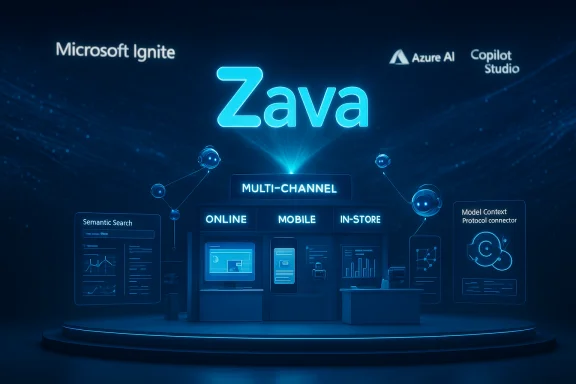
Microsoft’s demo universe has quietly shifted its cast: the two most familiar fictional customers in Microsoft documentation and demos — Contoso and Fabrikam — remain in the archives, but a new, AI‑era storytelling brand called Zava is now the centerpiece of Ignite-stage demos, workshop repositories, and GitHub-backed hands‑on labs aimed at showing agentic AI, multichannel retail, and Fabric‑centric data scenarios.
For more than two decades Microsoft and its ecosystem have relied on fictional companies as a stable, predictable way to teach, demo, and test features without exposing real customer data. Contoso served as the canonical multinational, used across Azure, Windows, and enterprise documentation, while Fabrikam has been a long‑standing sample company used in Dynamics, BizTalk and earlier Windows Server tutorials. Those sample companies became shorthand across training materials, partner scripts and sample databases. What changed at Microsoft Ignite and in the accompanying workshop resources is not a legal or formal “retirement” announcement but a clear narrative pivot: Zava has been introduced as the modern demo brand that better matches the company’s agentic AI messaging. Zava appears in public workshop labs, GitHub session repositories, and demonstration scripts designed to teach retrieval‑augmented generation (RAG), vector search, Model Context Protocol (MCP) integrations, and agent orchestration in Azure AI Foundry. The pivot is visible on Microsoft‑published GitHub repos and conference session materials.
Source: Windows Report Microsoft Quietly Retires Contoso and Fabrikam, Introduces ‘Zava’ as Its New AI-Era Demo Brand
 Background / Overview
For more than two decades Microsoft and its ecosystem have relied on fictional companies as a stable, predictable way to teach, demo, and test features without exposing real customer data. Contoso served as the canonical multinational, used across Azure, Windows, and enterprise documentation, while Fabrikam has been a long‑standing sample company used in Dynamics, BizTalk and earlier Windows Server tutorials. Those sample companies became shorthand across training materials, partner scripts and sample databases. What changed at Microsoft Ignite and in the accompanying workshop resources is not a legal or formal “retirement” announcement but a clear narrative pivot: Zava has been introduced as the modern demo brand that better matches the company’s agentic AI messaging. Zava appears in public workshop labs, GitHub session repositories, and demonstration scripts designed to teach retrieval‑augmented generation (RAG), vector search, Model Context Protocol (MCP) integrations, and agent orchestration in Azure AI Foundry. The pivot is visible on Microsoft‑published GitHub repos and conference session materials. What exactly is Zava?
Zava is a fictional retail firm that appears in multiple Microsoft demo artifacts in two main flavours:- A keynote/demo persona described on stage as an “intelligent athletic apparel” brand used to illustrate customer journeys and Copilot/agent scenarios.
- A richer, workshop‑focused dataset labeled Zava DIY — a Washington State‑based home‑improvement retailer with multiple stores, online channels, seasonal buying patterns, and a detailed product catalog built to support hands‑on labs (SQL backups, PostgreSQL stacks, pgvector examples and Row Level Security). These artifacts are designed to feed agent demos and Fabric pipelines with realistic, reproducible sample data.
Where Zava appears — documented traces
Microsoft’s public repositories and session repos are the clearest evidence that Zava is being used as a modern demo brand:- A Microsoft GitHub repository for the AI Tour session WRK540 (“Unlock Your Agents' Potential with Model Context Protocol”) explicitly uses Zava as the workshop scenario and lists PostgreSQL, pgvector, RLS and Azure AI Foundry as technologies in the workshop. That repo contains session delivery resources intended for presenters and reproduces the same Zava dataset used in training labs.
- Conference and AI Tour session descriptions referenced in Microsoft’s event documentation list Zava in the session synopses and materials, signaling that event teams are aligning demo content around the new brand.
- Meanwhile, many existing Microsoft Learn pages, samples, and legacy code examples continue to reference Contoso and Fabrikam (BizTalk tutorials, Windows scenarios, service fabric samples), confirming that the old demo companies remain part of Microsoft’s documentation corpus. That juxtaposition explains the community impression that Contoso and Fabrikam were “retired” when in fact they remain live in many Learn samples.
Why Microsoft introduced Zava now
The introduction of Zava aligns with several trends in enterprise product messaging and technical education:- Agentic storytelling: Microsoft’s keynote and product messaging in the recent events emphasize multiagent orchestration, autonomous workflows, and agent‑centric user journeys. A modern retail brand lends itself to tangible agent scenarios: orders, returns, seasonal demand shifts, and multi‑channel fulfillment.
- Data realism for AI: Where Contoso and Fabrikam historically served general IT and ERP teaching needs, Zava’s dataset has richer time‑series, customer behavior signals and product catalogs designed for training RAG pipelines and testing semantic search at scale. That makes Zava a better playground for demonstrating vector search, pgvector, and RLS.
- Event consistency: Conference and workshop teams benefit from a single, modern story world that is tuned to show Fabric, Copilot Studio, Azure AI Foundry, and MCP integrations in a reproducible way on stage and in labs. Zava is intentionally engineered to hit those story beats.
What did not happen: Contoso and Fabrikam were not formally “retired”
A key clarification: Microsoft has not published a corporate press release declaring Contoso and Fabrikam retired. Instead, the evidence points to a storyline shift at high‑profile events and a purposeful creation of new educational artifacts around Zava. Contoso and Fabrikam still show up across Learn content and legacy samples, and many tutorials will continue to use those brands for backward compatibility and continuity. Treat the transition as evolution, not erasure.The significance for IT pros, partners, and documentarians
Zava’s rise matters beyond nostalgia. It affects how practitioners learn, prototype, and present Microsoft technology.Concrete technical implications
- Datasets: Zava DIY datasets include PostgreSQL‑backed data, with examples for pgvector and Row Level Security (RLS) tailored to show secure semantic search and role‑based data access in agent workflows. If you plan to reuse these artifacts for proofs‑of‑concept (PoCs), expect to run a short compliance and privacy audit on the sample data.
- Agent patterns: The Zava demos show integrations with Azure AI Foundry, Model Context Protocol (MCP) connectors, and Copilot/Agent Studio flows. These sessions are designed to be reproducible in labs and teach observability and governance patterns for agents.
- Operational realism: The Zava artifacts are simplified to be consumable in a workshop timeframe. They intentionally smooth over messy source systems, data quality debt, and integration complexities that organisations will face in production. Treat the examples as pedagogical scaffolding — not production blueprints.
Risks and practical concerns
- Fragmentation for newcomers: If your team follows GitHub workshops that use Zava while older Learn modules use Contoso/Fabrikam, onboarding friction will increase. Expect to map from one example data model to another.
- Overfitting to marketing narratives: Zava is designed to showcase Microsoft’s modern capabilities. Demos may understate cost, deployment overhead, and governance needs (model routing, telemetry, DLP). Don’t assume a stage demo equals production readiness.
- Vendor lock‑in optics: Deeply coupling agent flows to Microsoft Fabric and Foundry in demos may make multi‑vendor comparisons harder. That’s expected in vendor demos, but architects should evaluate abstraction layers if portability matters.
- Safety and hallucination: Microsoft’s agent messaging includes explicit caveats about hallucination risk and the need for safety layers, but workshop artifacts may not fully simulate enterprise‑grade guardrails. Plan for content safety, runtime guardrails and audit trails.
Verification of claims and technical facts
A responsible read of the evidence shows:- Microsoft used Zava in Ignite and workshop demos: confirmed by Microsoft GitHub session repos (WRK540 session and related resources) that name Zava as the demo dataset and list technologies like PostgreSQL, pgvector, RLS, MCP and Azure AI Foundry.
- Zava’s public descriptions vary: in some keynote contexts Zava is an “intelligent athletic apparel” brand, while workshop resources include a more elaborate “Zava DIY” home‑improvement dataset with multiple stores and seasonal data. Both descriptions are visible in Microsoft‑published artifacts and third‑party coverage.
- Contoso and Fabrikam remain in Microsoft Learn: Microsoft Learn and archived docs still contain Contoso and Fabrikam tutorials across BizTalk, Service Fabric, Windows identity and other products. There is no catalog‑wide purge of those names.
- No formal “retirement” press release: independent reporting (trade press) and Microsoft’s repositories show a narrative shift, but no corporate statement was found that formally retires the older demo companies. Treat claims of “retirement” as community shorthand unless an official Microsoft statement appears.
Recommendations for practitioners (practical, actionable)
If you’re an IT leader, partner engineer, or documentation owner, adopt a pragmatic approach to Zava and its artifacts:- Use Zava artifacts for learning: clone the GitHub session repos for hands‑on labs to learn agent patterns (MCP, vector search, RLS, agent observability).
- Audit sample data before reuse: run a short compliance and privacy check. Confirm whether sample datasets contain synthetic PII or assumptions that bypass enterprise entitlements.
- Validate model routing and SLAs: check which model providers are assumed in workshops and whether the promised SLAs or compute consumption maps to production expectations.
- Map demo flows to your architecture: identify where the demo uses Fabric‑native components and where you’ll need adapter layers to preserve portability.
- Implement runtime guardrails: plan content safety, DLP, logging, and provenance for any agent that acts on customer‑facing tasks. Consider integrating content‑safety APIs and evaluation SDKs that the workshops reference.
The cultural angle: why practitioners care about Contoso and Fabrikam
Contoso and Fabrikam have been more than placeholders — they were cultural anchors. Teams, trainers, and documentation historically converged around those names to create common mental models. Removing them without a widely shared alternative would risk fragmentation; introducing Zava gives the ecosystem a new, targeted canvas for AI‑first demos. But the emotional impact matters: long‑time practitioners see the pivot as the end of a shared shorthand, while newcomers will likely find Zava’s modern retail scenarios more relevant to cloud‑native and AI use cases.Critical analysis — strengths and potential pitfalls
Strengths
- Better alignment with modern tech stacks: Zava’s dataset and scenario design map neatly to Fabric, Copilot Studio and Azure AI Foundry, making it easier to demonstrate agentic outcomes on stage and in labs.
- Data realism for AI tasks: Worker scenarios for inventory, seasonal demand and customer behavior provide richer signals that are especially useful when teaching RAG, vector search, and pgvector integration.
- One cohesive story for events: Having a dedicated demo brand reduces ad‑hoc story changes in conference demos and improves reproducibility across sessions.
Pitfalls and risks
- Simplification bias: Demos are simplified. They do not capture enterprise complexity — messy master data, long migration tails, or bespoke integrations — which can lead teams to underestimate implementation effort.
- Inconsistent learning paths: With Learn docs still using Contoso/Fabrikam and workshops using Zava, there’s a training disconnect that can slow onboarding for newcomers.
- Marketing‑first danger: Zava’s purpose is to show a story; customers must guard against conflating demo theatrics with production maturity. Verify cost models, SLAs, and compliance needs before committing to a given architecture.
- Governance gaps: Agentic systems amplify governance needs — model provenance, entitlements, and real‑time monitoring — yet sample workshops will likely focus more on feature showcases than enterprise controls. Plan for guardrails from day one.
Short‑term outlook and what to watch for
- Expect Microsoft to continue using Zava in agent and Fabric demonstrations across events and AI Tour sessions; session repos and workshop materials already reference the brand. Watch for more published lab artifacts and curriculum that use Zava datasets.
- Monitor Microsoft Learn for coordinated updates. If Microsoft decides to deprecate Contoso/Fabrikam across the Learn corpus, that would require a formal, documented migration path; until such an announcement appears, consider Contoso and Fabrikam still part of the learning ecosystem.
- Look for third‑party partners and ISVs to begin publishing Zava‑based PoC templates, which will accelerate ecosystem adoption — and, potentially, the propagation of any demo assumptions that need critical scrutiny.
Conclusion
Zava is not a casualty of corporate housekeeping; it’s a deliberately crafted demo identity optimized for the AI‑first, agentic narratives Microsoft is pitching to partners and customers. The change reflects a strategic storytelling pivot that maps neatly to Fabric, Copilot/Agent Studio, and Azure AI Foundry patterns, and it supplies reproducible artifacts for workshops and hands‑on learning. But this is a pivot, not a purge: Contoso and Fabrikam remain present in Microsoft Learn and legacy samples, and there is no single authoritative Microsoft declaration that ends their usage. For IT teams, the practical approach is simple: use Zava artifacts to learn and prototype modern agent patterns, but subject any demo assumptions to rigorous governance, cost, and data‑protection reviews before rolling similar architectures into production.Source: Windows Report Microsoft Quietly Retires Contoso and Fabrikam, Introduces ‘Zava’ as Its New AI-Era Demo Brand
