

Zyxel Builds a Wi‑Fi 7 Access Point for Places That Hate Access Points
Enterprise Wi‑Fi has always been less glamorous than consumer router marketing suggests. In homes, a router can sit on a shelf and shout through drywall. In warehouses, loading yards, freezer rooms, event venues, manufacturing floors, campuses, and outdoor retail areas, radio design becomes a battle against metal, weather, forklifts, bodies, temperature swings, cable distance, and regulatory limits.
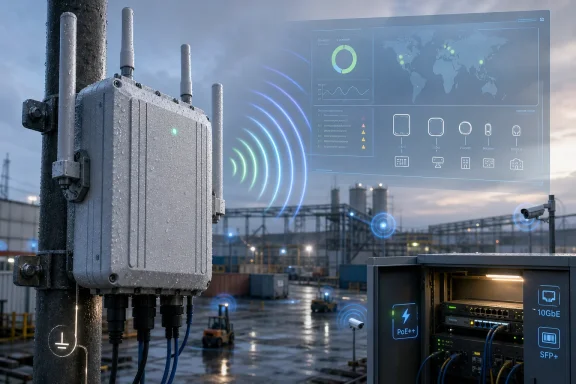
That is the world Zyxel is targeting with the WBE665S. This is not a discreet ceiling puck or a plastic rectangle meant to disappear above a conference room. It is a large, heavy, hardened access point measuring roughly 410 x 410 x 110mm and weighing close to 5kg, built around a metal chassis and polycarbonate shell.
The physical specification tells the story before the Wi‑Fi numbers do. IP67 protection means the unit is dust-tight and rated for temporary immersion in water. A quoted operating range of -40C to +70C and 6kV lightning protection places it squarely in the category of equipment intended to stay mounted when conditions turn hostile.
That matters because enterprise Wi‑Fi 7 is not just a speed upgrade. The point of this generation is to make wireless networks behave more like predictable infrastructure. Zyxel’s pitch is that the WBE665S can provide that predictability in places where a normal indoor AP would be a maintenance ticket waiting to happen.
The Speed Numbers Are Real, but They Are Not the Whole Product
The WBE665S carries a BE22000 rating, with 12 spatial streams split evenly across its 2.4GHz, 5GHz, and 6GHz radios. Zyxel claims maximum theoretical rates of up to 1,376Mbits/sec on 2.4GHz, 8,646Mbits/sec on 5GHz, and 11,530Mbits/sec on 6GHz. As always, those are ceiling numbers, not user experience numbers.
Still, the lab results reported by ITPro are the sort of figures that make Wi‑Fi 7 feel less theoretical. Using a Lenovo Windows 11 Pro desktop with a TP-Link Archer TBE550E Wi‑Fi 7 PCIe adapter and a Dell PowerEdge Windows Server 2022 host on a 10GbE wired connection, the reviewer saw a 2.4/6GHz MLO link at an aggregated 6,108Mbits/sec. OpenSpeedTest then reported close-range upload and download rates of 538MB/sec and 445MB/sec.
That is not “fast for Wi‑Fi” in the old apologetic sense. That is fast enough to make the wired backhaul, switch fabric, endpoint storage, and application stack part of the conversation. Once Wi‑Fi starts producing several hundred megabytes per second in real transfers, the access point is no longer the only likely bottleneck.
The 5GHz results were also notable. When the AP was switched into outdoor mode, disabling 6GHz under the review’s UK regulatory context, the Windows 11 client reconnected over a 2.4/5GHz MLO link at 3,570Mbits/sec. Close-range throughput of 353MB/sec up and 317MB/sec down is still well into the territory where many client workloads will feel limited by something other than the air interface.
At 10 metres with a wall in the way, the 6GHz result fell but remained strong: 378MB/sec up and 300MB/sec down. The 5GHz outdoor-mode result at distance was lower, at 275MB/sec up and 211MB/sec down, but still serious enterprise throughput. The lesson is familiar but important: 6GHz is spectacular when conditions are friendly, while 5GHz remains the practical workhorse when range, walls, and regulation intrude.
Multi-Link Operation Finally Starts to Look Like an IT Feature
One of Wi‑Fi 7’s defining features is Multi-Link Operation, or MLO, which allows capable devices to use more than one band at once. In consumer marketing, MLO is often reduced to “bigger number go faster.” In enterprise networks, its more interesting promise is resilience: better use of available spectrum, smoother steering, and potentially less disruption when one band is congested or unavailable.
Zyxel’s implementation appears to lean into that practical value. The review notes that the WBE665S supports auto-MLO: set the radios to 802.11be operation, apply supported encryption such as Enhanced Open, WPA3 Personal, or WPA3 Enterprise, and MLO-capable clients can automatically form aggregated links. That is the right model for business Wi‑Fi, because administrators do not want a science project every time a fleet of client adapters changes.
The Windows angle is especially relevant. A modern Windows 11 desktop with a Wi‑Fi 7 PCIe adapter was able to form the expected MLO links in the test setup, first using 2.4/6GHz in indoor mode, then 2.4/5GHz after the AP was flipped to outdoor mode. That sort of automatic behavior is what makes Wi‑Fi 7 administratively interesting rather than merely impressive in a datasheet.
There is a catch, of course. MLO only helps if the client estate supports it, the drivers are mature, the encryption settings permit it, and the RF plan is coherent. Many enterprise fleets still contain a long tail of Wi‑Fi 5, Wi‑Fi 6, and Wi‑Fi 6E hardware, including handheld scanners, printers, rugged tablets, shared laptops, industrial controllers, and IoT devices that will not behave like a freshly built Windows test desktop.
That makes the WBE665S a bridge product. It can deliver headline Wi‑Fi 7 behavior to new clients while still serving legacy devices, but the return on investment depends heavily on how quickly an organization’s endpoints catch up. The access point may be ready for MLO before the procurement spreadsheet is.
The 6GHz Toggle Is a Clever Fix for an Awkward Regulatory Reality
The most revealing feature in the WBE665S review is not the BE22000 rating. It is the indoor/outdoor toggle.
In the UK, Ofcom’s current approach to 6GHz Wi‑Fi remains more constrained than the simple “Wi‑Fi 7 equals 6GHz everywhere” story many vendors would prefer. Standard 6GHz Wi‑Fi use is generally an indoor affair, while outdoor use is limited and tied to very low power or future automated frequency coordination frameworks. The reason is not bureaucratic fussiness for its own sake; the 6GHz band has incumbent users and coexistence concerns, including fixed links, satellite services, radio astronomy, and other sensitive systems.
Zyxel’s workaround is straightforward. Set the WBE665S to indoor mode, and the 6GHz radio is enabled. Set it to outdoor mode, and 6GHz is disabled. The switch exists in both the standalone web console and the Nebula Cloud Control portal.
As product design, this is sensible. It gives administrators a simple compliance mechanism rather than forcing them to navigate country tables, channel availability, and obscure power rules manually. In a distributed estate with many sites, that matters.
As risk management, it also shifts responsibility back to the operator. A single toggle can prevent accidental non-compliance, but it can also create accidental non-compliance if someone chooses the wrong mode. The review rightly points out that administrators must ensure the AP is not left in indoor mode when deployed outside.
That tiny UX decision captures the state of Wi‑Fi 7 in 2026. The hardware is becoming impressively capable. The software is becoming easier to operate. The rules governing 6GHz use are still uneven across markets, and the access point has to embody that uncertainty.
Outdoor Wi‑Fi 7 Is Waiting on AFC as Much as Silicon
Automated Frequency Coordination, or AFC, is one of the dull acronyms that will decide how useful outdoor 6GHz Wi‑Fi becomes. The basic idea is that higher-power or outdoor 6GHz devices check with a coordination system to determine which channels and power levels are safe at a given location. That protects incumbent users while letting Wi‑Fi use more spectrum than blanket low-power rules would allow.
The United States moved earlier toward AFC-enabled standard-power 6GHz Wi‑Fi, while the UK and other markets have taken a more cautious and consultative path. Ofcom has been working through proposals for enabling AFC and for expanding access to the 6GHz band, including standard-power use in the lower 6GHz range under AFC control and broader sharing arrangements in the upper 6GHz band.
For buyers, the practical consequence is simple: the WBE665S may be physically ready for outdoor 6GHz, but the usefulness of that capability depends on the country, the deployment mode, and the regulatory calendar. This is why the AP’s outdoor mode disables 6GHz in the reviewed UK context. The radio can do more than the law currently permits.
That makes the WBE665S a future-facing purchase rather than a universally unlocked one. If AFC frameworks mature and outdoor 6GHz permissions broaden, an AP like this becomes much more attractive for campuses, transport hubs, yards, stadium perimeters, and industrial zones. If the rules remain constrained or fragmented, the product still offers strong 5GHz Wi‑Fi 7 performance, but part of its most expensive promise stays dormant in outdoor installations.
This is not unique to Zyxel. Every vendor selling rugged Wi‑Fi 7 hardware has to navigate the same policy problem. The difference is that Zyxel has made the tension unusually visible through a user-facing indoor/outdoor mode.
The 10GbE Uplink Is Not Luxury Anymore
A decade ago, many access points could be constrained by a single gigabit Ethernet uplink without much practical drama. That era is over for high-end Wi‑Fi 7. The WBE665S includes a 10GbE multi-Gig copper uplink and a 10GbE SFP+ fiber port, which is not spec-sheet vanity but a requirement if the AP is expected to serve multiple high-performance clients without collapsing into a wired bottleneck.
The review’s lab setup demonstrates why. If one Windows 11 client can move hundreds of megabytes per second in favorable conditions, a busy enterprise environment can make gigabit backhaul look quaint very quickly. Multiple Wi‑Fi 7 laptops, scanners syncing rich media, AR devices, high-resolution cameras, temporary event systems, and local application traffic can collectively demand more than 1GbE.
The SFP+ option is just as important as the copper port. Outdoor and industrial APs often need to be mounted where Ethernet distance, electrical interference, and lightning exposure make fiber desirable. Zyxel’s inclusion of both copper and fiber backhaul means the WBE665S can fit into more realistic site designs.
Power is the other side of that equation. The AP needs 802.3bt PoE++ for all features to function, and that requirement should not be treated as a footnote. A network team considering this class of AP also needs to consider switch budgets, power redundancy, UPS sizing, cable quality, and whether existing PoE infrastructure is ready for a fleet of high-draw Wi‑Fi 7 radios.
This is where enterprise Wi‑Fi 7 becomes a facilities conversation as much as an IT one. Mounting a 5kg outdoor AP with 10GbE backhaul and PoE++ power is not the same project as refreshing a handful of office access points. It touches poles, glands, weather sealing, grounding, switch closets, fiber paths, and sometimes landlords.
Nebula Turns the Beast Into a Managed Asset
The WBE665S can be managed in standalone mode, through Zyxel’s USG Flex WLAN controllers, or through Nebula Cloud Control. That flexibility is useful, but the review’s emphasis on cloud management is realistic. Most organizations buying this kind of hardware will want centralized monitoring, templating, inventory, alerting, and troubleshooting.
Nebula’s onboarding process sounds appropriately low-friction. The reviewer added the AP by scanning the QR code with the Nebula iOS app, then assigning it to the relevant site. That is the kind of mundane workflow that matters when dozens or hundreds of devices are being deployed by field staff who may not be RF specialists.
The portal itself provides an organization-and-site model, dashboards, device and client views, wireless traffic reporting, detected client operating systems, and PoE consumption data for Zyxel switches. None of this is conceptually new in cloud-managed networking, but execution matters. An AP that is physically difficult to reach needs remote visibility more than a ceiling unit in an office corridor.
The included one-year Nebula Pro Pack license also changes the value equation. Features such as SecureWiFi, collaborative detection and response, WiFi Aid, and Wireless Health push the product beyond “fast radio in a tough box” toward managed operational tooling. For smaller IT teams, that may be more important than squeezing out another 10 percent of peak throughput.
The caution is the same one that follows most cloud-managed networking platforms. Advanced features often live behind subscriptions, and the true total cost of ownership emerges after year one. A £1,000-to-£1,200 access point with a bundled Pro license is not simply a hardware purchase; it is an entry into a management and licensing model.
Security Features Are Useful, but They Do Not Replace Architecture
Zyxel’s inclusion of SecureWiFi and collaborative detection and response fits the broader industry trend of folding security visibility into network management. Access points are increasingly expected to identify suspicious clients, segment guests, enforce policies, and feed telemetry into broader incident response workflows. In hostile or semi-public environments, that is not optional decoration.
The WBE665S supports up to eight SSIDs per site, custom captive portals, guest authentication options including two-factor support with Google Authenticator, and Layer 2 isolation to prevent guest devices from seeing one another. Those features are essential in retail, hospitality, education, venues, and contractor-heavy industrial sites where the boundary between trusted and untrusted clients changes constantly.
But security features at the AP layer should not be mistaken for a complete security model. Guest isolation does not solve poor VLAN design. Captive portals do not make unknown devices trustworthy. Cloud detection tooling does not replace logging, endpoint controls, identity-aware access, patching, and sane firewall policy.
The WBE665S gives administrators useful tools, especially in environments where wireless is a primary access layer. The hard work remains designing the network so that a compromised handheld scanner, contractor laptop, or guest phone has nowhere interesting to go. Wi‑Fi 7 makes the air faster; it does not make trust simpler.
For Windows-heavy organizations, this is particularly relevant because client capability will vary widely. Some Windows 11 devices may support Wi‑Fi 7 and MLO with current drivers. Others may be stuck on older adapters, enterprise images, conservative driver packages, or security baselines that affect wireless behavior. The AP can advertise modern capabilities, but the fleet decides how consistently those capabilities appear in production.
The Price Looks Aggressive Only If the Deployment Is Real
At a reported street price in the £1,000-to-£1,200 range, the WBE665S is not cheap in absolute terms. It is, however, competitive for a rugged enterprise Wi‑Fi 7 AP with 12 streams, 10GbE copper, SFP+, IP67 protection, cloud management options, and a bundled Pro license. The more relevant question is whether the buyer actually needs all of that.
For a normal office, this is overkill. Indoor APs can be smaller, cheaper, easier to mount, and better matched to ceiling grids and dense room layouts. Buying a WBE665S for a conventional office because it is fast would be like buying a fire engine because it has a large water tank.
For outdoor industrial and large-site deployments, the economics look different. Truck rolls, lift rentals, weather failures, difficult cable runs, and intermittent coverage can dwarf the cost of the AP. In those environments, rugged build quality and remote diagnostics are not luxuries. They are cost-control measures.
The WBE665S also has value as a consolidation play. A high-performance AP with a smart antenna array, strong weather protection, and flexible backhaul may reduce the number of devices needed in certain open or semi-open spaces. That said, RF planning cannot be replaced by optimism. Large venues and industrial spaces still need site surveys, channel planning, capacity modeling, and post-install validation.
The danger is buying the benchmark instead of the deployment. The lab results are excellent, but real sites are full of reflections, obstructions, regulatory constraints, client diversity, and operational surprises. The WBE665S deserves attention because it appears to perform well under test, not because any one AP can repeal physics.
Enterprise Wi‑Fi 7 Is Becoming a Platform Decision
The WBE665S lands at a point where Wi‑Fi infrastructure purchasing is becoming less about individual access points and more about platforms. Buyers are choosing cloud controllers, license tiers, security integrations, switch ecosystems, power budgets, and lifecycle commitments. The AP is the visible object, but the platform is the thing IT lives with.
Zyxel’s advantage is that Nebula gives it a coherent story for organizations that want capable networking without necessarily paying the premium associated with the largest enterprise incumbents. The company has been steadily expanding from SMB and prosumer familiarity into more serious business deployments. A product like the WBE665S is a statement that Zyxel wants to be considered in harsher, higher-performance environments.
That ambition also raises expectations. Enterprise buyers will judge not only throughput and ruggedness but firmware quality, vulnerability response, long-term support, cloud reliability, API maturity, logging depth, role-based administration, and how cleanly the gear integrates with existing monitoring systems. In this market, the support experience is part of the product.
The Wi‑Fi 7 generation will intensify that scrutiny. Features like MLO, 6GHz operation, AFC readiness, and advanced radio optimization create more moving parts than older Wi‑Fi deployments. When things go wrong, administrators need tools that explain why a client chose a band, why MLO did or did not form, why a channel changed, and whether the issue is RF, driver, authentication, roaming, policy, or power.
That is why the WBE665S review’s cloud-management details matter. Raw speed gets the headline, but troubleshooting determines whether the help desk hates the deployment six months later.
The Windows Client Is Now Part of the Wi‑Fi Story Again
For years, enterprise Wi‑Fi reviews could treat the client as a mostly interchangeable endpoint. That is no longer true. Wi‑Fi 7 depends heavily on client adapter support, driver maturity, operating system behavior, and security configuration. The fact that the review used a Windows 11 Pro desktop with a TP-Link Wi‑Fi 7 PCIe adapter is therefore more than a lab detail.
Windows fleets are heterogeneous by nature. A business may have new AI PCs, older ultrabooks, rugged tablets, point-of-sale terminals, shared desktops, industrial Windows systems, and servers used for testing or edge workloads. Some will support Wi‑Fi 7. Some will not. Some may support 6GHz but not MLO. Some may need firmware or driver updates before they behave reliably.
This creates a staged adoption curve. The WBE665S can be installed now and deliver immediate benefits to compatible devices while improving aggregate capacity for the wider estate. But the full Wi‑Fi 7 value proposition arrives only as clients refresh.
Administrators should also expect policy friction. WPA3 requirements, Enhanced Open, enterprise authentication methods, certificate handling, and roaming behavior can all affect whether advanced features are usable. In many organizations, the wireless upgrade will expose old assumptions in endpoint management.
The good news is that the performance ceiling is finally high enough to justify the effort for demanding environments. When wireless can realistically deliver hundreds of megabytes per second to a Windows client in favorable conditions, it becomes viable for workflows that once required plugging in. The bad news is that “viable” is not the same as “automatic.”
The Most Important Specification Is the One Regulators Have Not Finished
The WBE665S is compelling partly because it is complete on paper and incomplete in the world. The hardware has the radios, the enclosure, the antenna system, the uplinks, and the management model. What it lacks, in some markets, is the regulatory permission to use its most exciting spectrum outdoors at full potential.
That tension will define the next stage of enterprise Wi‑Fi 7. Vendors are shipping hardware that anticipates AFC and broader 6GHz outdoor use. Regulators are trying to balance Wi‑Fi demand against incumbent protection and mobile industry claims on the same frequencies. Customers are left deciding whether to buy for today’s constraints or tomorrow’s permissions.
There is a rational case for buying ahead. Access points in industrial and outdoor environments are not refreshed casually. If a business is mounting equipment on poles, sealing cable glands, provisioning PoE++ switches, and running fiber, it may prefer hardware that can grow into future 6GHz permissions rather than equipment that is obsolete when the rules change.
There is also a rational case for caution. Regulatory timelines can slip, country rules can diverge, and AFC support may require additional certification, firmware updates, service relationships, or operational processes. An AP that is “ready” in marketing terms may not be ready in a given jurisdiction on a given deployment date.
Zyxel’s indoor/outdoor toggle is therefore more than a compliance convenience. It is a visible reminder that Wi‑Fi 7’s enterprise future is being negotiated among vendors, regulators, spectrum incumbents, and IT departments. The fastest access point in the room still has to ask permission to speak on the most valuable channels.
The WBE665S Shows Where the Buying Decision Gets Practical
The WBE665S is easy to admire as a piece of engineering, but the practical buying decision should be narrower than the marketing story. It makes the most sense where ruggedness, backhaul flexibility, cloud operations, and high-density Wi‑Fi 7 performance all matter at once. If one of those pillars is missing, the case becomes less obvious.
- The WBE665S is best understood as an outdoor and industrial enterprise AP, not as a premium office access point.
- Its strongest performance story comes from Wi‑Fi 7 MLO and 6GHz operation, but outdoor 6GHz use remains constrained by local spectrum rules.
- The 10GbE copper and SFP+ uplinks are necessary parts of the design, because high-end Wi‑Fi 7 can make gigabit backhaul look undersized.
- The PoE++ requirement means buyers must audit switching, power budgets, cabling, and backup power before treating the AP as a drop-in upgrade.
- Nebula cloud management and the included Pro Pack features strengthen the operational case, but subscription costs after the first year belong in the budget.
- Windows 11 clients with modern Wi‑Fi 7 adapters can benefit immediately, but mixed endpoint fleets will experience Wi‑Fi 7 as a gradual transition rather than a single upgrade event.
The WBE665S is the kind of product that makes Wi‑Fi 7 feel real for enterprise networks: fast enough to challenge wired assumptions, rugged enough to live outside the office, and managed enough to fit into modern IT operations. Its biggest limitation is not ambition but timing, because 6GHz policy has not caught up evenly with the hardware now arriving on loading docks and rooftops. For Windows shops and infrastructure teams planning the next five years rather than the next quarter, that makes Zyxel’s giant AP less a finished answer than a preview of the wireless networks many sites will soon be expected to run.