

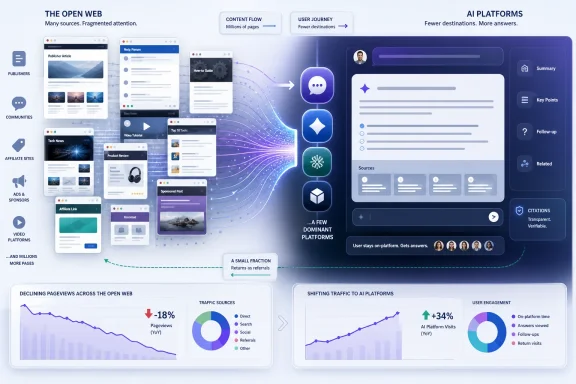
That does not make the advertising problem imaginary. It changes its scale and mechanism. The immediate threat is not that AI interfaces have already consumed two-fifths of the web; it is that high-value answer-seeking sessions — searches that once produced a page view, an affiliate click, or an ad impression — are increasingly resolved inside an interface owned by a handful of platforms.
MediaPost’s core observation is sound: Google Search, ChatGPT, Copilot, Gemini, Perplexity, and similar products are shifting discovery away from the open web and toward an answer layer. The important unresolved issue is whether those systems can keep extracting useful material from publishers, documentation sites, retailers, and independent experts while returning too little measurable economic value to sustain the sources.
OneLittleWeb’s Numbers Show Concentration, Not a Full-Web Takeover
OneLittleWeb’s 24-month study covers May 2024 through April 2026 and relies on estimated traffic figures from Semrush and Ahrefs for 9,531 AI tools across more than 170 categories. Its topline is striking: 144.5 billion estimated AI-tool visits, up 40.12% from the previous 12 months; the top 100 tools account for 129.6 billion of those visits, or 89.69%.
ChatGPT is the dominant property in that data set, with an estimated 64.7 billion visits and 44.76% of all AI-tool traffic. Canva, ranked second, is far behind at 10.5 billion visits. Gemini, Claude, and Grok are posting faster percentage growth from smaller bases, but the bigger finding is that consumer attention is not dispersing among thousands of specialist products. It is concentrating in a few general-purpose interfaces.
That concentration matters more than the 4.20% aggregate share. A general-purpose assistant can absorb a query that previously might have sent users to a Windows troubleshooting forum, Microsoft’s support documentation, a software vendor’s knowledge base, a product-review publisher, or an affiliate comparison page. A visit redirected from a conventional search result into an answer box is not merely a lost session; it is a session in which the platform sees the question, controls the follow-up, chooses the cited sources, and increasingly controls advertising placement.
There is also a reporting discrepancy worth flagging. MediaPost describes the chatbot category as holding 59.52% of AI-tool market share. OneLittleWeb’s public study summary currently says chatbots generated 86 billion visits and represented 52.89% of the tracked market. Its published landing page does not provide a category breakdown detailed enough to reconcile the two figures, and the full study is gated behind a lead form. The difference does not overturn the study’s broader concentration finding, but it is large enough that buyers should not treat every percentage circulated from the report as independently auditable.
The 40% Claim Blurs Growth With Displacement
The most consequential leap in MediaPost’s framing is the suggestion that, if AI products “absorb 40% of web traffic” and send only 4% back to publishers, the missing 36 points represent engagement permanently held inside the AI interface. The evidence presented does not establish that calculation.
OneLittleWeb’s 40.12% figure describes growth in traffic to AI tools compared with the previous year. It does not measure a 40% decline in publisher traffic, nor does it establish that every incremental AI visit replaced a visit to a content site. People use chatbots for writing, coding, translation, image generation, document work, and other tasks that do not map neatly to a traditional web referral. Its 4.20% share of the study’s tracked web traffic is the relevant figure for broad market scale, and it points to an important but still bounded portion of online activity.
The publisher-side evidence nevertheless points in one direction: AI summaries reduce the likelihood of a click when they satisfy the searcher’s immediate need. A 2026 research paper examining 55,393 Google queries across 19 categories found AI Overviews on 13.7% of queries overall, rising to 64.7% for question-form searches. Those are exactly the explanatory, troubleshooting, comparison, and “how do I fix this?” searches where publishers historically captured intent.
A separate 2026 study using Wikipedia’s multilingual traffic and Google’s staggered AI Overview rollouts found a causal decline in traffic to affected pages. The research should not be generalized mechanically to every publisher category, but it provides stronger evidence than correlation alone: the answer panel’s arrival changed behavior for a major information source.
For Windows users, this is already familiar in miniature. A person asking an assistant why a Windows 11 update failed may receive a synthesized repair sequence without ever reaching Microsoft Support, a forum thread, a driver vendor’s release note, or the blog that first documented the workaround. If the assistant is right, that is efficient. If it is wrong, the user may not see the original context, version-specific caveats, or follow-up corrections that a destination site would have supplied.
AI Search Is Moving the Ad Unit Upstream
The old search bargain was imperfect but comprehensible. Search engines indexed the web, placed ads around results, and sent users outward. Publishers monetized the resulting visit through display advertising, subscriptions, commerce links, or lead generation. Search platforms kept a substantial share of the advertising value, but the click supplied a measurable handoff.
AI answers alter the handoff. The platform can summarize multiple pages, cite several sources, answer a follow-up question, and keep the user in the same session. The source may gain a mention without gaining a reader, an email signup, a purchase, or an ad impression. This is the difficult distinction between visibility and traffic: an AI citation is not equivalent to a referral.
The 2026 Google AI Overview study adds an uncomfortable wrinkle for ad-supported sites. Its authors found that more than half of pages cited by AI Overviews carried display advertising, while Google’s sponsored ads could remain on the search page. In plain terms, the underlying publisher may provide the information that enables the answer but lose the pageview where it would have sold its own ad inventory.
Google disputes the idea that AI search is causing dramatic aggregate traffic declines and says it continues to send billions of clicks to websites. It has also argued that clicks arriving after AI-assisted searches are more qualified — more likely to lead to deeper reading, registrations, purchases, or subscriptions. Those claims may be true for some commercial queries, but Google has not supplied a public, publisher-level measurement framework that lets an independent site distinguish an AI Overview’s impressions, citations, clicks, and downstream conversions from conventional search behavior.
That missing instrumentation is the operational problem. Google Search Console reports aggregate impressions and clicks, but publishers cannot reliably isolate the revenue impact of AI Overviews or AI Mode in the way they can isolate a campaign, a referral domain, or a tracked paid placement. When traffic falls while impressions rise, a publisher can be “more visible” in the dashboard and still have less inventory to sell.
ChatGPT’s Lead Does Not Equal a Referral Lead
MediaPost also cites YouGov data placing ChatGPT first among U.S. generative-AI users’ preferred tools, ahead of Gemini and Copilot. YouGov’s publicly available AI brand research from July likewise shows ChatGPT ahead of peer brands on several perception measures, while Gemini scores strongly on perceived quality and satisfaction. But the specific preference figures quoted by MediaPost were not available in the public YouGov material reviewed for this report, so they should be treated as MediaPost’s account of the BrandIndex release rather than independently verified market-share data.
The distinction is important because preference, web visits, weekly active users, and outbound referral volume are different measures. A user may prefer ChatGPT for drafting or coding, Gemini for Android-connected tasks, Copilot for Windows and Microsoft 365 work, and Google Search for navigational queries. None of those behaviors automatically tells a publisher who receives the click.
Existing referral data suggests the replacement is incomplete. Axios, citing Similarweb figures, reported that between February 2024 and February 2025, search referrals to the top 500 news sites declined by 64 million while AI chatbot referrals rose by roughly 5.5 million. The gap does not prove every lost search visit was caused by AI. It does show that chatbot referrals, while growing, were not replacing traditional search traffic on a one-for-one basis.
This is why the phrase zero-click has become more than SEO jargon. The financial loss is rarely one dramatic event. It is the accumulation of answers that no longer generate a visit, a page load, an auctionable ad impression, a product comparison, or a newsletter conversion.
What Publishers and Site Owners Can Actually Measure
The near-term response should not be to abandon search or to chase every “generative engine optimization” pitch. Search remains vastly larger than the tracked AI-tool segment, and OneLittleWeb’s own figures show that clearly. The rational response is to stop treating ranking, citation, referral, and revenue as interchangeable outcomes.
Sites dependent on discovery traffic should separate four measurements that are often collapsed into one:
- Track traditional search referrals, known AI referrals, direct traffic, and branded-search trends separately rather than calling all of them “organic.”
- Preserve pages that provide original troubleshooting, testing, downloads, product data, community expertise, and first-hand reporting — material an answer engine cannot safely reduce to two paragraphs without losing value.
- Measure conversions per visitor as search volumes change, because Google’s claim about higher-intent AI-driven clicks is testable in a site’s own analytics even if Google does not provide a clean AI Overview report.
- Treat an AI citation as a brand-discovery signal, not as earned traffic, unless server logs or analytics record a real referral and a real user session.
For the Microsoft and Windows community, the opportunity is narrow but real: assistants will keep sending users to sources that are current, specific, attributable, and useful when a generic answer fails. The cost is that generic explainers and thin support pages are now competing against an interface designed to answer the first question without sending anyone away.
The old playbook was to win the click. The emerging one is harsher: publishers must prove that the click is still necessary — while the platforms monetizing the answer decide how much of that necessity remains visible.