
The practical appeal is not that CPUs have displaced GPUs across AI. DutchBoy uses narrowly focused, lightweight models to analyze manufacturing telemetry where low power draw, heat output and local deployment matter more than the brute-force throughput associated with large language models.
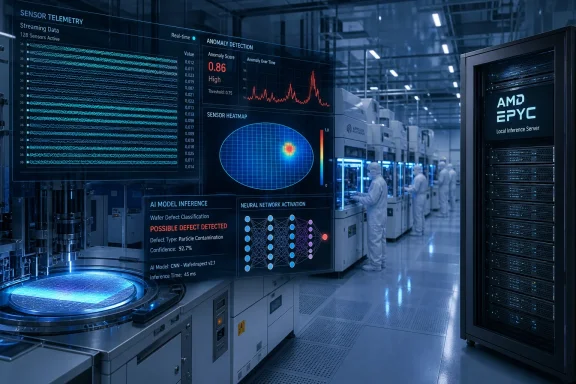 A Small Model Watching Hundreds of Signals
AiBiz installs DutchBoy alongside etching equipment and ingests time-series data from roughly 20 tools. Each machine can expose around 300 sensor inputs, with readings collected every 100 milliseconds, according to AMD’s case study.
The platform uses anomaly detection and graph neural-network techniques to identify process conditions associated with future wafer damage. AiBiz points to electrical arcing inside etch chambers as an example: sensor spikes can indicate an event likely to damage wafers, allowing engineers to intervene before the defect reaches later production stages.
That changes the value proposition from inspecting completed wafers to identifying process trouble while it can still be contained. AMD says DutchBoy’s compact models have fewer than 100,000 parameters, a scale that makes CPU inference practical even when the surrounding production environment is generating continuous sensor data.
There is an important qualification to the “GPU-free AI” framing. AiBiz’s deployment is GPU-free for inference, not necessarily for model training. AMD’s published material says GPUs can still be needed during training, while the operational detection workload runs on EPYC CPUs.
EPYC Replaces a Reported Intel Bottleneck
AiBiz previously used Intel processors, according to AMD, but said increasing sensor-data volume created performance bottlenecks. After optimizing its software for EPYC, the company reported a 30% improvement in AI inference performance across five domain datasets.
AMD’s role was not limited to supplying processors. The company said it helped match core count, clock speed, cache and memory bandwidth to AiBiz’s models, while HPE assisted with identifying suitable server platforms for deployment.
For Windows and enterprise infrastructure readers, the noteworthy part is the workload profile. This is an example of edge inference that rewards balanced CPU performance, high memory bandwidth and reliable on-premises hardware more than accelerator density. In a fab, eliminating a GPU can mean simpler appliance design, less rack power demand and less cooling burden near sensitive production tools.
Yield Claims Are Promising, but Vendor-Supplied
AiBiz projects that DutchBoy can improve semiconductor yields by 3% to 5%. It also estimates that early detection could save a large manufacturer up to $100 million annually, based on avoiding batches of costly memory wafers that might otherwise be discarded after delayed quality sampling.
Those figures come from AiBiz and AMD rather than an independently audited fab-yield study, so they should be treated as deployment targets and case-study economics rather than a broadly established industry benchmark. Still, the underlying premise is straightforward: catching a process failure before it affects an entire batch has vastly higher value than identifying the same fault at final inspection.
AiBiz says it plans to extend DutchBoy into outsourced semiconductor assembly and test operations, LG Innotek, and eventually other major manufacturers including SK Hynix, Intel and Micron. Whether those plans translate into broader customer deployments will matter more than the CPU-versus-GPU marketing angle: the real test is whether the system consistently reduces scrap and improves yield across different tools, fabs and process nodes.
