
The July 30 comparison published by 24/7 Wall St. gets the headline financial numbers largely right, but it overstates what has been committed and blurs a distinction that matters to enterprise planners. Meta has made a binding commitment for an initial one gigawatt of AMD Instinct capacity. The larger six-gigawatt figure is an up to target whose later stages remain contingent on purchases, technical and commercial conditions, and performance milestones embedded in AMD’s warrant agreement with Meta.
That does not diminish the significance of the deal. It does mean the appropriate conclusion is more precise: AMD has secured its first visible path to a production-scale, custom hyperscaler deployment, while NVIDIA still has the current revenue, margin, supply-chain scale, and integrated networking business of the incumbent platform.
 NVIDIA’s financial lead is a platform-scale lead
NVIDIA reported $81.615 billion in revenue for the quarter ended April 26, 2026, including $75.246 billion from Data Center. Its Data Center revenue rose 92% year over year, while GAAP gross margin reached 74.9% and non-GAAP gross margin was 75.0%. Free cash flow was $48.554 billion.
AMD’s first-quarter results, announced May 5 for the quarter ended March 28, 2026, were strong on their own terms: $10.253 billion in total revenue, $5.775 billion in Data Center revenue, and 57% year-over-year Data Center growth. AMD reported a 53% GAAP gross margin and a 55% non-GAAP gross margin, alongside $2.566 billion in free cash flow.
The gap is therefore more than a question of who ships the fastest accelerator. NVIDIA generated nearly three times AMD’s total quarterly revenue in free cash flow alone. That financial capacity pays for advanced packaging reservations, networking inventory, software development, reference architectures, customer engineering, and the ability to return capital to shareholders while continuing to fund product transitions.
NVIDIA also authorized another $80 billion for share repurchases and raised its quarterly dividend from $0.01 to $0.25 per share in May. Those actions are not an IT-performance metric, but they underscore the company’s ability to finance the next hardware cycle without depending on a single pending deployment to prove demand.
The comparison also needs one bookkeeping caveat. NVIDIA changed its external reporting structure beginning in fiscal 2027, moving to Data Center and Edge Computing platforms, with Data Center split between Hyperscale and AI Clouds, Industrial and Enterprise. Its $60.4 billion compute and $14.8 billion networking figures are presented as legacy sub-market measures to help investors bridge the old reporting model. Networking’s 199% annual growth is real for the reported quarter, but it will no longer be a clean standalone line item in the new framework.
For infrastructure buyers, that reporting change reflects a commercial reality: NVIDIA increasingly sells a system rather than a GPU. NVLink fabrics, InfiniBand, Spectrum-X Ethernet, software, reference designs, and support arrangements are now part of the buying decision. A cluster can be assembled from components, but NVIDIA’s preferred purchase path is becoming a rack-scale platform with fewer integration variables for the customer.
Meta’s six-gigawatt headline contains an important condition
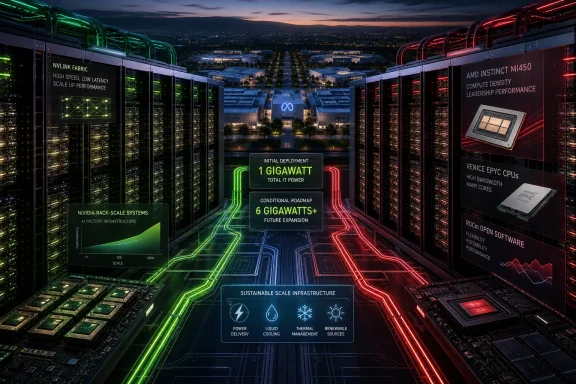
AMD and Meta announced their multi-year, multi-generation agreement on February 24. The companies said Meta plans to deploy up to six gigawatts of AMD Instinct GPUs. The first one-gigawatt deployment is expected to begin shipping in the second half of 2026 and will use a custom MI450-based GPU, sixth-generation EPYC processors codenamed Venice, ROCm software, and the Helios rack-scale architecture.
The filed record provides the detail absent from the headline announcement. AMD’s February 24 Form 8-K says Meta agreed to a binding commitment to buy the initial one-gigawatt equivalent of Instinct products. The six-gigawatt total is not described as a fully binding six-gigawatt purchase obligation in that filing.
Instead, AMD issued Meta a performance-based warrant to buy up to 160 million AMD shares for $0.01 per share. The warrant vests in stages as Meta purchases more Instinct capacity. The first tranche vests after shipment of the initial one gigawatt; the full 160 million shares require purchases reaching six gigawatts. The last tranche also depends on AMD reaching a $600 share-price threshold, alongside specified technical and commercial conditions.
That structure is material for readers evaluating AMD’s competitive position. Meta has a direct incentive to help make the deployment successful and to expand it, because scaling purchases unlocks more of the warrant. AMD, in turn, gains a customer commitment and a major validation event while accepting potential shareholder dilution if the arrangement succeeds at the highest levels.
The Register, which examined the arrangement when it was announced, described the deal as a chips-for-stock transaction and noted that neither Meta nor AMD disclosed a dollar value for the full agreement. That missing price is not a trivial omission. Six gigawatts describes power capacity, not a fixed count of GPUs, racks, years, utilization levels, or booked revenue.
A gigawatt-scale AI deployment requires far more than accelerators. It involves utility power, cooling, building capacity, networking, memory, server integration, software qualification, model tuning, and operational staffing. The first shipment is scheduled for the second half of 2026; neither company has published a detailed delivery schedule for the remaining capacity, a site list, or a revenue-recognition schedule.
AMD has crossed the credibility threshold, not the scale threshold
The practical shift in the NVIDIA-versus-AMD narrative is that AMD now has an identifiable route from accelerator product announcements to a hyperscaler-scale deployment. Meta’s custom MI450 commitment makes Helios more than a slideware response to NVIDIA’s rack-scale systems.
AMD has also disclosed an earlier agreement with OpenAI for up to six gigawatts of Instinct GPU capacity, beginning with an initial one-gigawatt MI450 deployment in the second half of 2026. The two announcements create a theoretical 12-gigawatt opportunity around the MI450 generation. But the same discipline applies: “up to” capacity targets are not equivalent to already shipped systems or recognized Data Center revenue.
AMD’s immediate test is execution. The company’s first-quarter release said customer forecasts for MI450 and Helios were exceeding its initial expectations, but that is a forward-looking management statement rather than evidence of completed production deployments. AMD will report second-quarter 2026 results after the market closes on August 4, one day after this article’s publication date. Its prior outlook called for approximately $11.2 billion in quarterly revenue, plus or minus $300 million.
The result will matter for more than whether AMD reaches its revenue guide. Administrators and platform teams should look for concrete disclosures on MI450 production timing, Helios availability, customer qualification, ROCm readiness, supply constraints, and whether Data Center growth is being driven by GPU accelerators, EPYC server CPUs, or both.
AMD’s Data Center revenue already includes an expanding EPYC business. That is a strength, but it makes it difficult to infer GPU market share from the segment’s $5.775 billion total. NVIDIA’s Data Center line similarly includes networking, software-related platform sales, and systems, rather than only discrete GPUs. Neither vendor’s broad Data Center number is a clean accelerator-unit comparison.
The “second source” argument is now operational
For organizations building large AI environments, AMD’s advance has a practical consequence: a dual-vendor strategy now has a more plausible roadmap at the highest end of the market. That does not mean a like-for-like swap between an NVIDIA Blackwell or Vera Rubin deployment and an AMD MI450/Helios deployment.
The software, networking, operational tools, and model-serving assumptions are different. A serious AMD evaluation requires testing ROCm compatibility with the organization’s actual frameworks, kernels, quantization choices, inference stack, monitoring tools, node image process, and failure-recovery procedures. It also requires validating performance at cluster scale, where collective communication and network behavior matter as much as a GPU benchmark.
NVIDIA’s advantage remains the maturity and breadth of that full stack. Its May guidance for $91 billion in second-quarter fiscal 2027 revenue, notably excluding assumed Data Center compute revenue from China, signals that it expects substantial growth without counting a market complicated by export restrictions. NVIDIA is scheduled to report that quarter on August 26.
The key error would be to read AMD’s Meta agreement as proof that NVIDIA’s position has been displaced. The evidence supports a narrower, more useful conclusion. AMD is now a credible strategic supplier for hyperscalers willing to co-design systems and carry the engineering work of a second platform. NVIDIA remains the vendor whose current scale lets it treat compute, fabric, software, and rack integration as one business.
The next hard evidence arrives August 4, when AMD reports whether its near-term numbers and MI450 commentary support the scale implied by its partnerships. The first Meta-backed Helios shipments, expected in the second half of 2026, will be the point at which AMD’s second-source story moves from contractual promise to deployed infrastructure.
