
That distinction is more than branding. This is an embedded product family built around the same broad heterogeneous-compute proposition as AMD’s Ryzen AI Max-class silicon: Zen 5 CPU cores, RDNA 3.5 integrated graphics, an XDNA 2 NPU, and shared LPDDR5X memory. AMD is pitching that combination to robotics integrators that now commonly bolt an x86 controller to a GPU module—and sometimes add FPGAs for time-sensitive sensing and control.
EE Times’ reporting from San Francisco captured AMD executives making the central argument plainly: robots need predictable behavior across perception, planning, control, networking, and sensor data handling, rather than a system optimized chiefly for GPU inference. AMD’s own documentation and independent coverage from Tom’s Hardware and CNX Software confirm the launch, the embedded focus, and the paired Kria AI Robotics Developer Platform. What remains unproven is the larger claim that this architecture will meaningfully displace Nvidia in deployed robots.
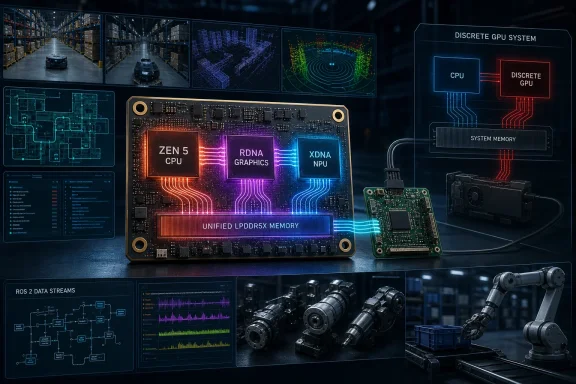 A single memory pool changes the system design
The X100 family’s strongest technical case is not its peak AI rating. It is the removal of one of the most awkward boundaries in an edge-AI design: the link between a discrete GPU’s memory and the CPU’s main memory.
In a conventional robot computer, camera frames, depth data, lidar output, maps, neural-network tensors, and motion-planning results can cross multiple memory domains. Each handoff adds software complexity and can create unpredictable delays under load. A unified-memory APU lets CPU, GPU, and NPU work from the same memory pool, which can reduce copies and make resource allocation more flexible.
AMD’s Kria AI SOM page lists up to 128 GB of LPDDR5X unified memory, up to 16 Zen 5 CPU cores, RDNA 3.5 graphics, and an XDNA 2 NPU. The company’s partner ecosystem is also advertising X100-based COM-HPC modules with up to 126 TOPS of combined INT8 AI performance, including a 50-TOPS NPU. Those figures explain why AMD is emphasizing workload placement: the NPU is intended for persistent, low-power inference, the GPU for more demanding perception and reasoning work, and the CPU for orchestration and real-time control.
That division is sensible for robots, where the work is rarely one giant batch inference job. A warehouse autonomous mobile robot may need to run localization, obstacle detection, path planning, fleet communications, safety monitoring, and motor-control coordination at the same time. A humanoid or surgical system adds higher sensor density and tighter failure tolerances. The task is to make the whole control loop meet timing targets, not simply to generate the highest model-throughput figure.
AMD repeatedly uses the term determinism to describe that goal. In practical terms, the vendor is saying integrators should care about predictable worst-case response time as well as average latency. A control loop that normally responds quickly but occasionally stalls when memory traffic spikes is a more serious engineering problem than a slightly slower loop with a dependable timing envelope.
The GPU comparison is sharper than the evidence
AMD is explicitly positioning X100 and Kria against Nvidia’s Jetson platform, including Jetson Thor. Its Kria page advertises up to 3.4 times better “real-time results,” 2.3 times more concurrent agents, and 1.6 times more CPU capacity versus Nvidia’s platform. Those are AMD claims, however, and the supporting benchmark is not a broad survey of shipping robotic systems.
The cited Open Navigation benchmark was commissioned by AMD and, according to AMD’s own footnotes, used a GMKtec EVO-X2 system configured to reflect Ryzen AI Embedded X199 specifications rather than a retail X199 robotics module. That does not invalidate the test, but it materially limits what the number proves. It is evidence that AMD’s architectural balance can perform well in the tested ROS 2-oriented workloads; it is not evidence that every X100 design will outperform Jetson Thor in a finished robot.
The comparison also exposes the trade-off AMD is asking customers to make. Nvidia’s advantage is not merely a GPU. Jetson buyers can draw on CUDA, JetPack, Isaac, simulation tooling, model support, and a large existing body of robotics integration work. AMD has ROCm, HIP portability tools, x86 familiarity, and a newly assembled robotics software suite based on ROS 2, but those ingredients do not instantly equal years of deployment experience.
AMD’s claim that CUDA-oriented code can be moved through HIPIFY is useful, but it should be read as a migration route rather than a promise of effortless portability. CUDA applications frequently depend on libraries, hand-tuned kernels, driver behavior, or deployment tooling that need validation on a new stack. For production robotics teams, the cost of porting and certifying software can outweigh a hardware advantage unless AMD and its partners make that transition demonstrably routine.
Kria gives AMD an FPGA answer that most rivals lack
The X100 is only half of AMD’s robotics pitch. The other half is the Kria AI SOM and its carrier board, which add an FPGA to a module built around the embedded APU. AMD is betting that this pairing will make it more attractive where a CPU, GPU, and NPU still do not provide enough deterministic I/O handling.
That matters at the edge of a robot: camera ingestion, sensor synchronization, industrial networking, motor-adjacent control, and some forms of sensor fusion are areas where programmable logic can process data with highly consistent timing. AMD has sold adaptive SoCs and FPGAs into those types of systems for years through its Xilinx acquisition. The new platform is an effort to connect that installed embedded footprint to the current push for generative and agentic AI in machines.
All About Circuits separately reported that AMD intends to publish the Kria AI Robotics Developer Platform carrier-card schematics, giving hardware teams a reference design rather than forcing them to begin with a closed evaluation board. EE Times went further, reporting that AMD told it the bill of materials and RTL for the carrier card’s Spartan UltraScale+ FPGA would also be open-sourced.
That is potentially significant, but it is also where AMD’s openness claims need to be judged by deliverables rather than presentation language. As of August 15, AMD’s public Kria material describes an “open” platform and lists the developer hardware and ROS 2/ROCm software stack, but it does not clearly identify a public repository containing the promised carrier-board design files or FPGA RTL. The difference matters: published schematics help a board designer; usable RTL and permissive licensing can help a team reproduce, modify, and support the design.
Embedded lifecycle is the less glamorous selling point
For Windows and enterprise IT readers, X100 is not a PC processor waiting to appear in a laptop. It is an industrial component proposition. AMD says the family is designed for 24/7 operation, industrial temperature configurations from minus 40 to 105 degrees Celsius, and up to 10 years of planned manufacturing availability.
Those promises are likely to matter more to an equipment maker than a TOPS rating. A factory automation supplier, medical-device builder, or warehouse robotics company often cannot redesign its compute board every two or three years to match a consumer silicon cycle. Long-life availability, supply commitments, stable firmware, and predictable software support can determine whether a platform is viable for a regulated or capital-intensive deployment.
AMD’s use of familiar x86 cores also deserves attention. Many robotics stacks run Linux, but their development and integration workflows frequently include x86 tools, existing control software, virtualization, observability agents, and standard build infrastructure. An x86 APU with substantial CPU capacity can make it easier to consolidate workloads that otherwise sit on separate computers or controllers.
That consolidation has a cost, too. A unified-memory architecture shares bandwidth and thermal limits among the CPU, GPU, and NPU. An integrator must validate performance under simultaneous peak loads—multiple cameras, inference, mapping, logging, network traffic, and control—not just in a vendor’s focused benchmark. A robot that runs inference quickly in isolation can still miss timing targets when every subsystem is active.
The missing details will decide whether X100 is a platform or a demo
AMD has provided the architectural outline, but several buyer-critical details are still thin. The company has not published broad pricing for X100 silicon, Kria AI SOM configurations, or the complete developer platform. It also has not laid out a public compatibility matrix showing which ROCm, ROS 2, Linux kernel, and NPU software versions are supported across the planned lifecycle.
Those omissions are normal for a new embedded platform, but they are precisely what system builders need before committing a product roadmap. The immediate hardware question is not whether AMD can place CPU, GPU, NPU, and FPGA capabilities around a robot. It plainly can. The commercial question is whether a developer can buy supported modules, reproduce the carrier-board design, port a real robotics stack, and maintain the result for a decade without rebuilding the software around vendor-specific gaps.
AMD’s X100 family therefore looks less like a direct replacement for every GPU-centered robot computer and more like a credible new option for designs where CPU-heavy planning, shared-memory data flow, industrial lifecycle support, and programmable I/O outweigh the convenience of Nvidia’s mature software stack. The first meaningful verdict will come from shipping Kria-based systems and disclosed design wins—not from the 126-TOPS headline.
