
Notebookcheck first reported that the Zenbook 14 had appeared in China with Core Ultra 5 325 and Core Ultra 7 365 options, while Asus’s global product page lists the Ultra 5 325, Ultra 7 355, and Ultra 9 386H. Chinese outlet IT Home separately reported the same CNY 7,999 starting price and a CNY 8,999 Core Ultra 7 365 listing. Intel’s own processor database confirms that both the Ultra 7 355 and Ultra 7 365 are real Panther Lake chips, so this is not a simple typo that can be dismissed without checking the exact SKU at purchase.
For Windows users, the broader development is useful: all three processors Asus lists meet Microsoft’s NPU threshold for Copilot+ PCs, and the Zenbook 14 combines that on-device AI capability with a 14-inch 3K OLED option, Windows Hello hardware, and a comparatively complete port selection. The less glamorous conclusion is that the lower-priced options do not turn this into a compact gaming notebook. Asus has paired the listed processors with Intel Graphics rather than the Arc B390 graphics configuration used in higher-end Panther Lake chips.
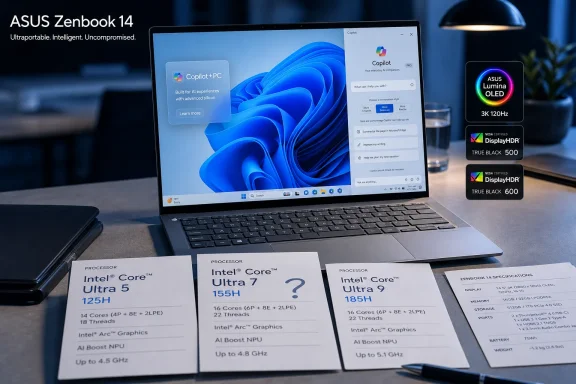 Asus’s global page confirms three processors — but not a retail launch
The strongest part of the story is straightforward. Asus’s global technical specifications for the UX3480AA now name three processor choices: Core Ultra 5 325, Core Ultra 7 355, and Core Ultra 9 386H. The company gives the Ultra 5 a 47 TOPS NPU rating, the Ultra 7 49 TOPS, and the Ultra 9 50 TOPS.
Those figures clear Microsoft’s requirement of a 40+ TOPS NPU for the Copilot+ PC class. Provided a shipped configuration also has Windows 11 version 24H2 or later, at least 16GB of memory, and at least 256GB of storage, the new lower-tier Zenbook configurations should retain the platform qualification associated with local Windows AI features such as Windows Studio Effects, Live Captions with translation, Click to Do, and supported Recall availability.
That is the practical distinction between these CPUs and a conventional “AI PC” marketing label. Buyers choosing the Ultra 5 325 are giving up CPU headroom compared with the 16-core Ultra 9 386H, but not the hardware basis for Copilot+ experiences. Intel lists the Ultra 5 325 as an eight-core, eight-thread part with a 4.5GHz maximum turbo frequency; the Ultra 7 355 is also an eight-core, eight-thread processor, reaching 4.7GHz. The Ultra 9 386H has 16 cores and 16 threads, with turbo up to 4.9GHz.
Asus’s listings are still specifications, rather than a promise that every configuration is purchasable in every country. The company’s U.S. product page describes the UX3480AA as a pre-release product subject to change and prominently presents the Ultra 9 version, while its global specification page includes the additional processors. Asus has not published U.S. pricing or availability dates for the Ultra 5 and Ultra 7 models.
The Core Ultra 7 identity is the detail buyers need to verify
The Chinese launch reporting points to a Core Ultra 7 365 configuration at CNY 8,999, or roughly $1,340 at current exchange-rate approximations. Notebookcheck’s English report contains an internal inconsistency: it initially calls the new middle option a Core Ultra 7 355, then identifies the CNY 8,999 configuration as an Ultra 7 365. IT Home also names the Ultra 7 365.
Asus’s global UX3480AA page, by contrast, identifies the middle option only as the Core Ultra 7 355. Intel lists the Ultra 7 355 at up to 4.7GHz and the Ultra 7 365 at up to 4.8GHz; both have eight CPU cores, Intel Graphics rather than Arc B390 branding, and a 49 TOPS NPU. The distinction will not change Copilot+ eligibility, but it can change clock behavior, regional warranty documentation, BIOS support, and the value proposition against an Ultra 5 machine.
There are several plausible explanations. Asus may be shipping a China-only SKU built around the Ultra 7 365 while maintaining a separate global SKU with the Ultra 7 355. Retailer metadata may also have been copied incorrectly. Neither explanation is confirmed publicly.
The buying rule is simple: do not order based solely on the headline processor tier. Check the retailer’s full model code, processor identifier in the configured specifications, installed-memory amount, panel description, and return terms. Once the machine arrives, Windows users can confirm the processor under Settings > System > About, Task Manager’s Performance tab, or System Information. That verification matters more here than it normally would because Asus’s global product record and the Chinese retail reports do not presently line up.
The OLED specification is also being overstated in one report
The UX3480AA’s display is a genuine differentiator within the 2026 Zenbook 14 family. ComputerBase and Tom’s Hardware reported during Computex coverage that the Intel model was the Zenbook 14 variant positioned for the 3K, 120Hz OLED panel, while the AMD and Qualcomm variants were described with 1920×1200, 60Hz OLED options.
Asus’s current global technical sheet lists optional 14-inch 2880×1800 OLED panels with a 120Hz refresh rate, 500 nits typical brightness, 1,100 nits HDR peak brightness, and 100% DCI-P3 coverage. It also lists touch and non-touch versions. Those are strong specifications for text-heavy work, photo review, and motion clarity on a 14-inch Windows notebook, although the 3K panel will draw more power than the Full HD option.
Notebookcheck describes the panel as VESA DisplayHDR True Black 700. Asus’s technical page instead says VESA DisplayHDR True Black 600. That is a material discrepancy, not a distinction without a difference: certification tiers are standardized claims and should be matched to the exact panel and regional SKU, not assumed from a general product-family description.
The record does not establish that Asus is using a True Black 700 panel anywhere in the UX3480AA line. It may be a reporting error, or Asus could be using different panels in different regions without having updated every specification page. Until Asus identifies a specific model with the higher certification, buyers should treat True Black 600 as the documented specification.
Productivity hardware, not a hidden Arc gaming machine
The Core Ultra 5 325, Ultra 7 355, and Ultra 9 386H entries on Asus’s UX3480AA page all specify generic Intel Graphics. Intel’s specifications show these chips carry four Xe3 graphics cores and 40 graphics TOPS, while Intel reserves the Arc B390 branding for selected Core Ultra X-series Panther Lake processors.
That makes the Zenbook 14’s position clearer. It is aimed at mobile office work, web workloads, media playback, video calls, NPU-assisted Windows features, and modest GPU-accelerated creative tasks. It will handle external displays and modern media codecs, but its graphics configuration should not be judged against Panther Lake laptops carrying Arc B390 integrated graphics.
There is a practical workaround for desk-bound users who need more graphics performance. Asus specifies one Thunderbolt 4 port, alongside USB-C, USB-A, micro HDMI 2.1, and the audio jack. Thunderbolt 4 gives the system a path to an external GPU enclosure, though eGPU performance comes with enclosure cost, desktop-only convenience, and bandwidth limitations compared with an internal discrete GPU. It is an expansion option, not an argument for buying this model as a gaming machine.
The rest of the platform is more balanced for premium ultraportable use. Asus lists a full-HD IR camera with a privacy shutter for Windows Hello face sign-in, Wi-Fi 6E, a 1.7mm-travel backlit keyboard, and a 50Wh or 70Wh battery depending on configuration. The company also lists 16GB and 24GB LPDDR5X options and storage from 256GB to 1TB, which means the Chinese claim that both new configurations ship with 16GB and 1TB should be read as a description of those specific retail bundles, not the worldwide configuration ceiling.
Availability remains the unanswered part
The CNY 7,999 Ultra 5 model gives Asus a lower entry point for its Panther Lake Zenbook 14, while the CNY 8,999 Ultra 7 listing appears to preserve the same 16GB-and-1TB package, according to Notebookcheck and IT Home. Those prices establish a China-market reference point, but they do not forecast U.S. pricing after taxes, channel margins, memory differences, and any changes to the panel or battery configuration.
For now, Asus has confirmed a three-processor UX3480AA family on paper, while Chinese reporting indicates at least two retail configurations. The next concrete milestone is not another specification listing; it is regional product pages that connect a purchasable model number to a named CPU, its OLED certification, battery capacity, memory, and price. Until then, the Ultra 5 model looks like the sensible route to a Copilot+ Zenbook 14, but the Ultra 7 designation in Chinese listings deserves verification before money changes hands.
