
The distinction matters for Windows and enterprise customers in East Africa. Microsoft’s May 2024 announcement promised a new Azure cloud region based around a geothermal-powered campus in Olkaria, northwest of Nairobi. But it tied the region’s availability to the signing of definitive agreements, saying it would become operational within 24 months of those agreements—not simply 24 months after the announcement. There is no public record that those agreements were completed, which means the oft-repeated claim that the site has already “missed” a 2026 completion deadline overstates what Microsoft actually committed to.
Bloomberg first reported in May that Microsoft and its Abu Dhabi-based partner G42 had sought an annual capacity-payment commitment from Kenya’s government. Its sources said Nairobi could not provide guarantees at the requested level and that talks had broken down. Semafor separately reported that President William Ruto had cited the country’s lack of power capacity as a reason the project was unlikely to proceed at its planned scale.
Kenya’s government has pushed back. Special Tech Envoy Philip Thigo said in May that the Microsoft-G42 project had not been withdrawn and remained part of the country’s digital-infrastructure plans. That leaves the project in a familiar but consequential state for large cloud builds: publicly alive, commercially unresolved, and without a published revised construction schedule.
 The $1 billion figure was for a broader Kenya package
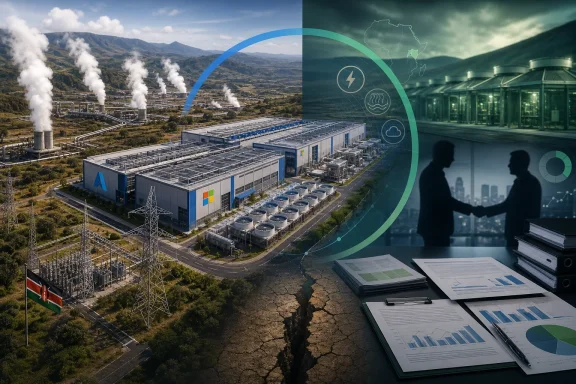
The first correction is important. Microsoft’s May 22, 2024 announcement did not describe a $1 billion check written solely for one data center. It said G42 would lead arrangements for an initial $1 billion comprehensive digital ecosystem initiative in Kenya, with Microsoft and other stakeholders involved.
The planned data center was one part of that package. Microsoft also identified local-language AI work, an East Africa innovation lab and skills program, connectivity investments, and government cloud-security collaboration as separate pillars. Reporting that labels the full $1 billion as the cost of a single Microsoft data center compresses a broader investment plan into a more dramatic headline.
Microsoft also said G42 and local partners would build the facility to run Azure in a new East Africa Cloud Region. That wording matters operationally. The project was not presented as a conventional Microsoft-owned Azure campus on the model of a wholly controlled hyperscale build. G42 would lead the investment arrangement and construction with local partners, while the resulting campus would provide Azure capacity.
For enterprise IT teams, the absence of a new Azure region means existing decisions about data residency, latency, disaster recovery, and cross-region replication remain unchanged. Organizations in Kenya and surrounding markets cannot plan against a published Azure region name, availability-zone design, service list, or launch date because Microsoft has not issued any of them.
A 1 GW ambition is being confused with the first phase
The strongest version of the power argument contains a real warning but is often presented without the project’s phasing. Kenya and G42 initially discussed a campus with a possible 1-gigawatt eventual capacity, while the first facility was described as a 100 MW build that could be expanded over time.
A fully built 1 GW campus would be enormous relative to Kenya’s electricity system. Kenya’s Energy Ministry reported installed generation capacity of 3,243 MW against peak demand of 2,444.4 MW in early 2026. Later ministry data put February installed capacity at 3,272 MW and peak demand at roughly 2,443 MW. On those figures, a single always-on 1 GW load would exceed the country’s nominal reserve margin before accounting for plant outages, transmission constraints, regional interchange, industrial growth, or the need for dependable backup power.
That supports President Ruto’s broad warning that the country cannot casually add a full-gigawatt data center to the system. It does not mean that a 100 MW first phase would itself consume one-third of Kenya’s national capacity. The one-third figure applies to the project’s potential ultimate scale, not the initial installation.
This is more than a semantic correction. Grid operators do not approve a final 1 GW load because a developer says it may be built gradually, and cloud operators cannot treat a nominal national capacity figure as firm deliverable power. Hyperscale data centers require predictable high-voltage supply, redundant feeds, substations, backup generation or storage, and contracts that specify what happens when the grid is constrained. Kenya’s 100 MW opening phase could be technically more manageable than the headline 1 GW buildout, but it still needs dedicated generation and transmission planning rather than an assumption that national spare capacity is available around the clock.
The Olkaria location was selected precisely because Kenya’s geothermal fleet offers low-carbon baseload generation: electricity that is available steadily rather than only when the sun shines or wind conditions cooperate. Yet the proposed campus would still be connected to a power system serving households, factories, hospitals, and public infrastructure. Calling the facility geothermal-powered does not by itself answer whether new geothermal supply, transmission upgrades, and contractual priority arrangements will be built alongside it.
The reported dispute is about demand, not only electricity
The payment-guarantee issue reported by Bloomberg changes how the delay should be read. A government commitment to buy a minimum amount of cloud capacity each year would provide a revenue floor for the infrastructure investor. In return, the state would take on the risk that public agencies fail to use enough compute, storage, or related Azure services to match the commitment.
That would be a major fiscal decision for Kenya, not merely a procurement detail. A cloud region needs anchor customers, but a state guarantee can turn uncertain future technology consumption into a fixed public obligation. Kenyan officials may reasonably want more flexibility; Microsoft and G42 may reasonably resist financing a large regional capacity build without enough contracted demand. Neither position resolves the other.
The public statements show why the project’s status remains unclear. Kenya’s representatives have emphasized that the initiative remains on track, while Bloomberg’s reporting describes broken talks and a possible smaller project. Both can be true at once: the government can remain committed to the strategic objective, while the original commercial structure is no longer viable.
Microsoft, G42, and the Kenyan government have not publicly disclosed a revised capacity plan, a signed offtake agreement, the project’s expected power-delivery model, or a new date for an Azure East Africa Cloud Region. Until they do, enterprise customers should treat the region as proposed infrastructure—not a near-term deployment option.
The IFC report cited in the claim does not match the record
The supplied account attributes its wider conclusions to a July 2026 International Finance Corporation report called Risks and Opportunities in Data Center and AI Investment in Emerging Markets. That title does not appear in the IFC’s public report record.
The relevant 2026 IFC and World Bank Group publication is Accelerating Artificial Intelligence Investment in Emerging Markets, released in May. It does make the broad case that AI investment in emerging markets depends on foundational conditions including data availability, digital infrastructure, skills, and energy infrastructure. But it is a framework for assessing and supporting AI investment, not the specific data-center market report described in the claim.
Several numbers circulated alongside the Kenya story also appear to have been blended from different publications. The International Energy Agency, not the IFC report, projected in its 2025 Energy and AI report that global data-center electricity consumption could more than double to around 945 TWh by 2030. That is a credible global warning, but it should not be presented as a finding from an IFC report that does not carry that title.
The correction does not weaken the underlying point. Kenya’s proposed Azure campus is a clear test of whether public policy, power planning, cloud demand, and financing can be aligned before capacity is announced. It does show why an AI strategy cannot stop at training programs and data-center renderings. But it should not be used to validate statistics or conclusions that cannot be traced to the report said to contain them.
What the Kenya delay means for Azure customers
For Microsoft customers, the practical consequence is caution rather than panic. Existing Azure services continue to be available through Microsoft’s established regions, but customers needing local East African processing or storage should not assume a Kenya region will arrive on the original promotional timetable. Data-sovereignty requirements, latency-sensitive applications, and resilience planning should continue to use confirmed regions and published Azure service availability rather than aspirational locations.
The larger lesson for cloud planners is that power is now part of capacity planning. A regional data center is not simply a real-estate project with servers inside it; it is a long-lived claim on generation, grid connections, cooling systems, connectivity, and contracted customer demand. Kenya’s project has exposed all five dependencies before construction became irreversible.
Microsoft and G42 can still return with a smaller initial build, a phased power contract, private generation investment, or a different anchor-customer structure. Until one of those arrangements is publicly signed, the promised Azure East Africa Cloud Region remains a plan whose central deadlines—and central economics—have yet to be fixed.
