
Cadence announced AuraStack on July 16, while Reuters reported the launch on July 15 from San Francisco. Both accounts agree on the core proposition: an engineer can state an objective, and AuraStack plans work and invokes Cadence’s established engines to lay out and virtually test a board or package. The vendor says the platform is accelerated by Nvidia Blackwell hardware and CUDA-X, and can use frontier or open-source language models rather than binding customers to one model provider.
The catch is availability. Cadence’s public announcement says AuraStack “will be available in 2026,” while Reuters reported that Cadence expected rollout completion in September 2026. Embedded.com, citing Cadence executive Ashutosh Mauskar, reported early access with production availability around late August or early September. Those descriptions are compatible, but they are not the same thing: Cadence has publicly launched the product and its marketing pages are live, yet it has not published a customer-facing availability date, edition matrix, regional rollout plan, or price list. For engineering managers, AuraStack should therefore be treated as a deployment program to evaluate this quarter, not as a generally available tool that can be assumed to be ready for a purchase order today.
 AuraStack Is an Orchestrator Above Allegro, Not a New Physics Engine
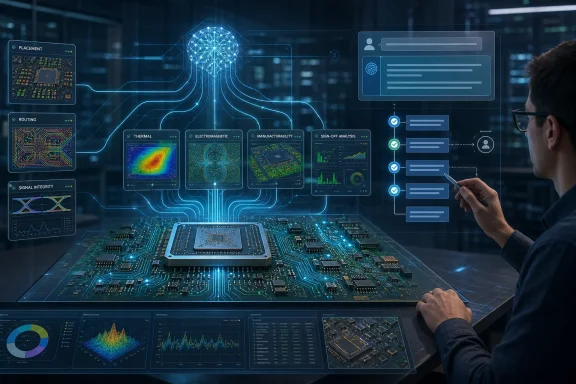
AuraStack sits on Cadence Allegro AI Studio and connects work already performed by its PCB, package, and multiphysics portfolio. Cadence identifies Allegro X for implementation work, Sigrity X for signal and power integrity, Clarity for 3D electromagnetic analysis, Celsius for thermal analysis, and MSC Nastran and Marc for mechanical simulations. In other words, the language-model-facing agent is intended to decide which engine to call and how to move the design context between stages; the underlying simulation results remain generated by conventional engineering solvers.
That architecture is the strongest part of Cadence’s pitch. A generative model should not be trusted to invent an impedance profile, a thermal gradient, an IR-drop result, or an eye diagram from prose. AuraStack instead uses the model for planning and tool invocation, then bases its engineering outputs on solvers that Cadence customers already use in design and sign-off flows. Reuters likewise described the product as allowing engineers to describe goals in plain language while Cadence’s existing software performs layout and virtual testing.
Cadence calls the common context shared among these agents a “mental model” of design intent, requirements, constraints, structures, and tradeoffs. Strip away the branding and that means AuraStack’s value depends on whether it can preserve constraints across tools that historically have been operated in separate steps, sometimes by separate specialists. If a change made after thermal analysis reaches placement, routing, signal-integrity validation, and manufacturing checks without someone rebuilding or miscommunicating the relevant context, the agent has removed a genuine source of rework.
The company’s public examples cover system planning, library and IP reuse, component placement, routing, power and ground-plane generation, transitions, fanout, breakout, design-for-manufacturability checks, and retargeting a design to a new manufacturing process. That breadth has an important limit: all of it is centered on Cadence’s own stack. AuraStack may reduce friction within a Cadence-led flow, but the announcements do not describe interoperability with rival EDA environments, third-party PLM systems, component-lifecycle platforms, or a customer’s internal requirements database. The more a team’s implementation, package, simulation, and library data already reside in Cadence tools, the more complete AuraStack’s proposed workflow can be.
The “15X” Claim Needs a Workload, Not a Slide
Cadence claims AuraStack can produce up to 15 times higher productivity and cut time to market by up to two times. The figures appear consistently in Cadence’s press release and product page, and Reuters reported the same claims, but the company has not supplied a public benchmark methodology showing the board complexity, starting data quality, human review time, number of iterations, compute configuration, or comparison baseline behind the headline results.
There is one concrete customer anecdote. Sven Hoenecke, president and CEO of Electronics NSA at Forvia Hella, said AI-assisted placement reduced a 300-component placement task from as much as four days to four minutes. That example describes a bounded placement task, which is precisely the kind of operation likely to benefit from well-defined rules and a mature design library. It does not demonstrate that an entire board program—from requirements through manufacturing release—will finish 15 times faster.
Cadence’s own description makes the distinction clearer than its promotional metrics do. AuraStack can study a design, produce a plan, call the relevant tools, run analyses, flag risk, and propose changes. Its highlighted smartphone demonstration used a 66-page schematic and a 10-layer 5G handset board; the agent created a power tree, ran a PSpice simulation, suggested component substitutions, reviewed thermal hotspots, changed placement, routed the design, performed design-rule checks, and evaluated signal integrity.
That sequence shows where the productivity case is plausible: eliminating idle time between steps, preparing analysis inputs, carrying results forward, and allowing more design alternatives to be evaluated before a team commits to a layout. It also shows why the headline multiplier should not be converted directly into a staffing forecast. A four-day manual activity can become a four-minute automated run, while the surrounding review, change control, supplier qualification, lab validation, and final approval still take days or weeks.
Cadence says AuraStack can recommend bill-of-material savings of approximately 28% in the handset demo. That result should also be read as a scenario outcome, not a broad claim that the software routinely removes 28% from a production BOM. Component replacement is constrained by availability, approved-vendor lists, second-source strategy, lifecycle status, package compatibility, electrical margins, software dependencies, regulatory requirements, and the cost of qualification. An agent can surface options much faster than a human can search them; an engineering organization still owns the risk of accepting them.
Human Approval Is the Product Boundary
Mauskar told Embedded.com that AuraStack is roughly Level 4 autonomy, rather than a fully autonomous Level 5 system, because PCB and packaging decisions remain iterative and application-specific. Cadence’s marketing language is more expansive, describing “end-to-end, fully automated and optimized workflows,” but the interview supplies the operational reality: the agent can manage the sequence of work, while an engineer decides which tradeoff is acceptable.
That difference matters most at the exact points AuraStack is designed to accelerate. A signal-integrity run may show an eye diagram with limited margin. A thermal solver may identify a hotspot. An electromagnetic analysis may recommend shielding. None of those outputs determines whether a product can accept the performance, cost, space, manufacturability, reliability, or certification consequences of a fix. The agent can make the loop shorter; it cannot turn an engineering judgment into a universally correct answer.
Cadence has been careful in its earlier ChipStack claims to describe the silicon-design system as an engineer-in-the-loop product even while highlighting autonomous generation, verification, debugging, and issue fixing. ChipStack, introduced in February 2026, targets front-end silicon design and verification; April additions InnoStack and ViraStack extended the company’s agent coverage into digital implementation and sign-off, plus custom and analog work. AuraStack takes that strategy beyond the chip into the package and board where electrical, mechanical, and thermal constraints collide.
The strategic point is Cadence’s attempt to own the coordinating layer across the electronic design chain. A router, simulator, and thermal tool are individually valuable, but a platform that retains the reasoning trail and routes tasks between all three has a stronger claim on an organization’s workflow. That is also why the company’s “only provider” claim should be read as a Cadence market-positioning statement, not an independently established industry classification.
Model Choice Creates an IT Governance Job
Reuters reported that AuraStack customers can pair the system with their choice of model, naming OpenAI’s ChatGPT, Google Gemini, Anthropic Claude, and open-source models. That flexibility is useful for enterprises that have already made a model, cloud, or data-residency decision. It is also an immediate governance concern because the prompts and context that make an engineering agent valuable can include schematics, constraints, component data, package information, manufacturing details, and proprietary design knowledge.
Cadence has not publicly spelled out which model hosts data where, how customer design context is isolated, whether prompts or tool traces are retained, what controls restrict agent permissions, or how administrators audit a chain of autonomous tool calls. Those are not peripheral questions. A PCB agent with authority to create libraries, alter constraints, generate routing changes, and launch expensive simulations needs granular access controls, traceability, and a reviewable record of every action.
The cost model is also less simple than a conventional EDA seat. Reuters reported that AuraStack pricing will be consumption-based according to how intensively the AI models are used, while customers must still license Cadence’s underlying tools. That means a trial must measure more than license cost: teams will need to budget model inference, accelerated compute, solver usage, data movement, and the human review that catches poor recommendations. Cadence has not published rates or usage units, so there is currently no public basis for comparing an AuraStack deployment with adding EDA capacity or engineering headcount.
For IT teams supporting hardware design groups, AuraStack’s arrival shifts the question from “Can we install an AI assistant?” to “Can we securely operate an engineering automation service?” The first deployment should use a noncritical but realistic board revision with known constraints and a complete audit trail. Compare the agent’s plan, every tool call, each generated artifact, solver outputs, engineer edits, runtime, and total consumption cost against the existing flow before expanding its authority.
Cadence has put the board and advanced-package stage into its larger agentic-design narrative. The first real test will arrive with September’s reported rollout target and with published customer evidence that shows complete design-cycle outcomes rather than isolated task acceleration. Until then, AuraStack is best understood as a potentially consequential orchestration layer whose claimed gains remain vendor benchmarks, with human engineering judgment—and the governance around it—still firmly in the loop.
