
China has reportedly begun mass production of domestically developed immersion DUV lithography machines, a milestone that could reduce a critical dependency on foreign semiconductor equipment even though it does not close China’s much larger EUV gap. Reuters reported on July 28 that Shanghai Aishengna Electronic Technology Group, a state-owned company, is leading the effort; Maeil Business News Korea separately framed the development as part of a broader push to localize China’s chip supply chain from wafers through packaging.
For Windows PC buyers and enterprise IT teams, this is not an immediate change to laptop prices, GPU availability, or Windows hardware compatibility. The practical significance is longer-term: immersion deep-ultraviolet lithography is a production tool used for many mature and mainstream chip designs, and domestic alternatives could give Chinese foundries and memory makers more room to keep expanding when imported equipment is restricted.
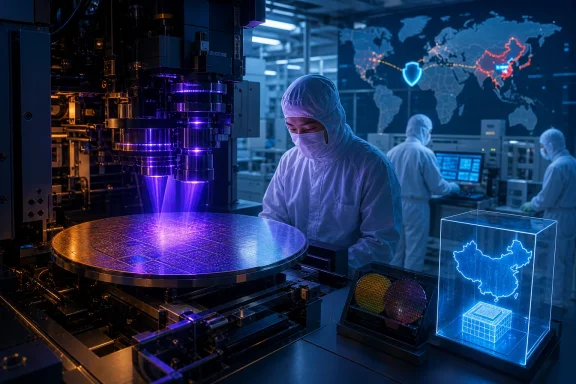
Immersion DUV machines use 193nm light and liquid between the lens and wafer to improve resolution. They are central to high-volume manufacturing and can support relatively advanced nodes with complex multi-patterning, though at higher cost and process complexity than EUV.
That distinction matters. ASML remains the only commercial supplier of EUV systems, which are essential to efficient leading-edge manufacturing. ASML’s 2025 annual report also says certain DUV immersion systems, along with EUV tools, require export licenses under applicable controls. China’s reported DUV production therefore weakens one constraint without eliminating the hardest ones: EUV optics, light sources, high-end metrology, advanced ion implantation, and AI-focused packaging.
Maeil Business News Korea’s reporting identifies Chinese suppliers already active across several adjacent segments, including NAURA and AMEC in deposition and etch, plus JCET, Tongfu Microelectronics and Huatian Technology in semiconductor assembly and packaging. The important story is less about a single scanner than the prospect of a more self-contained equipment ecosystem.
A homegrown immersion DUV platform would not necessarily match ASML’s throughput, overlay accuracy, uptime, service network, or yield performance. Those details are not public, and Reuters’ account relied on a person familiar with the matter. The first real test will be whether the tools can run reliably in production fabs, meet customer yield targets, and scale beyond limited deliveries.
The corresponding risk is fragmentation. Hardware vendors and IT departments may face a market where supply-chain access, firmware support, component provenance and export-control compliance matter as much as raw benchmark performance. Organizations buying Chinese-manufactured systems or components should continue to validate driver support, firmware update practices, TPM implementation, Windows 11 compatibility and vendor patch commitments independently.
China’s reported DUV milestone does not make EUV irrelevant, and it does not instantly remake the global chip market. It does, however, make one conclusion harder to dismiss: restrictions on finished equipment are accelerating a domestic substitute pipeline—and the next question is whether those machines can prove themselves on the fab floor.
For Windows PC buyers and enterprise IT teams, this is not an immediate change to laptop prices, GPU availability, or Windows hardware compatibility. The practical significance is longer-term: immersion deep-ultraviolet lithography is a production tool used for many mature and mainstream chip designs, and domestic alternatives could give Chinese foundries and memory makers more room to keep expanding when imported equipment is restricted.
A Manufacturing Capability, Not an EUV Replacement
Immersion DUV machines use 193nm light and liquid between the lens and wafer to improve resolution. They are central to high-volume manufacturing and can support relatively advanced nodes with complex multi-patterning, though at higher cost and process complexity than EUV.That distinction matters. ASML remains the only commercial supplier of EUV systems, which are essential to efficient leading-edge manufacturing. ASML’s 2025 annual report also says certain DUV immersion systems, along with EUV tools, require export licenses under applicable controls. China’s reported DUV production therefore weakens one constraint without eliminating the hardest ones: EUV optics, light sources, high-end metrology, advanced ion implantation, and AI-focused packaging.
Maeil Business News Korea’s reporting identifies Chinese suppliers already active across several adjacent segments, including NAURA and AMEC in deposition and etch, plus JCET, Tongfu Microelectronics and Huatian Technology in semiconductor assembly and packaging. The important story is less about a single scanner than the prospect of a more self-contained equipment ecosystem.
Export Controls May Be Driving the Substitution Cycle
The reported production ramp is the predictable industrial response to years of U.S. and Dutch restrictions on sales of advanced chipmaking equipment to China. China’s third National Integrated Circuit Industry Investment Fund, launched in 2024 with 344 billion yuan, has given the localization campaign a large funding base, while local governments have backed strategic memory companies including CXMT and YMTC.A homegrown immersion DUV platform would not necessarily match ASML’s throughput, overlay accuracy, uptime, service network, or yield performance. Those details are not public, and Reuters’ account relied on a person familiar with the matter. The first real test will be whether the tools can run reliably in production fabs, meet customer yield targets, and scale beyond limited deliveries.
The Windows Hardware Effect Is Indirect but Real
The near-term effect is likely to be strongest in Chinese-made chips for PCs, networking gear, storage, displays, and consumer electronics—not necessarily in the processors powering premium Windows systems. More domestic capacity could eventually support lower-cost or more resilient sourcing for mature components, including controllers, power-management chips, Wi-Fi silicon and NAND-related products.The corresponding risk is fragmentation. Hardware vendors and IT departments may face a market where supply-chain access, firmware support, component provenance and export-control compliance matter as much as raw benchmark performance. Organizations buying Chinese-manufactured systems or components should continue to validate driver support, firmware update practices, TPM implementation, Windows 11 compatibility and vendor patch commitments independently.
China’s reported DUV milestone does not make EUV irrelevant, and it does not instantly remake the global chip market. It does, however, make one conclusion harder to dismiss: restrictions on finished equipment are accelerating a domestic substitute pipeline—and the next question is whether those machines can prove themselves on the fab floor.
References
- Primary source: mk.co.kr
technology hurdle again... Expert "South Korea's threat is only a matter of time before the production of high-tech equipment." - MK
China is speeding up its supply chain independence by filling its entire semiconductor production, from wafers to equipment, materials, and packaging with its own companies. In the photo process, whic..www.mk.co.kr - Related coverage: stock12.mk.co.kr
- Related coverage: file.mk.co.kr
- Related coverage: stock.mk.co.kr
- Related coverage: pcgamer.com
Chinese company reportedly building its own DUV chipmaking machines, and that's a really big deal | PC Gamer
Meanwhile, the US still hopes to block ASML from selling and servicing similar machines in China.www.pcgamer.com - Related coverage: tomshardware.com
Zeiss expands German site that caps ASML's EUV scanner output — first new building opens four years after Oberkochen site groundbreaking | Tom's Hardware
ASML's 2025 annual report stated that its lithography tool output is limited by Carl Zeiss SMT's capacity.www.tomshardware.com