
Google says Chrome 149 and Chrome 150 together fixed 1,072 security bugs, more than the prior 23 stable milestones combined—a surge the company attributes to putting AI into vulnerability discovery, triage, patch generation, testing, and release engineering. For Windows users and administrators, the immediate conclusion is simple: Chrome’s security pipeline is moving much faster, but the protection still arrives only when managed devices actually install and activate the update.
In a July 30 post, the Chrome Security Team described large language models as a force multiplier rather than a replacement for its engineers or established testing systems. SecurityWeek independently reported that the two milestones’ total exceeded the fixes delivered across the preceding 23 Chrome releases, while Chrome’s 2026 vulnerability volume has already climbed past 1,800 issues.
This is not evidence that Chrome abruptly became less secure. It is evidence that Google can now locate, validate, and remediate weaknesses that had been hard to find with conventional fuzzing, static analysis, code review, and external vulnerability reports alone. The uncomfortable counterpart is that attackers can use the same broad advance in AI-assisted code analysis to turn publicly visible fixes into working exploits faster.
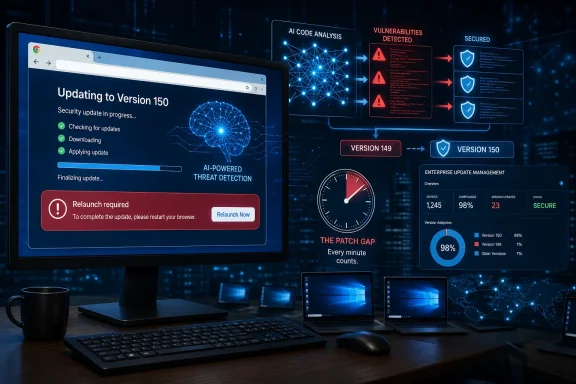
The 1,072 figure needs interpretation. It is a count of security bugs addressed through Chrome 149 and Chrome 150, not a declaration that all were independently exploitable, remotely reachable, or critical. Security defects span a wide range: defense-in-depth fixes, low-severity conditions, variants of a bug pattern, flaws blocked before production, and issues that matter only when paired with another vulnerability.
Google’s own release history shows the variation. SecurityWeek reported that an initial Chrome 150 advisory covered 382 vulnerabilities, including 15 rated critical and 67 rated high; the advisory was later revised to 433. Chrome 149 similarly saw multiple security updates during its stable lifecycle. Counting a milestone therefore captures the wider set of fixes arriving while that version was current, rather than one patch Tuesday-style release.
That distinction matters for enterprise risk reporting. A very large CVE or bug count should prompt administrators to verify update compliance, but it should not be translated automatically into “more than 1,000 critical browser exploits.” The meaningful change is not merely the total. It is the rate at which Chrome can turn suspected weaknesses into reviewed, tested, shipped fixes.
The company later worked with Google DeepMind and Project Zero on Big Sleep, an AI vulnerability research agent that found flaws in Chrome’s V8 JavaScript engine and graphics stack. In early 2026, Google deployed a Gemini-based agent harness across a broader portion of Chrome’s codebase, with the stated goals of improving efficiency and reducing false positives.
One result was CVE-2026-3545, a high-impact sandbox escape Google says had remained in Chrome’s code for more than 13 years. The vulnerability, fixed in Chrome 145, could let an attacker who had already compromised a renderer process trick the browser into reading local files. That is precisely the kind of issue Chrome’s multi-process sandbox is designed to contain: a renderer exploit should not automatically become broad access to the Windows file system or the rest of the machine.
The example does not establish that AI has solved vulnerability research. It does show that agentic analysis can revisit mature code with different assumptions—and produce a finding that survived years of human review and conventional automated testing.
Google has added context to improve those agents’ judgment. Its security models can draw on Chrome’s Git history and previously identified CVEs, while component owners are being encouraged to add
The company also runs models repeatedly over the same code. Because generative-model results are non-deterministic, another pass can find a flaw missed by a prior run, and newer models can reassess old code without waiting for a human researcher to revisit it.
For repair work, Google uses a multi-agent loop: a fixing agent proposes several candidate patches, a critic evaluates them, and test-writing agents produce regression coverage. The Chrome Security Team says LLMs now generate candidate fixes for most vulnerabilities, while developers remain responsible for reviewing whether those changes are correct and safe to merge.
That last condition is not ceremonial. A patch can suppress a crash without fixing its root cause, break an edge case on a specific Windows configuration, introduce a performance regression, or create a new security issue elsewhere. Chrome supports multiple operating systems, CPUs, hardware capabilities, policies, extensions, and enterprise deployment states; the candidate patch is only the beginning of the verification task.
Traditional techniques remain important as well. Google specifically identifies fuzzing as particularly useful for bugs that require long execution sequences or interactions between distant components. Static analysis and compiler-enforced protections remain deterministic tools in a process that increasingly contains probabilistic components.
The Chrome team is also moving the scanning closer to the time code is submitted. Big Sleep and CodeMender are integrated into Chrome’s continuous integration infrastructure and run every 24 hours across code changes. Google says those checks blocked more than 20 vulnerabilities from reaching production during May, including a critical S1+ issue. At the commit-queue level, models can flag dangling pointers, unsafe numeric operations, and code that should use safer
Google says it can now complete the triage, fix, test, and release cycle in one or two days in some cases. But Chrome’s staged update does not normally become active until the browser restarts. On Windows, where users may leave Chrome open for weeks with extensive tab sets, browser restart latency can consume more of the real-world risk window than engineering work does.
Google is responding on several fronts. Chrome is transitioning to a two-week major-release cadence beginning in September 2026, while weekly security updates continue; it is also piloting two security releases per week. The company is working to automate release notes and CVE descriptions, removing another manual choke point between a completed fix and public disclosure.
More consequentially, Google is developing dynamic patching. The proposed design uses Chrome’s multi-process architecture to replace background child processes—such as renderer and GPU processes—with updated binaries while the browser remains running. It will not eliminate every restart requirement; changes to the core browser process or incompatible internal interfaces can still require one. But it could materially reduce the exposure created by a pending update sitting unused on a user’s machine.
Chrome 150 already introduced a narrower version of that idea on macOS. If Chrome is running with no visible windows, it can restart automatically to activate an update. Windows does not yet receive that same behavior, which makes enterprise relaunch policy particularly relevant on managed PCs.
For managed environments, the practical priorities are clear:
The Chrome Security Team’s announcement shifts the security question from whether AI can find software flaws to whether vendors can safely absorb the resulting volume. Chrome has now demonstrated an operational model that includes discovery, triage, patch generation, regression testing, CI enforcement, release acceleration, and endpoint activation. For Windows organizations, the last step remains theirs: a Chrome update waiting for a restart is not yet a Chrome update protecting the machine.
This is not evidence that Chrome abruptly became less secure. It is evidence that Google can now locate, validate, and remediate weaknesses that had been hard to find with conventional fuzzing, static analysis, code review, and external vulnerability reports alone. The uncomfortable counterpart is that attackers can use the same broad advance in AI-assisted code analysis to turn publicly visible fixes into working exploits faster.
Chrome’s Number Is a Throughput Metric, Not a Critical-Flaw Count
The 1,072 figure needs interpretation. It is a count of security bugs addressed through Chrome 149 and Chrome 150, not a declaration that all were independently exploitable, remotely reachable, or critical. Security defects span a wide range: defense-in-depth fixes, low-severity conditions, variants of a bug pattern, flaws blocked before production, and issues that matter only when paired with another vulnerability.Google’s own release history shows the variation. SecurityWeek reported that an initial Chrome 150 advisory covered 382 vulnerabilities, including 15 rated critical and 67 rated high; the advisory was later revised to 433. Chrome 149 similarly saw multiple security updates during its stable lifecycle. Counting a milestone therefore captures the wider set of fixes arriving while that version was current, rather than one patch Tuesday-style release.
That distinction matters for enterprise risk reporting. A very large CVE or bug count should prompt administrators to verify update compliance, but it should not be translated automatically into “more than 1,000 critical browser exploits.” The meaningful change is not merely the total. It is the rate at which Chrome can turn suspected weaknesses into reviewed, tested, shipped fixes.
Gemini Is Now Part of the Entire Vulnerability Lifecycle
Google began using LLMs to augment fuzzing in 2023, then expanded the work with Project Zero’s Naptime research framework in 2024. Naptime gave models tools such as debuggers, code browsers, and Python environments, allowing an agent to investigate a hypothesis, execute code, examine a crash, and revise its approach instead of simply offering a speculative code review.The company later worked with Google DeepMind and Project Zero on Big Sleep, an AI vulnerability research agent that found flaws in Chrome’s V8 JavaScript engine and graphics stack. In early 2026, Google deployed a Gemini-based agent harness across a broader portion of Chrome’s codebase, with the stated goals of improving efficiency and reducing false positives.
One result was CVE-2026-3545, a high-impact sandbox escape Google says had remained in Chrome’s code for more than 13 years. The vulnerability, fixed in Chrome 145, could let an attacker who had already compromised a renderer process trick the browser into reading local files. That is precisely the kind of issue Chrome’s multi-process sandbox is designed to contain: a renderer exploit should not automatically become broad access to the Windows file system or the rest of the machine.
The example does not establish that AI has solved vulnerability research. It does show that agentic analysis can revisit mature code with different assumptions—and produce a finding that survived years of human review and conventional automated testing.
Google has added context to improve those agents’ judgment. Its security models can draw on Chrome’s Git history and previously identified CVEs, while component owners are being encouraged to add
SECURITY.md files that explain trust boundaries and threat models. A separate critic agent uses that context to assess whether apparently unusual behavior is a genuine security concern or simply intended design.The company also runs models repeatedly over the same code. Because generative-model results are non-deterministic, another pass can find a flaw missed by a prior run, and newer models can reassess old code without waiting for a human researcher to revisit it.
The Human Review Gate Still Matters
Google’s workflow is notably more ambitious than “AI finds bugs.” It uses automated systems to filter spam and duplicates, attempt proof-of-concept reproduction, attach stack traces and metadata, estimate severity, identify the responsible component, and assign a human owner. Google says the process is saving hundreds of developer hours per month.For repair work, Google uses a multi-agent loop: a fixing agent proposes several candidate patches, a critic evaluates them, and test-writing agents produce regression coverage. The Chrome Security Team says LLMs now generate candidate fixes for most vulnerabilities, while developers remain responsible for reviewing whether those changes are correct and safe to merge.
That last condition is not ceremonial. A patch can suppress a crash without fixing its root cause, break an edge case on a specific Windows configuration, introduce a performance regression, or create a new security issue elsewhere. Chrome supports multiple operating systems, CPUs, hardware capabilities, policies, extensions, and enterprise deployment states; the candidate patch is only the beginning of the verification task.
Traditional techniques remain important as well. Google specifically identifies fuzzing as particularly useful for bugs that require long execution sequences or interactions between distant components. Static analysis and compiler-enforced protections remain deterministic tools in a process that increasingly contains probabilistic components.
The Chrome team is also moving the scanning closer to the time code is submitted. Big Sleep and CodeMender are integrated into Chrome’s continuous integration infrastructure and run every 24 hours across code changes. Google says those checks blocked more than 20 vulnerabilities from reaching production during May, including a critical S1+ issue. At the commit-queue level, models can flag dangling pointers, unsafe numeric operations, and code that should use safer
std::span bounds-aware abstractions.The Patch Gap Becomes the New Bottleneck
Finding and fixing a vulnerability is only half the security outcome. Once a patch lands in Chromium’s public source repository, attackers can compare old and new code to infer what was fixed and develop an N-day exploit. The time between a fix becoming visible and the protected version running on endpoints is the patch gap.Google says it can now complete the triage, fix, test, and release cycle in one or two days in some cases. But Chrome’s staged update does not normally become active until the browser restarts. On Windows, where users may leave Chrome open for weeks with extensive tab sets, browser restart latency can consume more of the real-world risk window than engineering work does.
Google is responding on several fronts. Chrome is transitioning to a two-week major-release cadence beginning in September 2026, while weekly security updates continue; it is also piloting two security releases per week. The company is working to automate release notes and CVE descriptions, removing another manual choke point between a completed fix and public disclosure.
More consequentially, Google is developing dynamic patching. The proposed design uses Chrome’s multi-process architecture to replace background child processes—such as renderer and GPU processes—with updated binaries while the browser remains running. It will not eliminate every restart requirement; changes to the core browser process or incompatible internal interfaces can still require one. But it could materially reduce the exposure created by a pending update sitting unused on a user’s machine.
Chrome 150 already introduced a narrower version of that idea on macOS. If Chrome is running with no visible windows, it can restart automatically to activate an update. Windows does not yet receive that same behavior, which makes enterprise relaunch policy particularly relevant on managed PCs.
Windows Administrators Need to Treat Relaunches as a Security Control
Google’s new tooling changes the defender-attacker timeline, not the endpoint-management fundamentals. A Windows fleet that is several Chrome versions behind remains exposed regardless of how quickly an AI agent discovered and repaired the issue upstream.For managed environments, the practical priorities are clear:
- Use Chrome Enterprise reporting to identify endpoints that are not receiving or activating current browser builds.
- Configure the
RelaunchNotificationpolicy so users receive escalating prompts and, where appropriate, a forced relaunch deadline. - Reserve Chrome Extended Stable for systems that genuinely require a longer application-validation window, understanding that this can increase exposure to fixes already present in the regular stable channel.
- Ensure help-desk and security teams distinguish between an update being downloaded and it being active; the latter requires the browser to relaunch.
std::span, harden allocation arithmetic against integer overflows, and selectively move high-risk components to Rust. These efforts matter because a faster repair conveyor belt does not remove entire vulnerability classes; it only processes the ones found more quickly.The Chrome Security Team’s announcement shifts the security question from whether AI can find software flaws to whether vendors can safely absorb the resulting volume. Chrome has now demonstrated an operational model that includes discovery, triage, patch generation, regression testing, CI enforcement, release acceleration, and endpoint activation. For Windows organizations, the last step remains theirs: a Chrome update waiting for a restart is not yet a Chrome update protecting the machine.
References
- Primary source: LinkedIn
Published: 2026-08-01T15:40:32+00:00
AI Helped Google Chrome Fix 1000+ Security Bugs
Google says artificial intelligence is reshaping how it secures Chrome, helping its engineers identify and address 1,072 security bugs across Chrome 149 and Chrome 150—more than the combined number fixed during the previous 23 major browser releases. The figure represents a dramatic increase in Chrowww.linkedin.com
- Related coverage: chromium.googlesource.com
- Related coverage: nvd.nist.gov
NVD - CVE-2026-5872
nvd.nist.gov
- Related coverage: tech.yahoo.com
Google Chrome 149: New Update Fixes 429 Security Flaws, 22 Critical
Google has just dropped a critical browser security fix for 3.5 billion users—Chrome 149 patches an incredible 429 vulnerabilities. Here’s how to install the update now.tech.yahoo.com - Related coverage: cisecurity.org
Multiple Vulnerabilities in Google Chrome Could Allow for Arbitrary Code Execution
<p>Multiple vulnerabilities have been discovered in Google Chrome, the most severe of which could allow for arbitrary code execution. Successful exploitation of the most severe of these vulnerabilities could allow for arbitrary code execution in the context of the logged on user. Depending on...
www.cisecurity.org
- Related coverage: pcworld.com
Chrome 150 fixes nearly 400 security flaws, including 15 critical ones | PCWorld
With the update to the new major version, Chrome 150, Google is fixing almost as many security vulnerabilities as it did in the previous version. More than a dozen vulnerabilities have been classified as critical.www.pcworld.com - Related coverage: blog.google
Architecting Security for Agentic Capabilities in Chrome
Chrome has been advancing the web’s security for well over 15 years, and we’re committed to meeting new challenges and opportunities with AI. Billions of people trust Chrome to keep them safe by default, and this is a responsibility we take seriously. Following the recent launch of Gemini in...blog.google - Related coverage: securityweek.com
Google Patches 5th Chrome Zero-Day Exploited in 2026
The vulnerability is tracked as CVE-2026-11645 and it was reported in late April by an anonymous researcher.www.securityweek.com - Related coverage: chromereleases.googleblog.com
- Related coverage: blog.google
Bringing AI agents to Chrome Enterprise security management
Google has launched an open-source MCP server that connects AI agents directly to Chrome Enterprise APIs, helping IT and security teams manage browser security more efficiently. This allows administrators to use natural language commands to quickly troubleshoot deployments, create complex Data...blog.google - Related coverage: techradar.com
Google will now pay up to $1.5 million for finding Android and Chrome security bugs, says it has 'greatly appreciated collaborating with the researcher community' | TechRadar
Google is prioritizing bugs that can't be easily found with AIwww.techradar.com - Related coverage: techradar.com
Claude’s Chrome extension still has hidden security gaps, as researchers warn simple tricks can trigger powerful AI actions | TechRadar
Anthropic’s Claude extension faces fresh security concernswww.techradar.com - Related coverage: securityweek.com
Google Patches 382 Chrome Vulnerabilities - SecurityWeek
Google announced the release of Chrome 151 with patches for 382 vulnerabilities, including 15 critical flaws.www.securityweek.com
- Related coverage: sqmagazine.co.uk
Chrome 150 Patches 382 Security Fixes, With 15 Critical Ones
Google's Chrome 150 stable release fixes 382 security bugs, including 15 Critical use-after-free flaws. Here's what changed and how to update now.sqmagazine.co.uk - Related coverage: nvd.nist.gov
NVD - CVE-2026-14395
nvd.nist.gov
- Related coverage: piunikaweb.com
New Chrome 150 update rolling out on Android, iOS, & desktop with 27 security fixes - PiunikaWeb
Google is rolling out new Chrome 150 updates across Android, iPhone, Windows, Mac, and Linux with 27 security fixes, plus stability and performance improvements.
piunikaweb.com
- Related coverage: vpncentral.com
Google Chrome 150 Patches 382 Security Flaws, Including 15 Critical Bugs
Google has released Chrome 150 to the stable channel with fixes for 382 security vulnerabilities, including 15 critical bugs that affect major browser components such as Extensions, GPU, WebUSB, Chromoting, Bluetooth, Browser, Views, Ozone, and Fullscreen. The update is rolling out for Windows...
vpncentral.com
- Related coverage: securitypointbreak.com
Google Patches Five Critical Chrome Webrowser Bugs - Security Point Break
Google’s latest Chrome security update fixes five critical browser vulnerabilities, putting pressure on users and admins to patch quickly.securitypointbreak.com - Related coverage: tomsguide.com
Billions of Chrome users at risk from 13 security flaws including four high-severity ones — update your browser right now | Tom's Guide
Google has issued fixes for 13 Chrome security flaws, and four of them are high-severity vulnerabilities.www.tomsguide.com - Related coverage: laptopmag.com
Critical Google Chrome update released today, don't miss it | Laptop Mag
The company recommends an immediate update after a series of vulnerabilities designed to attack the Google Chrome browser hit the web.www.laptopmag.com - Related coverage: itpro.com
Everything you need to know about Google and Apple’s emergency zero-day patches | IT Pro
A serious zero-day bug was spotted in Chrome systems that impacts Apple users too, forcing both companies to issue emergency patcheswww.itpro.com