
The Register’s August 3 opinion piece points to talks associated with the UK’s National Museum of Computing at Bletchley Park, including work on Inmos Transputer software and a heavily annotated disassembly of Acorn’s Network Filing System, or NFS. The latter is a credible demonstration of what modern tooling can unlock: NFS is an 8 KB 6502 ROM that implemented remote file access for BBC Micro systems over Acorn Econet, including protocol handling, interrupt-driven transmission and reception, and integration with the machine’s filing-system interface.
But the public project record adds an important qualification missing from the broad enterprise pitch. Rob Smallshire’s Acorn NFS project describes an approach based on emulation, automatically traced execution, a modified version of the py8dis disassembler, original Acorn source material, hardware documentation, and manual annotation. It publishes reassemblable source, memory maps, version comparisons, and its own analysis of particular code paths. The project also says the annotations are incomplete and invites corrections.
That is the part enterprise IT should copy. An AI-produced explanation without tests, inputs, and a way to prove behavior is documentation-shaped risk. A model can accelerate the work of discovering meaning in old code. It cannot turn an unverified narrative into an operational specification.
 The Acorn NFS work proves a method, not autonomous understanding
The Register reports that Claude Code was used in the NFS investigation to run and debug emulators, work through hardware documentation, interpret circuit diagrams, analyze control flow, and reconcile code with chip behavior. No second outlet located in this reporting independently documents the Claude Code workflow, and the public Acornaeology project pages themselves focus on the conventional engineering machinery: ROM images, reference sources, emulator-assisted tracing, versioned disassemblies, and manually reviewable output.
That does not negate the reported use of Claude Code. It establishes the boundary of what outsiders can verify. The useful deliverable is not the model session or an impressive claim that a ROM was understood in a day. It is the result: named routines, comments tied to machine behavior, a source form that reassembles to the original binary, and a body of work that another expert can inspect and challenge.
The Acorn NFS listing exposes precisely the kind of details that make reverse engineering valuable. It explains, for example, how NFS handles file byte input and output through BBC Micro vectors, how it uses the 6502 carry flag as a compact control-flow selector, and why a remote Econet subroutine call has to be deferred from a non-maskable interrupt handler into a later interrupt. Those are not generic summaries. They are propositions about behavior that can be tested against the ROM, an emulator, and documented hardware.
For a Windows administrator facing a 15-year-old line-of-business application, that is the standard to pursue. The objective is not “generate documentation for this server.” It is to establish facts: which scheduled task launches which executable; which registry keys alter connection behavior; which SMB share a service account reaches; what a PowerShell script changes; and what breaks when a dependency is removed.
Legacy estates have more context — and more ways to leak it
The Register’s central argument is sound: contemporary enterprise systems should, in theory, be easier to excavate than 1980s machines. A company may retain source repositories, installer media, Active Directory groups, Windows Event Logs, IIS configuration, SQL Server schemas, backups, old ticket threads, monitoring history, and former employees. A BBC Micro ROM does not come with any of that.
The catch is that enterprise context is also far more sensitive. A legacy application folder may contain production connection strings, database backups, private certificates, service-account credentials, customer exports, internal network names, and proprietary business rules. Giving an agent permission to inspect a codebase, execute commands, or fetch external documentation is a materially different security problem from uploading a sanitized source file to a chat window.
Anthropic’s current Claude Code documentation says the tool defaults to read-only permissions and requests approval for editing files and running commands. It also offers sandboxing, write restrictions intended to keep edits within the working folder, organization-managed settings, and enterprise deployment options including SSO, policy controls, audit capabilities, and zero-data-retention arrangements. Those are useful controls, but they do not eliminate the consequences of granting the wrong access or approving a destructive command in haste.
Anthropic also acknowledges that agentic tools face prompt-injection and data-exfiltration risks. Its documentation warns users to review actions, restrict network activity, and use sandbox boundaries. That warning deserves to be treated as an operational requirement, not a legal disclaimer buried beneath a pilot project.
An organization using Claude Code, or any comparable coding agent, for archaeology should assume that every reachable file and every permitted command is part of the attack surface. The model’s ability to correlate a forgotten batch file with an old database schema is the feature. Its ability to read credentials, contact arbitrary endpoints, or delete artifacts during “cleanup” is the failure mode.
Build the evidence before asking for an explanation
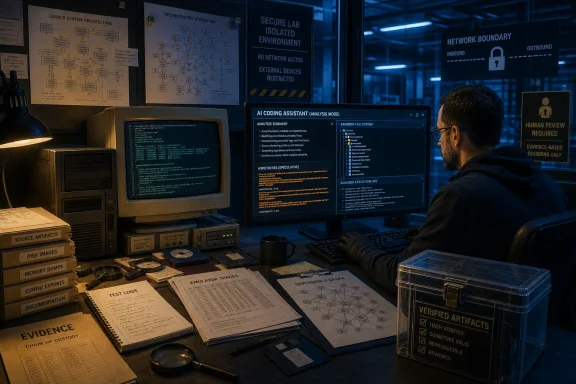
The best enterprise use of an AI coding agent is to make it a disciplined participant in a reconstruction process. Start with a copy of the system, a bounded question, and an independent test of the answer.
A workable first engagement might be a retired Windows service that still runs a monthly report. Copy the executable, configuration, supporting scripts, a representative scrubbed input set, and relevant logs into an isolated lab repository. Prevent the environment from reaching production networks and remove live credentials before the agent sees it. If the service cannot be replicated safely, begin with static inspection rather than allowing command execution.
Then have the agent produce artifacts that can be checked rather than a single expansive report:
- It should inventory files, hashes, timestamps, formats, and apparent entry points before making interpretive claims.
- It should distinguish directly observed behavior from inferences, citing the local file, log record, configuration value, or test result that supports each conclusion.
- It should turn every claimed dependency into a verification task, such as a DNS lookup, an SMB connection, a Windows service dependency, a database query, or an API call.
- It should generate a runbook from observed execution paths and keep it separate from proposed modernization work.
- It should record commands, tool output, prompt context, and code changes so another engineer can reproduce or reject the result.
This is where Claude Code’s agentic design can help. The tool can read a repository, run controlled commands, edit working files, and iterate through tests. Anthropic now also positions its artifact feature around creating maps of services, incident timelines, root-cause material, and code walkthroughs from a session’s local context. Those outputs could become useful internal documentation, especially when a system has no owner and its only “design document” is the behavior it exhibits at 2 a.m.
They should still be treated as drafts. A polished dependency graph can be wrong in ways that are especially dangerous in a legacy estate: an inactive integration may activate only on quarter-end; a hard-coded IP address may exist in a binary rather than a configuration file; a service may depend on a domain policy nobody remembers; and a database field a model labels obsolete may be the sole record of a regulatory exception.
Verification is the enterprise advantage
The NFS project is instructive because it did not stop at readable comments. Its source is checked by reassembly against the original ROM. That creates a hard constraint: whatever interpretation produced the reconstructed assembly must preserve the bytes and behavior of the artifact under study.
Corporate archaeology needs equivalent constraints. For a Windows application, that may mean confirming that a reconstructed build generates the same report from the same sanitized data; replaying captured requests against a cloned service; comparing file-system, registry, and SQL changes before and after a transaction; or validating that a proposed firewall rule has no unaccounted-for dependencies. The exact method varies, but the principle does not: an explanation should meet the system where it actually runs.
This is also where experts remain essential. A model can identify routines that appear to parse a date, authenticate a user, map a network drive, or select a stored procedure. A Windows administrator, application owner, database engineer, or security analyst has to decide whether that behavior is expected, safe, compliant, and worth preserving. The more obscure the system, the more likely it is that a strange branch exists because someone once encountered an expensive real-world failure.
There is a revealing limitation in the Acorn example. Smallshire’s project is explicitly provisional, despite the availability of ROMs, original source for a related version, hardware manuals, an emulator, and a knowledgeable retrocomputing community. If an 8 KB ROM deserves that degree of humility, an undocumented Windows estate containing millions of lines of code, years of production data, and business-specific workarounds certainly does.
Start before the migration clock starts
The immediate opportunity is not to let an agent loose on the ugliest production server in the company. It is to select one low-risk, high-value artifact: an obsolete installer, a scheduled PowerShell job, a VB6 utility, a .NET Framework service, or an old SQL Server integration package. Put it in a controlled Windows lab, collect its observable behavior, and test whether an AI-assisted investigation produces a better inventory and runbook than the team could create manually in the same time.
Keep the project’s evidence local, use least-privilege access, block unnecessary outbound connectivity, and require human review for every proposed change. Commercial Claude Code accounts are not used to train Anthropic’s models by default, according to Anthropic, but that does not override an organization’s own data-classification rules, retention obligations, or need to understand local session storage and optional feedback flows.
The real payoff from digital archaeology is not a chatbot that confidently narrates old code. It is a defensible map of what an inherited system does, why it still exists, who depends on it, and how to retire or rebuild it without learning its secrets during an outage.
