
Notebookcheck reported the retirement alongside Microsoft’s consolidation of its consumer Microsoft Copilot app and Microsoft 365 Copilot app. Microsoft’s own support documentation confirms the important part: Deep Research is gone from Copilot for consumers, saved reports are not being deleted, and Researcher is the continuing in-depth research option for Microsoft 365 Premium. Neowin and Windows Central previously reported the planned August 18 cutoff, making this more than a naming change during an app migration.
The practical takeaway for Windows users is narrower, and less reassuring, than Microsoft’s “successor” language suggests. Researcher may produce structured reports with cited sources, but Microsoft 365 Personal and Family subscribers do not receive it. Existing subscribers who used Deep Research now retain an archive, not a working research tool.
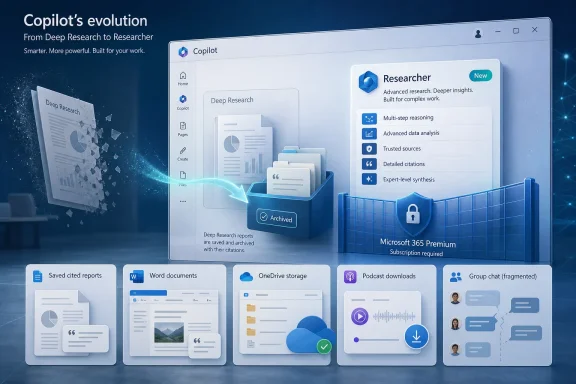 Deep Research has been removed; saved reports have not
Microsoft says Deep Research reports already created in Copilot remain available. Premium subscribers can reach them through Researcher, while Personal and Family subscribers can find their old Deep Research sessions in Copilot chat history. Reports can also be opened in Word and saved independently.
That directly contradicts the common shorthand that Microsoft “deleted” Deep Research reports. It did not, according to the company’s support page. What Microsoft removed is report generation: users cannot start another Deep Research job in the consumer Copilot app after August 18.
The distinction is consequential. A saved report is a static snapshot of whatever Copilot found and generated at the time. It cannot be refreshed for new facts, expanded with another prompt in the same dedicated workflow, or reused as a current research process unless the user has access to Researcher. Anyone treating an old Deep Research output as a living project should export it to Word, preserve the cited sources where possible, and record the date it was created.
Microsoft’s documentation says no action is required to preserve reports, but that is a preservation promise rather than a guarantee that the old chat interface will remain the most convenient retrieval method forever. Exporting material that matters is still sensible, particularly for students, independent consultants, and small organizations that used consumer Copilot as a lightweight research workspace.
Researcher is similar, but the subscription boundary is real
Microsoft describes Researcher as an agent for multistep research that can analyze web sources and, in eligible work environments, files, email, meetings, and chat content the user already has permission to access. It produces a structured report with citations, and Microsoft explicitly says that Researcher and Deep Research were “very similar experiences.”
But “similar” does not mean the migration is neutral for everyone. Researcher’s potential access to Microsoft 365 work data makes it more useful in a business tenant than consumer Deep Research ever was. At the same time, that capability does not restore the old consumer feature for a Microsoft 365 Personal or Family subscriber.
Microsoft’s U.S. store lists Microsoft 365 Premium at $19.99 monthly or $199.99 annually. The plan includes the benefits of Microsoft 365 Family alongside higher Copilot limits and Premium-only Copilot features. Microsoft’s comparison material identifies Premium as a plan for up to six people, yet it also says AI features are available only to the subscription owner and cannot be shared. That detail limits the apparent value of the household plan for families expecting each person to receive Researcher.
Microsoft has not presented a separate, lower-cost Researcher add-on for Personal or Family subscribers. So the immediate decision is not whether to pay a small feature fee to recover Deep Research. It is whether the broader Premium bundle justifies an annual cost that is roughly double the standard $99.99 Personal plan and above the $129.99 Family plan cited by Notebookcheck.
The merger carries more losses than a new app icon
Notebookcheck says Microsoft began migrating accounts as it folds the standalone consumer Copilot app and Microsoft 365 Copilot app into one application. It reports that chats, images, and user-created content transfer; files from the old app move to OneDrive; and work and personal account contexts remain separated.
Those migration mechanics have not been described with the same specificity in the Microsoft support pages covering Deep Research, so they should be read as Notebookcheck’s reporting rather than as a fully documented Microsoft data-migration contract. No other outlet located in this review detailed the file-transfer behavior or account-conversion sequence. Users with content stored only in Copilot should therefore verify that important documents appear in OneDrive after their own migration instead of assuming every item will be where expected.
The wider change also removes Copilot Podcasts and the consumer app’s group-chat model, according to Notebookcheck. Microsoft’s previous Podcasts support documentation had described a feature that turned a requested topic into generated audio and retained the result in conversation history. The current retirement is a sharper outcome: there is no new podcast creation after the transition.
Podcast owners should not confuse a disappearing playback surface with preservation. Notebookcheck reports that downloads remain available from the podcast library menu before migration. Downloading the audio now is the safest approach, and users should test that the resulting file plays outside Copilot. A shared Copilot link is not an archive if the service behind that link no longer supports the content.
Group-chat history has a more serious retention problem
The most easily missed migration consequence concerns group chats. Notebookcheck reports that conversations are converted into one-to-one chats: a user retains their own visible history but cannot keep the group conversation going, while messages and media contributed by other people become inaccessible.
This is not equivalent to deleting a chat outright, but it breaks the shared record. A thread that once functioned as a collaborative discussion can become an incomplete personal transcript, with missing participant context and unavailable shared images. For users who used Copilot group chats to plan a trip, compare purchases, coordinate volunteer work, or draft a document together, that change can leave the surviving chat difficult to interpret.
Microsoft’s support documentation for Teams shows that group conversations with Copilot still exist in a separate product context, including the ability to bring Copilot into a Teams group chat. That is not a direct replacement for consumer Copilot group chats. Teams requires its own setup, account relationships, and, in many cases, organizational administration. It also does not reconstruct a retired consumer chat.
Before the migration reaches an account, participants should save shared images and any material posted by someone else that they need to retain. If a group discussion has lasting value, create a conventional record: export or copy the text into Word, preserve attachments in OneDrive, and ensure every participant has access to the final files outside Copilot.
Microsoft is drawing a clearer line between consumer chat and paid research
Microsoft can reasonably argue that maintaining an expensive, compute-heavy research workflow requires subscription limits. Researcher also has a different role inside Microsoft 365, where it can work across organizational information under existing permissions and compliance controls. For a business user with a Microsoft 365 Copilot add-on, that integration may be materially more useful than Deep Research was.
For consumer customers, though, the change is simpler: a free or lower-tier capability has been retired, and the nearest Microsoft replacement now sits in Premium. Windows Central characterized the pattern as Microsoft shifting more meaningful Copilot functions toward paid plans. The Deep Research decision supports that reading because Microsoft’s own support page identifies Researcher as the alternative while excluding Personal and Family plans from access.
Today’s task is preservation, not panic. Save the Deep Research reports worth keeping as Word documents, download any Copilot Podcasts that matter, and capture group-chat media or shared discussions before the account migration changes what remains visible. Once the transition completes, Microsoft 365 Personal and Family users will still have Copilot chat and their old research history — but they will no longer have a way to create a new Deep Research report without moving to Microsoft 365 Premium.
