
The practical significance is less about a new Share button than about separating agent use, agent review, and agent administration. Copilot Studio deployments routinely need subject-matter experts to judge answers, analysts to inspect quality trends, and makers to fix prompts, tools, or knowledge sources. Those are materially different privileges, and Microsoft’s current documentation shows why a more explicit role model matters.
The roadmap remains marked In development, with general availability listed for worldwide standard multi-tenant tenants in November. It does not state an exact rollout date, licensing change, migration path, or whether every Copilot Studio environment type will receive identical behavior at launch.
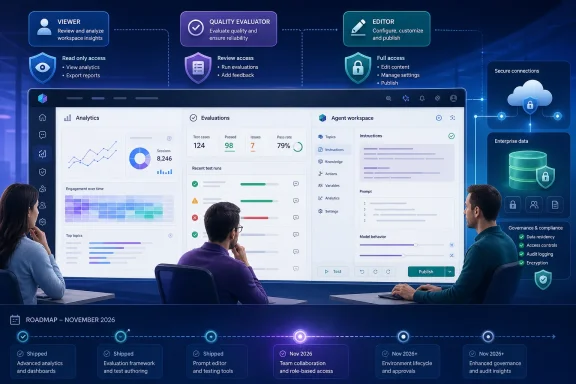 What Roadmap 569475 promises
Microsoft’s roadmap wording is unusually specific about the two intended roles. Agent Viewer is described as access to view analytics and evaluations only, while Editor is described as access to view, edit, configure, share, and publish. The same item says Copilot Studio will automatically assign the required security roles.
That automatic assignment is the consequential part for administrators. In the existing Copilot Studio sharing model, collaborative authoring is not merely a per-agent permission choice. Microsoft Learn says coauthors require the Dataverse Environment Maker security role, and the person sharing the agent needs System Administrator rights if Copilot Studio is to add that role on the recipient’s behalf.
In other words, the present workflow can turn an ordinary request to “let Sam help improve this agent” into an environment-permissions task. A maker may have to involve an administrator, wait for the recipient to become available in the environment, and separately account for permissions on the agent’s dependencies. The roadmap suggests Microsoft intends to streamline that sequence for the GitHub Copilot harness experience.
But automatic role assignment should not be read as automatic least privilege. It removes a manual step; it does not remove the responsibility to decide whether the person receiving access should be allowed to alter an agent that can retrieve internal data, invoke tools, or be published to employees.
Viewer and Editor do not mean the same thing everywhere
Microsoft already uses several role names in Copilot Studio, and the documentation makes clear that their boundaries are narrower than their names may suggest. In the established sharing documentation, the Analytics Viewer role grants read-only access to an agent’s Analytics page. It does not permit editing, sharing, publishing, access to authoring topics, actions, settings, or testing tools.
Agent Viewer is different again. Microsoft says that role is intended for evaluations: the recipient can view and run evaluation test sets without access to the agent itself. The documented capabilities also include renaming, cancelling, and deleting evaluations. That is a useful control for quality reviewers, but it is not a broad operational role.
The submitted roadmap combines “analytics/evaluations only” under Agent Viewer, which is broader than the current Learn article’s definition of Agent Viewer alone. That may signal a consolidation in the new harness, or simply different terminology for a new interface. Microsoft has not yet published detailed documentation describing the November implementation, so administrators should avoid assuming that current Analytics Viewer assignments will convert automatically, or that today’s Agent Viewer behavior precisely predicts the final feature.
Editor, by contrast, is an authoring privilege. Microsoft’s administrative documentation says the Editor assignment allows a maker to edit, configure, share, and publish content. It also establishes one important limit: Editor permissions can be granted only to individual users, not to security groups. If that limitation remains when Roadmap 569475 reaches general availability, organizations will be able to give a team viewer-level access through a group but will still need to enumerate authors individually.
That design is defensible. Publishing and resharing are propagation privileges, and assigning them to a group would make the effective author population harder to audit. It also means organizations should expect Editor access to become a recurring access-review item rather than a one-time team membership setting.
The GitHub Copilot harness has a sharing gap today
The roadmap calls the destination experience “the new GHCP harness.” Microsoft Learn uses the fuller name, GitHub Copilot harness, for a newer Copilot Studio agent experience that uses Copilot Credits for usage-based billing. Its current sharing documentation describes a more constrained model than the roadmap’s Editor promise.
For agents created in that new experience, Microsoft says the Share interface currently gives other people viewing rights: they can see the agent in their list, inspect its details, and test it, but cannot edit its contents. To enable editing, Microsoft’s current guidance points makers to two alternatives: turn off the new GitHub Copilot harness experience to use the older sharing path, or add people to the environment and assign editing rights through environment security roles.
That is the discrepancy the November roadmap item appears designed to address. The feature is not announcing agent sharing from nothing; agent sharing and collaborative authoring already exist in other Copilot Studio paths. It is bringing finer maker roles and automated role assignment into an experience where Microsoft’s own guidance currently sends users outside the new harness to perform collaborative editing.
For teams evaluating the GitHub Copilot harness now, the timing matters. A November target is a reason to plan for the new role model, but it is not a reason to abandon the existing permission process before the feature arrives. The current documentation still governs the production workflow: viewer sharing is available in the new experience, while collaborative authoring requires the older experience or environment-level role management.
Microsoft has also documented prerequisites that will remain relevant even if agent-level sharing becomes smoother. For the GitHub Copilot harness sharing flow, recipients need a Copilot Studio per-user license, agents must be published to Teams and Microsoft 365 with availability in Microsoft 365 Copilot enabled, and user authentication must be configured to authenticate with Microsoft.
Agent access is not dependency access
The most important limitation is that agent sharing does not automatically solve access to everything the agent uses. Microsoft’s Copilot Studio documentation explicitly says that sharing an agent does not automatically share Power Automate flows used by that agent. A collaborator may be able to open and test an agent while lacking permission to edit or add the flow behind an action.
That split is easy to miss during a pilot, especially when an owner tests an agent using their own connections. Microsoft also warns that agents connected to external services can work for the maker but fail for other users because the connection is tied to an individual identity. Microsoft recommends, where supported, service-principal authentication, environment-level connections using a shared non-user identity, or individual OAuth authentication.
The same distinction applies to analytics. An Analytics Viewer can see top-level metrics, but Microsoft says drill-down into transcript-derived information requires both the sharing role and the environment-level Bot Transcript Viewer Dataverse role. That latter role may provide access to conversation transcripts for agents a person creates or has shared with them in the environment, so it deserves a separate privacy review.
The roadmap’s phrase “auto-assigned security roles” should therefore be treated as a convenience feature with real governance implications. Admins will want to establish whether an assignment adds only the minimum entitlement necessary for the agent role, whether it grants broader environment access, how it appears in audit records, and what happens when a maker removes the person from the agent.
What Copilot Studio admins should prepare before November
The feature is still future-facing, but the preparation is straightforward. Inventory production agents built in the GitHub Copilot harness and identify where a person currently needs to switch out of the new experience or ask an administrator merely to become a coauthor. Those are the candidates most likely to benefit first.
Administrators should also map people into three groups that the product’s terminology can otherwise blur:
- Agent users need permission to chat with an agent, but they do not require visibility into its instructions, tools, evaluations, or publishing configuration.
- Quality reviewers need controlled access to evaluations and possibly analytics, with transcript access considered separately.
- Editors need authority to change an agent and potentially redistribute or publish it, which is a higher-risk permission than testing it.
Managed Environments can already enforce sharing limits for agents that require authentication. Microsoft says those controls can determine whether makers may grant Editor or Viewer assignments, restrict sharing to individuals rather than security groups, and cap the number of viewers. Importantly, Microsoft also says new sharing rules do not revoke access that already exists; if an agent becomes noncompliant after a policy change, owners can stop sharing it but cannot extend sharing again until it complies.
That means the cleanest time to set policy is before the new sharing flow is widely used, not after dozens of agents have accumulated ad hoc collaborators. Review whether a maker should be able to grant Editor access without administrator approval, whether group-based Viewer sharing is acceptable, and whether audit procedures distinguish agent access from transcript, connection, and flow permissions.
Microsoft’s November 2026 target could eliminate a real friction point in the GitHub Copilot harness, but it will not make collaboration permissionless. The rollout should make agent ownership easier to distribute; the remaining work is ensuring that an agent’s data connections, publishing scope, flows, and transcripts do not quietly follow along with a role assignment that was meant only to let someone review its answers.
