
The discovery does not mean that NBA 2K27 has DLSS 5 support, nor that DLSS 5 has quietly launched. VideoCardz found no Neural Rendering control in the game, and NVIDIA has not named NBA 2K27 among its announced DLSS 5 titles. What has surfaced is more limited but still revealing: an apparent production-bound runtime, named nvngx_dlssnr.dll, which RenoDX modders have persuaded to accept Control’s output.
That distinction is the important one. The mod demonstrates that NVIDIA’s new rendering model can run outside a bespoke pre-release showcase. It does not establish that the current DLL, its image quality, its compatibility rules, or its performance profile represents what NVIDIA will ship to players later in 2026.
 A public DLSSNR runtime, not an enabled game feature
VideoCardz first reported that the NBA 2K27 installation contains a 158MB file identified by Windows as NVIDIA DLSSNR version 310.8.0.0, with an August 26, 2026 modification date. The “NR” designation closely matches NVIDIA’s own name for the DLSS 5 component: Neural Rendering.
NVIDIA announced DLSS 5 at GTC on March 16 with a fall 2026 release window. The company said the model takes a game’s color data and motion vectors, then generates enhanced lighting and material information grounded in the 3D scene. Unlike conventional resolution upscaling, the stated purpose is to change the final image’s appearance—adding the kind of skin shading, fabric response, hair detail, and lighting behavior NVIDIA associates with photorealism.
The NBA 2K27 DLL is therefore stronger evidence than a driver-profile string or a placeholder configuration entry. VideoCardz had already reported hidden DLSS-NR-related entries in NVIDIA’s May GeForce 610.47 driver. The new file appears to be the first publicly reachable runtime tied to that feature. But its mere presence in a game folder does not prove the basketball game renders the extra engine data that DLSS 5 requires, and it does not reveal whether Visual Concepts intended it for launch, testing, or a future patch.
The file size is also suggestive rather than conclusive. At 158MB, it is substantially larger than the usual DLSS Super Resolution components, which VideoCardz puts in roughly the 20MB-to-50MB range. TechSpot, citing analysis of the library, says it carries approximately 148 million parameters stored in FP8 precision. A neural model of that scale helps explain why the file is much larger than its predecessors, but it does not itself tell players how much GPU time the final implementation will consume.
RenoDX exposes controls NVIDIA said developers would have
The most useful evidence comes from the RenoDX add-on published for Remedy Entertainment’s Control on August 27. Its Nexus Mods page confirms that the add-on supports “DLSS 5 neural rendering,” requires nvngx_dlssnr.dll, and only works with an RTX 50-series GPU and NVIDIA driver 616.56 or later.
It also exposes settings that line up remarkably closely with NVIDIA’s March description of developer control. Users can toggle Neural Uplift, set overall intensity, adjust local tone and micro-detail strength, separately tune skin structure, and enable an automatic skin mask. The add-on includes controls for how much of the neural model’s color output gets transferred back into an HDR frame.
Those sliders should not be mistaken for NVIDIA’s final DLSS 5 integration interface. They are controls built by the mod author around an experimental library in an older game. Still, they provide a practical confirmation of the underlying point NVIDIA made at launch: Neural Rendering is designed to be selective rather than an all-or-nothing full-frame replacement.
That matters because the technology’s controversy has never centered only on performance. NVIDIA’s DLSS Super Resolution, Ray Reconstruction, and Frame Generation may alter how a game is presented, but they are generally framed as ways to reconstruct an intended image or create intermediate frames. DLSS 5 is explicitly intended to infer appearance beyond the conventionally rendered result. When it changes a face’s skin response, eye detail, shadows, and local contrast, it is making an aesthetic intervention.
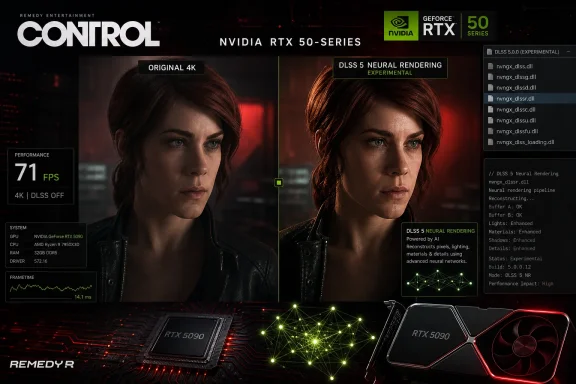
The Control footage circulating from the mod shows exactly why that has prompted criticism. Jesse Faden’s underlying character model remains recognizable, but its facial surfaces, eye area, shadows, and lighting can look materially different. Whether that reads as an improvement will depend on the game and the settings. The broader issue is that a developer now has to decide where the model is allowed to reinterpret the work—and, just as importantly, where it is not.
The 4K frame-rate loss is a warning, not a DLSS 5 benchmark
The initial performance figures are dramatic enough to warrant attention, but they need tighter framing than the headline suggests. The reported RTX 5070 Ti run drops from 71 fps to 35 fps at 4K. TechSpot also cited an RTX 5090 demonstration that declined from 91 fps to 50 fps with Neural Rendering engaged. Both figures point to meaningful overhead, especially for a feature marketed alongside high-end visual fidelity.
They do not, however, tell readers what DLSS 5 will cost in a shipping game.
The RenoDX package is an unofficial add-on using an early runtime in a 2019 title. Its setup requires the DirectX 12 executable, ReShade with full add-on support, DLSS enabled, and Screen Space Ambient Occlusion turned on. It also combines a Ray Reconstruction implementation with a separate Neural Uplift function. That makes the results valuable as an early stress test, but insufficient as a clean product benchmark without a published test route, resolution scale, DLSS mode, ray-tracing settings, frame-time data, and a controlled comparison using the same mod version.
There is an additional complication for HDR users. The mod author says the current Neural Rendering path appears to accept only SDR images. The add-on works around that limitation by feeding the model an SDR version of the HDR frame and applying its changes back to the HDR result. That is ingenious modding, but it is also a direct indication that this is unfinished software being adapted outside NVIDIA’s intended integration path.
The stronger conclusion is not that “DLSS 5 cuts performance in half.” It is that this particular early DLSSNR runtime can impose a very large 4K cost when injected into Control, even on NVIDIA’s current-generation hardware. NVIDIA has several months to improve the model, its scheduling, its integration, and its quality presets. It also has not published official frame-time or performance targets for DLSS 5.
RTX 50 exclusivity is already visible
The RenoDX implementation lists an RTX 50-series GPU as a requirement for Neural Uplift, while its Ray Reconstruction option has no such limitation. That is consistent with the direction NVIDIA has taken for its newest AI graphics features: software branding may carry the DLSS name across several generations, while the headline capability depends on the latest hardware’s neural-processing path.
For PC builders and IT administrators maintaining gaming workstations, that means the DLSS 5 conversation is already partly a deployment question. An RTX 40-series system may continue to receive DLSS updates and support existing DLSS capabilities, but the experimental Neural Rendering component currently refuses to run there. No official NVIDIA compatibility matrix for DLSS 5 has been published yet, so RTX 50-only support should be treated as the state of this runtime and mod, not a final support policy.
It also means users should resist the temptation to source the DLL from unverified file-sharing mirrors or overwrite game components to experiment. The RenoDX release deliberately does not bundle NVIDIA’s libraries; it expects users to supply them. A DLL named like a familiar NVIDIA component is an attractive vehicle for malware, and a modified game directory can complicate anti-cheat, stability, game updates, and troubleshooting even when the download is benign.
NVIDIA’s fall release now has a more concrete hurdle
NVIDIA’s March announcement supplied an ambitious visual pitch but few practical answers: no launch-day game list, no formal hardware-support table, no performance target, and no public explanation of how DLSS 5 will behave when a developer chooses to limit its edits. The Control experiment fills in one gap. It shows that the neural model can affect localized structure, skin, contrast, and lighting through adjustable controls.
It also makes the unresolved problems impossible to ignore. A model that can make a character look more lifelike can also make that character look less like the artist’s intended design. A feature presented under the DLSS umbrella can now consume performance rather than recover it. And an HDR workaround in a community add-on shows that the path from a working DLL to a robust PC release remains substantial.
As of August 28, NVIDIA’s only official timing is still fall 2026. The accidental availability of nvngx_dlssnr.dll makes that schedule look more credible, but it has also set a public baseline NVIDIA will need to beat: shipping DLSS 5 must preserve meaningful developer control, handle HDR natively, and avoid turning a visual enhancement into a 4K frame-rate collapse.
