

For residents, IT administrators, and security professionals, the more consequential story is what the Flock Sock cannot address: a nationwide system that has already collected and shared vehicle-location records at scale, alongside documented cases of misuse by law-enforcement users. Flock Safety says it operates more than 120,000 cameras nationwide. The company announced new privacy and accountability controls on August 13, but the timing makes clear that the changes are a response to public pressure and investigations, rather than safeguards built into the platform from the outset.
The camera cover may be a viral object. The dispute is really about searchable location data, access controls, and oversight.
A protest object has become part of a larger surveillance fight
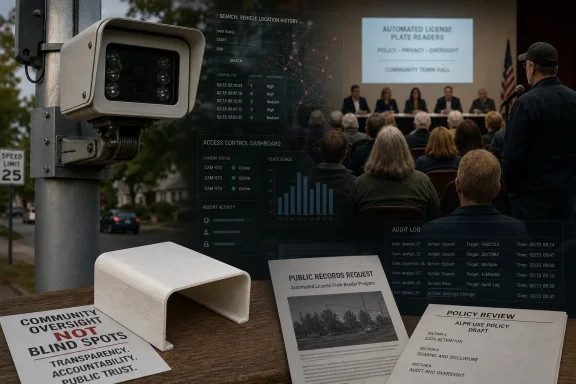
The Flock Sock is a 3D-printed cover designed to obstruct the lens of a Flock camera without permanently altering the device. Tom’s Hardware first described the design as a reaction to rising anger over automated license plate reader deployments, while The Cool Down framed it as an alternative to destructive acts such as painting cameras or cutting down poles.
That framing needs care. A device being removable does not establish that its use is lawful. FindLaw, writing about interference with Flock cameras, noted that state statutes vary but can expose people to charges ranging from criminal mischief and property damage to obstruction or interference with public-safety equipment. The relevant facts will depend on the jurisdiction, whether the camera sits on public or private property, whether access required trespass, and whether the equipment was deployed for a government agency, business, homeowners association, or another customer.
The online attention also risks reducing a complicated civic dispute to an escalating contest between camera owners and people trying to disable them. That is a dead end for both sides. Destroyed or blocked cameras invite enforcement, replacement costs, and harder security designs; they do not establish limits on retention periods, rules for cross-agency searches, or meaningful remedies when a database is misused.
Recent incidents show that the conflict is already moving beyond local public meetings. The Washington Post reported this week that Flock cameras have been spray-painted, shot at, and cut down as opposition has spread. Oregon Public Broadcasting reported that Josephine County ended its contract for 10 Flock automated license plate readers after local privacy concerns and vandalism, even though the sheriff said the tools had assisted investigations.
The Flock Sock belongs in that context: it is evidence that opposition has become technically literate and visible, but it is not a substitute for policy.
Flock’s scale makes access controls more important than the camera hardware
Flock’s cameras capture license plates and vehicle characteristics such as make, model, and color, allowing authorized users to search where a vehicle was observed. Flock says the system helps agencies investigate crimes, recover stolen vehicles, and locate missing people. Those are real use cases, and they explain why the technology has been adopted by police departments and local governments across the United States.
But the same capability creates a concentrated access-control problem. A plate-reader query is not merely a photograph from a fixed street corner. It can become a retrospective location lookup, potentially reconstructing movements across participating camera networks. The security question is therefore not just whether a camera is accurate enough to read a plate. It is whether every user, query, export, data-sharing relationship, and retention exception is appropriately constrained and auditable.
That distinction has become harder to ignore after reporting by The Washington Post. Its investigation found that at least 50 law-enforcement officers nationwide had been accused, charged, or convicted of using Flock or similar license plate reader systems to track romantic partners, former partners, or other people for personal reasons. The Post later reported additional confirmed cases.
This is the central operational failure that cameras covered by a Flock Sock cannot solve. If an officer already searched a vehicle, accessed historical sightings, or shared data through an authorized channel, blocking one roadside unit today does not remove past records or prevent inappropriate use of records held elsewhere.
For enterprise security teams, the pattern should be familiar. A platform may have strong perimeter hardware, encrypted connections, and audit logs, yet still fail users if least privilege is optional, monitoring is uneven, and suspicious activity is reviewed only after harm occurs. Surveillance systems require the same discipline as any high-value data environment: justified access, durable logs, rapid anomaly detection, independent review, and consequences that are not left to the discretion of the individual customer.
Flock’s August safeguards are significant, but their deadlines matter
Flock announced on August 13 that it would shift its recommended and default automated license plate reader retention period from 30 days to seven days. The company also said it would require law-enforcement searches to include a case code by the end of 2026, make its Audit Assistance misuse-detection feature mandatory for law-enforcement customers, and introduce automatic lockouts when user activity crosses its internal abnormal-behavior threshold.
Those are meaningful changes on paper. A seven-day default narrows the ordinary window in which historical location data can be searched. Required case identifiers could make it easier for supervisors and auditors to match a lookup with an actual investigation. Automatic review and lockouts are closer to the kind of preventative control that security teams expect when a system can reveal sensitive information at national scale.
Yet the company’s own announcement also shows why the reforms should be judged by implementation, not by their labels. Flock said its case-code requirement, introduced as an optional capability in July 2025, will not become mandatory for all law-enforcement searches until the end of 2026. Its Audit Assistance feature likewise becomes compulsory for law-enforcement customers by year-end, despite having already been available voluntarily.
In other words, a nationwide system handling sensitive location data had optional guardrails for well over a year before the company committed to making them standard. Flock says more than one-third of customers had voluntarily adopted Audit Assistance. That leaves a substantial portion of the customer base operating without the tool before the deadline.
TechCrunch reported another unresolved issue: Flock has described Audit Assistance as a system that identifies suspicious-looking searches, but has not disclosed the criteria used to flag abnormal activity. There is a valid reason not to publish detailed detection thresholds that could help a bad actor evade them. But customers, elected officials, and independent auditors still need enough information to determine whether the tool produces reliable alerts, how often alerts are reviewed, and whether administrators can override or ignore them without an external record.
The new “Evidence Mode” also deserves scrutiny. Flock says it will allow particular data to be held beyond the ordinary seven-day period for an active case. That may be appropriate in serious investigations, but it turns the retention policy into a two-part system: a short default for most data and a potentially longer hold for data selected by investigators. The practical protections will depend on whether every preservation request is tied to a real case, whether preservation is time-limited, and whether those decisions are routinely audited.
Local contracts are the control point residents can actually influence
The Flock Sock’s popularity reflects frustration with cameras that may appear on a road with little public understanding of the system behind them. But the strongest pressure point is ordinarily the local procurement and governance process, not the camera enclosure.
Flock says its customers control the data captured by their cameras. That means cities, counties, police departments, school systems, private businesses, and homeowners associations should be asked to state their policies in public and put them in enforceable contracts. They should not rely on a vendor’s current product defaults as the sole privacy protection, particularly when defaults can change and exceptions can be created through administrative settings.
A responsible local policy should specify more than a nominal retention period. It should address:
- The exact agencies and users allowed to search the system, including whether other jurisdictions can access locally collected records.
- The categories of investigations that justify a search and whether a case number must be verified rather than simply entered.
- How long logs are retained, who reviews them, and whether outside auditors can inspect search activity.
- Whether immigration enforcement, civil matters, or non-criminal investigations are excluded from data sharing.
- What happens when an employee misuses the system, including notification, suspension of access, and public reporting.
The current backlash has already pushed some governments to reconsider their deployments. Axios reported that communities across the country have protested, cancelled, suspended, or reconsidered Flock-related arrangements. The Associated Press reported that lawmakers, civil-liberties groups, and local residents have all intensified scrutiny of the company’s network.
That political pressure is more durable than camera-by-camera interference because it can alter the rules under which a system operates. It can also force officials to make a clear decision: retain the technology with enforceable limits, or remove it through an accountable public process.
The immediate consequence is a test of whether oversight catches up
The Flock Sock is likely to prompt conversations about vandalism, enforcement, and redesigned camera housings. Those are secondary issues. The central test is whether Flock’s promised controls become mandatory on schedule, whether customers actually configure them tightly, and whether misuse is detected before it becomes another stalking or privacy-abuse case.
Flock has publicly committed to a seven-day default retention period, mandatory case codes, mandatory abnormal-activity review, and proactive account lockouts by the end of 2026. That creates a concrete benchmark. Local agencies that use the platform should be able to say now whether those protections are already enabled, what exceptions they allow, and who independently checks their records.
Until those answers are public, a plastic cover over a roadside camera will remain an attention-grabbing protest symbol—and a reminder that the public debate arrived after the surveillance network did.
Update: Flock CEO publicly calls for a privacy-and-safety compromise (August 24, 2026)
Flock Safety CEO Garrett Langley has now publicly responded to the mounting backlash, arguing in an August 22 Fox News appearance that privacy and public safety should not be treated as opposing goals. According to Startup Fortune, Langley called for a “compromise” as scrutiny of the company’s camera network intensifies across political lines.
That message does not change Flock’s announced retention, case-code, and misuse-monitoring commitments. It does, however, put the company’s leadership on record as pressure shifts from local objections toward a broader national argument over federal access, warrant requirements, and automated location tracking.
For Windows and IT security professionals, the practical implication remains clear: compromise cannot be a substitute for measurable controls. Agencies and other Flock customers should be able to demonstrate enforced search justification, independently reviewable audit trails, prompt investigation of anomalous access, and tightly governed exceptions for preserved evidence.