
 A short first life does not mean a dead concept
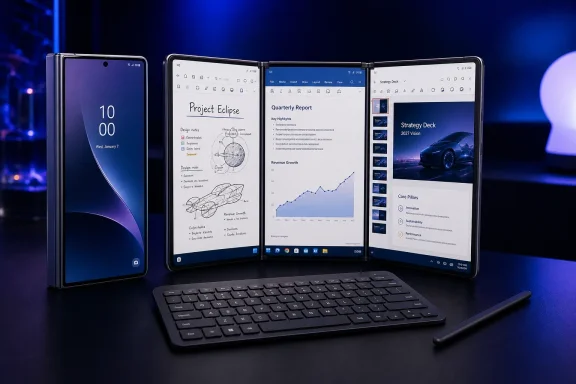
The original Galaxy Z TriFold arrived in the United States on January 30, 2026, after its late-2025 debut elsewhere. Samsung framed it as a device that could put a conventional smartphone, a larger tablet display, and a mobile productivity station into one piece of hardware. Its defining feature was simple to describe and challenging to execute: two inward-folding hinges that opened into a 10-inch flexible display. Samsung Electronics America
That ambition gave the device a compelling identity. Folded, it presented a 6.5-inch cover screen with a familiar phone-like footprint; opened, it offered a 10-inch main panel with enough room for three apps at once. Samsung also equipped it with a Snapdragon 8 Elite for Galaxy processor, 5,600mAh battery, 200MP main camera, and support for a tablet-oriented version of Samsung DeX. Samsung’s 2026 interim report
Yet the practical compromises were substantial. The TriFold measured 12.9mm thick when closed and weighed 309g, according to Samsung’s own technical disclosures. That is an impressive engineering result for a device that houses three display sections and two hinge assemblies, but it is still dramatically more cumbersome than the smartphones most people carry daily. Samsung’s 2026 interim report
The price made the target audience narrower still. At $2,899 in the US, the original Galaxy Z TriFold was not positioned as a rival to ordinary premium phones or even a standard Galaxy Z Fold. It was a technology showcase for enthusiasts, executives, and buyers willing to pay a considerable premium to eliminate—or at least reduce—the distinction between phone and tablet. PCMag
Samsung’s sales strategy underscored that status. The company released the device in limited quantities rather than treating it as a broadly available flagship. In March, reporting from South Korea said Samsung had ended domestic sales because of high production costs, while remaining inventory would continue to be sold in markets including the United States and China. Yonhap News Agency
That unusual market run should not be misread as an ordinary product cancellation. A limited, high-cost first-generation device can serve several purposes simultaneously: it creates a public proof of technical capability, gives engineers real-world durability data, reveals where software behaves poorly at new screen sizes, and tests whether a premium audience will pay for the form factor. The Galaxy Z TriFold appears to have done all of those things.
What the 2027 report actually signals
The new reporting, attributed to industry sources speaking with Korean outlet ETNews, says Samsung is evaluating a 2027 foldable lineup that could include the Galaxy Z Flip 9, Galaxy Z Fold 9, Galaxy Z Fold 9 Ultra, and a follow-up TriFold. It also points toward a July Unpacked launch window, matching Samsung’s current summer cadence for the Galaxy Z family. ETNews
The essential word is could. The report does not amount to a Samsung product announcement, a final specification sheet, or a confirmed retail date. It is a supply-chain and planning report about a device understood to be under consideration. Readers should therefore treat the Galaxy Z TriFold 2 name, final production volume, price, and exact configuration as provisional.
Still, the report matters because it fits Samsung’s visible 2026 strategy. On July 22, Samsung introduced three distinct foldable models: the Galaxy Z Flip8, Galaxy Z Fold8, and Galaxy Z Fold8 Ultra. The company has explicitly described that launch as its most complete foldable lineup yet, designed to meet different needs rather than forcing every premium buyer toward a single book-style Fold model. Samsung Global Newsroom
A second-generation TriFold would extend that segmentation into a fourth category. In the simplest terms, Samsung’s prospective hierarchy would look like this:
- Galaxy Z Flip 9 for compactness, style, quick interactions, and a lower entry point into foldables.
- Galaxy Z Fold 9 for buyers who want a larger internal screen without adopting a radically different device.
- Galaxy Z Fold 9 Ultra for premium productivity, camera, AI, and large-display capabilities.
- Galaxy Z TriFold 2 for users seeking the maximum possible working area in a pocketable, self-contained device.
This would be a more deliberate portfolio than Samsung’s earlier “Flip versus Fold” approach. The question is whether the market is large enough to support that granularity—or whether the TriFold remains an expensive halo product that exists primarily to lift the perceived innovation of the entire Galaxy brand.
The Fold8 Ultra creates a new benchmark
Samsung’s just-announced Galaxy Z Fold8 Ultra makes the potential TriFold successor harder to position but also easier to understand. The Fold8 Ultra uses an 8-inch main display, weighs 215g, and measures 4.1mm when unfolded, according to Samsung. That gives buyers a lighter and simpler route to an expansive mobile workspace than the 309g TriFold offered. Samsung Global Newsroom
The TriFold must therefore deliver a visibly different experience, not merely a slightly bigger screen. Its 10-inch panel is closer to compact-tablet territory, allowing three applications to sit side by side without the cramped compromises common on a narrower book-style foldable. Samsung’s current TriFold software supports up to three adjustable apps simultaneously, while DeX can create up to four workspaces when paired with a Bluetooth keyboard and mouse. Samsung’s US Galaxy Z TriFold page
That is the real product thesis for a triple-folding phone. It is not merely a phone that becomes a tablet. It is a phone that attempts to make a small laptop unnecessary for certain tasks: reviewing documents, taking notes in meetings, working through email and chat queues, editing images, monitoring dashboards, or running a browser beside communications apps.
For Windows users, that distinction is important. A TriFold is not a replacement for a full Windows 11 notebook for serious development, production work, PC gaming, or desktop-class peripheral workflows. But it can act as a highly capable companion device, especially for people whose main PC work is cloud-based and who already use Microsoft 365, Teams, OneDrive, Outlook, Edge, and Windows Phone Link across platforms.
Why Samsung would return to a two-hinge design
The first Galaxy Z TriFold was, in effect, a public engineering demonstration. Samsung used an inward-folding configuration that enclosed the flexible main display when shut, avoiding the permanently exposed screen arrangement used by some competing tri-fold concepts. Samsung says that the design uses two hinges, titanium hinge housing, and an Armor FlexHinge system intended to balance a thin profile with structural durability. Samsung’s US Galaxy Z TriFold page
This approach has meaningful advantages:
- The large flexible display is protected while the device is closed.
- The outer display works as an everyday phone screen without requiring the user to expose the tablet panel.
- The handset can retain a conventional “closed device” behavior for calls, messages, payments, navigation, and one-handed tasks.
- The fully opened layout has a more consistent tablet-like surface than a dual-panel device with a visible central division.
However, each benefit comes with a cost. A second hinge is not simply one more moving part. It introduces more structural complexity, additional display stress points, more opportunities for dust ingress, and more engineering pressure on thickness, battery placement, and weight distribution.
Samsung’s own figures reveal the scale of that pressure. The original TriFold could reach a remarkably thin 3.9mm at its thinnest unfolded point, yet it was 12.9mm thick when closed. The need to stack three rigid sections inevitably creates a device that is more substantial in a pocket, bag, or hand than a normal bar phone. Samsung Electronics America
A successor’s design work will probably revolve around five priorities:
- Reducing closed thickness without reducing structural strength.
- Cutting weight enough to make the device viable for all-day use.
- Improving hinge consistency so each fold feels equally smooth and stable.
- Minimizing display creases across two distinct folding lines.
- Making software transitions feel immediate, whether the user opens one panel, unfolds fully, rotates the screen, or connects to an external display.
None of those goals is trivial. In fact, they explain why Samsung’s return to the category, if it happens, is more meaningful than an annual spec refresh. The first model demonstrated that a commercially sold Samsung tri-fold could exist. The second must show that it can become convenient.
The pricing problem may be harder than the hardware problem
The original TriFold’s $2,899 US price was both its clearest limitation and its most honest signal. Samsung was not asking mainstream smartphone buyers to stretch a little; it was asking them to pay considerably more than the price of a well-equipped laptop and a premium phone combined. PCMag
ETNews reportedly suggests that a lower price is unlikely in the near term because of pressure from RAM and storage costs. That detail should be viewed as a market condition rather than a firm retail-price forecast, particularly this far ahead of a prospective 2027 product release. But it is directionally credible that a more complex folding device will remain constrained by expensive displays, custom hinge parts, high-end processors, larger battery systems, premium cameras, and low-volume manufacturing. ETNews
The more interesting possibility is that Samsung could expand production enough to improve its cost structure. The report says the company is considering higher volume for the next TriFold, and larger production runs can spread development, tooling, component qualification, and assembly costs over more units. PCMag
But economies of scale do not automatically mean affordability. A meaningful price reduction would require several things to happen at once:
- Higher-yield production of large flexible OLED panels.
- Better manufacturing efficiency for dual-hinge assemblies.
- Lower component costs for flagship memory and storage.
- Enough demand to justify increased inventory.
- Fewer expensive bundle items or limited-edition support arrangements.
- A willingness by Samsung to accept lower margins in exchange for category growth.
The last point is vital. Samsung may prefer a TriFold that remains extremely profitable per unit and visually aspirational, even if it sells in small numbers. That strategy can make sense when the device is intended to elevate the reputation of the broader Galaxy Z range rather than become a volume leader itself.
A lower price is not the only way to create value
There are other levers Samsung could use. Trade-in incentives, installment financing, business deployment programs, bundled accessories, accidental-damage coverage, and desktop-workflow bundles could all improve the perceived value of a TriFold without changing its sticker price substantially.
The first-generation device already included unusually premium in-box accessories, including a 45W charger, protective case, and anti-reflective film. Those inclusions helped justify the cost, although they could not erase it. Samsung’s US Galaxy Z TriFold page
A TriFold 2 aimed at business users could go further. Samsung might position it around secure mobile workspaces, DeX, multitasking, large-screen document workflows, and long-term software support. In that scenario, the comparison is not a $1,300 phone but a package consisting of a premium phone, tablet, and occasional-use travel computer.
Software will decide whether the extra screen earns its place
The hardware creates the possibility of a 10-inch workspace. Software determines whether that workspace is useful.
Samsung’s current TriFold software proposition is built around flexible multi-window use, app continuity, DeX workspaces, Galaxy AI features, and a layout that can move from a 6.5-inch cover screen to a 10-inch main display. Samsung’s US Galaxy Z TriFold page
This is where Android’s strengths and weaknesses become magnified. Android has improved dramatically on large screens, but app behavior remains inconsistent. Some applications make intelligent use of broad layouts, responsive panes, keyboard shortcuts, and multiwindow states. Others simply stretch a phone interface across a larger canvas, wasting the very space buyers paid a premium to obtain.
For a 2027 Samsung tri-folding phone, the experience needs to be more than “three phone apps at once.” The operating system should actively understand context:
- A document should expand cleanly from a phone view into a two-pane editing and reference layout.
- A Teams or video call should let notes, calendar items, chat, and shared content coexist without awkward rescaling.
- Drag-and-drop should work predictably across apps and panes.
- Bluetooth keyboard and mouse support should feel desktop-like in DeX, not like an afterthought.
- Apps should retain their position and state during folding transitions.
- Windows-linked experiences should be easy to invoke from Microsoft apps rather than requiring a maze of settings.
Samsung’s 2026 Fold8 family indicates that the company is continuing to link foldable hardware with AI and multitasking. Samsung says its Fold8 and Fold8 Ultra models use larger screens to make multitasking easier, while the Flip8 focuses more heavily on quick interactions through its FlexWindow. Samsung Global Newsroom
A TriFold successor should represent the fullest version of that philosophy. If the Fold8 Ultra is the premium book-style productivity phone, the TriFold 2 needs to become Samsung’s mobile workspace device: a product that makes a 10-inch canvas feel purposeful every time it opens.
Durability, repairability, and ownership risk
The appeal of a large folding display is obvious. The long-term ownership question is harder.
Two hinges mean more mechanical complexity than a typical foldable, and foldables already demand greater care than traditional slab phones. Samsung says the original TriFold used a design intended to protect the main display when closed, as well as strengthened hinge, glass, and frame materials. Samsung’s US Galaxy Z TriFold page
Those measures are meaningful, but buyers of a possible TriFold 2 should not assume they eliminate the risks inherent in flexible display hardware. A second-generation model would need clear answers around:
- Hinge-cycle testing and real-world durability expectations.
- Dust and water resistance.
- Screen protector replacement policies.
- Out-of-warranty display repair pricing.
- Availability of replacement parts.
- Battery-service procedures.
- Software support length.
- Insurance and accidental-damage coverage.
The rapid end of the original model’s sales run adds another ownership consideration. Even if Samsung remains committed to updates and repairs, short-lived hardware can make prospective buyers sensitive to accessories, resale value, replacement inventory, and long-term service logistics. Samsung’s current site still documents the TriFold’s feature set and specifications, but a successor needs an explicit longevity message from day one. Samsung’s US Galaxy Z TriFold page
The most encouraging interpretation is that Samsung has already collected the kind of first-generation feedback that cannot be fully replicated in a laboratory. Limited production may have constrained commercial reach, but it did not prevent the company from observing how people charged, carried, unfolded, multitasked with, and protected the device.
The larger Samsung strategy: four premium tiers, not one flagship
The TriFold report also includes a separate but related claim: Samsung may introduce a Galaxy S Pro model in 2027, creating four Galaxy S models alongside the standard Galaxy S27, Galaxy S27 Plus, and Galaxy S27 Ultra. PCMag
If that plan and the four-device foldable plan both materialize, Samsung would be moving toward a broad “four plus four” flagship structure. The Galaxy S line would provide conventional premium phones across several sizes and capability levels, while the Galaxy Z line would do the same for folding devices.
That strategy has advantages. It gives Samsung more room to differentiate cameras, screens, performance tiers, materials, AI capabilities, and form factors. It also avoids forcing every customer into an Ultra model simply because they want one distinctive feature.
The risk is complexity. More models can blur the value proposition, create pricing overlap, complicate carrier inventory, and make buyers wait for comparisons rather than purchase confidently. Samsung will need sharply defined reasons for each device to exist.
The 2026 Galaxy Z launch shows the company believes it can make those distinctions. Samsung positions the Flip8 around portable self-expression and quick access, the Fold8 around immersive content and everyday flexibility, and the Fold8 Ultra around the highest level of productivity and performance in the foldable range. Samsung Global Newsroom
A future Galaxy Z TriFold 2 would sit above them not just in price, but in intent. It would be the model for people who view screen area as the primary luxury feature.
A second chance needs a more practical answer
The potential return of the Galaxy Z TriFold is significant because Samsung is reportedly not abandoning an idea simply because its initial commercial version was too expensive, too scarce, and too specialized for broad adoption. Instead, the company appears to be evaluating whether the concept can graduate from technology showcase to a sustainable premium category. ETNews
The original device proved that Samsung could build a 10-inch, dual-hinge handset with serious flagship hardware, multiwindow software, and DeX functionality. It also proved that the engineering feat alone was not enough to make a $2,899 phone practical for most buyers. Samsung Electronics America PCMag
For a TriFold 2 to succeed, Samsung will need to make it lighter, less awkward when closed, easier to repair, more durable, and more deeply optimized for real work. It will also need to explain why a 10-inch fold-out workspace offers something that an 8-inch Galaxy Z Fold8 Ultra, a conventional tablet, or a lightweight Windows laptop cannot.
That is a demanding standard. But it is also exactly why a second-generation Galaxy Z TriFold could be more interesting than the first: the next model would no longer be judged primarily on whether triple-folding hardware is possible. It would be judged on whether Samsung has finally made it sensible.
