

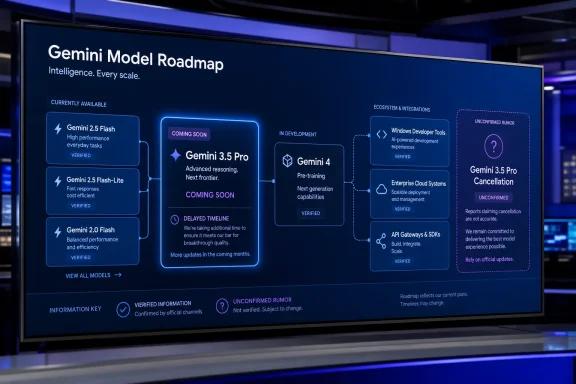
There is a real story here: Gemini 3.5 Pro has missed Google’s own June target, and Google DeepMind is undergoing a major leadership change. But those facts do not establish that the model has been killed, that its work has been folded into Gemini 4, or that Google has privately abandoned its planned flagship release. For Windows developers, enterprise admins, and organizations deciding whether to build around Google’s AI tooling, the practical conclusion is simpler: do not architect around Gemini 3.5 Pro until it is actually available, but do not mistake a delayed product for a confirmed cancellation.
Google’s public product page contradicts the cancellation claim
The key problem with the cancellation narrative is that it conflicts directly with Google’s current public-facing product catalog. Google DeepMind’s Gemini page lists Gemini 3.6 Flash, Gemini 3.5 Flash-Lite, Gemini 3.1 Pro, and Gemini 3.1 Deep Think. In the same model lineup, it continues to display Gemini 3.5 Pro as “coming soon.”
That is not proof that a release is imminent. Companies frequently leave stale roadmap language online longer than they should, and a “coming soon” badge is not a date, a preview commitment, or an availability guarantee. But it is strong evidence against reporting the model as quietly canceled without an on-the-record statement, a product-page removal, a deprecation notice, or corroborating reporting from multiple independent outlets.
Google’s July 21 launch of Gemini 3.6 Flash, Gemini 3.5 Flash-Lite, and Gemini 3.5 Flash Cyber made the gap more conspicuous. TechCrunch reported at the time that Google DeepMind product lead Logan Kilpatrick said Gemini 3.5 Pro was being tested with partners and that the company hoped it would “land soon.” Axios separately reported Google’s statement that 3.5 Pro remained in testing, while Gemini 4 was in pre-training.
Those two statements can coexist. Pre-training a next-generation model does not mean the prior generation’s flagship model has been canceled. Major AI labs overlap model development cycles as a matter of course; a model family can be in external testing while its successor begins a much larger training run. The submitted report presents that normal overlap as evidence of a forced strategic pivot, but the public statements do not support that leap.
The source chain also matters. Geeky Gadgets cites Universe of AI, while the wider discussion circulating on August 10 traces back to a SemiAnalysis report. No second independent outlet has confirmed a cancellation, and Google has not announced one. That leaves the central assertion as a single-source report, not settled fact.
The delay is real, and it is already a problem for Google
Google’s original schedule was much clearer. In its May 19 Gemini 3.5 announcement, Google said Gemini 3.5 Pro was already being used internally and that it expected to roll it out the following month. June passed without a launch. Then July passed without a public preview or a general release.
That is a meaningful miss because Gemini’s “Pro” tier occupies a different role than Flash. Flash models are built around throughput, latency, and cost for high-volume production uses. They are useful for summarization, document extraction, chat assistants, routing, lightweight coding, and agent workloads that must scale without runaway token bills. A Pro model is where Google needs to demonstrate top-end reasoning, software-engineering performance, complex tool use, and long-context reliability against flagship offerings from OpenAI, Anthropic, and xAI.
Google has instead released around the missing flagship. Gemini 3.5 Flash arrived in May. Gemini 3.6 Flash and Gemini 3.5 Flash-Lite followed in July, with Google emphasizing efficiency and agent deployments. The company’s own benchmark table compares those models with GPT-5.6 Luna, Grok 4.5, and Claude Sonnet 5, and it shows Google’s Flash models performing competitively in some specific workloads while trailing rivals in others.
For enterprise customers, that means Google has not stopped shipping useful AI. Gemini 3.5 Flash is already available through the Gemini app, Google AI Studio, Android Studio, Google Antigravity, Gemini Enterprise, and related Google Cloud services. Google Cloud’s published materials also describe Gemini-powered tools that integrate with Microsoft SharePoint, OneDrive, ServiceNow, Jira, and other workplace systems.
But “Google has capable Flash models in production” is not the same proposition as “Google has delivered its expected flagship.” The delay leaves customers who need the strongest Gemini option choosing between the existing Gemini 3.1 Pro line, newer Flash models, or a competing provider. In procurement terms, the missing product is a roadmap risk, not an operational outage.
The leadership account in the report is materially wrong
The submitted report says that Demis Hassabis was retained in a revised role to stabilize Google’s stock value and that a new leader named “Cory” was appointed to guide DeepMind. The available reporting and Google’s announced changes tell a different story.
On August 5, Alphabet reorganized its AI leadership. Axios reported that Hassabis is leaving the Google DeepMind CEO role to become chairman of Google DeepMind and Alphabet’s chief scientist, while continuing to lead Isomorphic Labs. Koray Kavukcuoglu, previously Google DeepMind’s chief technology officer and Google’s chief AI architect, is taking day-to-day leadership of the unit as senior vice president, reporting to Alphabet CEO Sundar Pichai.
There is no evidence in Google’s announcement or the independent coverage that a leader named Cory has been appointed to run Google DeepMind. Nor is there support for the assertion that Hassabis was retained to shore up Alphabet’s share price. The restructuring is substantial enough without inventing a stock-stabilization rationale: Jeff Dean, Sanjay Ghemawat, Oriol Vinyals, and Quoc Le are leaving to form Discovery Loop, an independent public-benefit corporation backed by Google as an investor and cloud provider.
That matters to the Gemini 3.5 Pro story because it establishes genuine organizational turbulence. Hassabis stepping away from daily operations and the departure of senior AI researchers add execution risk at exactly the point Google needs to convert model research into a competitive, broadly deployed product. It does not, however, prove that one specific unreleased model was canceled.
The alleged competitors do not check out
The report also claims that Meta and SpaceX have models called “Museark 1.2” and “Gro 4.5” that outperform Gemini on key benchmarks. Those names do not match the major models and companies identified in the available AI industry record.
Google itself compares Gemini models with Grok 4.5, the xAI model line associated with Elon Musk’s AI company, not SpaceX. “Gro 4.5” appears to be a misspelling or conflation. “Museark 1.2” does not correspond to a known Meta frontier model in the reporting or official model materials reviewed for this article.
That is more than a copy-editing issue. Benchmark claims only mean something when the model name, provider, benchmark version, evaluation harness, tool permissions, prompting policy, price point, and test date can be checked. A model that “outperforms Gemini” in a coding benchmark may lose badly on latency, context length, multimodal tasks, agent reliability, or cost. Google’s own published table illustrates the point: the rankings vary considerably across SWE-Bench Pro, Terminal-Bench, MLE-Bench, GDPVal-AA, OSWorld-Verified, CharXiv, and long-context retrieval tests.
Anyone using benchmark comparisons to select a Windows developer tool, AI coding assistant, security workflow, or enterprise agent platform should demand reproducible details. A vague claim that unnamed rivals “outperformed Gemini in key benchmarks” is not enough to guide deployment.
What enterprises should do while Google’s roadmap remains unclear
The immediate impact is not a forced migration away from Gemini. Organizations already using Gemini 3.5 Flash, Gemini 3.6 Flash, Gemini Enterprise, or Google Cloud’s agent services can continue to evaluate and deploy those products based on their present capabilities, pricing, data controls, and integrations. Google’s July releases are real and available; Gemini 3.5 Pro is the unresolved part of the portfolio.
The safer plan is to treat Gemini 3.5 Pro as an uncommitted future dependency. Do not tie a Windows application release, an Antigravity workflow, a Google AI Studio production rollout, or an internal agent modernization project to it. Keep model selection abstracted behind an API gateway or provider layer, maintain fallback models for critical workloads, and test the models that can be called today rather than ones appearing on a roadmap.
Google now has two straightforward ways to resolve the confusion. It can launch Gemini 3.5 Pro, even first as a clearly scoped partner or developer preview, with documented limits and pricing. Or it can formally retire the name and explain whether the underlying work is moving into Gemini 4. Until one of those happens, the responsible reading is that Gemini 3.5 Pro is late, still publicly listed, and unconfirmed as canceled—not that Google has quietly ended it.