
VideoCardz first reported the official confirmation after spotting the system in Geekbench earlier this month, while Gagadget separately identified GMKtec’s claim that the EVO-X5 Pro will be the first mini-PC built around AMD’s flagship Ryzen AI Max+ PRO 495. GMKtec’s own IFA event notice corroborates the September 5 showcase, scheduled for 3:30 PM CEST at Messe Berlin.
There is a wrinkle in the timing. VideoCardz says GMKtec told the publication that AMD’s embargo lifts at 5:00 PM CEST, while GMKtec’s advertised presentation runs from 3:30 PM to 4:30 PM CEST—ending 30 minutes before that reported embargo time. The product has already been named publicly, so the likely embargoed material is the full platform configuration rather than the existence of the EVO-X5 Pro itself.
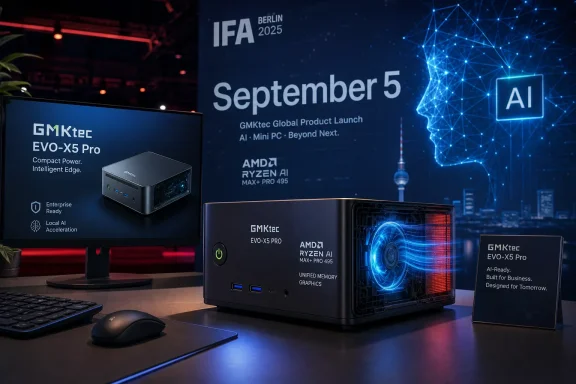 The processor is real; the system configuration is still unknown
AMD’s official product record lists the Ryzen AI Max+ PRO 495 as a 16-core, 32-thread Zen 5 processor with boost clocks up to 5.2 GHz, a configurable power range of 45W to 120W, Radeon 8065S integrated graphics with 40 compute units, and an NPU rated at up to 55 TOPS. The chip is formally supported on 64-bit Windows 11, RHEL, and Ubuntu.
Most importantly for this class of compact desktop, AMD specifies support for up to 192GB of LPDDR5X-8533 unified memory. That is the defining upgrade over the preceding Ryzen AI Max+ 395 generation, whose platform ceiling was 128GB. A Ryzen AI Max system does not have dedicated VRAM in the conventional desktop-GPU sense: the CPU, integrated Radeon graphics, and AI workloads draw from the same pool of soldered system memory.
GMKtec has not yet said whether the EVO-X5 Pro will actually ship with 192GB. The Geekbench entry reported earlier in August showed approximately 128GB, which proves only that GMKtec tested a 128GB configuration. It does not confirm the maximum retail configuration, memory speed, operating power, BIOS options, or whether more than one SKU is planned.
That distinction should keep buyers from reading AMD’s processor limit as a GMKtec product promise. A mini-PC carrying the 495 with 128GB of memory could still be an extremely capable compact Windows machine, but it would not deliver the one capacity advantage driving interest in AMD’s refreshed AI Max platform.
The EVO-X5 Pro name replaces the leaked EVO-X5
The original Geekbench listing identified the machine as the GMKtec EVO-X5. GMKtec is now using the EVO-X5 Pro name. VideoCardz notes that the company has not explained whether “Pro” is the final retail designation, a suffix separating it from a future non-Pro version, or merely a change made between early validation hardware and launch marketing.
It is a small detail, but it matters for business buyers and homelab operators tracking firmware, support listings, and regional SKUs. GMKtec already sells several similarly named EVO systems, including the Ryzen AI Max+ 395-based EVO-X2 and EVO-X3. A product page and downloadable support materials will be needed before anyone can determine whether the EVO-X5 Pro is a clean successor, a differently positioned chassis, or another branch of the lineup.
The prior leak was useful because it placed the machine on an actual Windows test system rather than only in a marketing graphic. But a single benchmark result is not a review and cannot establish sustained performance. With an APU rated for as much as 120W configurable TDP, the chassis’ cooling design and vendor power settings can materially change CPU clocks, integrated graphics performance, fan behavior, and long-duration local inference throughput.
AMD’s PRO features are relevant, but they do not make the box enterprise-ready by themselves
The “PRO” designation is more meaningful than a speed-bin label. AMD lists DASH remote-management support, AMD Memory Guard, firmware TPM, Windows Device Guard, virtualization-based security, Windows Secured-Core PC capability, and Secure Boot support for the Ryzen AI Max+ PRO 495 platform.
Those capabilities give an OEM the ingredients needed for a better-managed Windows deployment, particularly in offices that want compact systems capable of local AI work, development, content creation, or virtualized workloads. They do not automatically establish that every EVO-X5 Pro configuration will ship as a certified Secured-core PC, expose the relevant remote-management functions in firmware, or include the BIOS and driver lifecycle an IT department expects.
GMKtec has not announced the operating system edition, management tooling, warranty terms, firmware-update mechanism, or any commercial support arrangement for the EVO-X5 Pro. For a small vendor, those omissions are more consequential than the presence of a PRO processor. A capable processor can make Windows 11 security features available; sustained enterprise deployment depends on whether the system builder implements and maintains them.
The company’s promotional language focuses on “enterprise AI agents” and local AI, but it has not named a validated Windows AI stack, model-serving software, driver package, or management partner. Administrators considering this system for a local inference role should wait for those specifics rather than assume a Ryzen PRO badge makes the device a drop-in replacement for a mainstream business desktop.
Unified memory is the real reason to watch the September reveal
AMD’s 192GB memory ceiling changes the practical appeal of the platform more than the modest clock uplift does. Tom’s Hardware reported that the 495 retains the same broad formula as the 395—16 Zen 5 cores and 40 Radeon compute units—but gains a 100 MHz maximum boost increase to 5.2 GHz and access to the larger memory pool.
For conventional Windows desktop work, 128GB is already beyond the requirements of most users. For developers running several virtual machines, creators handling very large projects, and enthusiasts running local language models, however, memory capacity determines which workloads fit without falling back to system paging or a cloud service.
There is a tradeoff. Unified memory makes a compact all-in-one machine possible, but it also means the Windows host, applications, GPU allocation, and local model compete for the same LPDDR5X pool. AMD has said that up to 160GB can be allocated as graphics memory on a 192GB system, with the remainder retained for the operating system. The actual allocation rules and options on the EVO-X5 Pro remain unknown.
Memory is also soldered LPDDR5X rather than user-replaceable DIMM memory. Buyers need to choose capacity at purchase and should assume that a 128GB model cannot later become a 192GB model through an upgrade. That makes GMKtec’s still-unpublished configuration list especially important.
“First mini-PC” is a narrow marketing claim
GMKtec’s claim to be the first mini-PC with the Ryzen AI Max+ PRO 495 should be treated as a claim about the company’s product category and announced hardware, rather than proof of a broad retail lead. AMD has already confirmed the 495 processor and has discussed systems from partners in the third quarter of 2026; the company also has its own Ryzen AI Halo compact desktop planned around the same chip.
The existing record suggests GMKtec may be first to publicly name a specific third-party mini-PC model around the 495, but no independent retail availability date has been announced. A system that appears at IFA on September 5 is not necessarily a system a U.S. customer can order that day, or one a business can source in volume.
Gagadget is right to flag the lack of specifics: GMKtec has not published a price, confirmed U.S. or UK retailers, described I/O, or stated the cooling and power envelope. Those are not peripheral omissions. A local-AI mini-PC’s value can swing sharply based on whether it offers dual USB4 ports at full speed, fast Ethernet, usable PCIe or OCuLink expansion, two NVMe slots, and cooling capable of holding performance under load.
GMKtec’s September 5 IFA presentation is therefore a configuration reveal to watch, not a buying signal yet. The decisive detail is whether the EVO-X5 Pro ships in a 192GB Windows-ready configuration with credible thermals, accessible firmware updates, and clear pricing—because until then, the confirmed processor is the product’s most concrete feature.
