
Club386 reported AMD’s IFA appearance and suggested it could set the stage for Ryzen AI Max PRO 400. Wccftech went further, describing a Ryzen AI MAX 400 launch among “surprise” consumer announcements. The latter wording conflates AMD’s existing commercial-only Ryzen AI Max PRO 400 products with a still-unconfirmed consumer Ryzen AI Max 400 lineup—and that difference is the story Windows buyers and IT teams need to keep straight.
IFA Berlin runs from September 4 through September 8, squarely inside the third quarter in which AMD said systems using its new Max PRO chips would arrive. AMD has not yet publicly identified an IFA product, system partner, retail configuration, price, or on-sale date. There is room for a meaningful reveal. There is not evidence, as of August 6, that AMD has an unannounced consumer chip launch to make.
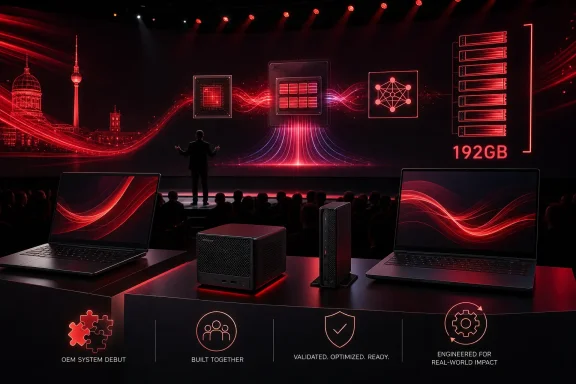 Ryzen AI Max PRO 400 was disclosed in May
AMD’s own May announcement set out a three-chip Ryzen AI Max PRO 400 range: the 16-core Ryzen AI Max+ PRO 495, 12-core Ryzen AI Max PRO 490, and eight-core Ryzen AI Max PRO 485. Each combines Zen 5 CPU cores, RDNA 3.5 integrated graphics, and an XDNA 2 NPU, with configurable power envelopes from 45W to 120W.
The key upgrade is not a new CPU architecture. It is memory capacity. AMD specifies support for up to 192GB of unified LPDDR5X memory, of which up to 160GB can be allocated as graphics memory. That is a major practical change for local AI work, because the integrated Radeon GPU and the CPU share the same memory pool rather than copying models across a conventional system-memory-to-discrete-VRAM boundary.
The flagship 495 pairs 16 CPU cores and 32 threads with a 40-compute-unit Radeon 8065S GPU, a 55-TOPS NPU rating, and up to a 5.2GHz boost clock. The 490 and 485 use a 32-CU Radeon 8050S GPU and are rated at 50 NPU TOPS. AMD’s public processor database already lists all three chips as globally available products for laptops and desktops, and identifies Windows 11 64-bit, Red Hat Enterprise Linux, and Ubuntu as supported operating systems.
Independent reporting from ServeTheHome, Neowin, and Tom’s Hardware treated the May disclosure as the product announcement it was. Tom’s Hardware also reported that AMD clarified the family being announced was specifically the PRO series, equipped with AMD’s enterprise security, manageability, and reliability features. That clarification matters because it undercuts a loose reading of “Ryzen AI Max 400” as a broad consumer refresh.
AMD said at the time that systems from HP and Lenovo would arrive in the third quarter of 2026. It did not publish model names, memory tiers, battery capacities, display options, pricing, or a retail schedule. Those omissions are precisely what makes IFA a sensible stage for the next step.
IFA could deliver the systems AMD did not name
There is a difference between a silicon announcement and a system launch, especially for a processor dependent on soldered LPDDR5X memory. A Ryzen AI Max PRO 495 configuration with 192GB of unified memory is not a part buyers can install into an existing workstation; it is a complete OEM design decision involving cooling, board layout, power delivery, memory capacity, firmware, Windows image configuration, and driver support.
That is why an IFA event centered on partner hardware would carry more weight than another specification slide. A Windows professional deciding between a mobile workstation, compact desktop, and an NVIDIA-equipped system needs answers AMD’s May release did not provide:
- Whether 192GB configurations will actually be sold rather than confined to headline demonstrations.
- How much memory will be reserved for the Radeon GPU by default, and whether end users can adjust that allocation without compromising system stability.
- Whether the first systems are notebooks, small-form-factor workstations, developer appliances, or all three.
- What sustained CPU and GPU performance looks like at 45W, 55W, 80W, and 120W—not merely peak clock speeds.
- What a 128GB or 192GB local-AI workstation costs relative to a conventional machine with a discrete GPU and comparable usable VRAM.
The Ryzen AI Max PRO 400 family is particularly sensitive to those questions. Its appeal is straightforward for local model inference: a machine with 128GB or 192GB of unified memory can accommodate models that overflow the VRAM of mainstream laptop GPUs. But memory capacity alone does not establish performance, developer experience, or value. The GPU architecture remains RDNA 3.5, while the NPU’s stated 50- or 55-TOPS figure does not automatically translate into support for every Windows AI application, every model runtime, or every GPU-accelerated workflow.
For Windows users, the principal benefit will depend on software support for the Radeon integrated GPU, AMD’s ROCm stack, DirectML, and application-specific acceleration—not on the Copilot+ PC badge. AMD’s NPU figures clear Microsoft’s 40-TOPS Copilot+ threshold, but Copilot+ certification is a baseline for Windows experiences, not proof that a workstation-class local AI workload will run well.
“Consumer-side” is the unsupported part of the IFA report
Wccftech’s report adds an important but unverified element: that Huynh’s keynote will include consumer-side announcements, including Ryzen AI MAX 400. Club386 is more cautious, saying the keynote could set the stage for Ryzen AI Max PRO 400. The distinction is not semantic. AMD has drawn a product boundary around the hardware currently on record.
The existing Ryzen AI Max PRO 400 chips are commercial products with AMD PRO technologies. The “PRO” designation generally signals capabilities aimed at managed fleets and business purchases: enterprise-focused security features, manageability, and longer-term platform treatment. AMD’s public May material explicitly described the chips for commercial AI PCs, mobile workstations, and small-form-factor desktops.
A non-PRO Ryzen AI Max 400 line may be plausible. The published specifications and third-party reporting identify the platform as a refresh of the prior Ryzen AI Max 300-class design, and a consumer counterpart would be a normal way to broaden that platform beyond commercial machines. But plausible is not announced.
Neither AMD’s May product release nor its public processor listings confirms non-PRO models, consumer notebooks, or a separate consumer release date. ServeTheHome explicitly reported that AMD had not confirmed whether non-PRO products would follow. Until AMD, an OEM, or IFA itself publishes an agenda or product teaser naming such hardware, “Ryzen AI Max 400 launch” should be read as Wccftech’s expectation—not as a confirmed IFA deliverable.
This is also where naming can create false expectations. AMD has already released Ryzen AI 400 processors for mainstream AI PCs, and it has separately released Ryzen AI Max PRO 400 processors for much higher-end unified-memory systems. Dropping both “AI” and “PRO” from the latter name risks making a workstation-oriented platform sound like a standard Ryzen AI 400 laptop refresh. Buyers should not assume that a regular Ryzen AI 400 notebook will deliver the memory scale, GPU configuration, or local-model capability advertised for Ryzen AI Max PRO 400.
The real test will be availability, memory, and Windows software
AMD’s most consequential claim for the Max PRO 400 family is that 192GB of unified memory and up to 160GB of assignable graphics memory let local systems tackle much larger models and data-heavy creative workloads without a discrete GPU. The hardware proposition is credible on paper, but the useful product is the shipping system, not the processor entry in a database.
At IFA, the information worth watching for is therefore unglamorous: OEM model numbers, RAM capacities, regional availability, Windows 11 editions, storage configurations, power profiles, warranty terms, and prices. A 64GB model with the same processor would be a fundamentally different local-AI machine from a 192GB flagship. Likewise, a thermally constrained laptop may share a name and silicon with a 120W desktop system while delivering very different sustained results.
IT departments should also watch for whether the systems expose manageable AMD PRO features in common enterprise tooling and whether vendors provide current Windows 11 driver packages at launch. Large unified-memory allocations can make a compact workstation attractive for local inference, rendering, and development, but they also raise the cost of a failure in firmware, graphics drivers, or memory tuning. The usual rule applies: wait for independent sustained-performance, stability, and application-compatibility testing before standardizing a fleet around first-generation 192GB configurations.
AMD’s IFA keynote is still significant because it gives the company a consumer-technology stage just before the end of its promised Q3 system window. But readers should treat it as a likely OEM availability milestone, not a first announcement of Ryzen AI Max PRO 400—and should not count on a non-PRO consumer Ryzen AI Max 400 launch until AMD puts that name on the record.
