
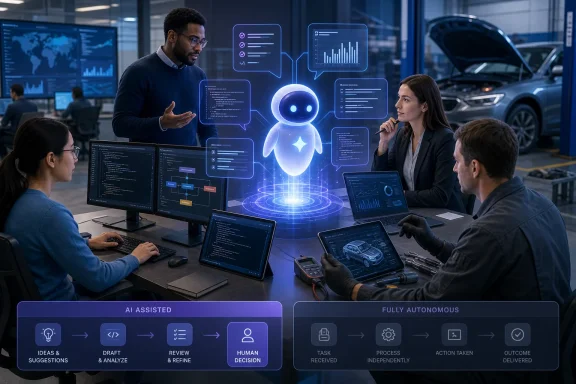
Google’s first AI & Economy ATLAS report finds that Gemini is being used across much of the workforce, but mostly as a collaborative assistant rather than an autonomous replacement. The study examined 15 million aggregated, de-identified interactions from the Gemini app, Google AI Mode, and the Gemini API—and found limited evidence that workers are handing complete jobs over to AI.
As reported by Ars Technica, the result cuts against the most sweeping predictions around generative AI and white-collar displacement. Google’s data shows broad experimentation, especially in technical and knowledge-work roles, but adoption remains selective at the task level.
Google says AI activity appeared in 68% of occupations represented in the data, covering jobs that account for roughly 90% of US employment. Yet within a typical occupation, AI was used for only about 21% of its associated tasks.
That distinction matters. A software developer may use Gemini to explain an API, draft a test case, or troubleshoot a snippet, but that is not the same as delegating architecture, code review, deployment, incident response, and accountability to an agent. Similarly, a systems administrator can ask for PowerShell help or assistance interpreting logs without automating away the operational judgment required to keep an environment running.
Google characterizes workplace use as “broad but shallow.” The report finds that end-to-end automation accounts for less than 10% of interactions involving non-routine cognitive work, while collaborative requests—research, drafting, brainstorming, explanation, and problem solving—make up the much larger share.
That does not mean AI is absent from physical or trade work. Google cites automotive technicians and industrial mechanics using the tools to interpret diagnostic results, trace electrical faults, and inspect machinery. The pattern is still assistance: AI can shorten the path to an answer, but the worker remains responsible for deciding whether that answer applies in the real world.
More than 86% of the interactions in the dataset occurred outside work, including consumer research, appliance help, and navigating administrative tasks such as taxes, licensing, and fines. That is a useful reminder that public AI usage metrics should not automatically be read as evidence of enterprise transformation.
It also cannot establish whether Gemini use improved productivity, reduced headcount, changed hiring, or produced revenue. A prompt asking for help with an Excel formula and an automated workflow that eliminates a recurring role are fundamentally different events, even if both are counted as AI interactions.
Google’s study is therefore not proof that AI will never displace workers. It is evidence that, as of July 2026, the widespread real-world pattern is narrower than the rhetoric: workers are using AI to complete pieces of their jobs, not routinely automating the whole job away.
As reported by Ars Technica, the result cuts against the most sweeping predictions around generative AI and white-collar displacement. Google’s data shows broad experimentation, especially in technical and knowledge-work roles, but adoption remains selective at the task level.
Gemini Is Reaching Jobs, Not Replacing Them
Google says AI activity appeared in 68% of occupations represented in the data, covering jobs that account for roughly 90% of US employment. Yet within a typical occupation, AI was used for only about 21% of its associated tasks.That distinction matters. A software developer may use Gemini to explain an API, draft a test case, or troubleshoot a snippet, but that is not the same as delegating architecture, code review, deployment, incident response, and accountability to an agent. Similarly, a systems administrator can ask for PowerShell help or assistance interpreting logs without automating away the operational judgment required to keep an environment running.
Google characterizes workplace use as “broad but shallow.” The report finds that end-to-end automation accounts for less than 10% of interactions involving non-routine cognitive work, while collaborative requests—research, drafting, brainstorming, explanation, and problem solving—make up the much larger share.
Heavy Use Is Concentrated in Familiar Knowledge Roles
Financial and market analysts, software developers, and systems administrators were among the occupations overrepresented in Gemini’s work-related use, according to the reporting. Sales, transportation, and food-service roles were comparatively underrepresented.That does not mean AI is absent from physical or trade work. Google cites automotive technicians and industrial mechanics using the tools to interpret diagnostic results, trace electrical faults, and inspect machinery. The pattern is still assistance: AI can shorten the path to an answer, but the worker remains responsible for deciding whether that answer applies in the real world.
More than 86% of the interactions in the dataset occurred outside work, including consumer research, appliance help, and navigating administrative tasks such as taxes, licensing, and fines. That is a useful reminder that public AI usage metrics should not automatically be read as evidence of enterprise transformation.
The Dataset Is Large, but It Is Not a Labor-Market Verdict
ATLAS is a meaningful new source of observational data, but it has important limits. It measures activity in Google’s consumer-facing Gemini products and API, not all AI use across a company, and it excludes major areas such as Gemini for Google Workspace, Gemini Enterprise, Google Translate, AI Overviews, and specialized agentic coding tools.It also cannot establish whether Gemini use improved productivity, reduced headcount, changed hiring, or produced revenue. A prompt asking for help with an Excel formula and an automated workflow that eliminates a recurring role are fundamentally different events, even if both are counted as AI interactions.
Google’s study is therefore not proof that AI will never displace workers. It is evidence that, as of July 2026, the widespread real-world pattern is narrower than the rhetoric: workers are using AI to complete pieces of their jobs, not routinely automating the whole job away.
References
- Primary source: Ars Technica
Published: 2026-07-28T20:20:20+00:00
Despite AI hype, Google's data shows workers aren't automating themselves away - Ars Technica
Analysis of 15 million real AI interactions finds most tasks at most jobs are unaffected.arstechnica.com - Related coverage: searchenginejournal.com
Google Data Compares Gemini & AI Mode Use Against Daily Life
Google's new AI & Economy report compares Gemini and AI Mode conversations against how Americans spend their days.www.searchenginejournal.com