

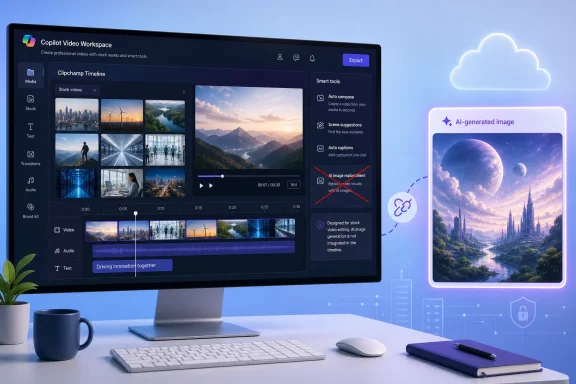
The practical result is straightforward: Copilot Create video drafts remain a stock-media workflow, not an image-generation workflow. Microsoft’s own current support documentation says the service creates a script and AI voice narration, then assembles the project with stock footage, graphics, and music from Microsoft’s content library. Users can replace stock items with their own media in Clipchamp, but the proposed in-video swap to a newly generated image will not arrive through this roadmap item.
The cancellation matters less as a lost checkbox in Copilot Create than as confirmation that Microsoft has not yet crossed a meaningful product boundary. It can generate images in Microsoft 365 Copilot, and it can generate a video project around licensed stock assets, but it is not shipping the promised bridge between those two experiences.
What Roadmap ID 501570 was supposed to change
The cancelled roadmap listing targeted Microsoft Copilot for Microsoft 365 across desktop, Mac, and web clients, with General Availability planned for Microsoft’s Worldwide standard multi-tenant cloud. The item was created on September 22, 2025 and carried a November 2025 general-availability target, before Microsoft marked it cancelled nearly nine months later.
Its proposed workflow was specific. In the Create experience, a user generating a video could take a stock visual selected by Copilot and replace it with an AI-generated image made from a prompt. Microsoft positioned the capability as a way to make video content more tailored, improve explanatory visuals, and avoid the generic feel of stock footage.
That would have been a substantial change to the underlying production model. Today, Copilot’s video tool uses AI to decide what the video should say and what stock assets might fit it. The planned feature would have let it generate at least some of the visual material itself, effectively moving from AI-assisted assembly to a hybrid stock-and-synthetic media project.
Microsoft did not disclose whether the feature would have replaced a still image, a video clip, a graphic card, or any arbitrary asset on the Clipchamp timeline. The wording referred to “stock video footage” and “stock visuals,” but it did not state the supported asset types, output resolutions, aspect-ratio handling, or whether generated images would receive animation or motion treatment in the final video.
Those omissions are important because an image swap does not automatically solve the real problem of producing coherent video. A generated 16:9 still can work as an establishing shot, slide-like explainer, or branded background. It is a poor substitute for footage that needs actual movement, continuity, or a recognizable real-world setting. Microsoft’s proposal described image generation, not generative video.
The current product documentation says stock media stays in place
Microsoft’s support guidance for “Create a video with Copilot” is more explicit than the now-cancelled roadmap card. Copilot generates a script, creates an AI voice narrative, and compiles stock footage into a Clipchamp project. Microsoft says no images, pixels, or video clips are generated during the composition process; the visual source is its internal stock library.
That documentation also sets the practical access conditions administrators need to know. Video creation in Copilot Create is for commercial users signed in with Microsoft Entra ID accounts who have a Microsoft 365 plan and access to Copilot Chat. Clipchamp must be enabled in the organization or the Create a video option does not appear.
The output is a Clipchamp project, saved to the user’s corporate OneDrive, where the user can make further changes and export the result as an MP4. The built-in editor already permits swapping stock footage with user-provided media. That is the currently supported route for teams that need company product screenshots, internal photographs, approved campaign artwork, or licensed third-party imagery in a Copilot-produced draft.
Microsoft’s broader Create documentation makes the same distinction. It says the script and audio are AI-generated, while images, video footage, and music are taken from Microsoft’s content library. If a video is created from a PowerPoint deck, the visual material comes from that deck instead.
In other words, the cancelled feature was not redundant with the existing AI image button in Copilot Create. AI image generation and Copilot video generation are already available as separate capabilities, but Microsoft has stopped short of integrating them into the same video-editing action.
GPT-Image-1.5 did reach Microsoft 365 Copilot, but this integration did not
The planned feature was described as being powered by OpenAI’s latest image-generation model. Microsoft has separately rolled out OpenAI’s GPT-Image-1.5 across Microsoft 365 Copilot and Copilot Chat image-generation experiences, according to a Microsoft 365 Message Center notice archived by M365 Archive. That rollout began in December 2025 and was expected to complete in March 2026.
Microsoft said GPT-Image-1.5 replaced GPT-4o for supported image-generation and editing scenarios, promising better prompt adherence, more precise image editing, improved visual fidelity, and faster output. The company also said existing Copilot policies, security commitments, data handling, and administrative governance would remain in place.
That model deployment should not be confused with the cancelled video feature. GPT-Image-1.5’s availability in Copilot Create means users can generate standalone images there. It does not mean those images can be inserted through the proposed one-click replacement control in a Copilot-generated Clipchamp video. Microsoft’s current video documentation still says the composition process does not generate images or clips.
This is the central discrepancy in Microsoft’s product messaging. The roadmap item implied that a model capable of generating visual assets would be connected to video production; the live support material still documents a deliberate separation between image creation and video composition.
Microsoft has good reasons to maintain that boundary, even if it has not named them in the cancellation notice. Stock libraries supply predictable licensing, known visual quality, and footage that has genuine motion. Generated images introduce review questions around accuracy, representation, branding, intellectual-property risk, and whether the resulting video makes a synthetic illustration appear to be documentary footage.
Microsoft itself previously promoted stock media in the Copilot video workflow as a way to reduce the risks associated with generative media in organizations. The cancelled item would have softened that safeguard while retaining the same business-oriented Create and Clipchamp workflow.
Admin controls do not answer the missing policy question
Microsoft 365 administrators can already control Copilot image generation through the Copilot Control System. Microsoft’s administration documentation says that when image generation is allowed, users can create, design, and edit images in Copilot and add them to Microsoft 365 work. When it is disabled, Copilot does not generate new images.
But Microsoft never said whether that image-generation setting would have governed AI image replacements inside videos. Nor did it say whether a separate policy would have been needed for the proposed capability, whether the feature would honor existing Clipchamp settings, or whether users could independently disable AI-generated visual substitutions.
The current video feature has a notably blunt control model. Organizations can prevent users from seeing Create a video by disabling Clipchamp, but Microsoft says there is no tenant- or user-level switch dedicated to the Copilot video-creation feature itself. That may have made the proposed integration harder to position for organizations that allow controlled image generation in documents and presentations but do not want synthetic visuals introduced into corporate video communications.
There is also a provenance issue that Microsoft left unresolved. The company says images generated within Microsoft 365 Copilot carry Content Credentials provenance based on the C2PA standard. Separately, Microsoft supports optional visual or audio watermarks for some video and audio content generated or altered by AI in Microsoft 365, while also placing metadata in generated or altered files.
The roadmap entry did not say whether an AI-generated still inserted into a Copilot video would preserve its image credentials through Clipchamp editing and MP4 export, trigger a video-level watermark, or remain detectable only in metadata. For communications teams publishing externally, those are deployment details, not technical trivia.
Teams should plan around the workflow Microsoft actually ships
For organizations already using Copilot Create, the sensible operating assumption is unchanged: let Copilot create the script, voiceover, outline, and stock-media draft; then review and replace visuals in Clipchamp using approved internal media. If a synthetic image is genuinely appropriate, create it separately in Microsoft 365 Copilot, verify it against brand and factual-review requirements, then add it manually through the editor if the workflow supports the desired asset format.
IT administrators should also avoid treating the cancelled item as a future compliance feature. There is no announced replacement roadmap ID, no revised rollout date, no explanation of why the work stopped, and no statement that the capability will return under a different name. Microsoft’s “at this time” language leaves the door open, but it is not a deployment commitment.
The durable takeaway is that Microsoft 365 Copilot can now generate images and can create a stock-based Clipchamp video draft, yet it still draws the line between those operations. Roadmap ID 501570 was meant to erase that line. As of August 10, 2026, Microsoft has chosen to keep it.