
The practical value is straightforward: a legal, compliance, or IT team managing many cases should no longer have to inspect each case separately to determine which Exchange mailboxes and SharePoint sites are under hold, whether a hold applied successfully, and where a policy has encountered an error. But the revised roadmap entry also exposes a timing problem Microsoft has not explained: the company previously told public-sector customers that the same capability would roll out to GCC, GCC High, and DoD by early October 2024.
Microsoft’s own current documentation adds a second complication. It describes the Hold report as a preview feature and warns that its underlying policy and location status can lag changes by up to seven days. Government-cloud customers should therefore treat the February 2027 date as a fresh availability milestone on the roadmap, not as proof that the report will become a real-time compliance control.
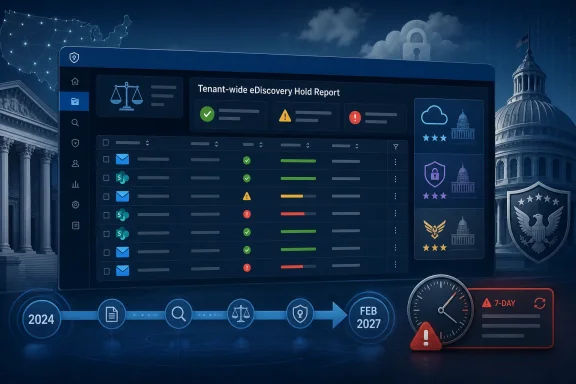 A 2027 roadmap date conflicts with Microsoft’s 2024 rollout notice
Roadmap ID 93269 was created in June 2022, but its latest update—dated August 17, 2026—now lists General Availability in February 2027 for GCC, GCC High, and DoD. The roadmap describes out-of-the-box reporting for all legal holds associated with eDiscovery cases, with filtering, sorting, and downloads.
That language is close to Microsoft’s August 2024 U.S. Public Sector Roadmap Newsletter. In that notice, Microsoft said Hold reports for eDiscovery Premium would begin rolling out to GCC, GCC High, and DoD in mid-September 2024 and complete by early October 2024. The company said the report would cover hold policies in both eDiscovery Standard and eDiscovery Premium cases, including enabled and disabled policies and the locations associated with them.
Microsoft has not published an explanation alongside the updated roadmap item for why a feature previously scheduled for completion in 2024 is now described as in development for February 2027. The record does not establish whether the 2024 rollout was delayed, partially delivered, withdrawn, or delivered under a prior Purview experience and now needs a separate release in the current portal.
That distinction matters for federal and defense organizations because Microsoft 365 Government service rollouts often differ from commercial tenants in both timing and feature scope. An administrator should not assume that seeing Hold report documentation for the broader Purview service means the capability is presently enabled, supported, or equivalently functional in their GCC, GCC High, or DoD tenant.
The safe interpretation is narrower: Microsoft’s public roadmap now makes a February 2027 availability commitment for those three government clouds. It does not clarify the status of any earlier deployment.
The report is an inventory tool, not proof that a hold is current
Microsoft’s Purview documentation describes the Hold report as a tenant-wide summary of hold policies linked to eDiscovery cases. It can show the case name, hold-policy name, affected mailbox or SharePoint location, location type, policy status, errors, dates, identifiers, and—in applicable cases—the content query associated with the hold rule.
This is useful operationally because a single data location may be subject to more than one legal hold. The report counts that location under each relevant policy, rather than deduplicating it into one tenant-wide record. A large item count can therefore represent overlapping preservation obligations, not necessarily an equal number of distinct mailboxes or sites.
The report’s policy-status values are also more meaningful than a simple “on hold” flag. Microsoft documents states including:
- A location marked Applied successfully has an enabled policy and rule that have been applied successfully.
- A location marked Applied partially can indicate that some locations in a policy were preserved while others failed; administrators must inspect the Location error field rather than infer that every listed target is protected.
- A location marked Released successfully has been removed from that hold policy, while a partially released result may require remediation.
- Applying and Releasing indicate asynchronous work still in progress, meaning policy changes should not be treated as complete until the final result is available.
The important limitation is that the report is not a live verification surface. Microsoft says it syncs policy and location status no more than once every seven days, while related documentation describes a full refresh cadence of roughly three to seven days. Case-name and case-status changes may appear sooner when an administrator updates an associated hold policy, but the underlying tenant-wide inventory can still lag.
For legal teams, that delay changes the appropriate workflow. The Hold report is well suited to periodic governance reviews, audits, reconciliation between legal and IT inventories, and identification of failed or partially applied policies. It is poorly suited as the sole evidence that a hold change made today has already taken effect. Microsoft directs users needing the current status of a specific policy and its locations to the hold-policy details within the relevant eDiscovery case.
In other words, the new report can help find exceptions at scale, but it does not replace case-level validation after a preservation action.
Export behavior needs an internal handling rule
Microsoft says users will be able to sort and filter the visual report and download its aggregated information. Its current Hold report documentation contains a detail that deserves attention in any compliance procedure: a CSV export downloads the entire report even when the on-screen view has been filtered or grouped.
That behavior can surprise an administrator who filters the portal to a single case, matter, business unit, or error state and expects the export to reflect that narrowed view. It also has two practical consequences.
First, a downloaded file may include legal-matter names, mailbox addresses, SharePoint URLs, hold policy identifiers, and status information outside the scope of the reviewer’s immediate task. The file should therefore be handled as sensitive compliance data, stored only in an approved location, and shared according to the organization’s existing legal and records-management controls.
Second, teams that use filtered views for audit work need to retain evidence of the filter criteria separately. A screenshot, documented filter settings, or a repeatable PowerShell process may be necessary if the organization needs to show why a reviewer focused on a particular subset of records. The CSV alone will not demonstrate that scope when it contains the entire tenant-wide dataset.
Microsoft also documents a PowerShell script for creating hold reports. That option may matter more than the portal download for organizations that need a recurring reconciliation process, provided they build their own access controls, retention period, and review workflow around the exported results. Automated reporting is valuable only if the organization understands the data’s refresh delay and does not mistake a stale report for a failed preservation action.
Permissions and licensing will decide who can use it
Microsoft says access to the built-in Hold report requires a subscription that supports Purview eDiscovery Premium features. The report is available to users assigned the eDiscovery Administrator or eDiscovery Manager role, but an eDiscovery Manager can view reports only for cases in which that manager is a member.
That case-scoped restriction is significant. A central compliance team may expect an assigned eDiscovery Manager to conduct a tenant-wide review, only to find that the role exposes a limited collection of cases. The tenant-wide reporting concept does not override Purview’s case membership model for eDiscovery Managers.
Organizations planning for the government-cloud release should review role assignments before the feature arrives rather than waiting for an active matter. They should confirm which people need cross-case visibility, which need case-specific visibility, and whether the users responsible for reconciliation have the premium licensing needed to generate and access the report.
They should also test how their existing holds are represented. Microsoft’s documentation says the report includes locations from enabled and disabled policies, and a location with no active target can appear as “None.” A policy listed in the report is therefore not automatically an active preservation obligation. Staff reviewing exports need to read policy status and location errors rather than use the report’s presence as a binary indication that data is preserved.
February 2027 is a planning date, not a legal-hold deadline
For GCC, GCC High, and DoD customers, the roadmap update offers an eventual centralized reporting surface, but it does not alter the obligation to validate individual holds now. Existing Purview case workflows, policy status reports, and case-level hold details remain the tools to use when a matter requires immediate confirmation.
The larger issue is Microsoft’s unexplained schedule reversal. A government tenant that believed the 2024 public-sector rollout notice had settled this feature’s availability should verify its current Purview experience directly and document any gap in its legal-hold reporting process. The February 2027 roadmap target may eventually close that gap, but Microsoft’s own documentation makes clear that even then, the Hold report will be an inventory with a delayed synchronization cycle—not an instant certificate that every preservation action succeeded.
