

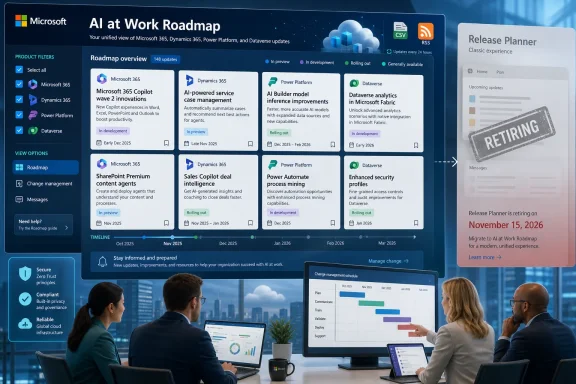
Neowin framed the rebrand as Microsoft forcing AI terminology onto a broad catalog of updates, and the label does create a real mismatch. The public roadmap still tracks conventional Microsoft 365 changes across products including Exchange, Outlook, OneDrive, Teams, Microsoft Edge, Intune, Purview, Windows, and Universal Print—not only Copilot features and agents. Calling the entire catalog “AI at Work” does not make a new Outlook setting or a Windows management update an AI feature.
But the naming dispute is the surface-level part of a larger planning change. Microsoft’s August 25 announcement on Microsoft Source says the combined roadmap will replace the release-wave system with continuous disclosure: items will appear when Microsoft considers plans committed and ready to share, rather than being held for the next Wave 1 or Wave 2 publication. For organizations that built testing, training, and change-management calendars around release-wave documents, that is a workflow change, even if no product deployment mechanism changes.
The new name covers far more than AI
Microsoft says the AI at Work Roadmap is intended to cover “core apps,” Copilot, agents, and related commercial features in one place. Its own current product filters underline the problem with treating the rebrand as a simple Copilot portal: the database encompasses dozens of workloads, including services where forthcoming changes may have nothing to do with generative AI.
The pre-existing Microsoft 365 Roadmap was never narrowly a Microsoft 365 Apps feature tracker. It was a practical public index for administrators and IT departments trying to answer basic operational questions: Is a Teams change rolling out? Which cloud environments are included? Is a feature still in development? Does a listed date mean Targeted Release or Standard Release? Is something launched, rolling out, or merely planned?
That function remains. Microsoft’s roadmap page still cautions that dates are estimates, that plans can change, and that features can be postponed or canceled. It also continues to distinguish release phases and cloud instances. Those details, rather than the new brand, are what administrators use when deciding whether to prepare a help desk, revise documentation, test policies, or simply wait.
The result is an awkward but accurate reading of the rename: Microsoft is positioning all of its work-planning information under an AI banner, while the underlying service catalog remains a mix of AI and non-AI changes. Neowin is on firm ground in calling the label potentially misleading. A roadmap for core Office and business-platform release planning has become a marketing statement about how Microsoft wants customers to understand its portfolio.
The substantive change is the end of release waves
The important operational change begins in September 2026. According to Microsoft’s announcement, new Dynamics 365, Power Platform, and Dataverse capabilities will start appearing on the AI at Work Roadmap instead of in new twice-yearly release plans. Microsoft will no longer publish a September 2026 Release Wave 2 announcement or a new Wave 2 release plan.
Microsoft’s stated rationale is that customers increasingly run business applications, productivity software, Copilot, Copilot Studio agents, and custom workflows together. Centralizing the material can help a company see developments across Microsoft 365, Dynamics 365, Power Platform, and Dataverse without moving between separate roadmap systems.
There is a practical upside. A Power Platform team building a workflow tied to Teams, SharePoint, Microsoft 365 Copilot, and Dataverse will have a better chance of seeing adjacent changes in one filtered view. Microsoft also says the new roadmap supports product and cloud filters, CSV export, RSS subscriptions, direct links, feature-ID searches, and advanced filters. Those tools can be useful for organizations that already maintain an internal change register or want to feed roadmap items into governance processes.
However, a unified feed is not the same thing as a unified release schedule. The old wave model imposed a predictable external rhythm: administrators could review a large published plan, identify relevant items, allocate testing time, and schedule stakeholder meetings around a known set of milestones. Continuous publication can make information available earlier, but it shifts the responsibility for assembling a coherent planning horizon to the customer.
Microsoft says this transition does not alter how products are built, released, or deployed. That is an important limitation. A roadmap entry is still forward-looking information, not a tenant-specific rollout notice, a guaranteed availability commitment, or an instruction to make a configuration change. Message Center remains the authoritative venue for changes relevant to an individual tenant, while Microsoft Learn remains the documentation destination.
In other words, the roadmap is becoming a broader discovery tool, not a replacement for the controls administrators already use to manage change.
Release Planner users have a concrete migration problem
The rebrand notice, Message Center post MC1461528, is paired with MC1461529, which describes the retirement of Microsoft’s Release Planner. The latter carries the more significant deadline: Release Planner is set to retire on November 15, 2026.
Microsoft says existing Dynamics 365, Power Platform, and Dataverse items with a Public Preview or General Availability date of June 1, 2026 or later will transition to the AI at Work Roadmap. Older material will remain in Microsoft Learn release plans as historical reference. Beginning in September, new release plans will no longer be published on Learn.
That split matters for anyone using old wave documentation as an audit trail. Existing Learn plans will not vanish immediately, but they will stop being the place to find new commitments. An organization that has linked internal project plans to release-wave pages needs to preserve the historical references it needs while moving its forward-looking process to the new roadmap.
Microsoft also says personalized “My Release Plans” saved views will not carry over after Release Planner’s retirement. That omission should not be treated as a cosmetic inconvenience. Saved views often encode a team’s scope—specific apps, platforms, regions, release phases, and business priorities. Losing them means organizations must rebuild their filters and, more importantly, document the criteria behind them.
Administrators should handle the change as a small migration project rather than a branding update:
- Teams that use Release Planner should inventory saved views, exported reports, bookmarks, and any internal documents that reference release waves before November 15.
- Change-management owners should recreate the relevant product, platform, release-phase, and cloud-instance filters in the AI at Work Roadmap and verify that the results match their prior monitoring scope.
- Organizations should decide whether RSS feeds, regular CSV exports, or a scheduled manual review is the right replacement for a twice-yearly release-plan review.
- Tenant-specific Message Center notices should remain part of the process, because the public roadmap does not tell an administrator whether a specific tenant will receive a change at a particular time.
Continuous disclosure creates a monitoring obligation
Microsoft presents always-on publication as a way to expose plans sooner. That may be true for customers watching actively, especially those that rely on Power Platform and Dynamics 365 changes that previously waited for wave publications. Yet the benefit depends on how well a company can monitor, interpret, and prioritize a faster-moving stream of announcements.
A twice-yearly release plan had obvious flaws. It could be stale by the time a feature reached customers, and it encouraged readers to mistake a broad roadmap intent for a delivery guarantee. Still, it created a predictable planning event. Continuous publication removes that event and gives organizations a choice: build their own recurring review cycle or accept that roadmaps will be reviewed reactively when someone notices a relevant change.
Microsoft explicitly recommends a monthly or quarterly review rhythm built around saved filters and RSS subscriptions. That is sensible advice, though it also confirms the burden being transferred. A large enterprise may automate the feed into a service-management process or an internal dashboard. A smaller IT team may simply need a calendar reminder and a filtered browser view. Either approach is more dependable than assuming an AI-branded public page will provide sufficient warning by itself.
Microsoft also points organizations toward its Release Communications MCP Server for querying roadmap information through AI tools and workflows. That may appeal to teams building internal planning assistants, but it should be evaluated as an integration project, not adopted merely because the destination now has “AI” in its name. The core governance questions remain ownership, data freshness, exception handling, and whether a human reviewer can distinguish a tentative roadmap entry from a tenant-specific service notice.
The immediate consequence is straightforward. Microsoft’s renamed roadmap is now the public planning hub for a substantially wider set of products, while Release Planner and the release-wave cadence are on their way out. Administrators have until November 15, 2026 to preserve the views and processes they relied on—and should treat Message Center, rather than the AI at Work Roadmap’s new branding, as the channel that still determines what their tenant needs to do.