

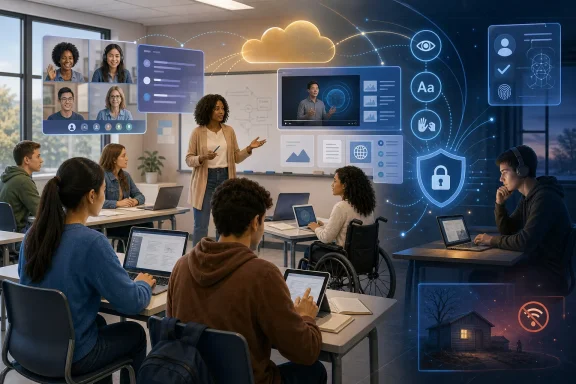
That distinction is missing from Professor Ts. Dr. Manjit Singh Sidhu’s BusinessToday Malaysia essay, which correctly identifies flexibility, access, personalization, social interaction, inequality, and assessment as the central issues. Its conclusion—that blended learning will outlast the emergency period—is supported by the record. But “hybrid” has become a convenient catch-all that risks obscuring the operational question institutions actually face: which parts of teaching should remain online because they improve access or instruction, and which parts were merely emergency substitutes for being together?
U.S. higher-education enrollment data makes the permanence clear. The National Center for Education Statistics reports that, in fall 2023, 4.98 million students at Title IV institutions—25.6% of all enrolled students—were taking their courses exclusively through distance education. Another substantial group took a mixture of online and in-person courses. That is well below the forced all-remote peak of 2020, but it is too large to describe as a temporary pandemic residue.
The post-pandemic settlement, then, is not online versus campus. It is a more complicated division of labor between physical classrooms and systems such as Microsoft Teams, Moodle, Canvas, Google Classroom, OneDrive, video platforms, learning analytics products, and online assessment tools.
The pandemic proved that platforms could carry education—under pressure
The emergency switch to remote teaching established something important: institutions could keep courses operating when students and instructors could not gather physically. That was a resilience test, not a clean test of online learning quality.
The distinction matters because much of what occurred in 2020 and 2021 was emergency remote teaching: courses designed for classrooms were moved online at speed, often with uneven home broadband, shared devices, overloaded instructors, and little time to redesign assessment or learning activities. Treating the performance of that period as a verdict on all distance education is as misleading as calling a disaster-recovery failover a normal production architecture.
The U.S. Government Accountability Office found that teachers working in virtual and hybrid settings during the 2020–21 school year more often reported students struggling to understand lessons than teachers in in-person settings. It also found a major difference between live interaction and self-paced work: asynchronous learning was widely used, but fewer than 40% of teachers believed it helped at least half their students make academic progress.
That finding does not mean that recorded lectures, digital assignments, or self-paced modules have no role. It means institutions should stop assuming that putting a worksheet, a slide deck, and a video link into a learning-management system creates an equivalent course. The format can extend learning time and make revision easier. It does not automatically provide the immediate feedback, social pressure, or intervention that students receive when an instructor can see confusion developing in real time.
For Windows administrators, this is a familiar technical lesson. Deploying Microsoft 365 or Teams is the beginning of the project, not the result. Whether a class works depends on device readiness, identity access, network capacity, educator training, accessible content, support response times, and a plan for students who lose connectivity. The same is true in education: the service is the teaching workflow, not merely the software license.
Higher education has retained distance learning; K–12 has retained digital infrastructure
The source essay treats “schools and universities” as though they are traveling toward the same destination. They are not.
Higher education has a clear, continuing market for fully online programs. Adult learners, working students, caregivers, military families, rural students, and people seeking a specific credential without relocating all have reasons to choose distance education deliberately. A fully online degree can be the right product when the program was designed for it, the student support exists, and the course’s learning outcomes do not depend on hands-on facilities or continuous in-person supervision.
K–12 education is different. Young students generally need supervision, routine, peer interaction, meals, special-education services, and the social environment that a campus provides. The GAO’s evidence from the pandemic period reinforces the point: live instruction helped, but in-person live instruction was more often viewed by teachers as helpful than virtual delivery. The practical legacy for most K–12 systems is therefore digital support for classroom teaching—not a broad retreat from the classroom.
That support can be meaningful. Recorded explanations can help a student revisit difficult material. A Teams channel can retain project discussions and documents. Cloud-based tools can enable teacher feedback outside the school day. Digital accessibility features can make materials more usable for students with disabilities. A weather closure or illness no longer has to sever all contact between teacher and class.
But these are reasons to preserve the digital layer, not reasons to declare the physical school obsolete.
The real risk is turning “hybrid” into a cost-cutting label
Blended learning can improve a course. It can also become a way to reduce the amount of actual teaching offered while continuing to charge students for a full educational experience.
A well-designed hybrid course decides, in advance, which activity belongs in person and which works better online. A laboratory session, clinical placement, supervised practice, debate, seminar discussion, studio critique, and relationship-building may benefit from being face-to-face. Pre-class explanations, low-stakes quizzes, revision resources, document collaboration, office hours, and feedback loops can often work well online.
A weak hybrid course does the opposite. It replaces classroom time with unstructured independent work, labels a library of recordings “flexibility,” and leaves students to solve technical or academic problems alone. The technology may be modern; the instructional design is not.
UNESCO’s Global Education Monitoring Report reaches a similarly restrained conclusion. Digital technology has broadened access to learning resources and can support personalization and administration, but evidence of its added educational value is mixed and often thin. The report warns that technology changes faster than it can be evaluated, while its long-term costs are routinely underestimated.
Those costs are not limited to subscriptions. Institutions must fund endpoint replacement, Wi-Fi improvements, help desks, captioning, accessibility remediation, staff training, cybersecurity, identity management, data retention, backup procedures, integrations, and vendor transitions. A school that moves class activity into Teams or another cloud platform also creates a dependency on tenant configuration, account lifecycle management, permissions, and a reliable support model.
The cost argument should therefore be tested honestly. If a proposed hybrid program reduces campus hours but adds instructors, tutoring, instructional designers, student-success staff, loaner devices, and responsive technical support, it may be a better educational model. If it reduces campus hours and support at the same time, it is more likely a budget maneuver dressed up as innovation.
Access depends on the whole setup, not the availability of a login
Sidhu’s argument that digital learning opens access is true for many learners, especially in higher education. But online delivery only removes a geographic barrier after several others have already been cleared.
A student needs a suitable device, reliable broadband, working audio and video, a quiet place to work, accessible materials, time away from employment or care responsibilities, and confidence using the institution’s systems. A password reset loop or multifactor-authentication failure may sound mundane to an IT department, but it can become the reason a student misses a timed quiz, loses access to a lecture, or gives up on a course.
UNESCO found that remote-learning platforms reached only a fraction of students worldwide during pandemic closures, despite widespread adoption by governments and schools. The gap was not simply an internet problem. It reflected poverty, geography, device access, language, disability support, and the fact that a platform cannot substitute for a local support network.
This is where Windows and cloud-management decisions become educational decisions. Schools that standardize on managed Windows devices can provide known performance, assistive technology, patching, security controls, and predictable support. They can also make remote troubleshooting and account recovery easier. But standardization helps only if students actually receive the device, can use it off campus, and are not blocked by policies designed solely for office workers.
Digital equity is a service-level obligation, not a claim that students can visit a website.
AI makes the governance problem harder, not easier
The original essay presents artificial intelligence and data analysis as tools for personalizing content. They can be useful for practice exercises, feedback triage, translation, tutoring prompts, and identifying students who may need help. They also introduce a governance problem that many institutions have not solved.
A learning platform may hold attendance patterns, assignment submissions, grades, disability accommodations, behavioral signals, communication history, and device or usage data. Adding generative AI can mean sending student work to another service, using prompts and responses to shape educational decisions, or creating opaque recommendations that teachers may over-trust.
The U.S. Department of Education’s student-privacy guidance has long urged schools to evaluate online educational services for privacy and security before deploying them. That principle is more urgent now, because modern platforms are not merely document repositories. They can become data collection and decision systems.
Schools need written answers to basic questions: What student data leaves the tenant or learning platform? Which vendors can retain it? Is it used to train models? Who can review automated flags? How are false positives corrected? How long are recordings retained? What happens to student files, chat histories, and assignments when an account is deleted or a vendor contract ends?
Academic integrity belongs in the same discussion. Remote proctoring software may deter some misconduct, but it can also create privacy, accessibility, and fairness problems. The better long-term response is often assessment redesign: oral defenses, project work, staged drafts, practical demonstrations, localized problems, and frequent low-stakes feedback. Those approaches are harder to outsource to an AI system and more revealing of what a student actually understands.
The permanent change is institutional responsibility
E-education has survived because the useful parts of it solved real problems before COVID-19 and will continue to do so: access across distance, flexible pacing for some learners, rapid collaboration, reusable learning materials, and continuity during disruptions. The pandemic accelerated adoption; it did not settle the evidence.
The strongest conclusion is not that every institution should become more online. It is that every institution now needs a deliberate digital teaching strategy. That means measuring outcomes by learner group, designing courses for their actual delivery mode, publishing clear support and privacy policies, and refusing to use technology as a shortcut around teaching, staffing, or access needs.
For students and educators, the classroom will remain central. For IT teams, the platform beneath it is now part of the educational contract—and a failed login, inaccessible file, unmanaged device, or careless AI integration can break that contract as surely as a locked classroom door.