
That is a consequential, if unglamorous, expansion. Fabricating a die is only part of producing a usable chip; assembly, packaging and test determine how it connects to a board, dissipates heat and survives field use. For a country trying to reduce reliance on foreign semiconductor services, bringing those steps closer to wafer production can remove a major logistical and supply-chain dependency.
 NM-Tech’s plan points to a vertically integrated operation
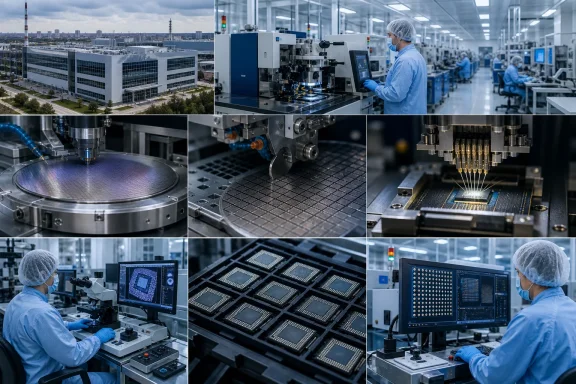
The opening appears aimed first at NM-Tech’s own production rather than at immediately creating a large outsourced semiconductor assembly and test business. According to Frontier India, the initial emphasis is expected to be plastic packages, with conventional wire bonding as well as flip-chip and ball-grid-array formats under consideration.
Those choices matter for mature-node chips used in industrial control, transport, embedded systems and general electronics. Flip-chip and BGA packaging support far denser interconnects than many legacy package types, although they also require capable substrate, inspection and thermal-management processes. The recruitment requirements suggest NM-Tech is assembling more than a narrow final-assembly line: it is building the process engineering and qualification capacity needed to ship components reliably.
NM-Tech has not publicly identified which processors or other devices would be packaged, and it told CNews that commercial terms and external agreements are subject to confidentiality obligations. That opacity has become characteristic of the company, whose public disclosures have been limited even while state-backed investment has expanded.
The packaging line sits beside a much larger bet
NM-Tech already advertises process design kits for 250 nm and 130 nm manufacturing and is developing a 90 nm PDK. Its longer-term profile is tied to the FAB-300 project in Zelenograd, intended to support production at 28 nm, though that project has faced visible delays, including cancelled laboratory-testing tenders in March 2025.
CNews reported that VEB.RF opened a non-revolving credit line of up to 116.4 billion rubles for NM-Tech in August 2023, with repayment due by the end of 2027. The funding covers equipment, commissioning, intellectual property and production-launch costs; CNews also reported in February that NM-Tech had pledged extensive production equipment and other assets as collateral.
The company is not operating in isolation. Mikron used NM-Tech facilities to expand 180 nm output in 2025, Frontier India reported, demonstrating that the Zelenograd site can serve as overflow manufacturing capacity even before any prospective 28 nm line reaches volume production.
Russia Has Packaging Capacity, but Not Necessarily Scale
NM-Tech would enter a domestic market that already includes Mikron, Milandr, GS Group, Kremniy El and the Zelenograd Nanotechnology Center. CNews reported in January that the Zelenograd Nanotechnology Center was preparing a polymer-packaging line rated for up to 100,000 chips per month, including PBGA and flip-chip BGA packages for 200 mm and 300 mm wafers.
The issue is less whether Russia can package chips at all than whether its facilities can sustain competitive volumes, yields and economics. Fragmented, low-volume lines can provide strategic resilience for domestic programs, but they do not automatically match the cost structure or throughput of major Asian assembly-and-test contractors.
For NM-Tech, the near-term test is straightforward: turn a hiring signal into qualified, repeatable production. If it does, the company will have moved one step closer to a domestic chain that can take its wafers further toward finished electronics without leaving Zelenograd.
