
As XDA argued after Nvidia’s SIGGRAPH 2026 presentation, the company has answered part of the backlash surrounding DLSS 5 while leaving the buying-critical performance questions unresolved. Nvidia says DLSS 5 will arrive this fall, but it has not published the VRAM requirements, parameter counts, frame-time impact, or practical GPU-tier guidance that would tell a PC builder whether the feature belongs on a mainstream RTX card or only at the far end of the market.
That uncertainty matters because DLSS has long been one of the clearest reasons to pay more for GeForce. Nvidia’s image reconstruction, ray reconstruction, and frame-generation stack gave the company a recognizable advantage in games where Radeon hardware could otherwise compete on raw raster performance. DLSS 5 may extend Nvidia’s technical lead—but it also asks users to accept a fundamentally different bargain.
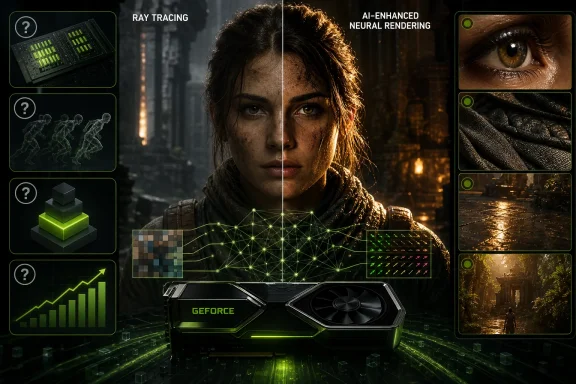 DLSS 5 Moves From Reconstruction to Interpretation
Nvidia’s own announcement is unusually direct about the change. DLSS 5 takes color and motion-vector data from a game frame, then uses an AI model to “infuse” scenes with photoreal lighting and materials while remaining anchored to the original 3D scene. The company says developers will have controls for intensity, color grading, and masking, with the integration using the existing Nvidia Streamline framework.
That is not conventional upscaling. Traditional DLSS reconstructs a higher-resolution output from a lower-resolution render, using temporal data to preserve edges, detail, and motion. Ray reconstruction replaces hand-tuned denoisers with a trained model intended to clean up ray-traced lighting. Frame generation creates additional display frames between rendered frames.
Those techniques can be controversial, but their role is comparatively legible: take the developer’s rendering and make it faster, cleaner, or smoother. DLSS 5 instead promises to generate visual characteristics—material response, skin translucency, fabric sheen, and lighting behavior—that are not necessarily present in the source frame at the same fidelity.
Nvidia frames that as the next necessary step because a 16 ms frame budget cannot reproduce the brute-force rendering workloads used for film visual effects. That is a reasonable technical premise. Real-time graphics have always relied on approximation: rasterization, shadow maps, screen-space effects, temporal anti-aliasing, denoisers, and now neural models all make trade-offs to produce a convincing image within a fixed budget.
The concern is not that DLSS 5 uses AI. GeForce users have been using AI-assisted rendering for years. The concern is that DLSS 5 explicitly moves closer to interpretation: a trained model deciding how a surface, light source, or character should appear from available game data.
For some players, that will be an exciting prospect. For others, particularly enthusiasts who want a game to look like the art direction and renderer intended, it will be a feature to scrutinize rather than automatically enable.
Nvidia Has Added Controls, but Not the Numbers Buyers Need
According to XDA’s SIGGRAPH reporting, Nvidia described three separately trained DLSS 5 models—A, B, and C—that developers could apply by scene, character, or object. It also reportedly demonstrated controls for structure intensity and tone, alongside object-level masking. Those are meaningful concessions to the fear that a blanket generative pass could overwhelm a game’s visual identity.
Developer-side masking is important. A studio may want neural enhancement on a face, cloth simulation, or a reflective floor while preserving a hand-authored effect, a stylized background, an interface element, or a deliberately rough texture. The ability to limit where the model operates is more credible than a one-size-fits-all “make this frame photoreal” switch.
Nvidia’s public announcement independently confirms the broader point: developers will control where and how enhancements are applied through intensity, color-grading, and masking tools. It also says the company is working with publishers and studios including Bethesda, Capcom, Ubisoft, Tencent, NetEase, Warner Bros. Games, and others. Listed games include Starfield, Hogwarts Legacy, Assassin’s Creed Shadows, Resident Evil Requiem, Delta Force, and The Elder Scrolls IV: Oblivion Remastered.
But creative controls are not performance specifications.
Nvidia has not yet given consumers the details needed to judge DLSS 5 as a purchase driver. There are no official per-model parameter counts. There is no clear accounting of additional VRAM use. There are no game benchmarks that show frame time before and after neural rendering on an RTX 5070-class, RTX 5080-class, or RTX 5090-class card. There is no published explanation of how quality scales across resolutions, whether models can be swapped dynamically without visible transitions, or how much performance is left for ray tracing and frame generation after the DLSS 5 workload runs.
That gap is especially conspicuous after the early GTC demonstration that used two RTX 5090 GPUs. Nvidia and subsequent reporting have said the shipping feature is intended to run on a single RTX GPU, with the dual-5090 setup used to separate rendering from inference in a controlled demo. That clarifies that consumers will not need a multi-GPU machine.
It does not clarify whether a single graphics card will deliver a satisfactory experience at 1440p or 4K with path tracing enabled, nor which card buyers should regard as the practical floor. A single-GPU requirement is not the same thing as a single-GPU recommendation.
The Existing DLSS Stack Is a Better Match for Many PC Gamers
This is why XDA’s argument—that DLSS 5 makes Radeon more appealing for its author—is less about a sudden collapse in Nvidia’s current technology and more about a refusal to pay a future premium for a feature one may prefer to disable.
DLSS 4.5 is already a capable, if sometimes demanding, upscaler. Independent testing from TechSpot found that it generally retains an image-quality lead over AMD FSR 4, particularly with fine detail, foliage, fences, and difficult reconstruction cases at lower internal resolutions. The same testing found exceptions: FSR 4 can look smoother, can avoid certain pixelation or moiré artifacts, and can trade blows with DLSS 4.5 in specific disocclusion, hair, and particle scenarios.
That is a much more mature competitive picture than the old shorthand of “DLSS is great, FSR is bad.” Nvidia still holds advantages, but the difference is increasingly dependent on the game, the preset, the resolution, and the kinds of artifacts a player notices.
AMD’s FSR “Redstone” stack has also expanded beyond upscaling. AMD now lists FSR Upscaling 4.1, FSR Frame Generation 4.0.0, FSR Ray Regeneration 1.1.0, and a preview of FSR Radiance Caching. Its current software strategy is plainly aimed at closing the feature gap rather than competing only on rasterized frame rates and price.
That does not make FSR 4.1 equivalent to DLSS 4.5. It is not. A blind-image test reported by Tom’s Hardware found DLSS 4.5 was preferred more often than FSR 4 and native rendering across six tested games. But it does demonstrate that Radeon buyers no longer have to accept an obviously inferior experience in every upscaling-enabled title.
For a builder choosing between two cards with broadly similar real-world performance, that narrowing gap changes the calculation. If Radeon undercuts an equivalent GeForce card, and the buyer does not see DLSS 5’s generative rendering as an advantage, Nvidia’s software premium becomes harder to justify.
“Future-Proof” Has Become the Wrong Selling Point
The awkward part of DLSS 5’s pitch is that Nvidia wants it to be both a showcase feature and an argument for future-proofing a GeForce purchase. Until the company publishes hard data, those messages work against each other.
A buyer cannot sensibly future-proof around an unknown VRAM footprint, unknown compute cost, and unknown implementation quality. This is especially true in the midrange, where a GPU may have enough performance today for 1440p raster gaming and conventional upscaling but less headroom for path tracing, neural rendering, frame generation, game-engine overhead, and high-resolution textures simultaneously.
The problem is not unique to Nvidia. AMD’s FSR stack is also evolving quickly, and it would be unwise to assume its current approach will remain permanently more conservative. AMD could eventually add its own more generative or semantic rendering stages. The GPU market has a long history of features arriving first as premium experiments before moving down the stack.
Still, Nvidia has placed the issue on the table now. Its own language describes DLSS 5 as a blend of hand-authored rendering and generative AI. That makes visual authorship, model behavior, and player choice part of the graphics-card conversation in a way they were not with DLSS Super Resolution alone.
The Real Test Starts With Shipping Games
DLSS 5 should not be dismissed because its ambitions are larger than prior DLSS releases. A neural rendering pass that materially improves difficult lighting and materials without breaking temporal consistency, corrupting visual intent, or imposing a punishing performance penalty could be a genuine advance.
But Nvidia has not yet demonstrated enough for buyers to treat it as an automatic reason to choose GeForce over Radeon. The company must show the cost on one GPU, at ordinary resolutions, in actual games—not just the visual promise of a stage presentation. It must also show that the controls developers receive translate into settings players can understand and trust.
The first DLSS 5 games due this fall will determine whether Nvidia has expanded the definition of a better-rendered game, or simply expanded the list of expensive features that demand more GPU headroom.
